
Addition and Subtraction on a Number Line
On a number line, addition usually moves right and subtraction usually moves left when working with nonnegative whole numbers. A number line helps visualize arithmetic by turning numerical values into distances and mathematical operations into directional jumps.
How do you add and subtract on a number line?
To add on a number line and subtract on a number line, you must start at the first number in the problem and move along the line to find the answer.
Understanding basic number lines is an important prerequisite step before jumping to solve operations.
The direction you travel depends on the mathematical operation. Addition combines amounts and increases the value, so the movement travels forward.
Addition moves forward to the right, and subtraction moves backward to the left.
Subtraction takes amounts away and decreases the overall value, so the movement travels backward.
Addition jumps
When performing addition on a number line, locate the first addend on the line.
From that starting position, make forward number line jumps to the right equal to the value of the second addend. The final number where you land represents the sum.
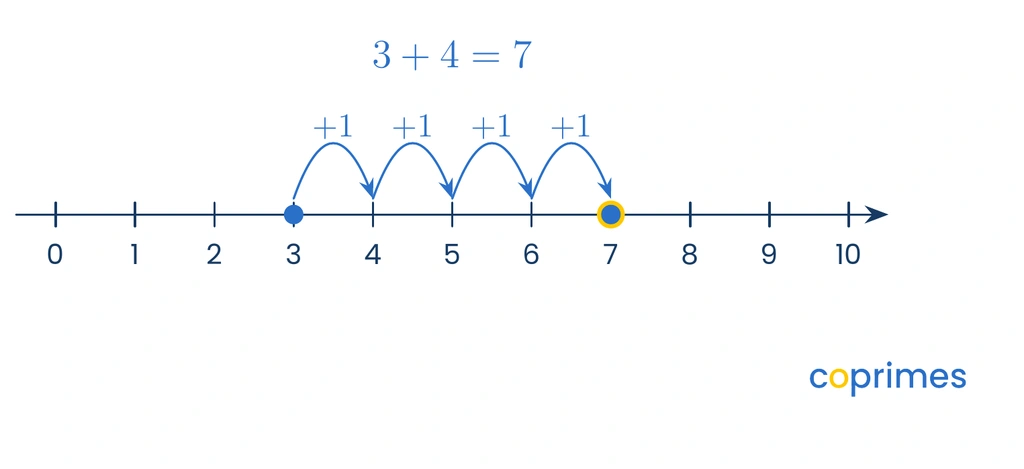
The model above visualizes . It starts at the first addend, , and moves exactly units to the right to reach the sum, .
Subtraction jumps
To calculate subtraction on a number line, find the minuend on the line. The minuend is the total starting amount.
From the minuend, make backward jumps to the left equal to the value of the subtrahend, which is the amount being taken away. The number where you finish represents the difference.
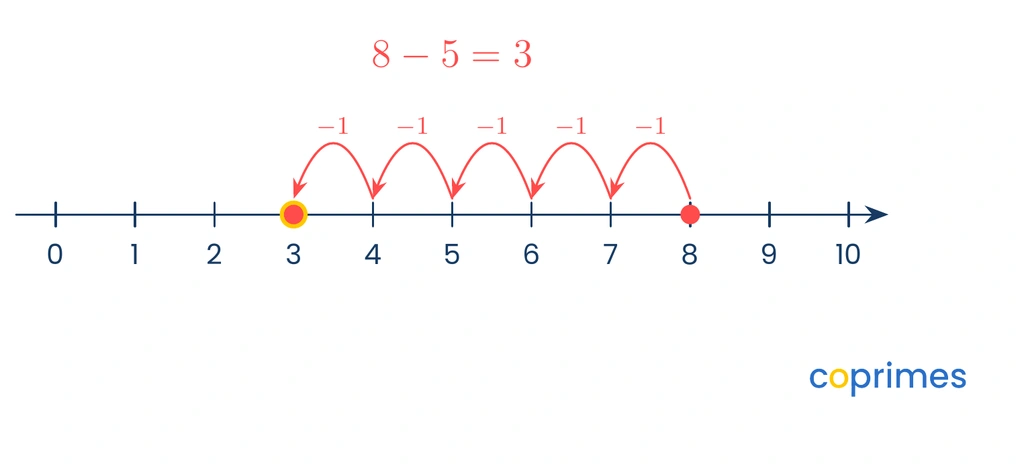
The model above visualizes number line subtraction for . It starts at the minuend, , and moves exactly units to the left to reach the difference, .

Finding a missing number
A number line is an excellent tool for solving missing number equations, such as .
Instead of guessing the missing addend, mark the starting number () and the final sum
(). Then, count the empty space or jumps required to travel between the two points. The total distance traveled reveals the missing value.
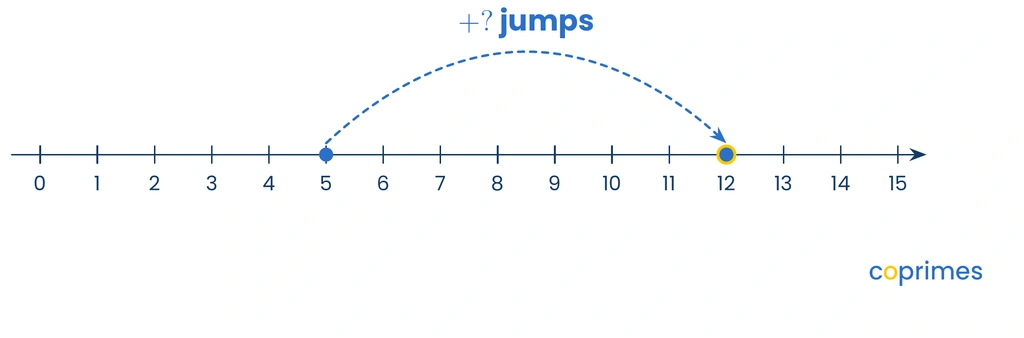
Because the gap from to spans exactly units, the missing value is . The complete equation is .
Large jumps and efficient strategies
When adding or subtracting large numbers, counting by ones becomes slow and prone to error. Instead, use multi-step movement by breaking the operation into larger, more efficient jumps.
You can decompose the number you are adding or subtracting into tens and ones. For example, to calculate , start at . First, jump forward by (two tens) to reach , then jump forward by (five ones) to land at .
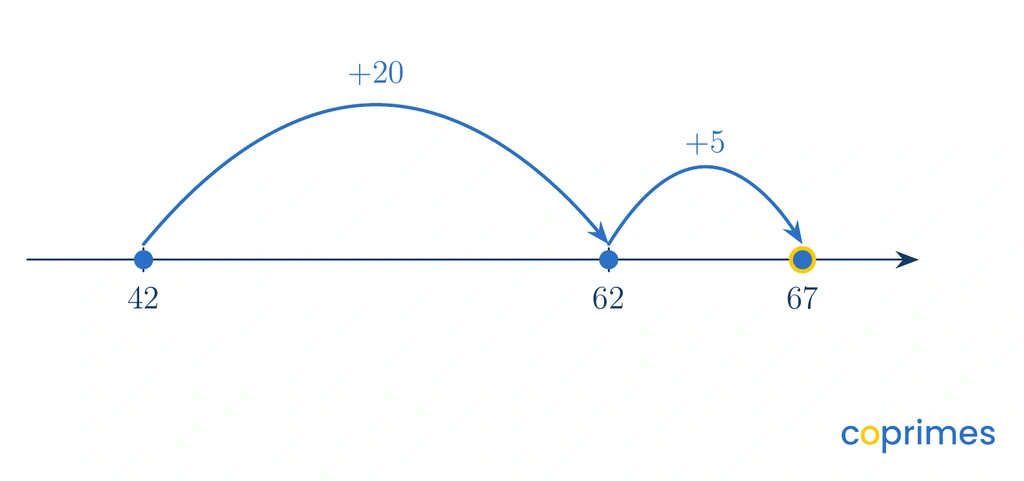
This open number line method visualizes the math clearly without requiring you to draw all individual tick marks.
Worked examples
Let's review some addition and subtraction number line examples to see how these efficient strategies apply to different problems.
Example 1: Subtracting on a number line
Question: What is ?
Given: The minuend is . The subtrahend is .
Method:
- Start at the minuend, .
- Break the subtrahend, , into and .
- Jump left by to land at .
- Jump left by to land at .
Answer: .
Check: Add the difference and subtrahend to see if you return to the minuend: . The answer is correct.
Example 2: Multi-step word problem
Question: A bookstore has notebooks. A delivery brings more notebooks, and then are sold. How many notebooks are left?
Given: The starting amount is notebooks. The delivery adds notebooks. Sales remove notebooks.
Method:
- Identify the starting amount: .
- Add the delivered notebooks by jumping right: .
- Subtract the sold notebooks by jumping left from the new total: .
- Break the subtraction into tens and ones: jump left by to , then jump left by to land at .
Answer: There are notebooks left.
Check: Reverse the final operations to verify: , and . The calculations correctly match the original amounts.
Example 3: Finding a missing starting number
Question: An unknown number is decreased by to result in . What is the original number?
Given: The final result is . The amount subtracted from the original number is .
Method:
- Write the problem as an equation: .
- Use the number line to work backward. If you ended at after moving left by , you must move right by to discover the starting point.
- Start at . Jump right by to reach .
- Jump right by to land at .
Answer: The original number is .
Check: Subtract from the answer: . This matches the final result provided in the question.
A learning plan shaped by your child, not the class
State-aligned Math plus our own Logic and English curriculum. An adaptive baseline test finds the gaps and fills them.
Common mistakes
When working on a number line, watch out for these frequent errors:
- Counting the starting point as a jump: When adding , learners sometimes count the tick mark at as the first jump, landing incorrectly on instead of .
- Moving the wrong direction: Subtraction decreases the value, requiring movement to the left. Moving to the right during subtraction will incorrectly increase the number.
- Misaligning place values during large jumps: When jumping by tens, verify that only the tens digit changes unless you are crossing a hundred. For example, jumping from lands on , not .
Always count the physical jumps, not the starting tick mark.
Frequently asked questions
What are the parts of an addition and subtraction equation?
In an addition equation, the numbers you combine are called the addends, and the total is the sum. In a subtraction equation, the starting amount is the minuend, the amount being taken away is the subtrahend, and the result is the difference.
What is the relationship between addition and subtraction?
Addition and subtraction are inverse operations, meaning they undo one another. If you move right on the number line to add, you can move left by the exactly the same amount to return to your original starting point.
What happens when you add or subtract zero on a number line?
Adding or subtracting zero means taking exactly zero jumps. You remain at your starting point, and the number's value does not change.
Practice questions
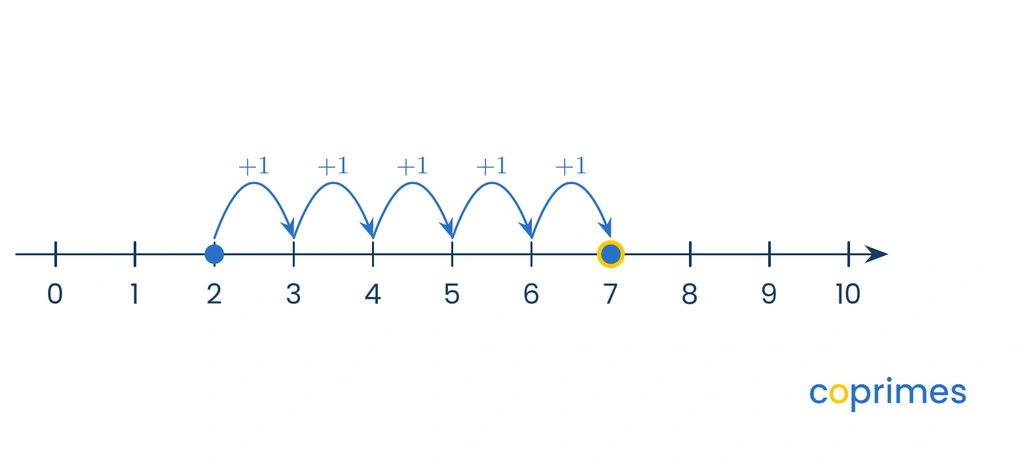
Which operation does this number line show?
If you start at on an open number line and make two jumps left of and one jump left of , where do you land?
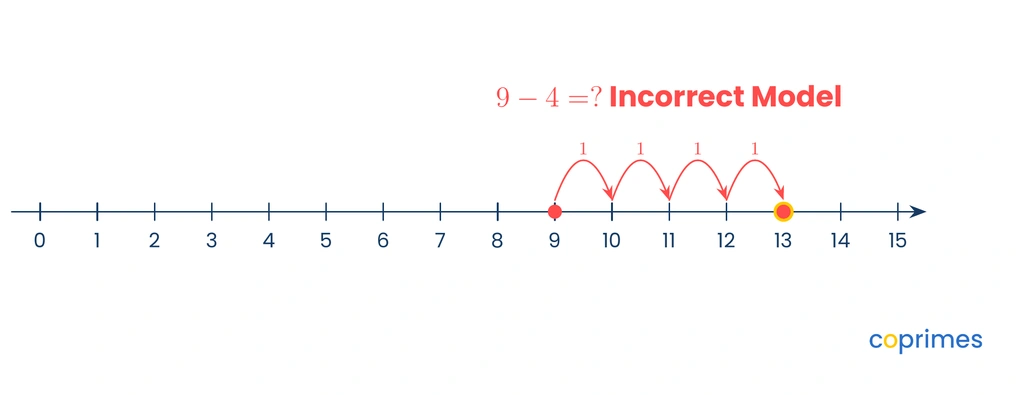
What mistake does this number line show for the problem ?
The jumps moved right instead of left.
The jumps started at instead of .
There are only jumps instead of .
The jumps started at instead of .
The jumps moved right instead of left.
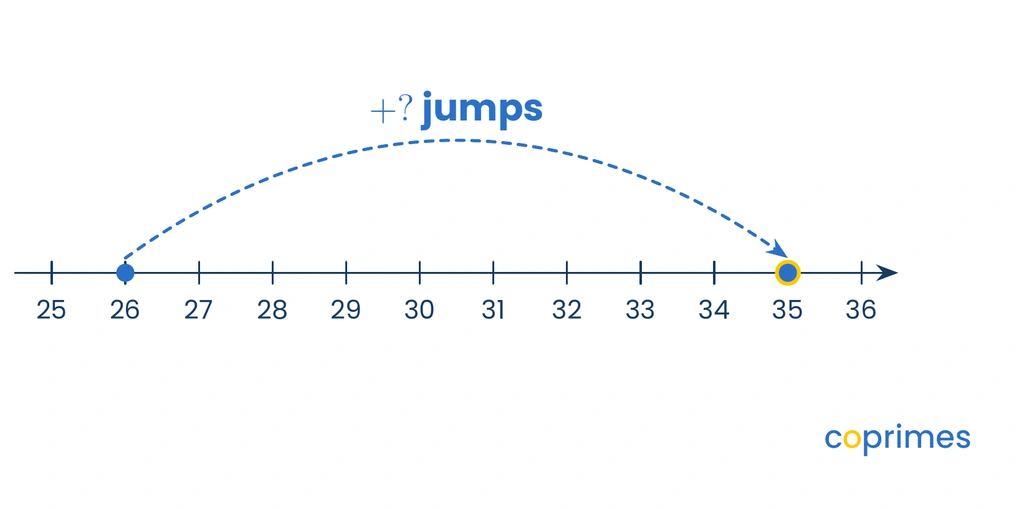
Which equation is represented by the missing jump on this number line?
During a board game, a player's token is on space . The player draws a card that says "Go back spaces." Which number line strategy efficiently finds the new space?
Start at , jump left by to , then jump left by to .
Start at , jump right by to , then jump right by to .
Start at , jump left by to , then jump left by to .
Start at , jump right by to , then jump right by to .
Start at , jump left by to , then jump left by to .