
Addition: Definition, Method and Examples
Addition is the operation of combining two or more quantities to find their total, called the sum.
When exploring what is addition, you are looking at the most basic mathematical process used to join groups of objects or numbers together. The symbol used to represent addition in math is the plus sign ().
Whether you are counting physical objects, working on paper, or solving complex equations, addition provides the foundation for almost all other mathematical operations.
Parts of an addition equation
Every addition equation consists of distinct mathematical parts that describe the relationship between the numbers.
The numbers you add together are called the addends. The final result you calculate is called the sum. Connecting them is the equals sign (), which shows that the total value of the addends is exactly the same as the sum.
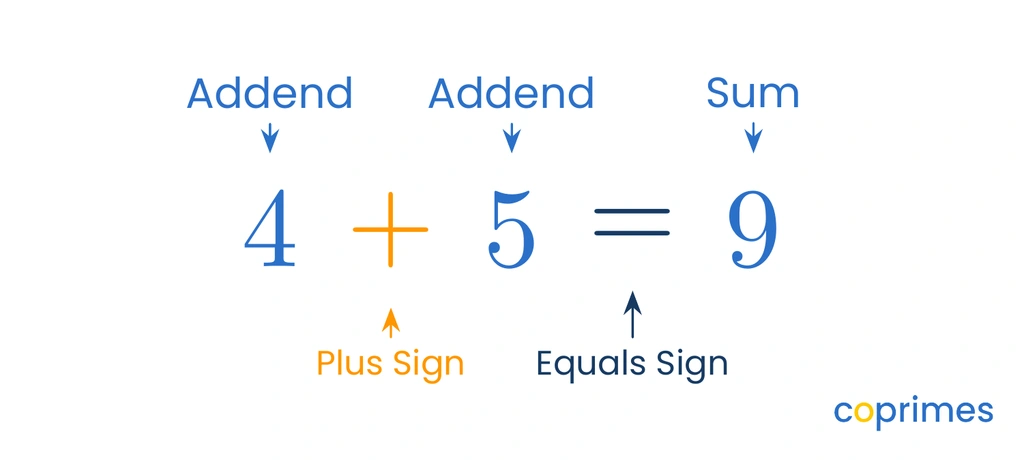
Understanding the addends and sum allows you to read mathematical equations clearly and communicate the steps of your calculations accurately.
The addends are the numbers being combined, and the sum is the total.
Ways to represent addition
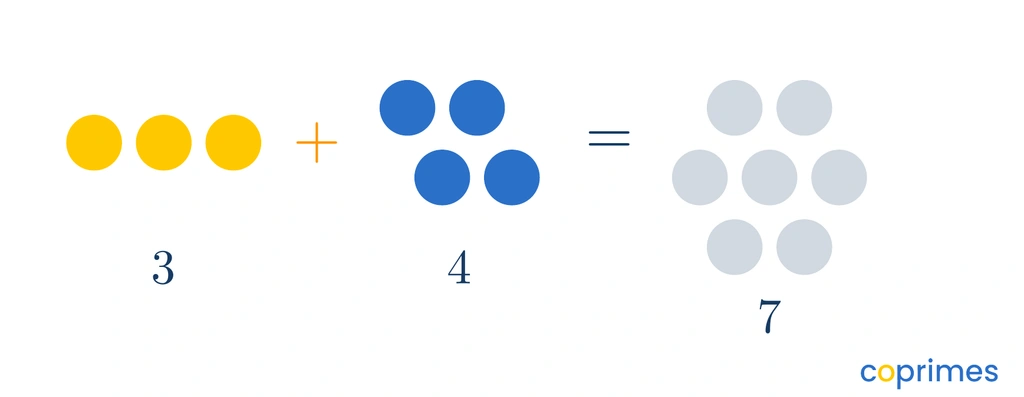
There are several visual ways to model how addition works. Concrete objects are helpful for small numbers, while diagrams help model larger quantities.
Using Objects
If you have a group of three yellow circles and another group of four blue circles, counting them all together gives you seven circles in total. This represents the equation .
Using a Number Line
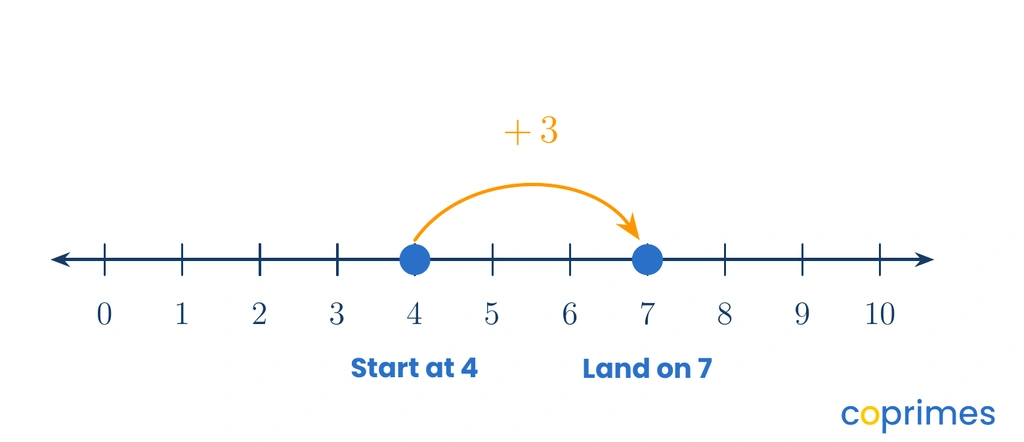
A number line is a continuous line with numbers placed at equal intervals. It helps you visualize addition as jumping forward along the line.
When learning about addition and subtraction on a number line, you always start at the first addend and jump to the right by the amount of the second addend.
How to add numbers
For small quantities, you can add by counting forward. To add , hold the number in your mind and count three more numbers: , , .
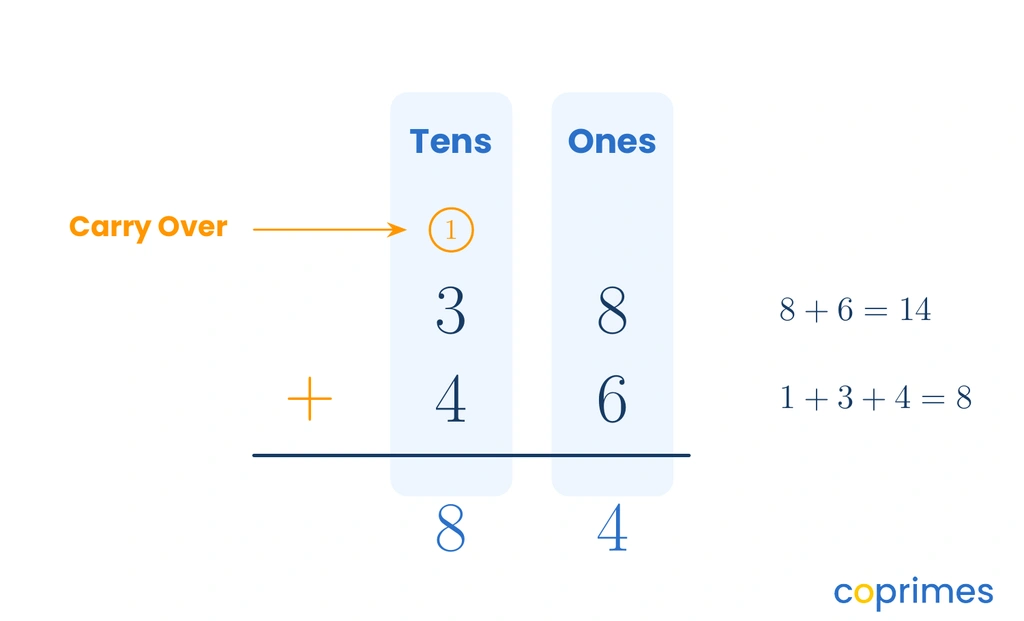
For larger numbers, standard vertical addition is the best method. This method lines up digits according to their place value, ensuring you add the ones to the ones, the tens to the tens, and so on.
Vertical Addition with Regrouping (Carrying Over)
When the sum of the digits in one column is or greater, you cannot write two digits in one column. You must regroup.
- Write the numbers vertically, aligning the ones column on the right.
- Add the digits in the ones column.
- If the sum is or more, write the right digit of the sum at the bottom of the column. Carry the left digit over to the top of the tens column.
- Add the digits in the tens column, including any carried-over digit.

Worked examples
Here is how you apply addition methods step by step, from basic problems to real-world addition word problems.
Example 1: Single-digit addition
Question: What is ?
Method:
- Start at the number .
- Count forward five numbers: , , , , .
Answer: The sum is .
Check: You can split into and . Add to to make a , and then add the remaining . The result is .
Example 2: Two-digit addition without regrouping
Question: Calculate .
Method:
- Write the numbers vertically, lining up the ones column ( and ).
- Add the ones column: .
- Write below the line in the ones column.
- Add the tens column: .
- Write below the line in the tens column.
Answer: .
Check: Add the tens () and the ones () separately. Combine them to get .
Example 3: Three-digit addition with regrouping
Question: A bakery sold muffins in the morning and muffins in the afternoon. How many muffins did they sell in total?
Method:
- Align the numbers vertically: over .
- Add the ones column: .
- Write in the ones place below the line, and carry the to the top of the tens column.
- Add the tens column including the carry: .
- Write in the tens place below the line, and carry the to the top of the hundreds column.
- Add the hundreds column including the carry: .
- Write in the hundreds place below the line.
Answer: The bakery sold muffins.
Check: Break the numbers down. . . . Adding gives exactly .
Common mistakes
A very common mistake when adding numbers is misaligning the place values. When writing an equation vertically, always ensure that the digits in the ones place are perfectly lined up on the right side.
If you are adding , placing the underneath the instead of the will give you an incorrect sum of instead of the correct sum of .
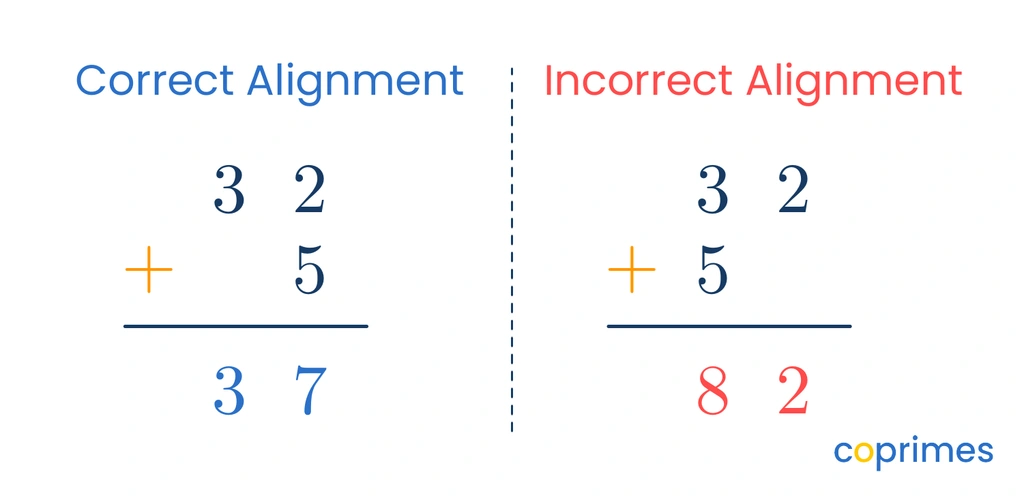
Another common mistake is forgetting to add the carry-over number. After carrying a to the next column, students often add only the main digits of the column and ignore the tiny sitting at the top.
Frequently asked questions
There are a few important rules, known as the properties of addition, that answer the most common questions about how addition behaves.
Does the order of numbers matter when adding?
No, the order does not matter. The equation gives exactly the same result as . You can swap the addends around, and the sum will always stay the same.
What happens if you add zero to a number?
Adding zero to a number does not change its value. For example, . Because zero means "nothing," combining a quantity with nothing leaves you with the original quantity.
Can you add more than two numbers at once?
Yes, you can add three, four, or as many numbers as you like. You can group them in any way that makes the math easier. For example, to solve , it is fastest to add first to make , and then add to get .
A learning plan shaped by your child, not the class
State-aligned Math plus our own Logic and English curriculum. An adaptive baseline test finds the gaps and fills them.
Practice questions
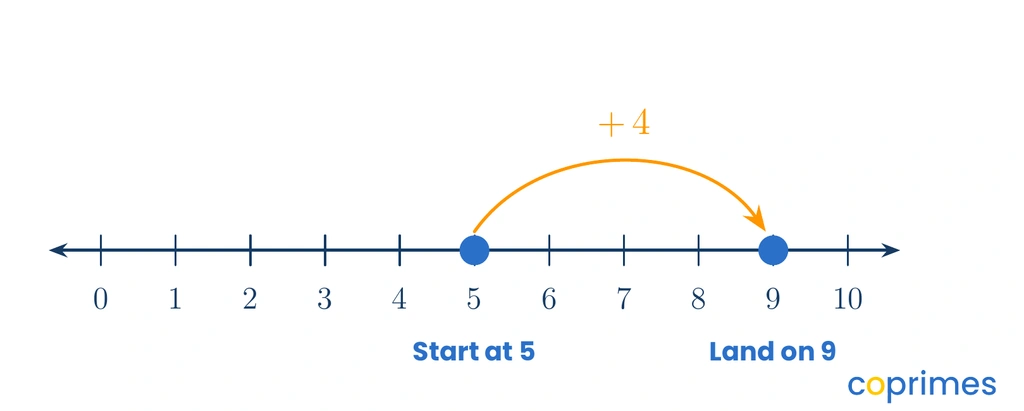
Which addition equation is represented by the number line shown above?
In the addition equation , what are the numbers and called?
Addends
Sums
Differences
Totals
Addends
Maya picks apples from a tree. Later, she picks more apples. How many apples does Maya have in total?
What is the sum of and ?
If you know that , what must equal?