
Directly Proportional: Definition, Method and Examples
Two quantities are directly proportional when their ratio is constant. When one quantity is multiplied by a specific factor, the other quantity is multiplied by the exact same factor.
This directly proportional relationship can be modeled algebraically as , where represents the constant multiplier.
What does directly proportional mean?
When two variables are directly proportional, they increase or decrease together at a consistent rate. If one variable doubles, the other variable exactly doubles. If one is halved, the other is halved.
This concept is also called direct proportion or direct variation. When a problem states that varies directly with , it means they share this exact scaling relationship.
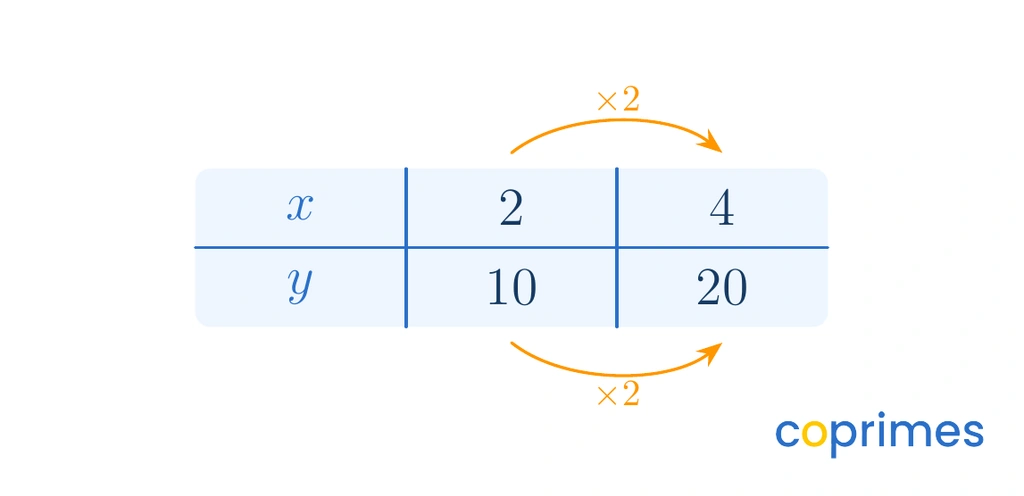
Not every relationship where variables increase together is a direct proportion. To vary directly, the starting point must be zero. If you buy zero tickets, the cost is zero.
Recognise a constant ratio
Because the two variables scale exactly the same way, the quotient of any pair of matching values is always the same number. Finding this constant multiplier proves the relationship is a direct proportion.
For any two corresponding values and , the fraction will simplify to the same constant value.
If a table contains the pairs , , and , you can verify the constant ratio by dividing each by its matching .
Because every division results in , the variables are directly proportional.
Use y equals kx
When two quantities are directly proportional, their relationship can be written as the equation . The variables and change, while is a fixed number.
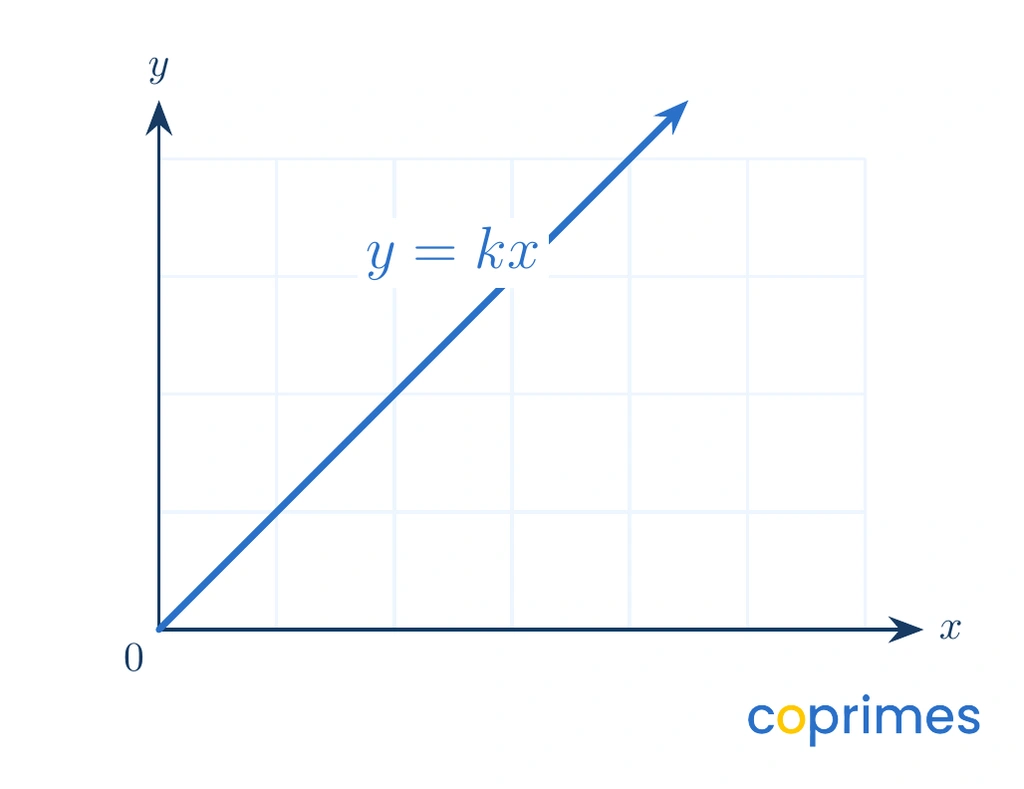
Plotting this equation on a coordinate plane creates a straight line that passes directly through the origin . Exploring directly proportional graphs reveals that passing through the origin is a mandatory condition. If a straight line does not cross at exactly zero, the relationship is not directly proportional.
A learning plan shaped by your child, not the class
State-aligned Math plus our own Logic and English curriculum. An adaptive baseline test finds the gaps and fills them.
Find the constant of proportionality
The multiplier in the equation is known as the constant of proportionality. It defines the exact rate at which changes for every single unit increase in .
To find this constant from any pair of corresponding values:
- Identify one pair of values for and .
- Substitute the values into the equation .
- Divide by to solve for .
Once is calculated, rewrite the general formula using the specific number, such as . This specific equation can then be used to find any missing value in the relationship.
Model direct proportion in context
Directly proportional relationships model many real-world situations, particularly those involving a constant rate. Common examples include hourly wages, fuel consumption, constant-speed travel, and calculating the cost of multiple identical items.
A non-zero starting amount means the relationship is not directly proportional.
When analyzing a scenario, verify there is no hidden starting value. A plumber charging dollars per hour is a direct proportion (). A plumber charging dollars per hour plus a dollar call-out fee is not a direct proportion (). Although the total cost increases as the hours increase, doubling the hours does not double the final bill.
Worked examples
Example 1: Constant-price items
Question: A store sells identical notebooks for dollars. How much would notebooks cost?
Method:
- Identify and . Let be the number of notebooks and be the total cost.
- Find the constant using the known pair .
- Write the specific equation.
- Substitute the new value of to find the cost.
Answer: notebooks cost dollars.
Check: Does the multiplier hold? notebooks scaled by gives notebooks. dollars scaled by gives dollars. The answer is correct.
Example 2: Scaled recipe
Question: A soup recipe requires milliliters of vegetable broth to serve people. How many milliliters of broth are needed to serve people?
Method:
- Let be the number of people and be the volume of broth.
- Find using and .
- Write the specific equation.
- Substitute to find the required volume.
Answer: The recipe requires milliliters of broth.
Check: The ratio equals , which matches the original recipe ratio of .
Example 3: Checking a table for direct proportion
Question: Is the relationship shown in the table directly proportional?
Method:
- Calculate the ratio for the first pair.
- Calculate the ratio for the second pair.
- Calculate the ratio for the third pair.
- Compare the ratios. They are not all identical.
Answer: No, the relationship is not directly proportional because the ratio is not constant.

Common mistakes
A widespread error is assuming that any relationship where both variables increase together is a direct proportion. An equation like increases, but it is not directly proportional because it does not pass through zero. A true directly proportional relationship always has a starting value of zero.
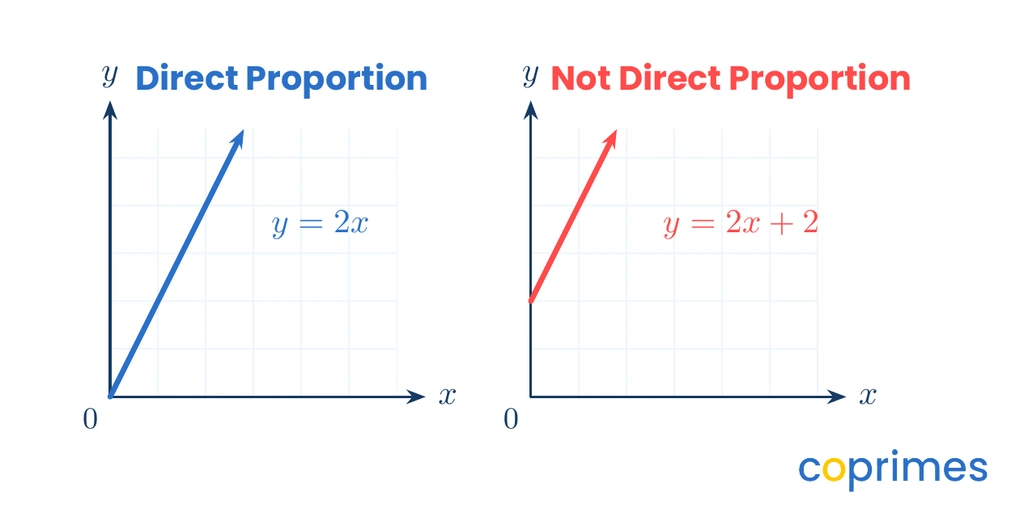
Another mistake is confusing direct proportion with an inversely proportional relationship. In an inverse proportion, when one variable increases, the other variable decreases at a consistent rate, producing a curve rather than a straight line.
Frequently asked questions
What is the symbol for direct proportion?
The mathematical symbol for proportional to is . Writing means that is directly proportional to . This expression can be converted into the equation to solve problems.
Can the constant of proportionality be a fraction or decimal?
Yes. The multiplier can be any positive constant number. For example, if , the relationship is directly proportional. As increases, increases at exactly half the rate.
Can and be negative in a directly proportional relationship?
Yes. The equation holds for both positive and negative values. The graph of a direct proportion is a straight line through the origin, which extends into the negative quadrants of the coordinate plane.
Practice questions
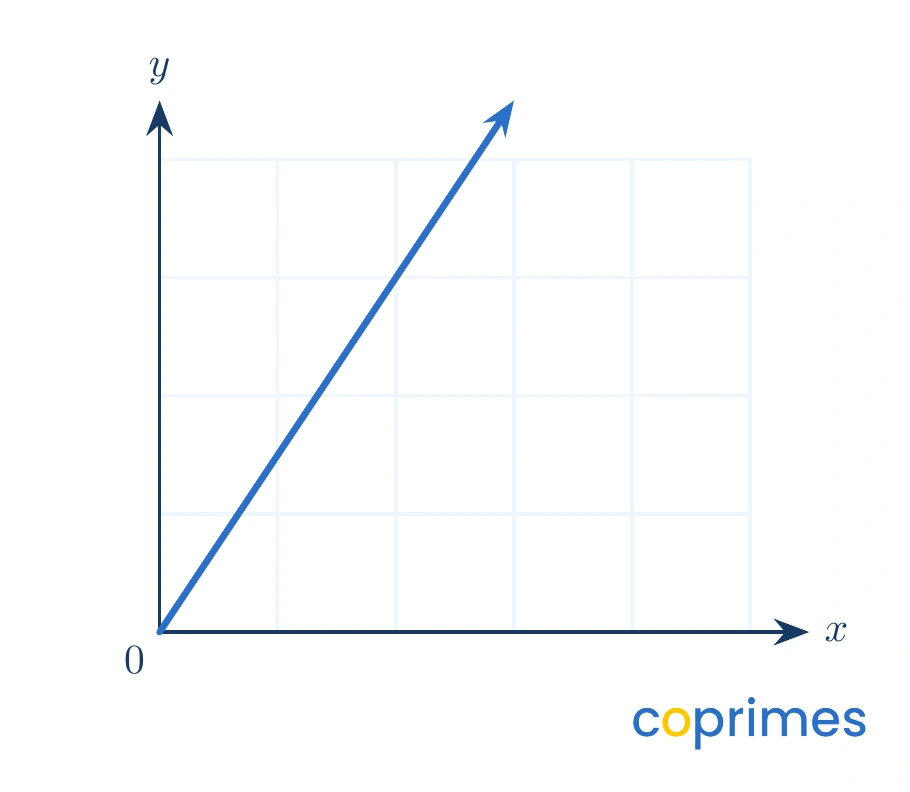
Which type of relationship is shown by the graph?
A directly proportional relationship
An inversely proportional relationship
A constant relationship
A non-proportional linear relationship
A directly proportional relationship
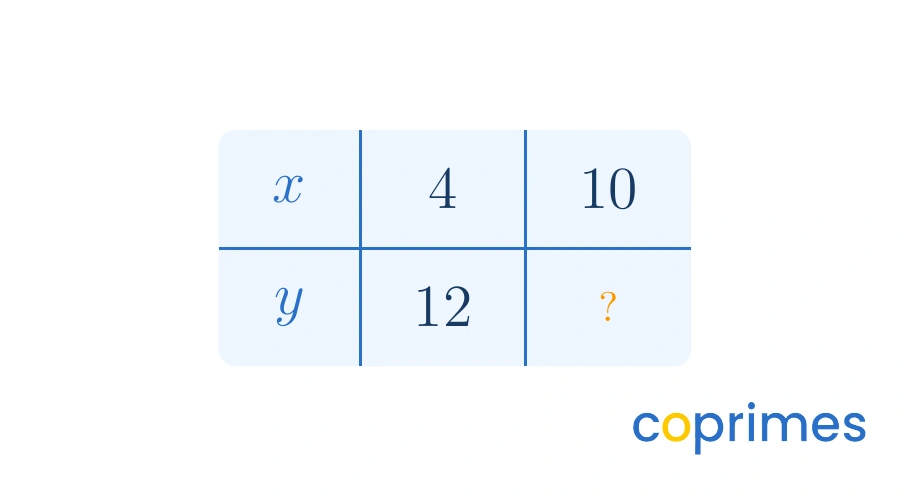
The variables and are directly proportional. What is the missing value in the table?
A machine produces parts in hours. If the number of parts produced is directly proportional to the time, how many parts will the machine produce in hours?
Which of the following equations represents a directly proportional relationship?
A delivery service charges a dollar flat fee plus dollars per mile. Is the total cost directly proportional to the distance traveled?
Yes, because the cost increases at a steady rate of dollars per mile.
No, because the total cost does not start at zero when the distance is zero.
Yes, because doubling the distance will exactly double the total cost.
No, because the cost per mile changes depending on how far the driver travels.
No, because the total cost does not start at zero when the distance is zero.