
Division in Math: Definition, Methods, and Examples
Division is a mathematical operation that splits a quantity into equal groups or finds how many equal groups of a given size can be made. It allows you to break down large numbers into manageable, equal parts.
What is division?
Division is the process of breaking a total amount into equal portions. It is widely used to solve real-world problems such as sharing items fairly among friends or arranging chairs into equal rows.
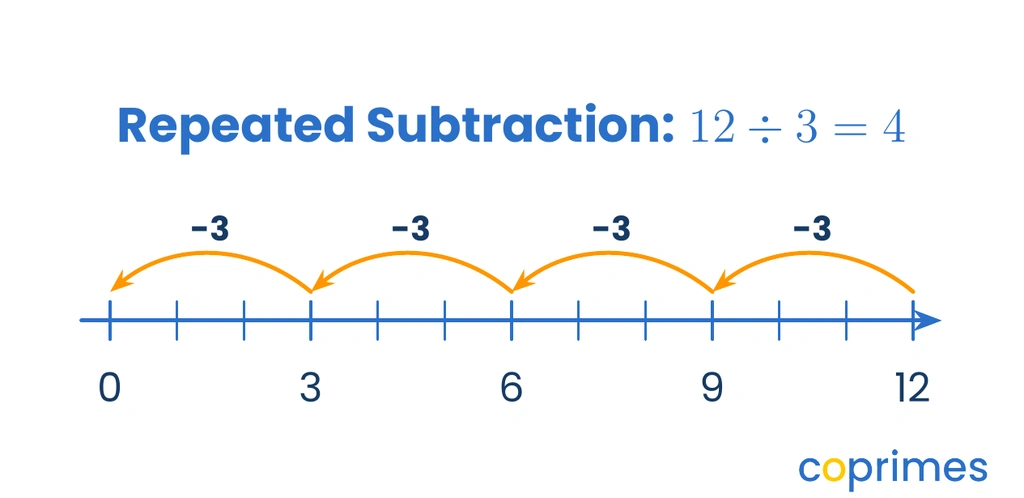
There are two primary ways to think about division: splitting a total into a known number of groups, or sorting a total into groups of a specific size. Division can also be seen as repeated subtraction. Just as multiplication is repeated addition, division finds how many times you can subtract a number from a total before reaching zero.
Parts of a division equation
Every division equation contains specific parts that describe what is happening to the total quantity.
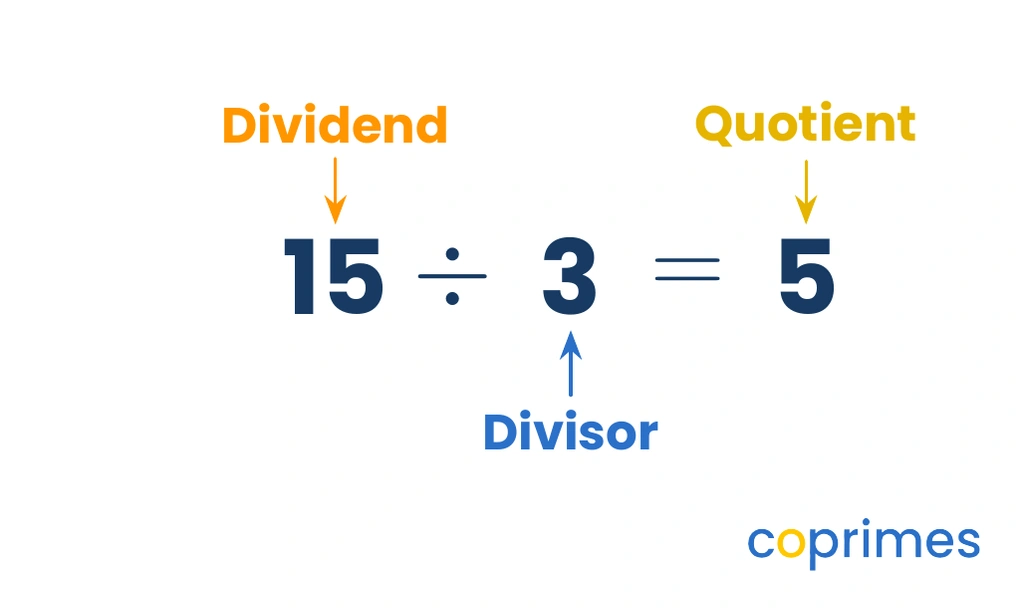
- Dividend: The total number being divided. In , the dividend is .
- Divisor: The number doing the dividing. It tells you either the number of groups or the size of each group. Here, the divisor is .
- Quotient: The final answer. In this example, the quotient is .
- Remainder: Sometimes, a number cannot be split perfectly. The amount left over is the remainder.
Understanding the relationship between the dividend, divisor and quotient helps you set up calculations correctly.
Equal sharing and equal grouping
When you divide, the divisor can represent two different real-world situations: sharing or grouping.
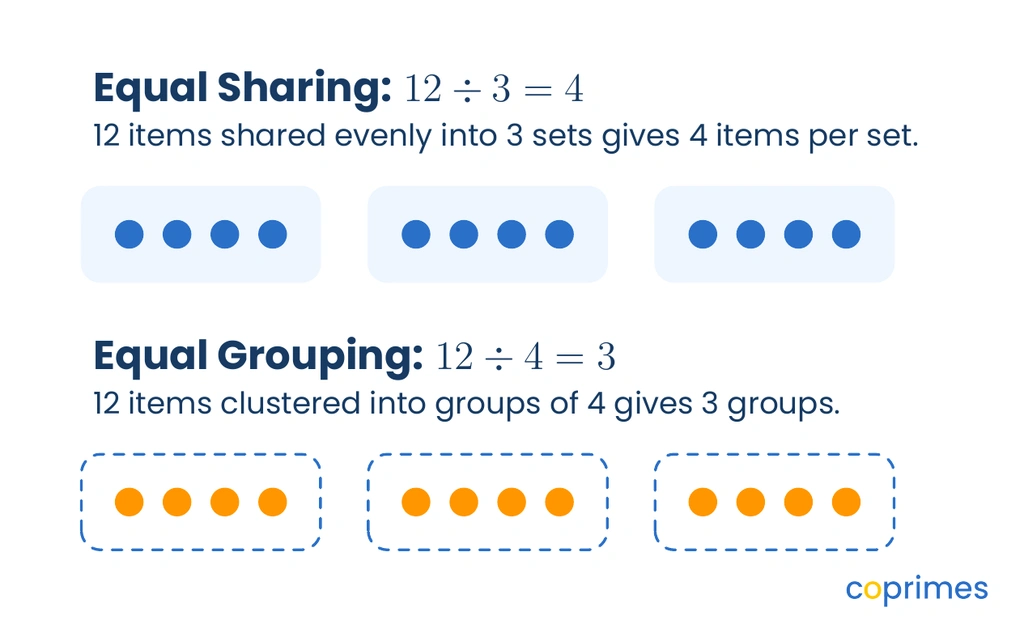
- Equal sharing: You know the total number of items and the total number of groups. The division tells you how many items go into each group. For example, dealing a deck of cards equally among four players is sharing.
- Equal grouping: You know the total number of items and how many items belong in each group. The division tells you how many groups you can form. For example, placing four tires on every car until you run out of tires is grouping.
To explore these two models in more detail, read about division as sharing and grouping.
A learning plan shaped by your child, not the class
State-aligned Math plus our own Logic and English curriculum. An adaptive baseline test finds the gaps and fills them.
Division symbols
Division can be written in several different ways. Recognizing these symbols will help you read and solve equations in any format.
- Division sign (): Used in standard horizontal equations, such as .
- Division slash (): Often used in text or computer formatting. For example, divided by can be written as .
- Fraction bar: Written as a stacked fraction, such as . The top number is the dividend, and the bottom number is the divisor.
- Division bracket: Used to organize calculations during long division. The divisor sits outside to the left, the dividend sits inside, and the quotient is written on top.
How division relates to multiplication
Division is the exact opposite of multiplication. Because they undo each other, they share the same numbers in what is known as multiplication and division fact families.
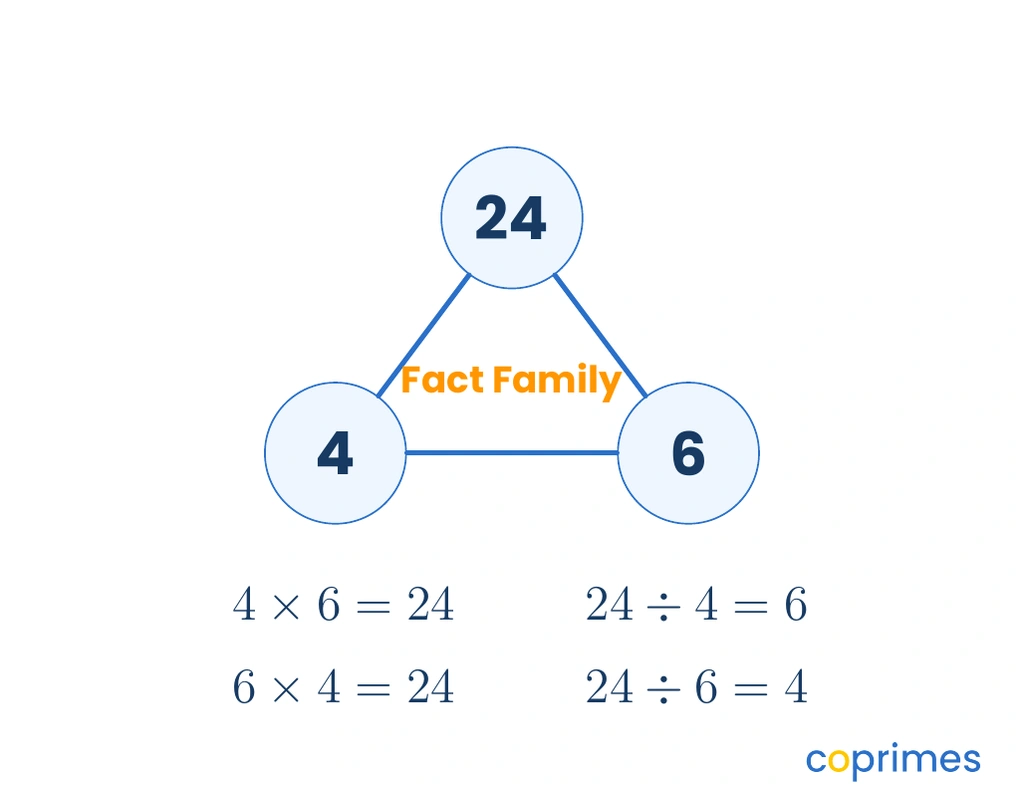
If you know a multiplication fact, you instantly know its related division facts. For example, if you know that , you can reverse the operation to find that and . You can always check a division answer by multiplying the quotient by the divisor to see if it equals the dividend.
Worked examples
Review these division examples to see the process in action. Applying a step-by-step method shows you how to divide confidently. Always check your final answer using the inverse operation.
Example 1: Basic equal sharing
Question: A baker puts cupcakes into boxes. Each box holds cupcakes. How many boxes does the baker need?
Method:
- Identify the total quantity and the required group size.
- Divide the total quantity by the group size.
Answer: The baker needs boxes.
Check: Use the inverse operation to verify the result by calculating .
Example 2: Division with a remainder
Question: Divide by . What are the quotient and the remainder?
Method:
- Determine how many times fits fully into without going over.
- Multiply that amount by .
- Subtract the result from the dividend to find the leftover amount.
Answer: The quotient is with a remainder of , often written as .
Check: Multiply the quotient by the divisor and add the remainder: .
Example 3: Applying division properties
Question: What is the result of ?
Method:
- Identify the dividend and the divisor.
- Apply the mathematical property that zero divided by any non-zero number is zero.
Answer: The quotient is .
Check: Multiply the quotient by the divisor: .

Common mistakes
Watch out for these frequent errors when learning to divide:
- Dividing by zero: You cannot divide a number by zero. An equation like is undefined because no number multiplied by zero equals .
- Reversing the dividend and divisor: The order of numbers matters in division. equals , but results in a fraction or decimal. Always start with the total amount.
- Ignoring the remainder: When calculating a problem that does not divide perfectly, remember to write down the leftover amount. Dropping the remainder makes the answer incomplete.
Frequently asked questions
Review these common questions to strengthen your understanding of division.
What is division?
Division is a mathematical process that breaks down a total quantity into equal, smaller groups.
When will I use division?
You use division whenever you need to share resources evenly, sort items into equal containers, calculate a fair price per unit, or determine how many times a smaller measurement fits into a larger one.
What is division the inverse of?
Division is the inverse operation of multiplication. It undoes the action of multiplying.
What are the main parts of division?
The three main parts are the dividend, the divisor, and the quotient. If the number does not divide perfectly, there will also be a remainder.
Practice questions
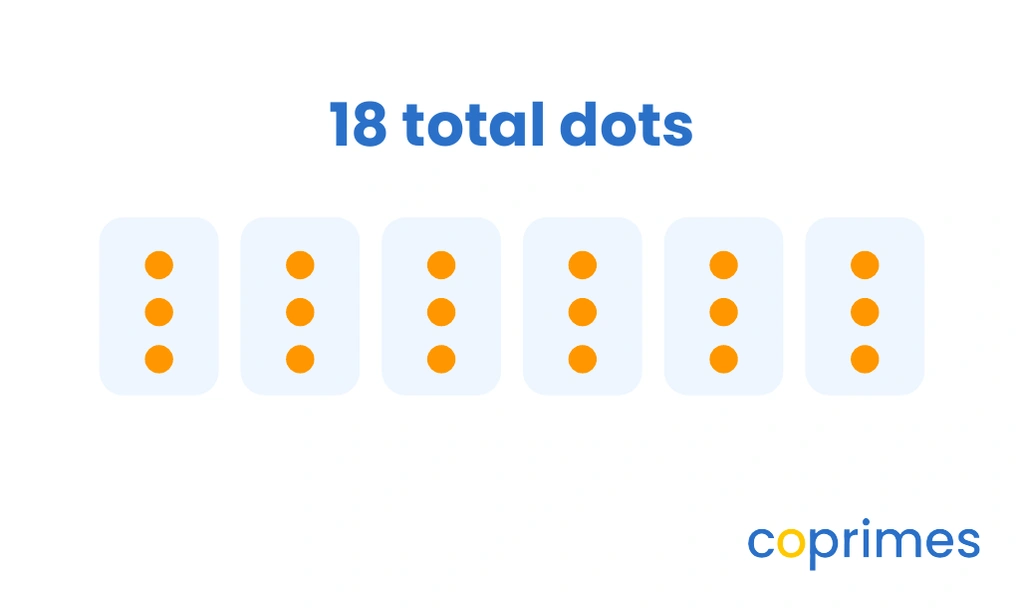
Based on the visual model showing a total of dots, which division equation is represented?
In the equation , which number is the dividend?
Which repeated subtraction expression shows ?
What is the result of ?
Undefined
Undefined
A teacher has pencils to share equally among students. How many pencils will each student receive, and how many will be left over?
pencils each, with left over
pencils each, with left over
pencils each, with left over
pencils each, with left over
pencils each, with left over