
Constant of Proportionality: Definition, Method and Examples
The constant of proportionality is the fixed multiplier linking two quantities in a proportional relationship. In the equation , calculate the constant by dividing the dependent variable by the independent variable for any nonzero , then use the units and context to interpret it.
What is the constant of proportionality?
When two quantities are in a proportion, they change at the exact same rate. The constant of proportionality, also called the constant of variation or proportionality constant, is the steady ratio between the dependent variable () and the independent variable ().
It is represented by the constant in the mathematical equation . To find the constant of proportionality, use the related division equation .
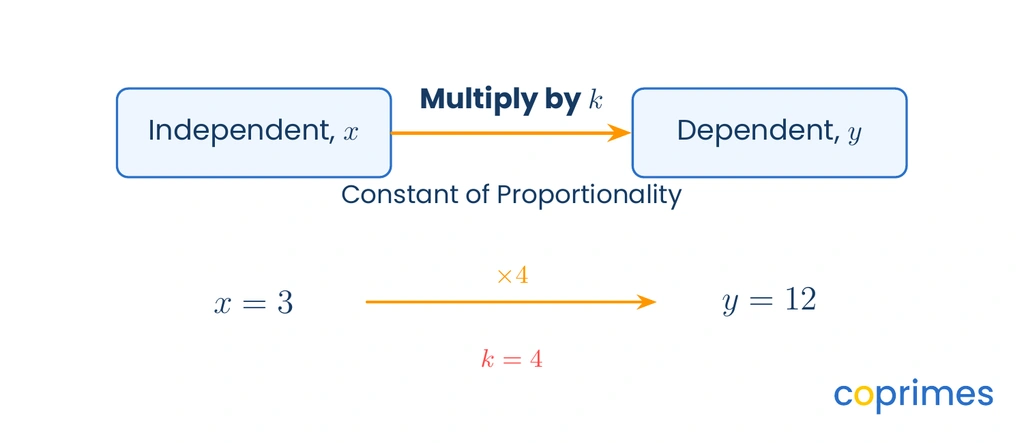
Every nonzero pair of values in a proportional relationship simplifies to the exact same constant ratio.
Find k from a table
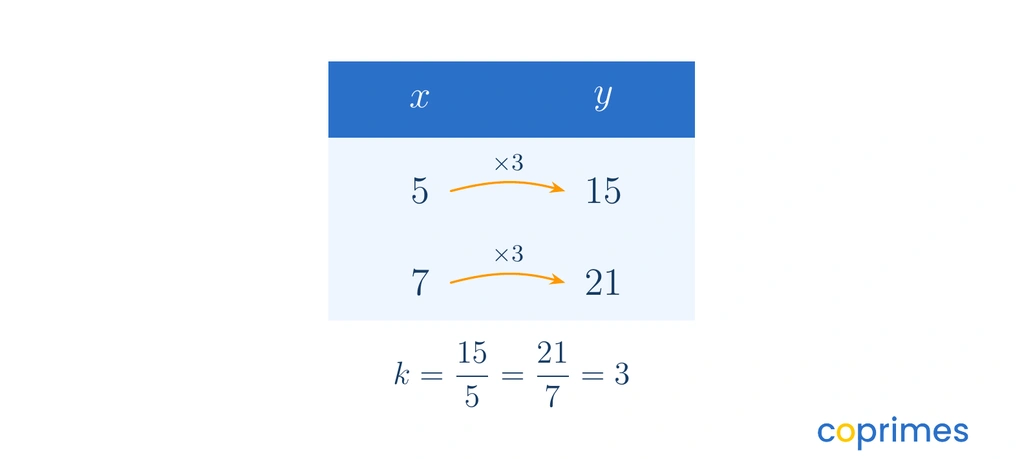
A table lists corresponding and values. To find the constant , divide the -value by the -value for any row where is not zero.
When working with ratio tables, you must check every pair to ensure the relationship is truly proportional. If the relationship is proportional, every row will simplify to the same constant multiplier.
Find k from an equation
If a relationship is directly proportional, its mathematical equation can be written in the specific form . The constant is the coefficient multiplied by .
For example, in the equation , the constant of proportionality is . This means that for every unit of , increases by units. You do not need to perform any division if the equation is already organized in this standard format.

Find k from a graph
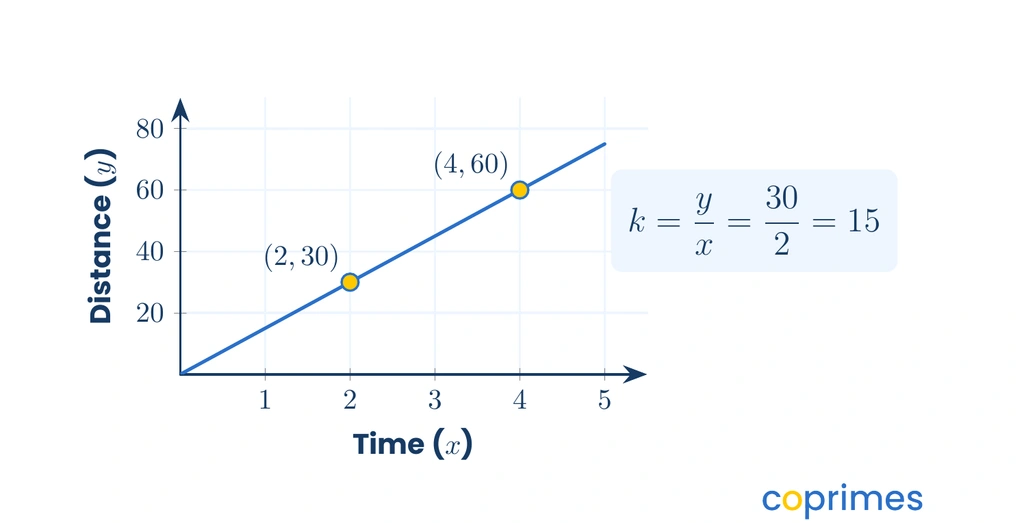
When examining directly proportional graphs, the line must be perfectly straight and pass exactly through the origin .
To find , identify a clear coordinate point on the line, excluding the origin itself. Divide the -coordinate by the -coordinate. Because the steepness of a proportional graph is uniform, any chosen point on the line will yield the exact same value for the constant.
Interpret units and direction
The constant often represents a unit rate, which describes how much of one quantity exists per single unit of another. To interpret it correctly, always read the variables in the order of per .
The sign of the constant gives the direction of the relationship. A positive constant means increases as increases, which is the most common case for proportional relationships. If a proportional model represents a steady decrease, the constant would be negative.
For example, if represents distance in meters and represents time in seconds, a constant of means the object travels meters per second. Both the numerical value and the descriptive units are necessary for a complete answer.
Worked examples
Example 1: Finding the constant from a table
Question: A table lists -values and corresponding -values . What is the constant of proportionality?
Method:
- Choose a pair of nonzero values from the table. Let and .
- Divide the -value by the -value to calculate .
Answer: .
Check: Verify with another pair from the table: . The constant ratio remains .
Example 2: Finding a fractional constant from a graph
Question: A straight line on a coordinate plane passes exactly through the origin and the point . What is the proportionality constant?
Method:
- Confirm the relationship is proportional, which is true because it is a straight line through the origin.
- Identify the and coordinates from the point. Here, and .
- Substitute the values into the division formula .
Answer: .
Check: Write the equation . Substituting gives , matching the coordinate point exactly.
Example 3: Interpreting a unit rate in context
Question: A pump fills a tank at a constant rate, modeled by the equation , where is the volume in liters and is the time in minutes. What is the constant of proportionality, and what does it mean?
Method:
- Recognize that the equation is in the standard form .
- Identify the constant coefficient multiplied by the independent variable .
- Apply the units of the dependent variable over the independent variable to interpret the rate.
Answer: The constant of proportionality is . This means the pump fills liters per minute.
Check: In minutes, the volume is liters, confirming that the tank fills at a steady rate of liters every minute.
A learning plan shaped by your child, not the class
State-aligned Math plus our own Logic and English curriculum. An adaptive baseline test finds the gaps and fills them.
Common mistakes
- Reversing the division: The most frequent error is calculating the ratio backward. Always place the dependent variable in the numerator and the independent variable in the denominator. Dividing by calculates the wrong multiplier.
- Ignoring the origin on a graph: A straight line that does not cross the origin represents a linear relationship, but it is not directly proportional. There is no constant of proportionality in this case.
- Forgetting units in a context problem: Writing down only the bare number for without its unit rate label loses the real-world meaning of the constant entirely.
Frequently asked questions
What is the proportionality formula?
The formula representing the relationship is , where represents the constant multiplier. You can also rearrange it to find the constant as .
How is the proportionality constant used in algebra?
In later mathematics, the constant is recognized as the slope of a proportional linear function. It dictates the rate of change and the steepness of the graphed line.
Practice questions
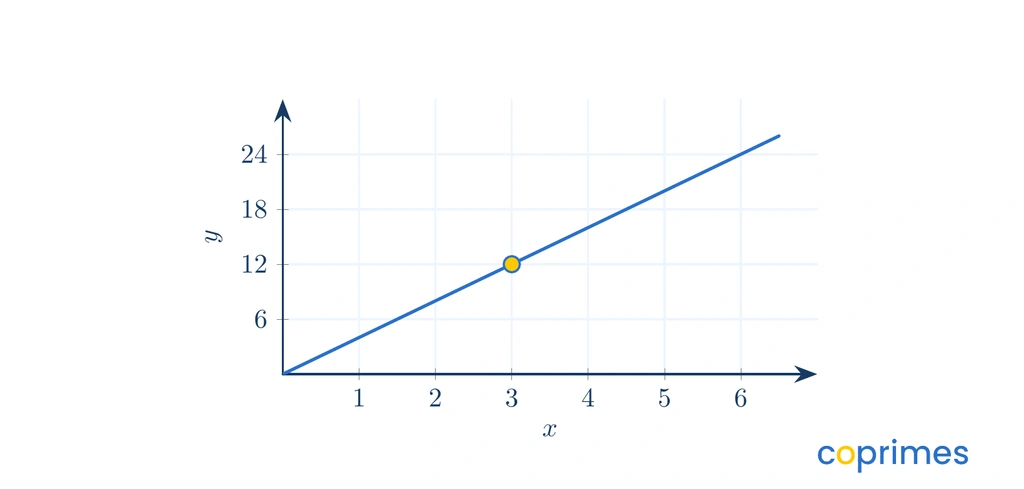
What is the constant of proportionality for the relationship shown in the graph?
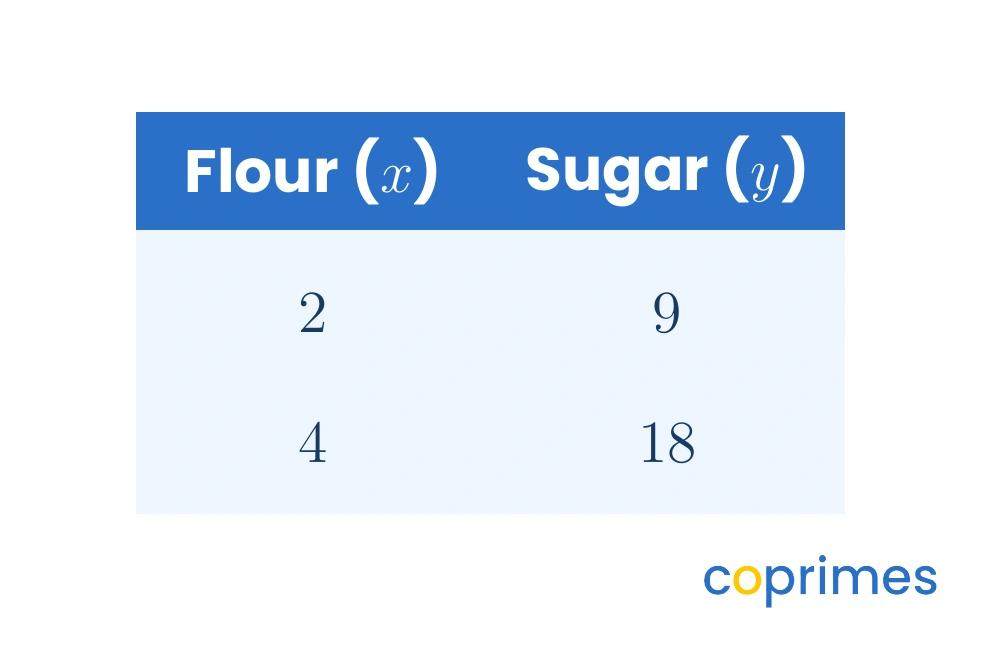
A recipe uses cups of flour and tablespoons of sugar, as shown in the table. What is the constant of proportionality?
The cost in dollars to rent a bicycle for hours is modeled by the equation . What is the constant of proportionality, and what does it represent?
; the cost in dollars per hour to rent the bicycle.
; the total number of hours the bicycle is rented.
; the hours needed to reach a cost of dollars.
; the total cost in dollars to rent the bicycle for hours.
; the cost in dollars per hour to rent the bicycle.
A machine prints pages every minutes. Which of the following is the correct calculation for the constant of proportionality, , in pages per minute?
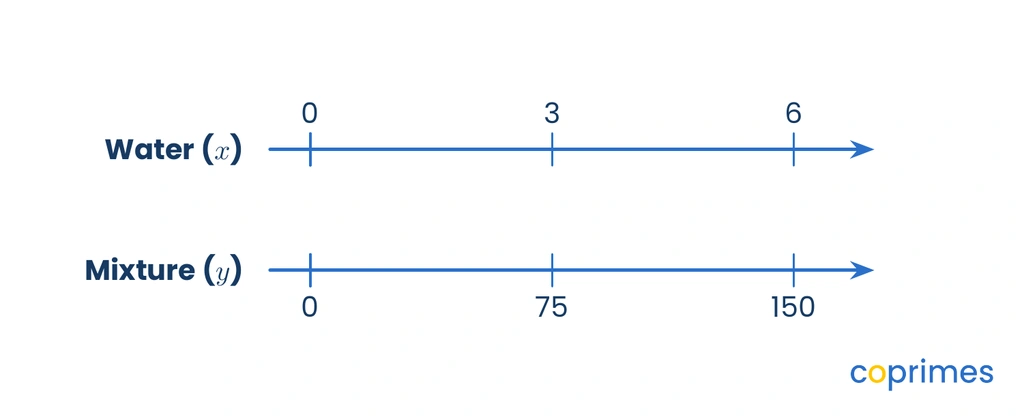
The double number line shows the relationship between liters of water () and grams of mixture (). What is the proportionality constant?