
Least Common Multiple: Methods and Examples
The least common multiple is the smallest positive number that is a multiple of each of two or more numbers.
Whenever you need to synchronize schedules, find a common denominator, or determine when cycles will meet, you are looking for the least common multiple.
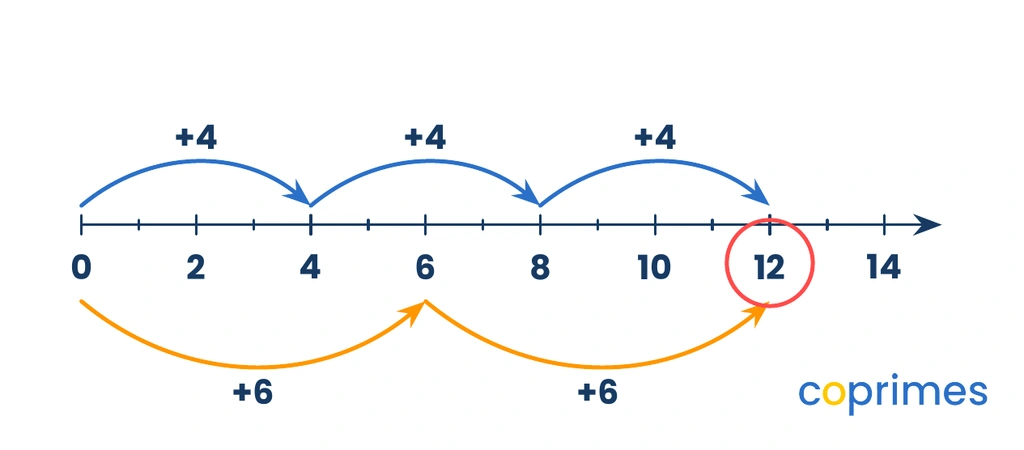
What Is Least Common Multiple?
When we list the multiples of two numbers side by side, they will share many values. These shared values are their common multiples.
The least common multiple (LCM) is the very first, or smallest, number that appears in both lists. Also known as the lowest common multiple, this concept guarantees you have found the smallest possible quantity that can be evenly divided by your starting numbers.
The LCM is never smaller than the numbers you are comparing. If one number happens to be a multiple of the other, the larger number itself is the LCM.
When to Use It
The LCM is frequently used to find common denominators when adding or subtracting fractions. It is also the perfect mathematical tool to solve real-world problems involving repeating events, such as finding out when two different blinking lights or bus schedules will sync up at the exact same time.
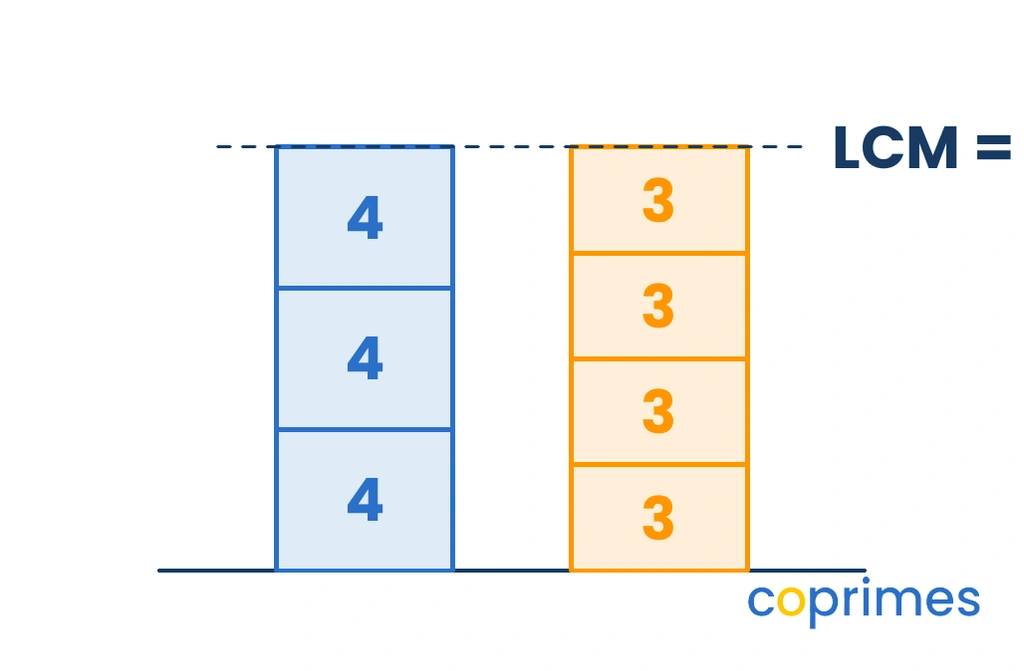
If two numbers share no prime factors in common other than , they are coprime numbers. In this case, their LCM is simply their product. After mastering this concept, you can explore the relationship between GCF and LCM to solve more advanced divisibility problems.
Step-by-Step Method
There are three main methods for finding the LCM. Choose the one that works best for the size of the numbers you are given.
Listing Method
- List the first several multiples of each number.
- Identify the smallest multiple that appears in every list.
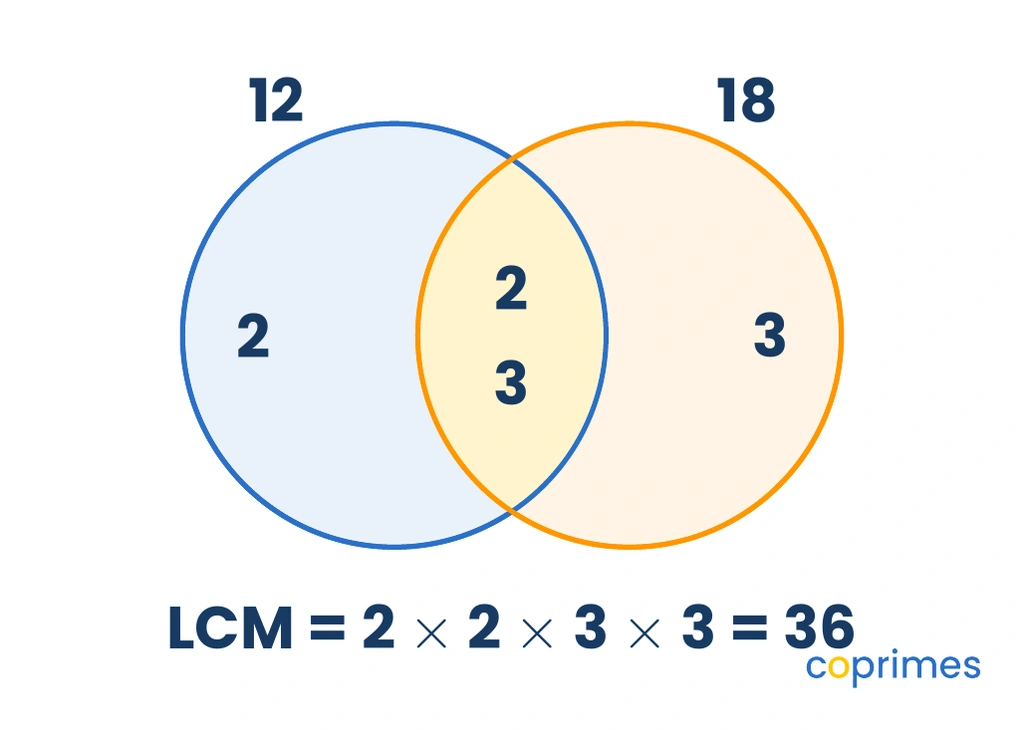
Prime Factorization Method
- Write each number as a product of prime numbers.
- Identify the highest power of each prime factor present.
- Multiply these highest powers together to find the LCM.
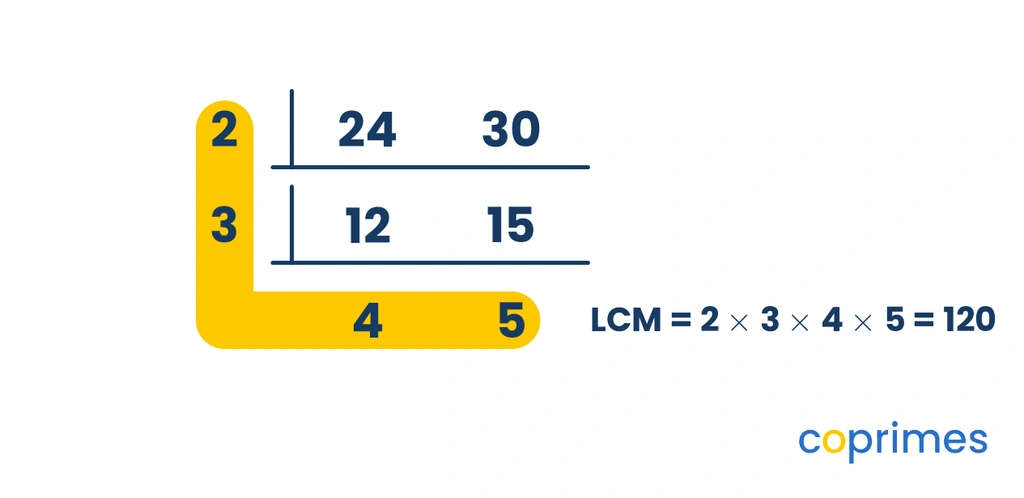
Division (Ladder) Method
- Write the numbers in a row.
- Divide by a common prime factor or their greatest common factor.
- Write the results in the row below. If a number is not divisible, bring it down unchanged.
- Repeat until the numbers in the bottom row have no common factors other than .
- Multiply all the divisors on the left and the numbers in the bottom row to find the LCM.
A learning plan shaped by your child, not the class
State-aligned Math plus our own Logic and English curriculum. An adaptive baseline test finds the gaps and fills them.
Visual Worked Examples
Review these three scenarios to see how each method helps you find the correct answer efficiently.
Example 1: Listing multiples
Question: What is the least common multiple of and ?
Method:
- List the multiples of :
- List the multiples of :
- Find the smallest number present in both lists.
Answer: The least common multiple is .
Check: and . Because both divide evenly with no remainder, is a valid common multiple. Since no smaller number in the lists matched, it is the least common multiple.
Example 2: Prime factorization method
Question: Find the LCM of and using prime factorization.
Method:
- Break into its prime factors: .
- Break into its prime factors: .
- Take the highest power of each prime factor. For , the highest power is . For , the highest power is .
- Multiply these highest powers together: .
Answer: The LCM is .
Check: and .
Example 3: Division method and repeating events
Question: Bus A arrives every minutes. Bus B arrives every minutes. If they arrive together now, in how many minutes will they next arrive at the exact same time?
Method:
- Finding the next simultaneous arrival requires the LCM of and .
- Write and in a row. Divide both by a common factor, such as . This leaves and .
- Divide and by a common factor of . This leaves and .
- The remaining numbers, and , share no common factors other than .
- Multiply the outer numbers forming the highlighted shape: the divisors and , and the bottom numbers and .
- .
Answer: They will arrive together again in minutes.
Check: trips for Bus A, and trips for Bus B.
How to Check the Answer
To verify that your LCM is mathematically correct, divide it by each of the starting numbers. If any division results in a remainder or a decimal, the number is not a valid common multiple.
To guarantee it is the least common multiple, ensure that the final quotients you receive share no common prime factors.
Common Mistakes
Confusing the concepts
The greatest common factor is the largest number that divides into your starting numbers. The least common multiple is the smallest number that your starting numbers divide into. The LCM is always equal to or larger than the original numbers, while the factor is always equal to or smaller.
Always multiplying the numbers together
Multiplying the two numbers directly will always give you a common multiple, but it is often not the least common multiple. For example, multiplying gives , but their actual LCM is . Only multiply the numbers directly when they have no shared prime factors.

Practice questions
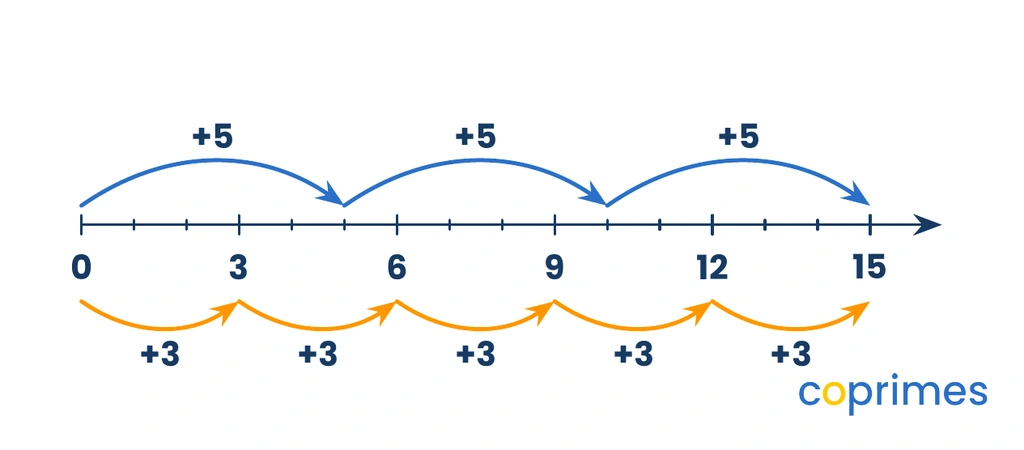
Based on the number line representation, what is the least common multiple of and ?
What is the least common multiple of and ?
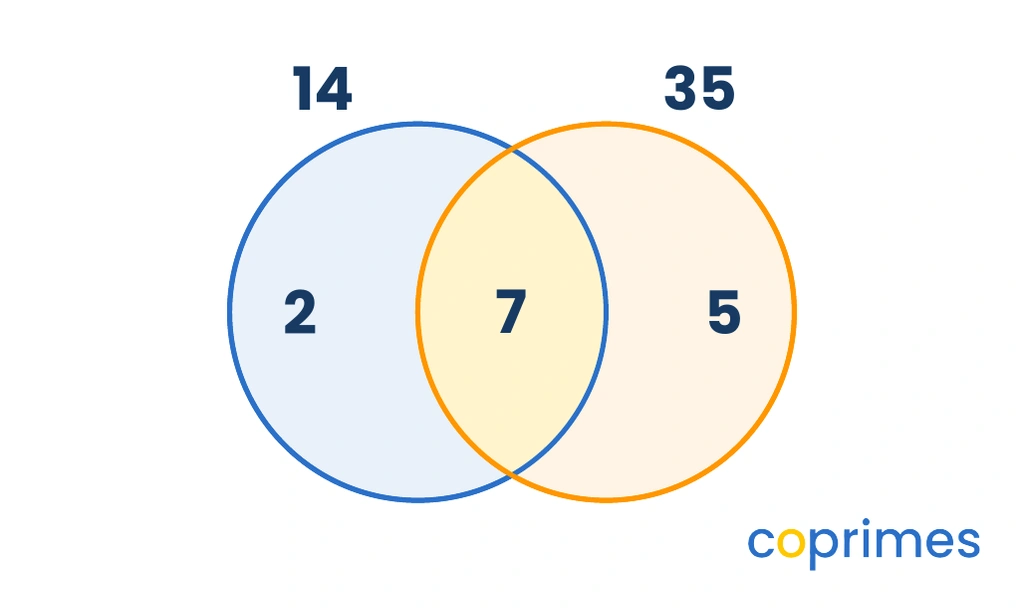
Based on the prime factorization Venn diagram for and , what is their least common multiple?
Two lights flash at different intervals. The red light flashes every seconds, and the blue light flashes every seconds. If they flash together right now, in how many seconds will they next flash at the exact same time?
If the least common multiple of a number and a number is exactly equal to , which statement must be true?
Number is a prime number.
Number is a multiple of number .
The numbers share no common factors.
Both numbers are equal to .
Number is a multiple of number .