
Factors: Guide and Examples
A factor of a whole number divides it exactly with no remainder, and factors multiply in pairs to produce that number.
Finding the factors of a number is a fundamental mathematical skill that makes it easier to simplify fractions and solve division problems.
What Is Factors?
A factor of a whole number is any integer that divides it exactly with no remainder. Every whole number greater than has at least two factors: and the number itself.
Because factors divide evenly into a larger number, they are also called divisors. If you divide a dividend by a divisor and get a whole-number quotient, both the divisor and the quotient are factors of the dividend.
Understanding how to find these values quickly helps in breaking down complex calculations into simpler, manageable steps.
Key Ideas and Vocabulary
Understanding how numbers break down requires a few essential terms.
When two whole numbers multiply together to equal a target number, they form a set of factor pairs. Since multiplication can happen in any order, checking for pairs is the fastest way to find all possible divisors.
Factors are the building blocks of numbers, which makes them different from multiples. Factors divide into a number, while multiples are the result of multiplying that number by another integer.
Depending on how many divisors a number has, it falls into one of two categories:
- Prime numbers: A prime number has exactly two distinct factors, which are and itself.
- Composite numbers: A composite number has more than two factors.
A fascinating application of these properties is the study of perfect numbers, which exactly equal the sum of their proper positive divisors.
Visual Explanation
We can visualize factors by arranging objects into rectangular arrays. If a set of objects can be arranged into complete rows and columns with nothing left over, the lengths of those sides are factors.
For instance, a group of objects can be arranged into three different perfect rectangles.
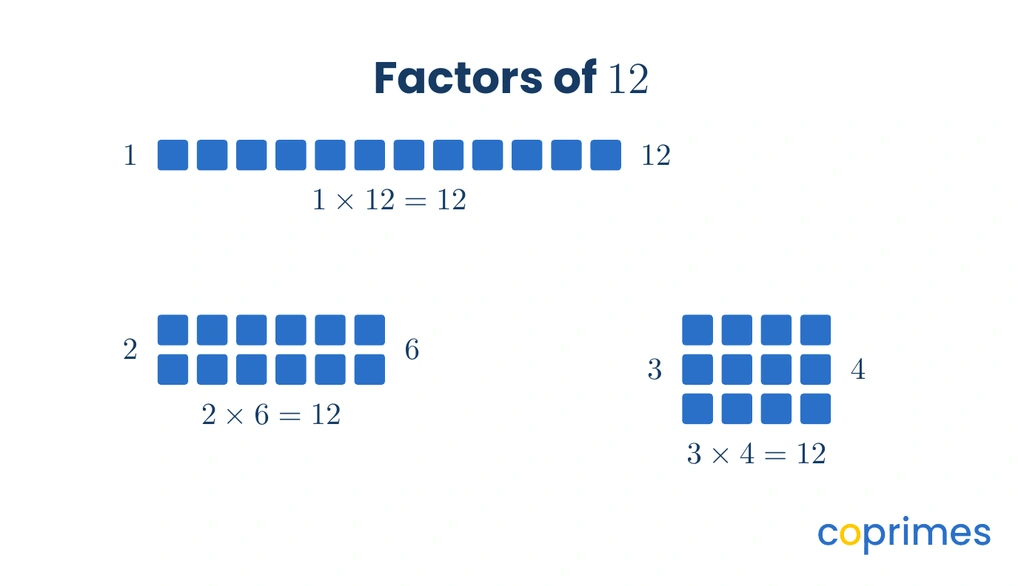
Because the objects form perfect rectangles with no gaps, the side lengths represent the divisors. Gathering all the unique side lengths from these arrays provides the complete list of factors of , which are and .
A learning plan shaped by your child, not the class
State-aligned Math plus our own Logic and English curriculum. An adaptive baseline test finds the gaps and fills them.
Worked Examples
Example 1: Using multiplication pairs
Question: Find all positive factors of .
Method:
- Start with the number and the target number itself.
- Test the next integer, . Since is even, divides evenly.
- Test . The calculation divides evenly.
- Test . It does not divide exactly.
- Stop testing when the factor pairs begin to reverse.
Answer: The factor pairs are , , and . The complete list of factors for is and .
Check: Multiply the pairs from the outside in to confirm they all equal .
Example 2: Using division checks
Question: Find all the factors of .
Method:
- List and .
- Check . Since is odd, is not a divisor.
- Check and . They do not divide exactly into .
- Check . The calculation leaves no remainder.
Answer: The factor pairs are and . The factors of are and .
Check: Divide by to confirm the quotient is with no remainder.
Example 3: Checking for prime numbers
Question: Find the factors of .
Method:
- List and .
- Because is odd, no even numbers can divide it.
- Test odd numbers like and . None of them divide evenly into .
- The only numbers that work are and .
Answer: The factors are and . Because it has exactly two distinct divisors, is a prime number.
Check: Confirm that cannot be split into any smaller equal groups.
Common Mistakes and Non-Examples
A common error is confusing divisors with multiples. The factors of a number are always less than or equal to the target number itself. In contrast, multiples are greater than or equal to the target number.
Another frequent mistake is forgetting to list the number itself. Every non-zero whole number divides perfectly into itself, meaning the number is always its own largest factor.
Fractions and decimals are never factors.
A factor must always be a whole integer. For example, even though , the number is a decimal. Similarly, is a fraction. Therefore, these are non-examples and cannot be considered factors.
Real-World Connections
We use divisors whenever we need to split a total quantity into equal groups without any remainders. If a teacher wants to arrange students into equal teams, the possible team sizes must be factors of .
To find these group sizes quickly without relying on trial and error, you can use divisibility rules to test numbers efficiently. For instance, any number ending in or has as a divisor, and any even number has as a divisor. By applying these patterns, we can solve everyday sharing problems much faster.

Practice questions
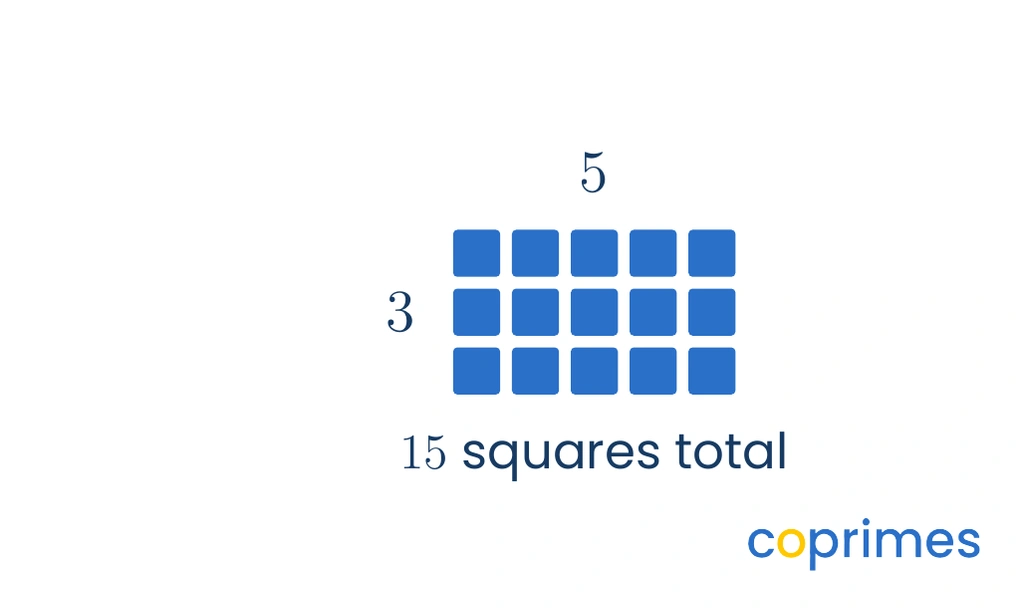
Which statement is true based on the visual model of squares?
and are factors of .
and are multiples of .
is a prime number.
is a factor of .
and are factors of .
What is the complete list of factors for the number ?
Which of the following numbers is NOT a factor of ?
A student is finding the factors of . They write down and . Which factor did they forget to include?
A baker has cookies. They want to put the same number of cookies into each box with none left over. Which of the following box sizes is possible?