
Understanding GCF and LCM: Guide and Examples for Grades 6-9
The greatest common factor (GCF) finds the largest shared factor, while the least common multiple (LCM) finds the smallest shared positive multiple; the required method depends on the problem context. Recognizing which mathematical tool to use is essential for simplifying complex fractions, solving algebraic equations, and answering real-world logic problems.
What Are GCF and LCM?
The Greatest Common Factor (GCF) of two or more numbers is the largest integer that divides perfectly into all of them without leaving a remainder. Depending on where you study, the GCF may also be called the Highest Common Factor (HCF) or the Greatest Common Divisor (GCD). These terms all describe the exact same concept.
The Least Common Multiple (LCM) of two or more numbers is the smallest positive integer that is a multiple of all the given numbers. While factors break a number down into its equal parts, multiples build a number up through repeated addition or multiplication.
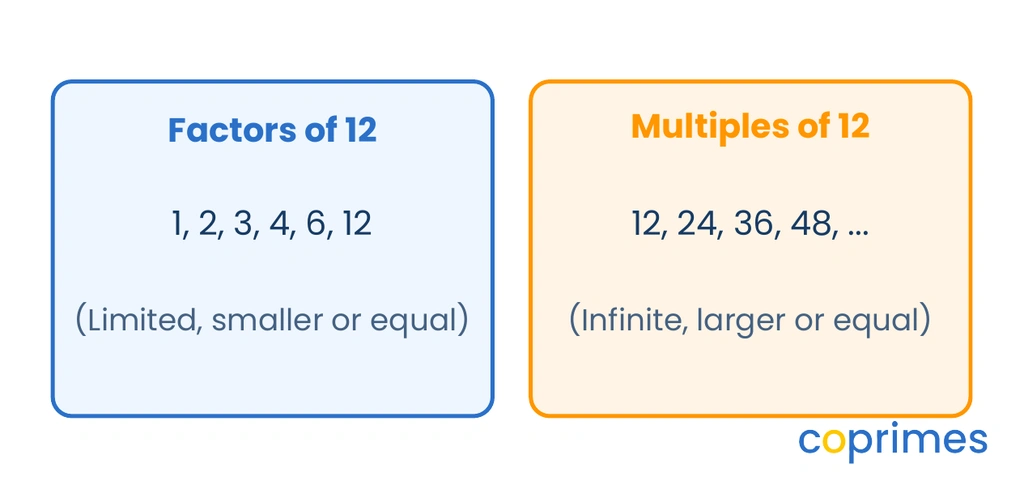
Key Differences
The most critical difference lies in the size of the result compared to the original numbers. The GCF is always less than or equal to the smallest number in your set. Conversely, the LCM is always greater than or equal to the largest number in your set.
There is also a powerful mathematical relationship connecting the two properties for any pair of positive whole numbers, and :
If you already know the GCF of two numbers, you can multiply the two numbers together and divide by the GCF to instantly find their LCM.
Comparison Table
Reviewing the properties side-by-side helps clarify which calculation you are performing.
Feature | Greatest Common Factor (GCF) | Least Common Multiple (LCM) |
Meaning | The largest number that divides into all given numbers perfectly. | The smallest positive number that all given numbers divide into perfectly. |
Size Limit | Always the smallest number in the set. | Always the largest number in the set. |
Method | Find shared divisors. | Find shared multiples. |
Example for and |

Visual Examples
One of the most efficient ways to find both the GCF and LCM simultaneously is to use the fundamental theorem of arithmetic to find the prime factorization of each number, and then place those prime factors into a Venn diagram.
The shared prime factors placed in the intersection multiply together to form the GCF. All the prime factors across the entire diagram multiply together to form the LCM. If there are no shared prime factors in the intersection, the numbers are coprime numbers and their GCF is .
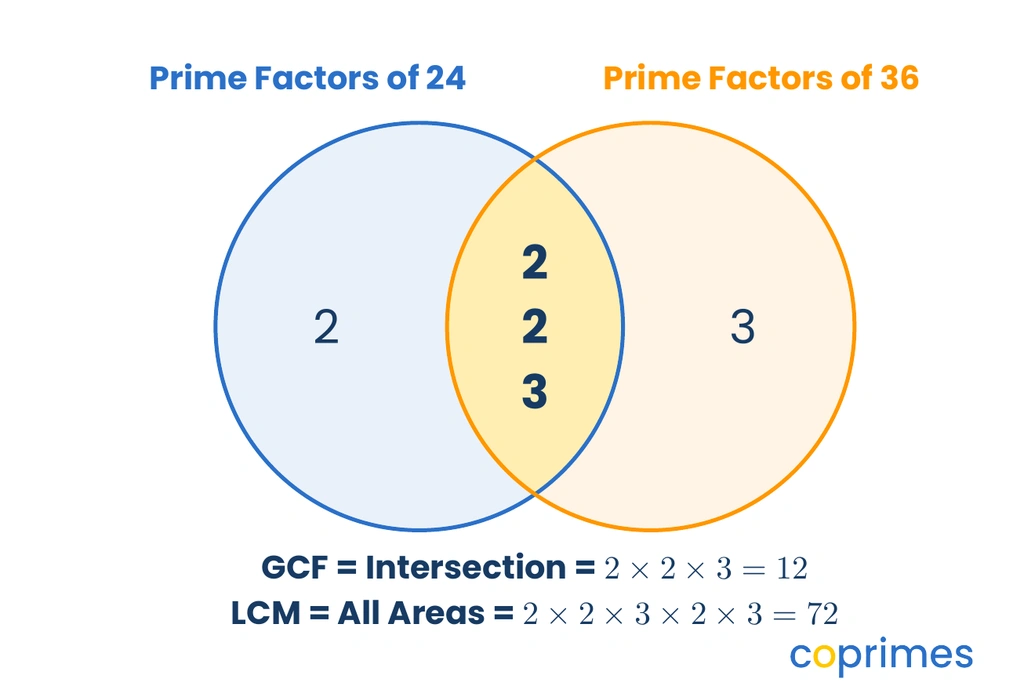
Example 1: Finding GCF and LCM using prime factorization
Question: What are the GCF and LCM of and ?
Method:
- Write the prime factorization of , which is .
- Write the prime factorization of , which is .
- Identify the shared prime factors. Both numbers share one and one .
- Multiply the shared factors to find the GCF: .
- Multiply the shared factors by the leftover unique factors (a from , and a from ) to find the LCM: .
Answer: The GCF is and the LCM is .
Check: Verify the answer using the product rule: . Checking the original numbers gives . Both products match exactly.
How to Choose or Classify
Word problems rarely explicitly ask for the GCF or LCM. You must decode the situation by analyzing the context.
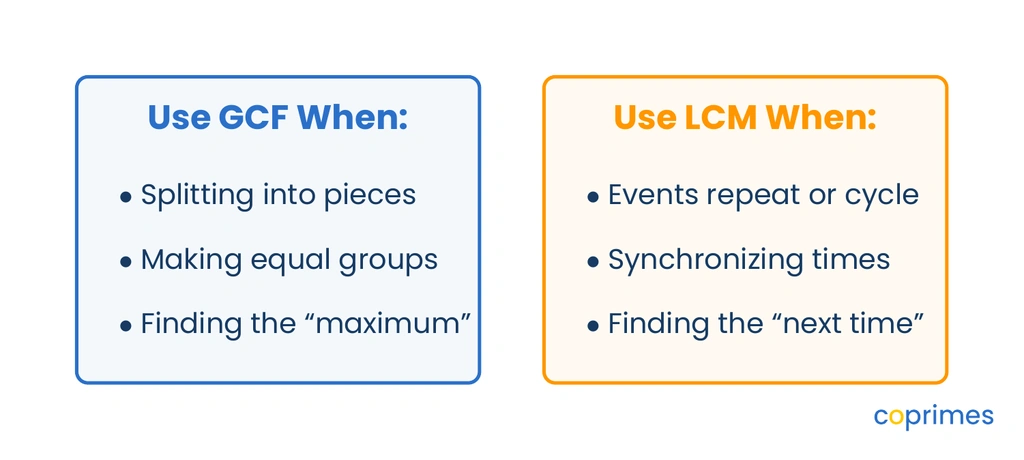
Use the GCF when a problem requires splitting things into smaller sections, organizing items into equal groups, or finding the maximum possible size for an arrangement.
Use the LCM when a problem involves events that repeat over time, cycles that must synchronize, or purchasing separate items in bulk quantities to ensure you have matching amounts.
Example 2: Solving a context problem
Question: A local station sends a red bus every minutes and a blue bus every minutes. If both buses depart together at noon, how many minutes will pass before they depart together again?
Method:
- Analyze the context. The buses operate on repeating cycles and we need to find when they synchronize again. This is an LCM problem.
- List the multiples of :
- List the multiples of :
- Identify the smallest matching multiple.
Answer: The buses will depart together again in minutes.
Check: Verify by dividing the target time by each cycle length. exact cycles for the red bus. exact cycles for the blue bus. Because both divide evenly, is a valid multiple.
Common Mistakes
A frequent error is calculating the correct value for the wrong property. When a problem asks for the GCF, students sometimes provide the LCM instead because the word "greatest" tricks them into thinking the answer must be a large number. Remember that "greatest" refers to the size of the divisor, which is inherently smaller than the original numbers.
Another mistake occurs when working with a pair of numbers where one number is a multiple of the other, such as and . In this special case, the smaller number () is the GCF, and the larger number () is the LCM.
Example 3: Using the product relationship
Question: The product of two numbers is . Their greatest common factor is . What is their least common multiple?
Method:
- Recall the relationship: .
- Substitute the known values into the formula: .
- Solve for the unknown LCM by dividing both sides by .
Answer: The LCM is .
Check: Multiply the computed LCM by the given GCF. , which perfectly matches the given product.
A learning plan shaped by your child, not the class
State-aligned Math plus our own Logic and English curriculum. An adaptive baseline test finds the gaps and fills them.
Practice questions
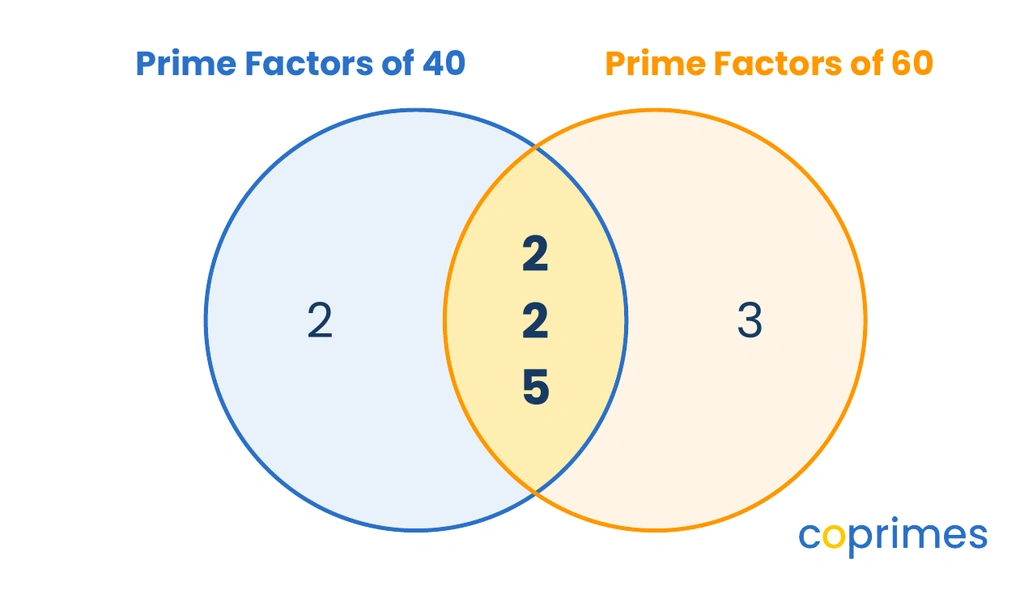
Based on the prime factorization in the Venn diagram, what is the least common multiple (LCM) of and ?
The product of two unknown numbers is . If their greatest common factor (GCF) is , what is their least common multiple (LCM)?
A gardener has rose bushes and tulip bulbs. They want to plant them in identical rows so that each row has the same number of roses and the same number of tulips, with no plants left over. Which mathematical tool should they use to find the maximum number of identical rows they can plant?
They should find the least common multiple because they are planting rows together.
They should find the greatest common factor because they are splitting items into equal groups.
They should multiply and to find the total possible combinations of plants.
They should find the least common multiple because is larger than .
They should find the greatest common factor because they are splitting items into equal groups.
What is the greatest common factor (GCF) of and ?
What is the least common multiple (LCM) of , and ?