
Powers of Ten: Guide and Examples
A power of ten is the number multiplied by itself a stated number of times. It is written using as the base and a smaller raised number called an exponent, providing a mathematical shortcut for writing very large or very small quantities.
The exponent tells you exactly how many times to use ten as a factor.
What Are Powers of Ten?
Powers of ten are expressions that show the base multiplied by itself. When counting everyday items, we use cardinal and ordinal numbers, but when expressing massive quantities, powers of ten are much more efficient.
A power of ten can be written in three forms:
- Exponential form: The compact way to write the value, such as . The base is , and the exponent tells us how many times to multiply the base by itself.
- Expanded form: The full multiplication expression, such as .
- Standard form: The final calculated number, such as .
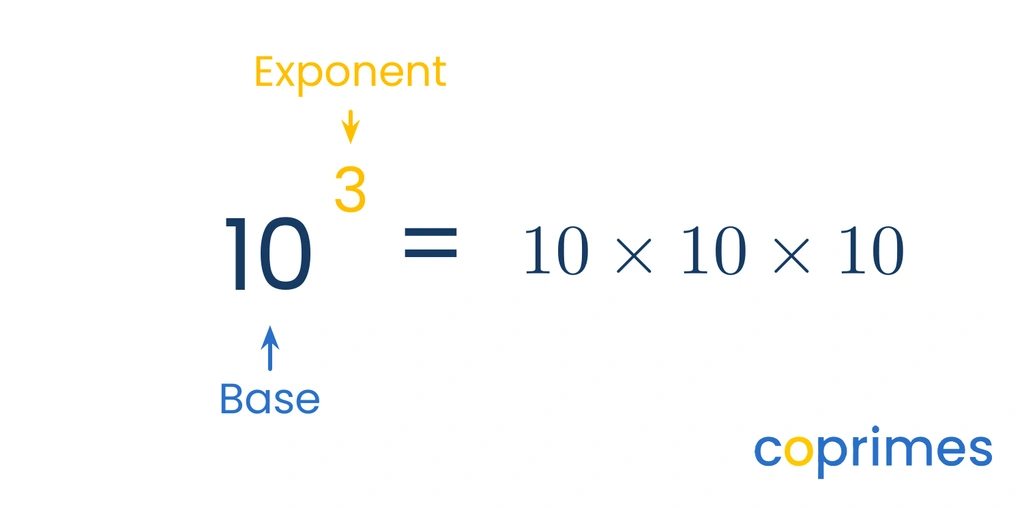
Key Ideas and Vocabulary
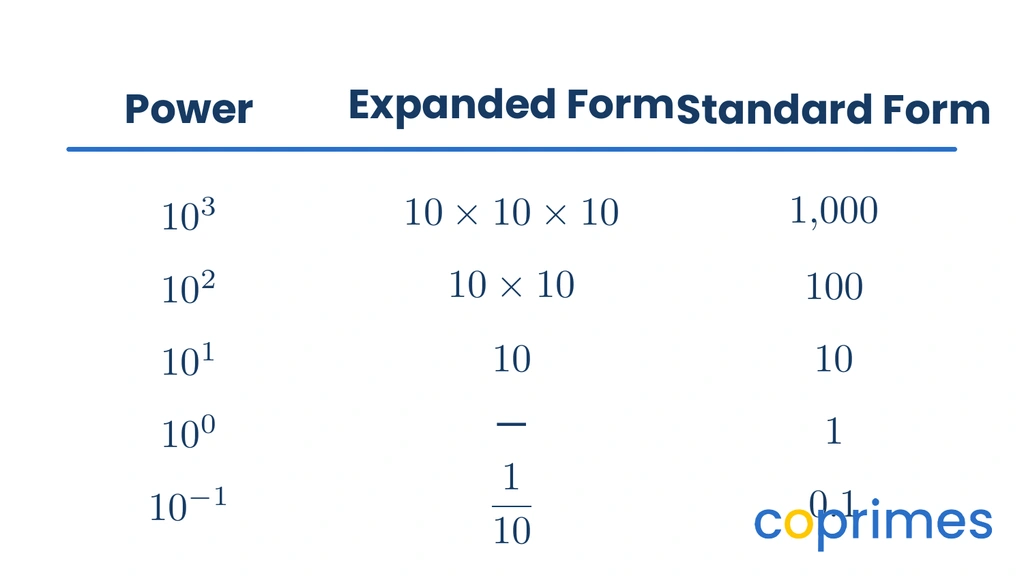
Understanding the pattern of zeros is crucial for reading and writing large numbers. When the exponent is a positive whole number, it matches the number of zeros in the standard form.
- (one zero)
- (two zeros)
- (three zeros)
The pattern also extends downward to zero and negative exponents:
- Zero exponent: Any non-zero base raised to the power of zero equals . Therefore, .
- Negative exponents: A negative exponent represents division rather than multiplication, creating a fraction or decimal. For example, .
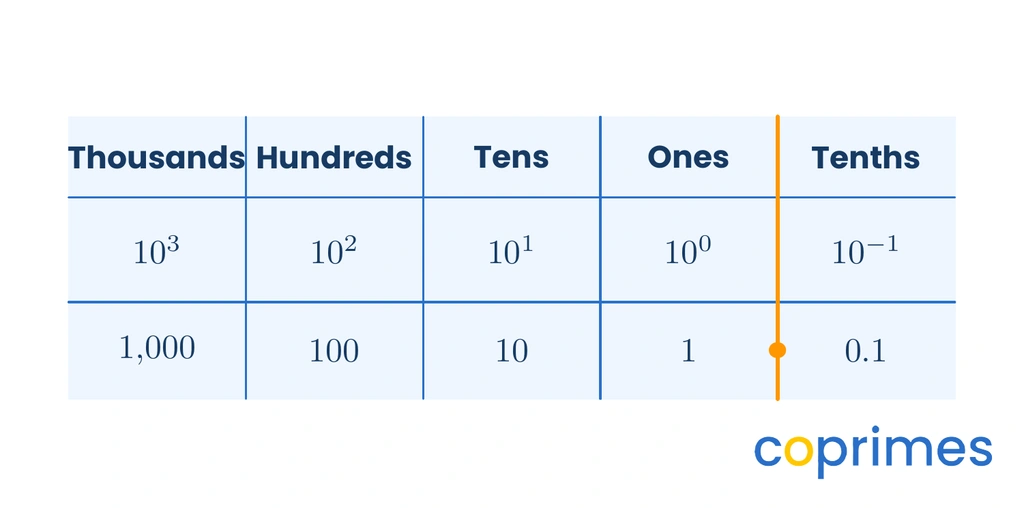
Visual Explanation
Every position in our base-ten place value system is a power of ten. Moving one column to the left makes a digit's value times greater, while moving one column to the right makes its value times smaller.
A learning plan shaped by your child, not the class
State-aligned Math plus our own Logic and English curriculum. An adaptive baseline test finds the gaps and fills them.
Worked Examples
Applying powers of ten simplifies multiplication and decimal conversion.
Example 1: Multiplying by a positive power of ten
Question: Evaluate .
Method:
- Identify the power of ten. The expression means , which is .
- Multiply the leading number by the standard form of the power of ten.
- Attach the correct number of zeros. Because the exponent is , the decimal point moves places to the right.
Answer: .
Check: .
Example 2: Writing a large number using a power of ten
Question: Write using a single digit multiplied by a power of ten.
Method:
- Identify the single non-zero digit. Here, it is .
- Count the number of zeros following the digit. There are zeros.
- Write the value as the single digit multiplied by raised to the power of the zero count.
Answer: .
Check: .
Example 3: Converting a negative power to a decimal
Question: Write in standard decimal form.
Method:
- Recognize that a negative exponent represents division.
- Rewrite the expression as a fraction with a positive exponent in the denominator.
- Convert the fraction to a standard decimal.
Answer: .
Check: The decimal has the digit in the thousandths place, which matches the fraction .
Common Mistakes and Non-Examples
A frequent mistake is multiplying the base by the exponent instead of multiplying the base by itself. A power of ten is not just a standard multiple of ten.
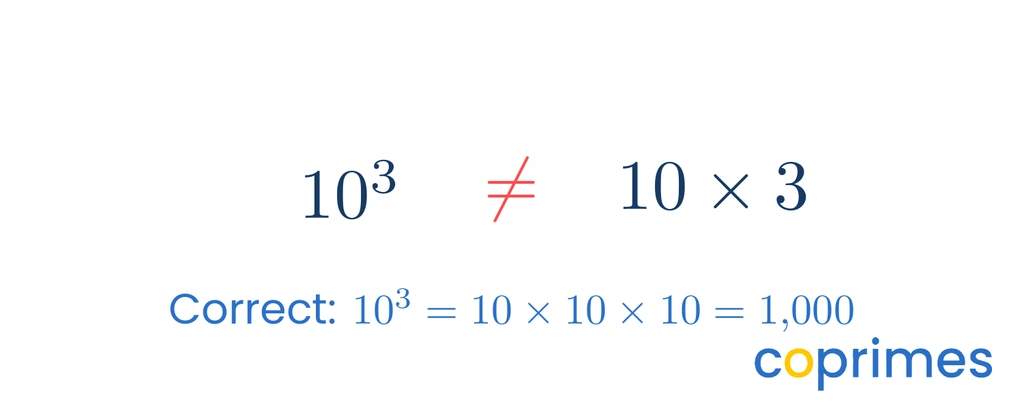
For example, means , which equals . It does not mean , which is only .
Another common error occurs when converting negative powers.
Students sometimes mistake for a negative number like or . A negative exponent indicates a fraction or a small positive decimal, never a negative standard number.
Real-World Connections
Scientists and engineers rely on powers of ten to organize the universe. Unlike Roman numerals, which require long and complex strings of letters to represent larger amounts, powers of ten keep calculations manageable.
Astronomers use positive powers of ten to express distances, such as the distance from Earth to the Sun, which is approximately kilometres. Biologists use negative powers of ten to measure microscopic cells, often sized around metres.
If you mapped these extremes on a logarithmic number line, each step would represent a multiplication by ten, allowing both the vast universe and tiny atoms to fit compactly on a single scale.

Practice questions
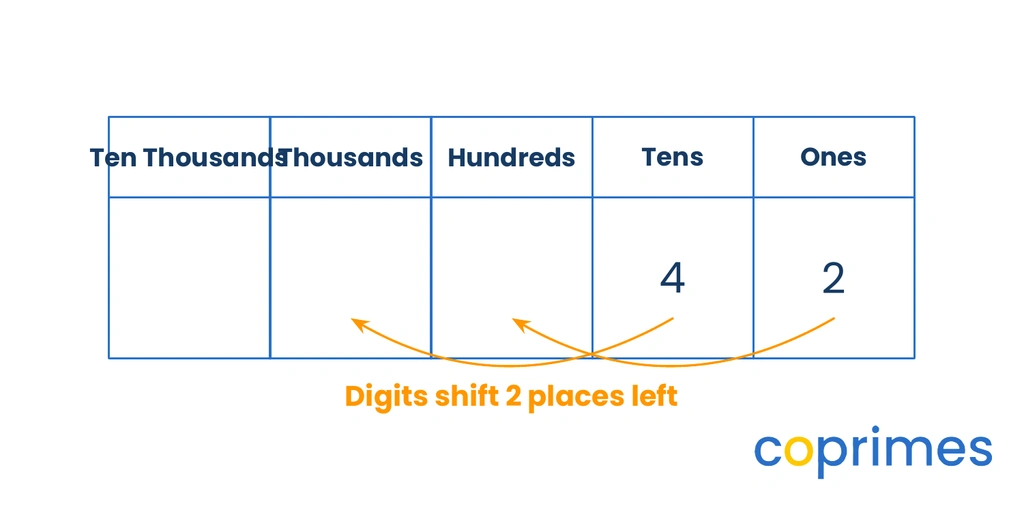
The place value chart shows the digits of the number shifting two places to the left. Which mathematical operation represents this shift?
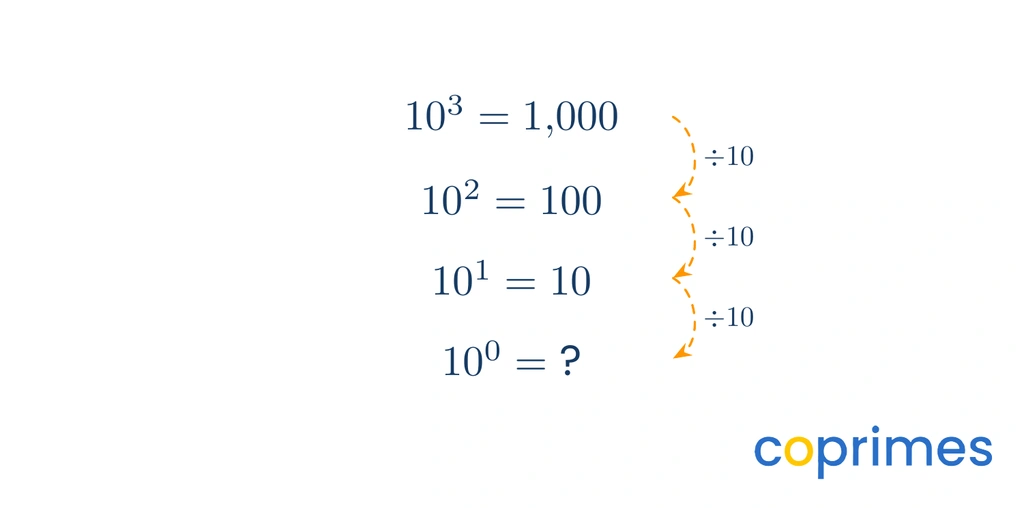
Based on the division pattern shown in the visual, what is the value of ?
How is the negative power of ten written in standard decimal form?
Which of the following numbers is equivalent to ?
A microscopic organism has a length of metres. How is this length written as a standard decimal?