
Cardinal and Ordinal Numbers: Meaning and Comparison
Cardinal numbers tell how many, while ordinal numbers identify position or order in a sequence. A clear comparison of cardinal and ordinal numbers shows that we use both types every day, whether we are counting objects in groups or finding a specific place in a line.
What Are Cardinal and Ordinal Numbers?
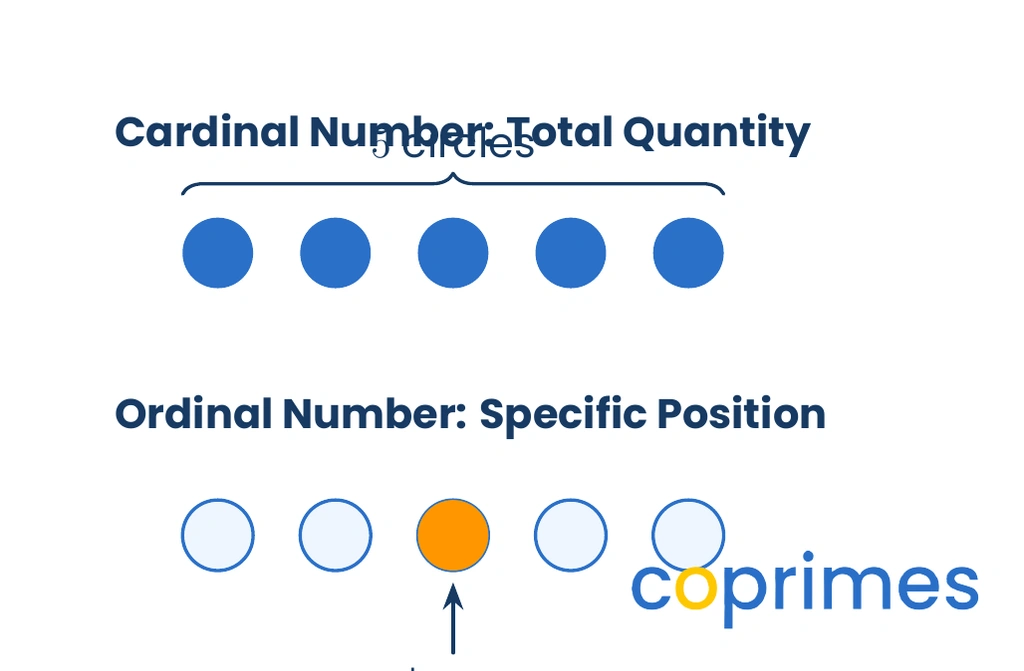
A cardinal number tells us the total quantity of something. When we count objects like apples in a bowl or students in a classroom, the result is a cardinal number. The standard counting numbers , , , and so on are cardinal numbers.
An ordinal number tells us where something falls in a sequence. If we want to know who won a race or which floor an apartment is on, we use an ordinal number. Words like first (), second (), and third () are ordinal numbers.
Understanding the difference between counting and ordering is an important part of learning place value, because it helps us describe both the size of a number and the specific position of its digits.
If you are finding a total amount, use a cardinal number. If you are finding a position, use an ordinal number.
Key Differences
The main difference between cardinal and ordinal numbers is the difference between counting a whole group and ranking one specific item. Cardinal numbers describe the entire set, while ordinal numbers describe exactly one position within a sequence.
When we build larger numbers using powers of ten like , , or , we use cardinal numbers to express the total amount. However, if we identify the person in a line, we are using an ordinal number.
Example 1: Identifying number types
Question: A bookshelf has books. A student takes the book from the left. Which number is cardinal, and which is ordinal?
Method:
- Look for the number that tells the total quantity.
- Look for the number that tells a position in a sequence.
Answer: The number is cardinal because it counts the total books. The number is ordinal because it identifies a specific position.
Check: Ask, "Am I counting or ranking?" Eight counts the books, and fourth ranks the chosen book. The definitions match perfectly.
Comparison Table
Comparing identical situations helps make the difference between cardinal and ordinal numbers clear. The numbers may look similar, but they answer entirely different questions.
Situation | Cardinal Number (How Many?) | Ordinal Number (Which Position?) |
Running a race | runners finished the race. | The fastest runner finished . |
Reading a book | The book has chapters. | We are reading the chapter. |
Sitting in class | There are desks in the room. | The student sits in the row. |
Calendar dates | A week has days. | Today is the of the month. |
Sometimes ordinal positions like first, second, and third are written using Roman numerals such as , , and , especially for kings, queens, or book chapters.

Visual Examples
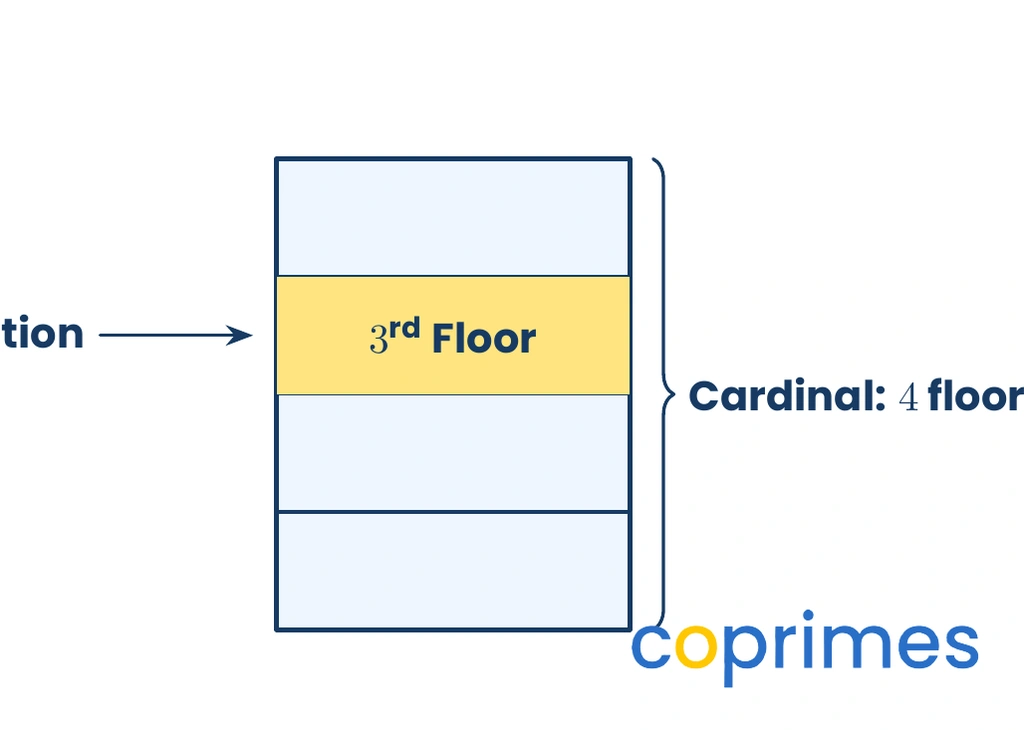
Visualizing numbers helps us separate quantities from sequences. When we look at a diagram, a cardinal number represents all the parts counted together, while an ordinal number points to one specific part in order.
Example 2: Analyzing a calendar
Question: May has days. A school trip is scheduled for May . What role does each number play?
Method:
- Analyze the number . It represents the total count of days in the entire month.
- Analyze the number . It represents a single, specific day in order from the beginning of the month.
Answer: The number is a cardinal number. The number is an ordinal number.
Check: You can count distinct days in May, but there is only one position called the .
How to Choose or Classify
When you need to classify a number as cardinal or ordinal, ask yourself a simple question: "Am I counting things, or am I ranking them?"
If you are answering "how many," choose a cardinal number. If you are answering "where in line,"
choose an ordinal number. Ordinal numbers usually end with suffixes like -st, -nd, -rd, or -th.
Example 3: Choosing the correct number type
Question: A student wants to describe the total number of slices in a pizza and which slice they ate first. Which types of numbers should they use?
Method:
- Determine the goal for the total number of slices. This requires counting all the slices, so a cardinal number is needed (such as slices).
- Determine the goal for the slice eaten. This describes a sequence in time, so an ordinal number is needed (such as the slice).
Answer: The student should use a cardinal number for the total slices and an ordinal number for the slice they ate.
Check: "Eight slices" answers how many. "First slice" answers which position. The classifications are correct.
Common Mistakes
A frequent question is whether zero () is a cardinal or an ordinal number. Zero is a cardinal number because it represents a real quantity: an empty set, or none. If a bowl has apples, we are counting how many apples are present.
However, zero is not an ordinal number in standard mathematics. Ordinal positions begin at first (). There is no place in a race, and no row in a classroom.
Another common mistake is mixing up the spelling of ordinal suffixes. The first three numbers have unique suffixes: (first), (second), and (third). From four onward, the standard suffix is -th, such as , , and .

A learning plan shaped by your child, not the class
State-aligned Math plus our own Logic and English curriculum. An adaptive baseline test finds the gaps and fills them.
Practice questions

Look at the visual showing a row of stars. The arrow points to a specific star in the sequence. Which type of number describes the position of this selected star?
A cardinal number
An ordinal number
A fractional number
A negative number
An ordinal number
Which of the following describes a cardinal number?
The car waiting in line
The place winner in a race
A box containing exactly crayons
The step on a tall ladder
A box containing exactly crayons

Look at the visual showing a group of blocks. A student counts exactly blocks in total. What kind of number is ?
Cardinal
Ordinal
Zero
Sequence
Cardinal
Why is zero () considered a cardinal number but not an ordinal number?
Zero represents an empty quantity, but there is no zero position in a standard sequence.
Zero only tells us the position of an object in a line.
Zero is larger than all other cardinal numbers.
Zero has the -th suffix like other ordinal numbers.
Zero represents an empty quantity, but there is no zero position in a standard sequence.
A student finished in a spelling competition that had participants. Which statement correctly identifies the numbers?
is cardinal and is ordinal.
Both and are cardinal numbers.
Both and are ordinal numbers.
is ordinal and is cardinal.
is ordinal and is cardinal.