
Simple Interest vs Compound Interest: Comparing Growth Models
Simple interest uses the same original principal for every period, so equal interest is added each period. Compound interest uses the current amount, including earlier interest, so the added interest can change each period. The applicable model is specified by the situation.
When evaluating the difference between simple and compound interest, the key distinction is what happens to the interest after it is earned. Understanding this difference is essential for analyzing savings, loans, and continuous growth.
Simple interest and compound interest at a glance
The fundamental difference between simple and compound interest is the amount used as the basis for each new calculation.
In a simple interest model, the interest is calculated only on the original principal. The amount of interest earned in the first period is exactly the same as the interest earned in the second period, the third period, and every period that follows.
In a compound interest model, the interest is calculated on the original principal plus any interest that has already accumulated. This means the interest earned in the second period will be larger than the interest earned in the first period, provided the rate remains positive.
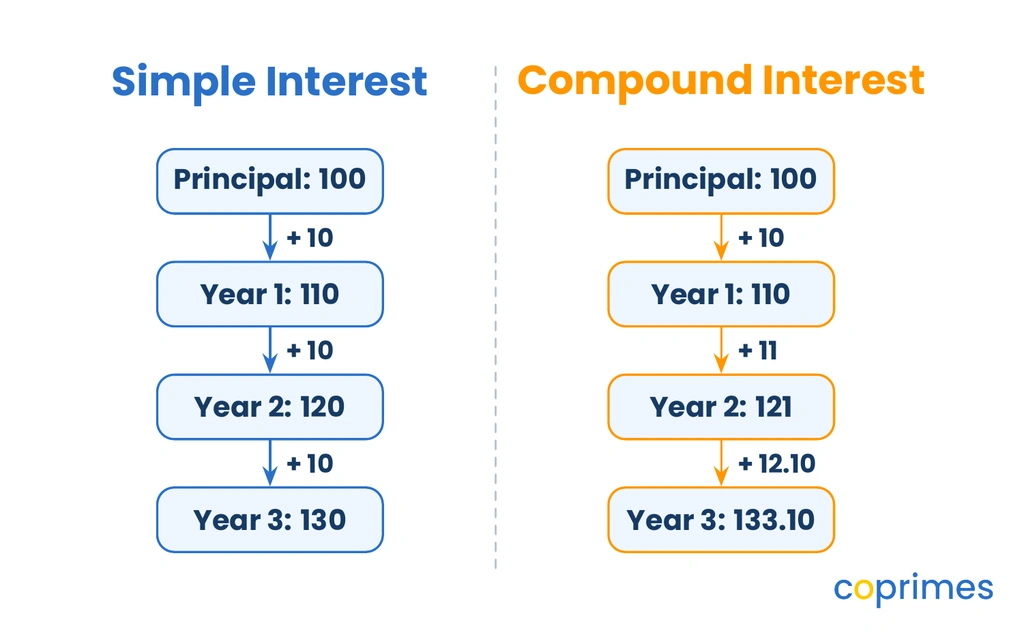
The two models yield the exact same total amount at the end of the very first period, assuming the rate and principal are identical. The difference only emerges during the second and subsequent periods.
Compare the two calculations
The formulas for the two models reflect how they treat accumulated interest.
For simple interest, the total interest earned over a period is calculated as:
Where:
- is the principal (starting amount).
- is the annual interest rate as a percentage.
- is the time in years.
To find the final amount , you add the interest to the principal: .
For compound interest, the final amount is calculated directly, because the principal grows during each compounding period:
To find the total compound interest earned, you subtract the original principal from the final amount: .
Simple interest grows steadily by the same amount, while compound interest accelerates.
Use a table to see the difference
A side-by-side comparison reveals exactly how the balances diverge over time.
Consider an initial principal of dollars invested at a rate of per year. The table below tracks the total balance at the end of each year for both models.
Year | Simple Interest Balance | Compound Interest Balance | Difference |
0 | dollars | dollars | dollars |
1 | dollars | dollars | dollars |
2 | dollars | dollars | dollars |
3 | dollars | dollars | dollars |
In Year 1, both accounts earn exactly dollars. In Year 2, the simple interest account earns another dollars. However, the compound interest account earns on the new balance of dollars, which yields dollars in interest. The gap between the two accounts widens every year.

Choose the model named in a problem
Mathematical problems usually state exactly which model to apply.
Look for key phrases. If a problem states that an account earns " simple interest," use the simple interest formula. If the problem mentions that interest is "compounded annually" or "compounded monthly," use the compound interest formula.
Working with percentages requires care. Compound interest can be understood as a repeated percent change applied to a growing balance, making it a geometric progression. Simple interest is an arithmetic progression. Financial scenarios involving exchange rates typically do not involve accumulating interest unless the converted money is subsequently deposited into an interest-bearing account.
Interpret growth over time
When plotted on a graph, the two models create distinctly different shapes.
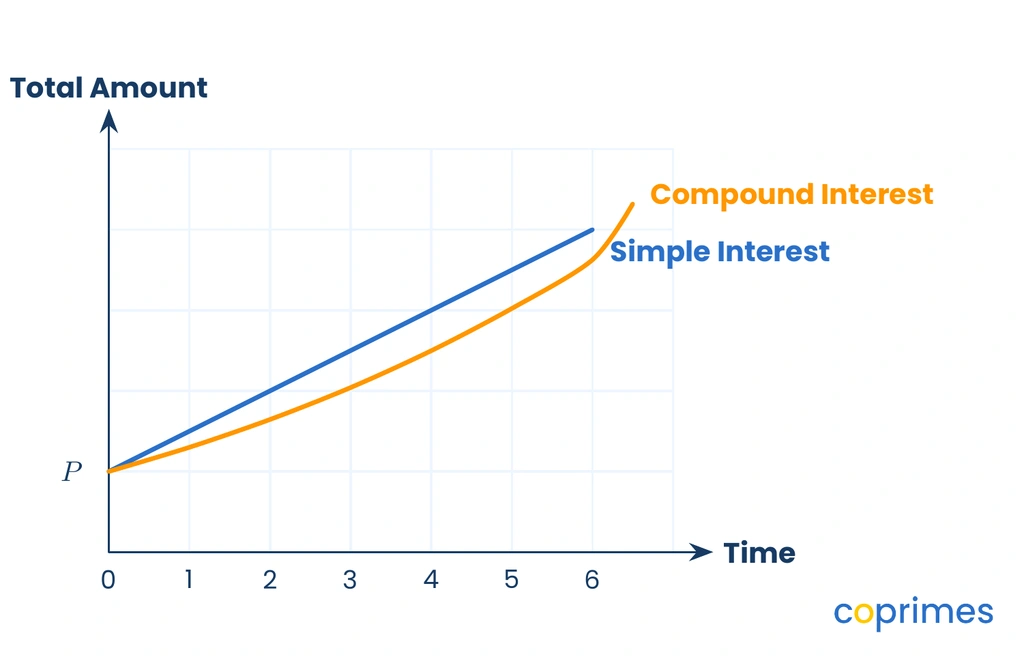
Simple interest produces linear growth. Because the interest added each period is constant, the graph is a straight line. Compound interest produces exponential growth. Because the interest is calculated on an increasing balance, the graph curves upward, rising more steeply as time goes on.
Worked examples
Working through calculations for both models side-by-side demonstrates exactly how they diverge.
Example 1: Calculating simple and compound interest over two years
Question: A principal of dollars is invested at a rate of per year. What is the difference between the final amounts if the interest is simple versus if it is compounded annually for years?
Method:
- Calculate the final amount using simple interest.
dollars.
dollars.
- Calculate the final amount using compound interest.
dollars.
- Subtract the simple interest amount from the compound interest amount.
dollars.
Answer: The difference between the two amounts is dollars.
Check: You can verify the difference by finding of the first year's interest. The first year's interest is dollars. The extra interest in the second year is of dollars, which is dollars.
Example 2: Comparing long-term growth
Question: An investment of dollars earns per year. Will simple interest or compound interest yield a higher final amount after years, and by how much?
Method:
- Calculate the simple interest total.
dollars.
Final amount = dollars.
- Calculate the compound interest total.
dollars.
- Find the difference.
dollars.
Answer: Compound interest yields a higher final amount by dollars.
Check: Compound interest always yields a higher amount than simple interest for periods greater than year when the rate is positive.
Example 3: Determining the principal given the difference
Question: The difference between compound interest and simple interest on a certain principal over years at per year is dollars. What is the principal?
Method:
- Express the difference algebraically. For years, the extra compound interest is exactly the interest earned on the first year's simple interest.
First year simple interest = .
- Calculate the interest on that interest for the second year.
Difference = .
- Set the expression equal to the given difference and solve for .
dollars.
Answer: The principal is dollars.
Check: If , simple interest for years is dollars. Compound interest is dollars. The difference is indeed dollars.
A learning plan shaped by your child, not the class
State-aligned Math plus our own Logic and English curriculum. An adaptive baseline test finds the gaps and fills them.
Common mistakes
Learners often mix up the two formulas or apply them to the wrong contexts.
- Using the compound interest formula to find just the interest: The compound interest formula calculates the total final amount (), not just the interest (). You must subtract the principal from the final amount to find the interest.
- Assuming linear growth for compound interest: Compound interest grows exponentially. Doubling the time does not simply double the compound interest earned; it increases it by a much larger factor.
- Applying simple interest when compounding is implied: In real-world banking and financial problems, interest is almost always compounded unless the problem explicitly states "simple interest."
Frequently asked questions
Why are simple and compound interest exactly the same for the first year?
During the first year, no previous interest has been accumulated yet. Because both models calculate the first year's interest based entirely on the original principal, the amounts earned are identical.
Is compound interest always better than simple interest?
It depends on whether you are saving money or borrowing it. If you are depositing money into a savings account, compound interest is better because your balance grows faster. If you are taking out a loan, simple interest is better because you will owe less total interest over time.
Does the frequency of compounding matter?
Yes. Compound interest can be calculated annually, monthly, or daily. More frequent compounding leads to slightly higher total interest because the accumulated interest is added to the principal more often.
Practice questions
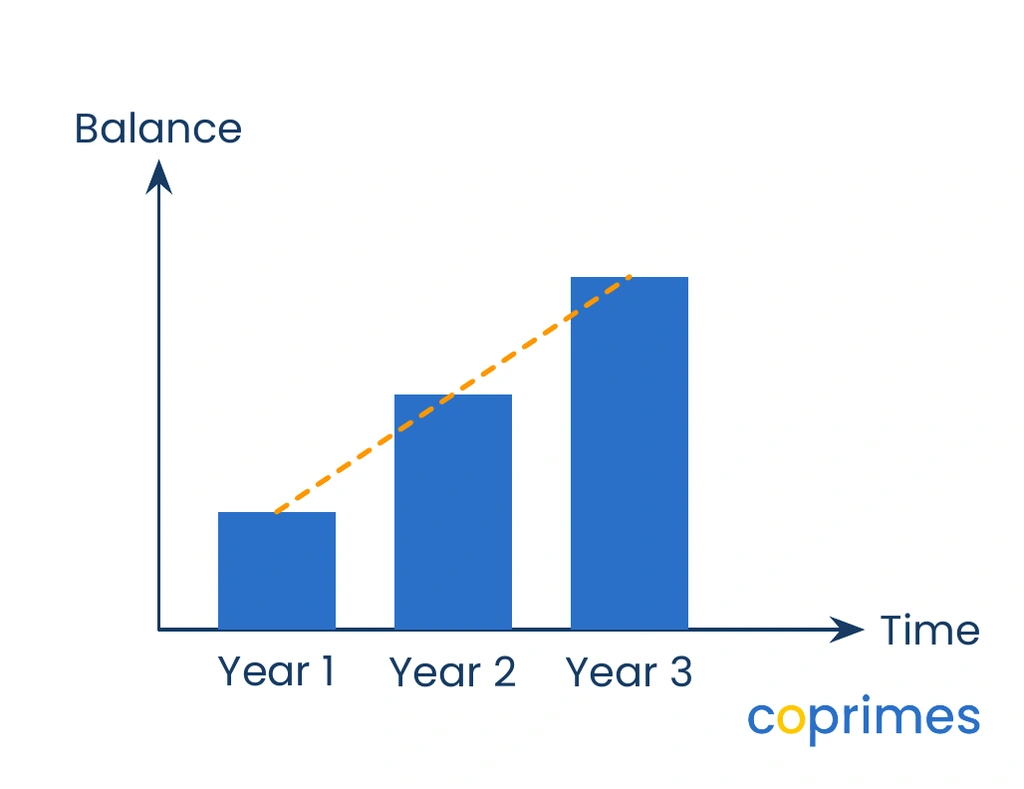
Which type of interest model does the graph represent?
Simple interest, because the balance increases by a constant amount each year.
Compound interest, because the balance continues to grow every year.
Compound interest, because the step size between bars increases.
Neither, because interest graphs must always curve.
Simple interest, because the balance increases by a constant amount each year.
What is the difference in total interest earned between simple interest and compound interest on dollars at per year after exactly one year?
dollars
dollars
dollars
dollars
dollars
A borrower takes out a loan of dollars at per year for years. Why would the borrower prefer simple interest over compound interest?
Because simple interest always calculates a lower initial principal than compound interest.
Because simple interest is only charged on the original principal, resulting in a lower total repayment.
Because simple interest does not charge any interest during the first year of a loan.
Because simple interest allows the borrower to skip payments without penalty.
Because simple interest is only charged on the original principal, resulting in a lower total repayment.
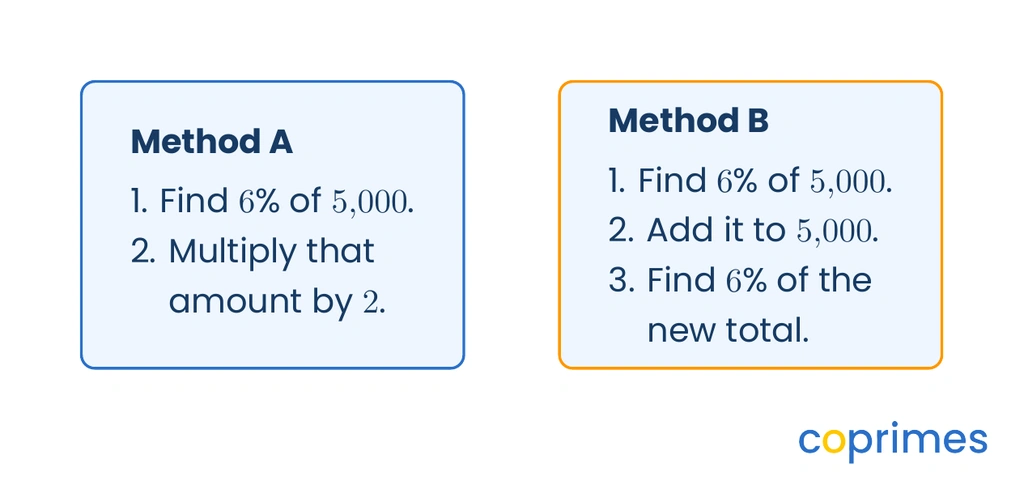
Which statement correctly identifies the methods shown in the diagram for finding interest over years?
Method A is simple interest and Method B is compound interest.
Method A is compound interest and Method B is simple interest.
Both methods calculate compound interest, but Method B is more accurate.
Both methods calculate simple interest, but Method A is faster.
Method A is simple interest and Method B is compound interest.
An investment of dollars earns a annual interest rate. How much more money will the investment earn over years if it is compounded annually instead of using simple interest?
dollars
dollars
dollars
dollars
dollars