
Understanding Compound Interest and Its Formula
Compound interest is calculated on both the original principal and the interest already accumulated in previous periods. For annual compounding, calculate the final amount with when is a decimal, then subtract the principal to find the total interest earned.
Before exploring compound growth, it helps to review basic percentages and standard simple interest.
What is compound interest?
Compound interest is often called "interest on interest." Unlike simple interest, which only calculates growth on the starting amount, compound interest continually calculates growth on a new, larger total at the end of each period.
Calculating the interest on a new total requires finding the percent of a number that includes the previous interest. This means the amount of interest earned grows larger every year, creating a curved, accelerating path rather than a straight line.
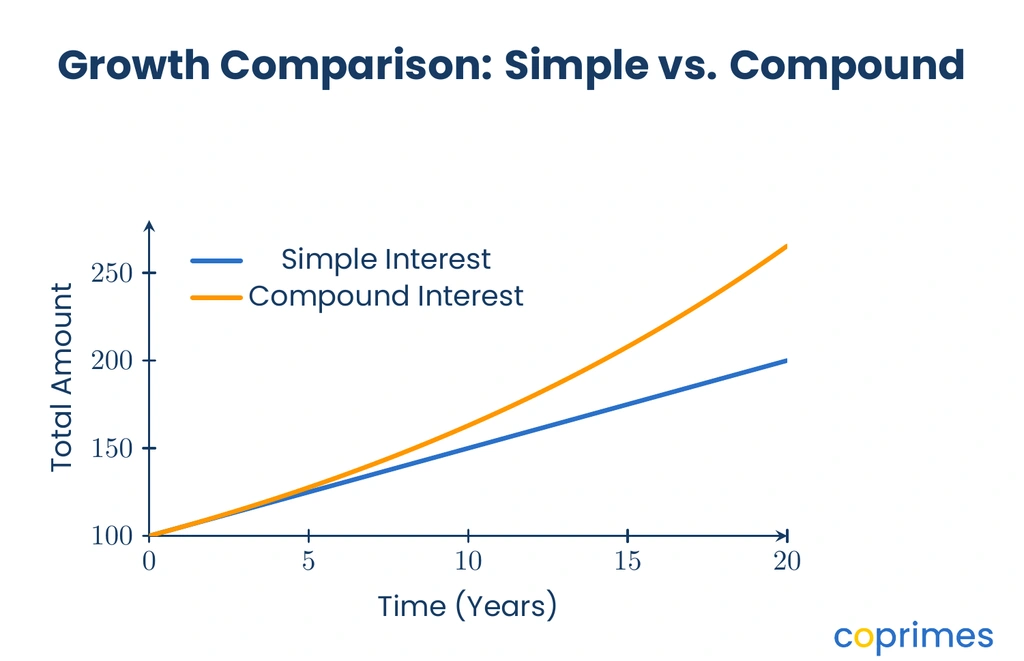
After mastering the basics of this growth model, you can explore the exact mathematical differences in simple interest vs compound interest.
See why the amount compounds
To see why the final amount compounds, track a starting principal of dollars earning interest each year. This compounding effect is a type of consecutive percent change applied to a growing base.
- Year 1: The starting principal is dollars. Ten percent of is . The new total is dollars.
- Year 2: The new starting principal is dollars. Ten percent of is . The new total is dollars.
- Year 3: The starting principal is now dollars. Ten percent of is . The new total is dollars.
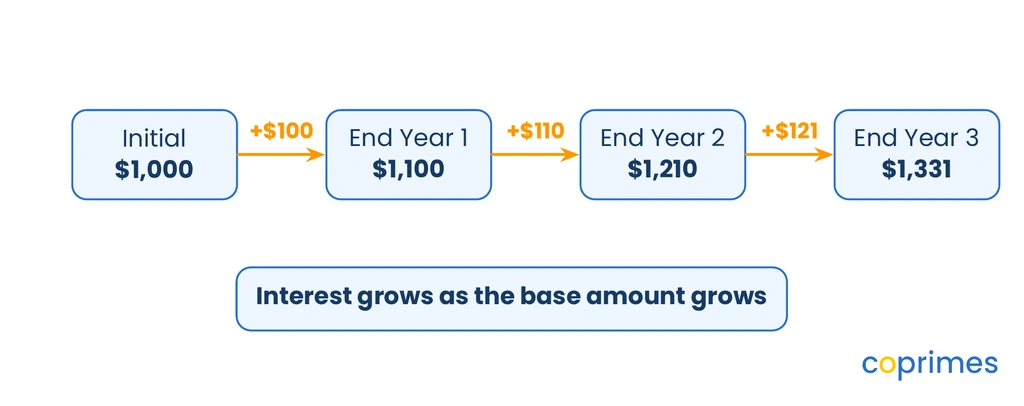
Notice that the interest earned in the third year ( dollars) is larger than the interest earned in the first year ( dollars). Calculating this year by year takes a long time, which is why a formula is used.
Use the compound-interest formula
The standard formula calculates the total final amount directly, rather than calculating the interest for each year separately.
The standard compound interest formula uses an annual rate expressed as a decimal.
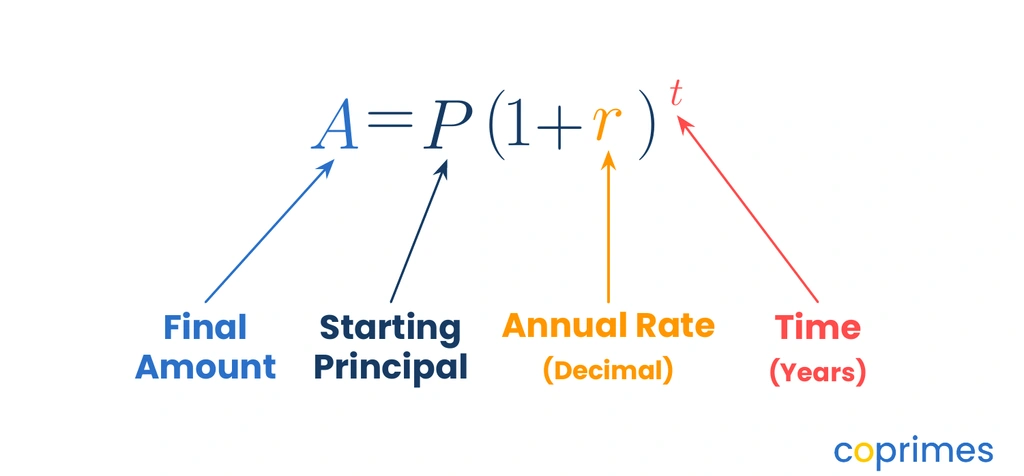
The formula for annual compounding is:
Here is what each variable represents:
- is the final amount, including the original principal and all accumulated interest.
- is the principal, the starting amount of money.
- is the annual interest rate expressed as a decimal, not a whole number.
- is the time the money is invested or borrowed, measured in years.
A learning plan shaped by your child, not the class
State-aligned Math plus our own Logic and English curriculum. An adaptive baseline test finds the gaps and fills them.
Handle compounding frequency
Interest is not always calculated once a year. When interest is added more frequently, you must adjust the formula to account for the number of compounding periods in a single year.
The modified formula is:
The new variable represents the number of times the interest is compounded per year.
- Annually: Compounded once a year, so .
- Semi-annually: Compounded twice a year, so .
- Quarterly: Compounded four times a year, so .
- Monthly: Compounded twelve times a year, so .
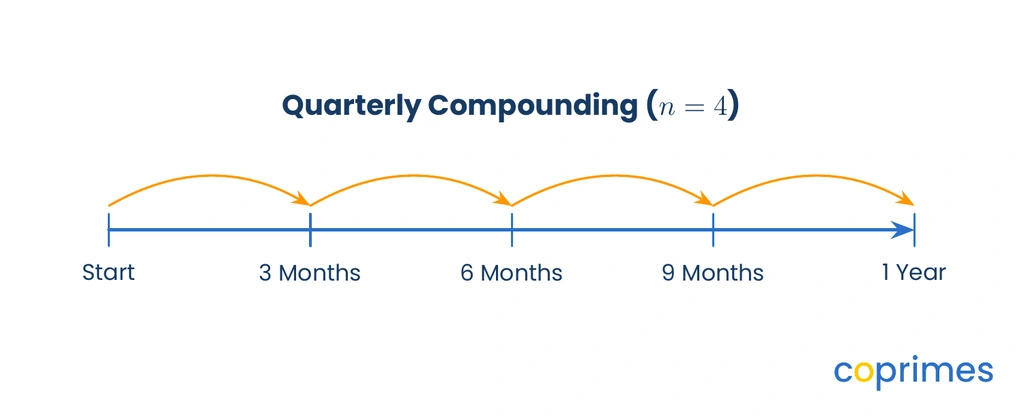
Because interest is applied more often, the total amount grows slightly faster with frequent compounding than with annual compounding at the same interest rate.
Find the interest from the final amount
The standard formula gives you the final amount , which includes the original principal. It does not isolate the interest earned.
To find the amount of compound interest () by itself, subtract the starting principal from the final amount:
You can also write this entirely in terms of the formula:
Always check whether a question asks for the final amount or just the interest earned.
Worked examples
Review these examples to see how the formulas are applied to different compounding frequencies.
Example 1: Calculating annual compound interest
Question: An investment of dollars earns interest compounded annually for years. What is the total compound interest earned?
Method:
- Identify the given values: , , , .
- Substitute the values into the formula to find the final amount:
- Calculate the power and multiply:
- Subtract the principal to find the interest:
Answer: The compound interest earned is dollars.
Check: A simple interest estimate () confirms the answer is reasonable, as compound interest should be slightly higher.
Example 2: Calculating quarterly compounding
Question: What is the final amount if dollars is invested at compounded quarterly for years?
Method:
- Identify the given values: , , (quarterly), .
- Substitute into the frequency formula:
- Simplify the rate per period and the total number of periods:
- Calculate the result:
Answer: The final amount is dollars.
Example 3: Setting up monthly compounding
Question: Write the expression for the final amount when dollars is borrowed at interest compounded monthly for years.
Method:
- Identify the variables: , , (monthly), .
- Substitute them into .
- Simplify the internal fraction and the exponent.
Answer: .

Common mistakes
When applying the formula, avoid these frequent errors:
- Using a whole number instead of a decimal: If the rate is , the value of must be . Using in the formula will calculate a interest rate.
- Forgetting to multiply the exponent by $n$: When interest is compounded monthly for years, the total number of periods is . It is a mistake to leave the exponent as .
- Confusing the final amount with the interest: The formula returns the total balance. If a question asks for the interest, you must subtract the original principal.
Frequently asked questions
Does compound growth apply to things other than money?
Yes. The same mathematical concept models population growth, bacterial reproduction, and radioactive decay. Any system where growth is based on the current size, rather than the starting size, uses a compounding formula.
What happens if the time is not a whole number?
The formula works exactly the same way. If you invest money for years with annual compounding, you substitute directly into the formula.
Is continuous compounding different?
Yes. As the compounding frequency becomes infinitely large, the standard formula shifts to a special continuous compounding formula: , where is a mathematical constant.
Practice questions
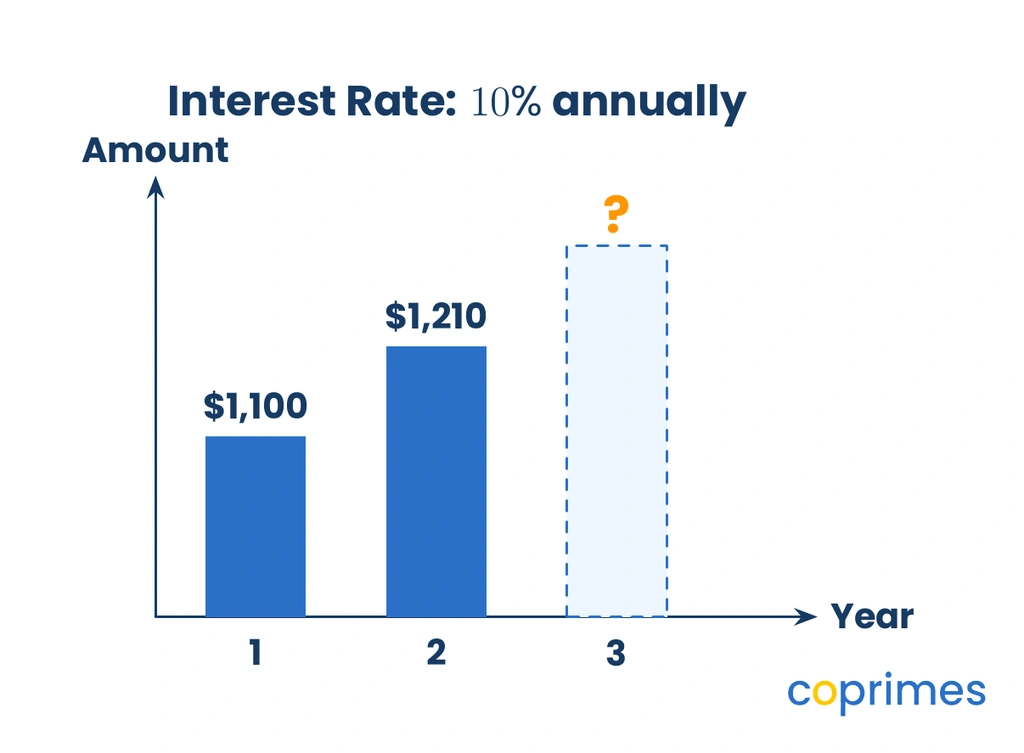
Based on the pattern of annual compound interest shown in the chart, what will the amount be at the end of Year 3?
dollars
dollars
dollars
dollars
dollars
Find the final amount if dollars is invested at compounded annually for years.
dollars
dollars
dollars
dollars
dollars
Find the compound interest earned on dollars at compounded quarterly for year.
dollars
dollars
dollars
dollars
dollars
What is the correct setup to find the final amount when dollars is compounded monthly at for years?
If dollars is invested at for years, how much more interest is earned with compound interest than with simple interest?
dollars
dollars
dollars
dollars
dollars