
Understanding Percentages: Definition, Methods, and Examples
A percentage is a way to express a quantity out of one hundred. For example, percent means out of , which is equal to one quarter and . Percentages provide a standard format to compare fractions and decimal numbers by giving them a common reference point.
A percentage describes a specific part of a whole, dividing that whole into exactly one hundred equal pieces.
What are percentages?
Percentages act as a universal scale for comparing quantities. Because they always use a base of , they make it easy to evaluate proportions that might otherwise be difficult to compare.
Learning how to work with fractions decimals and percentages allows you to express the same mathematical relationship in the format best suited to the problem. Whether analyzing a discount, a test score, or a probability, a percentage tells you exactly how many parts out of one hundred are being considered.
Understand per hundred
The term "percent" translates directly to "for every hundred" or "out of one hundred."
Whenever you see a percentage, you can rewrite it as a fraction with a denominator of . This makes calculating with percentages straightforward. If you have parts out of , you have percent. If you have a complete whole, you have all parts out of , which is percent.
The foundation of every percentage is the ratio of a value to one hundred.
Use the percent symbol
The symbol is placed immediately after a number to indicate a percentage.
Writing is a compact way of writing the fraction or the decimal . The percent symbol mathematically instructs you to divide the preceding number by .
Whenever you need to use a percentage in a calculation, replace the symbol by either placing the number over or moving the decimal point two places to the left.
A learning plan shaped by your child, not the class
State-aligned Math plus our own Logic and English curriculum. An adaptive baseline test finds the gaps and fills them.
Represent percent with grids and fractions
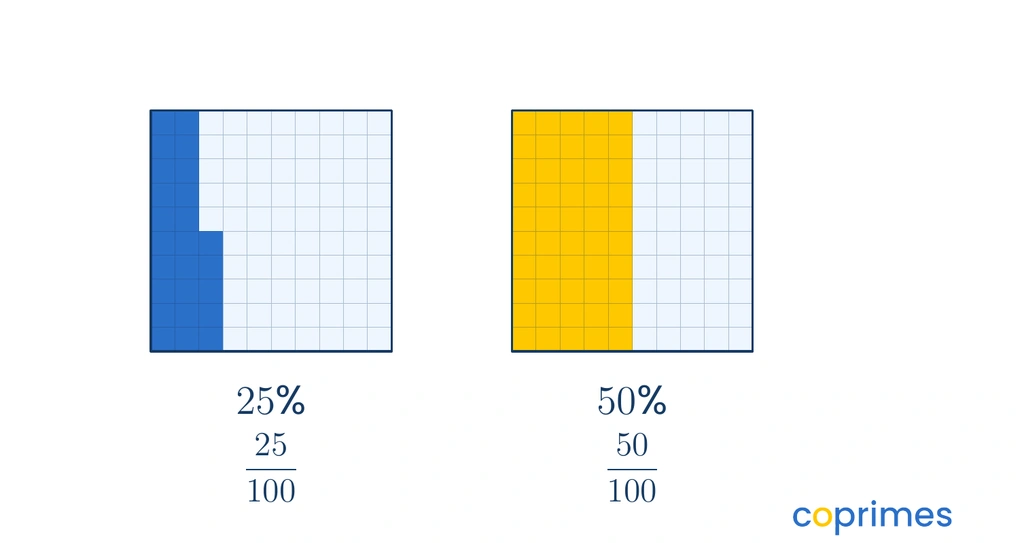
Visual models such as hundred grids and bar models are powerful tools for understanding percentages.
A hundred grid contains exactly small squares. The number of shaded squares directly matches the percentage. You can summarize these relationships in an equivalence table to help with fractions decimals and percents conversion.
Percentage | Fraction | Decimal |
Recognise percentages above 100
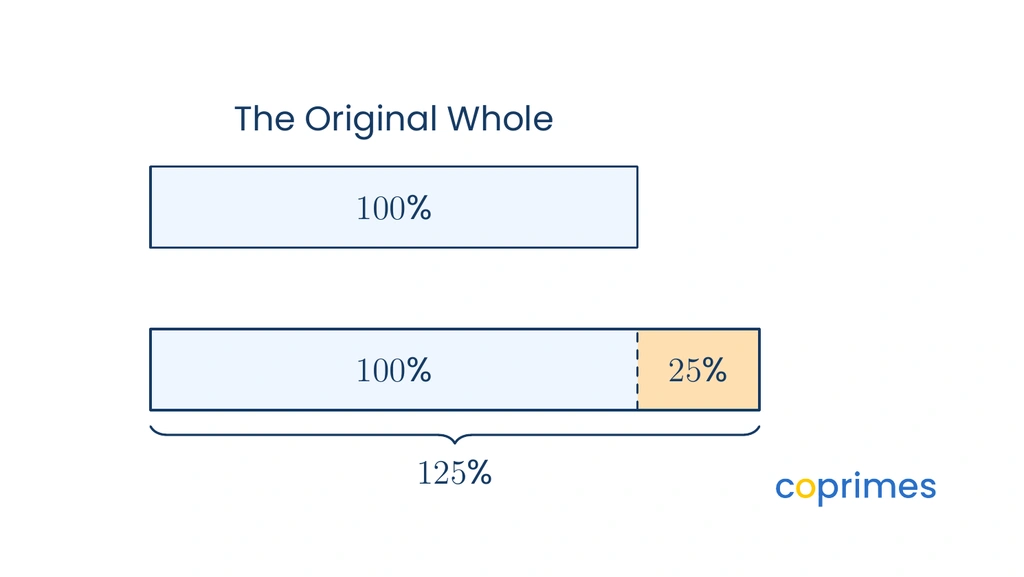
A percentage is not capped at . While represents exactly one complete whole, percentages can exceed when describing a value larger than the original amount.
For example, if an item's cost increases, its new price might be of its original price. This means the new price includes the full original amount () plus an additional portion ().
Worked examples
Applying these methods involves structured steps. Finding a percent of a number is the most common application, followed by calculating increases or working backwards to find original values.
Example 1: Finding the percent of a number
Question: What is of ?
Method:
- Write the percentage as a decimal by dividing by to get .
- Multiply the decimal by the total amount: .
Answer: .
Check: Since of is , is . Half of is , which is . Adding and gives .
Example 2: Calculating a percent increase
Question: A plant measuring grows by . What is its new height?
Method:
- Find of the original height: .
- Add the increase to the original height: .
Answer: The new height is .
Check: You can also multiply the original height by , which represents . Calculating gives .
Example 3: Finding the original amount (reverse percent)
Question: A jacket is on sale for , which is a discount from its original price. What was the original price?
Method:
- Determine the percentage of the original price that the sale price represents. A discount means the jacket costs of its original price.
- Set up the relationship: of the original price equals .
- Find of the original price by dividing by : .
- Multiply by to find the full original price: .
Answer: The original price was .
Check: A discount on is . Subtracting from gives the sale price of .

Common mistakes
When working with percentages, a few errors appear frequently. Being aware of them helps you avoid incorrect calculations.
- Confusing decimals and percentages: It is common to incorrectly convert to . Because percent means "out of one hundred," you must multiply the decimal by . The correct conversion for is .
- Assuming percentages cannot exceed While a probability cannot exceed , growth and price increases often result in values above . An increase of means more than doubling the original amount.
- Forgetting to add or subtract for changes: When a problem asks for a percentage increase, finding the percentage is only the first step. You must add that value to the original amount to find the final total.
Frequently asked questions
What is a percentage?
A percentage is a standardized mathematical way of showing a part of a whole by expressing it as a fraction out of .
How do you find the percent of a number?
Convert the percentage into a decimal by dividing by , or write it as a fraction over . Then, multiply that decimal or fraction by the given number.
What does mean?
A value of means zero parts out of one hundred, which is mathematically equal to . It represents none of the whole amount.
Practice questions
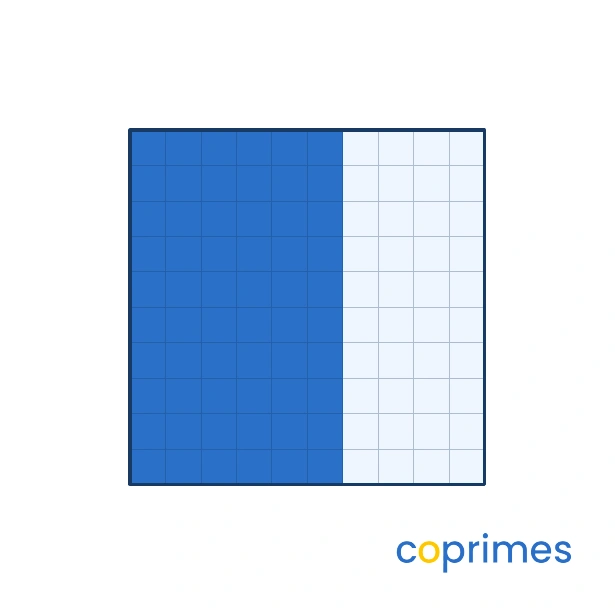
What percentage is represented by the shaded region?
Convert to a percentage.
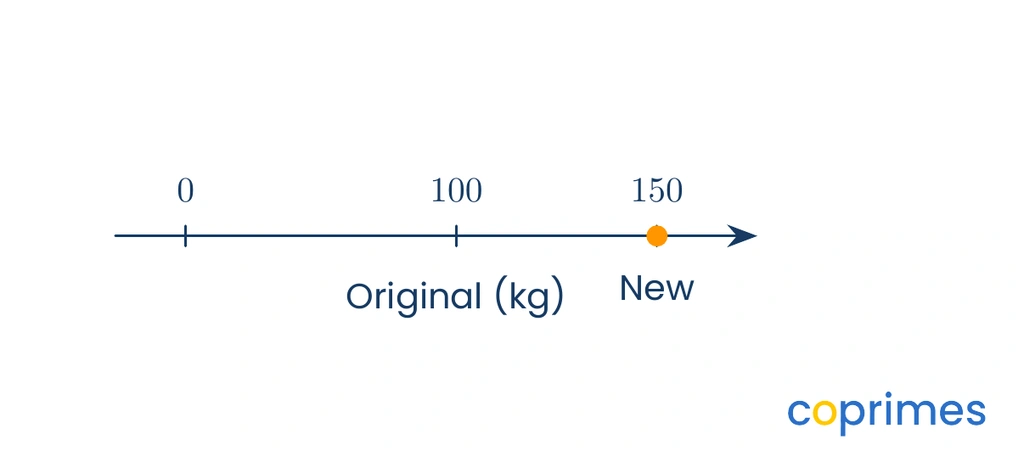
A mass increases from the original value to the new value shown on the number line. What is the percentage increase?
What is of ?
A store marks down a computer by . If the sale price is , what was the original price?