
Types of Numbers: Classification and Sets
Common number types include natural numbers, whole numbers, integers, rational numbers, irrational numbers, and real numbers, organized as nested sets where each successive category expands the mathematical framework available for calculation.
Types of Numbers: Definition and Notation
In mathematics, numbers are classified into structured sets based on their arithmetic properties, representation on the number line, and algebraic behavior.
Understanding these categories begins with natural numbers, which are the counting numbers used in everyday life. As mathematical needs expand—from measuring zero to tracking debts, ratios, and continuous physical distances—each number set builds directly upon the previous set.
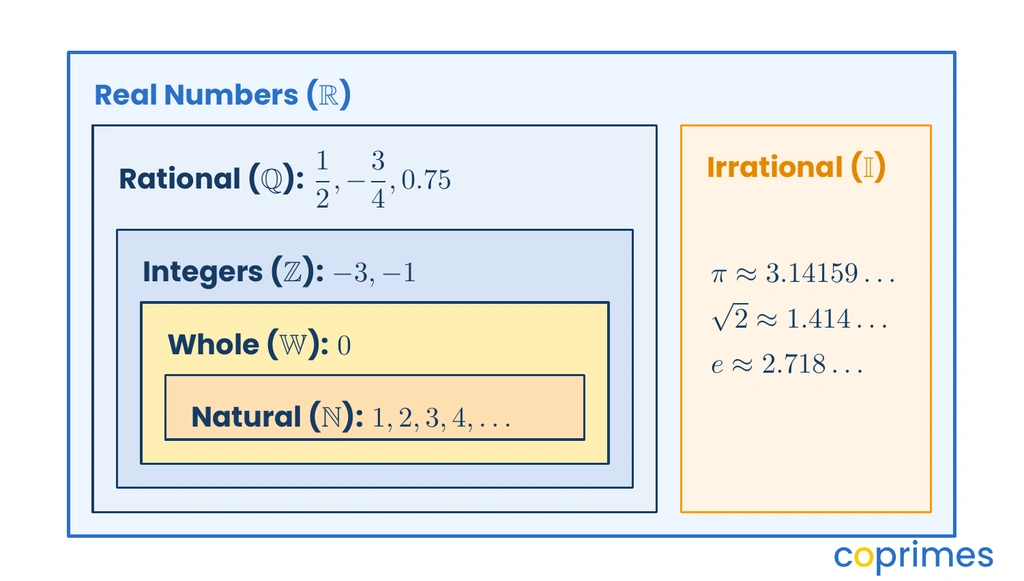
The standard number sets and their standard mathematical symbols are defined as follows:
- Natural Numbers (): Also called counting numbers. The set of positive integers starting from : .
- Whole Numbers (): The set of natural numbers combined with zero: .
- Integers (): The set of whole numbers and their negative opposites: .
- Rational Numbers (): Numbers that can be written as a fraction , where and are integers and . Their decimal forms either terminate (like ) or repeat indefinitely (like ).
- Irrational Numbers (): Numbers that cannot be expressed as a ratio of two integers. Their decimal expansions are non-terminating and non-repeating (like or ).
- Real Numbers (): The complete set formed by combining all rational and irrational numbers, representing every point on a continuous number line.
Rules or Reference Table
When determining which number sets contain a specific value, evaluate the number in its fully simplified form.
Every natural number is also a whole number, an integer, a rational number, and a real number. However, irrational numbers stand completely separate from rational numbers, sharing no elements with them.
Number Set | Symbol | Starting / Defining Rule | Key Examples | Included Subsets |
Natural | Counting integers | None | ||
Whole | Natural numbers zero | Natural () | ||
Integer | Whole numbers negative wholes | Natural (), Whole () | ||
Rational | Expressible as ratio () | Natural, Whole, Integer | ||
Irrational | Non-repeating, non-terminating decimals | None | ||
Real | Union of rational and irrational sets | All numbers above | All real subsets () |
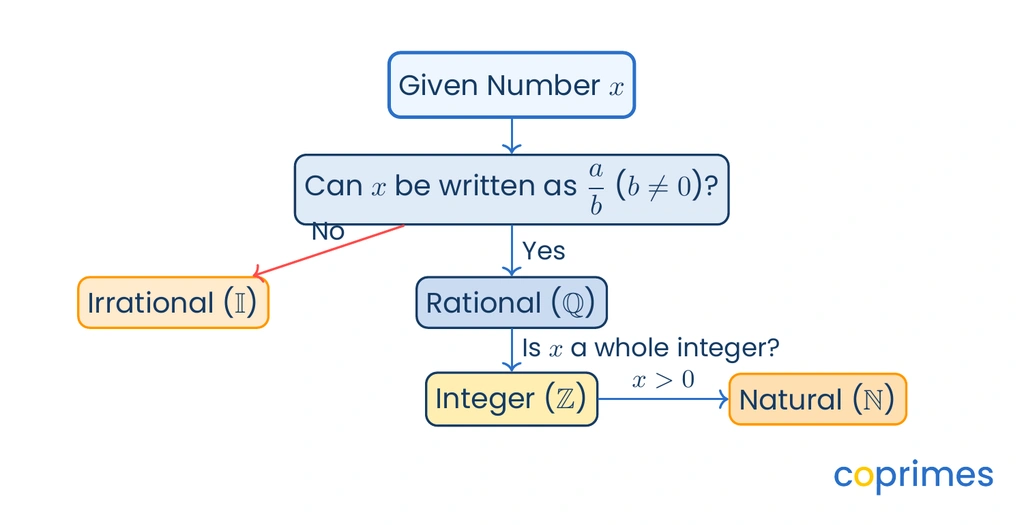
To classify any given number , test its attributes using a step-by-step decision sequence:
- Check if the simplified value contains an imaginary unit (). If not, it is a real number ().
- Check if it can be expressed as a ratio of two integers . If no, it is irrational ().
- If it is rational (), check if the simplified denominator is . If no, it remains strictly rational.
- If it is an integer (), check if . If no, it is an integer.
- If , check if . If , it is a whole number (). If , it is a natural number ().
Why It Works
The hierarchy of number types exists because mathematics required increasingly powerful tools to solve broader equations and represent real-world physical quantities.
Each number set expands the previous set to solve new algebraic operations
Consider how each set solves a limitation of the set before it:
- Natural numbers satisfy basic counting needs (). However, subtracting a quantity from itself () requires introducing zero, leading to whole numbers.
- Whole numbers cannot represent negative outcomes (). Introducing negative opposites creates integers, allowing subtraction across all values.
- Integers cannot measure fair division or parts of a whole (). Defining ratios creates rational numbers, closing the set under division.
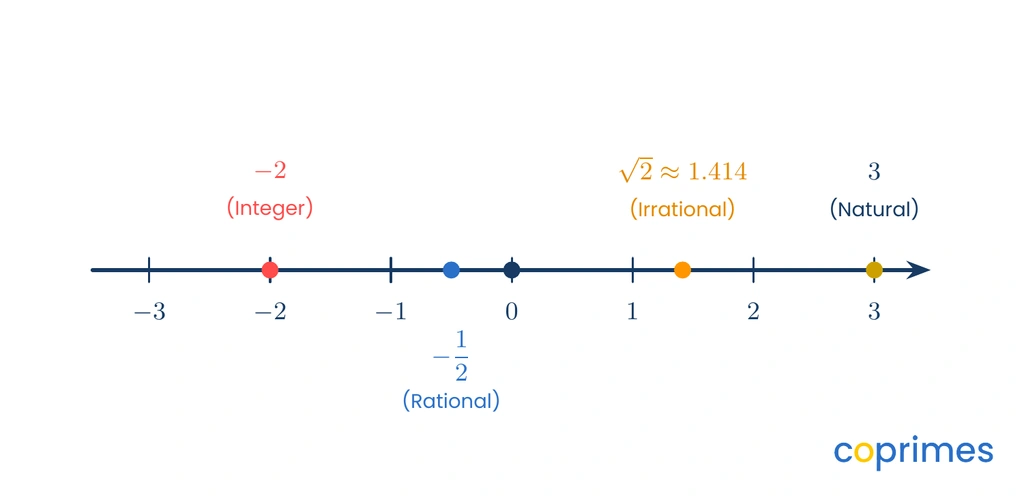
- Rational numbers leave geometric gaps on the number line. For instance, the hypotenuse of a unit right triangle () cannot be written as any integer fraction. Introducing irrational numbers fills every gap, completing the system of real numbers.
A learning plan shaped by your child, not the class
State-aligned Math plus our own Logic and English curriculum. An adaptive baseline test finds the gaps and fills them.
Visual Worked Examples
Example 1: Classifying basic integers and fractions
Question: Determine all number sets to which belongs, and identify its narrowest classification.
Given: The numerical expression .
Method:
- Simplify the fraction by performing integer division.
- Compare the simplified value against the definitions of natural numbers, whole numbers, integers, rational numbers, and real numbers.
- Identify the smallest (narrowest) nested set containing the value.
Answer: The simplified value is . It belongs to the set of integers (), rational numbers (), and real numbers (). Its narrowest classification is the set of integers ().
Check: . Because is a whole negative quantity, it is an integer. Because , it is also a rational number and a real number.
Example 2: Classifying square roots and decimals
Question: Classify the numbers and into their respective narrowest number sets.
Given: Two radical expressions, and .
Method:
- Evaluate or simplify each radical expression.
- Determine whether the resulting value is a whole integer or a non-terminating, non-repeating decimal.
- Assign each number to its narrowest set.
Answer: simplifies to , which is a natural number (). simplifies to , which is an irrational number ().
Check: , so (a positive counting integer). For , is not a perfect square, so its decimal expansion never terminates or repeats.
Example 3: Comprehensive multi-number set identification
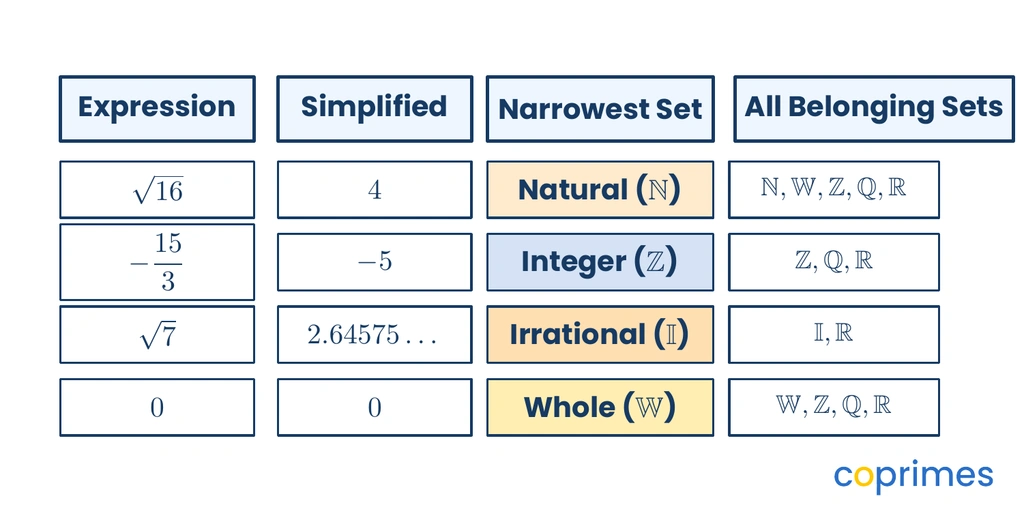
Question: Classify the expressions , , , and into their narrowest and complete set memberships.
Given: A set of four numerical expressions: .
Method:
- Simplify every expression completely:
- Trace each simplified value through the nested set hierarchy to find all valid sets.
Answer:
- : Narrowest set is Natural (). All sets: .
- : Narrowest set is Integer (). All sets: .
- : Narrowest set is Irrational (). All sets: .
- : Narrowest set is Whole (). All sets: .
Check: Verify that every rational number can be written as a ratio of integers and that irrational numbers do not overlap with rational numbers.
Common Mistakes and Exceptions
Learners often encounter specific traps when classifying numbers:
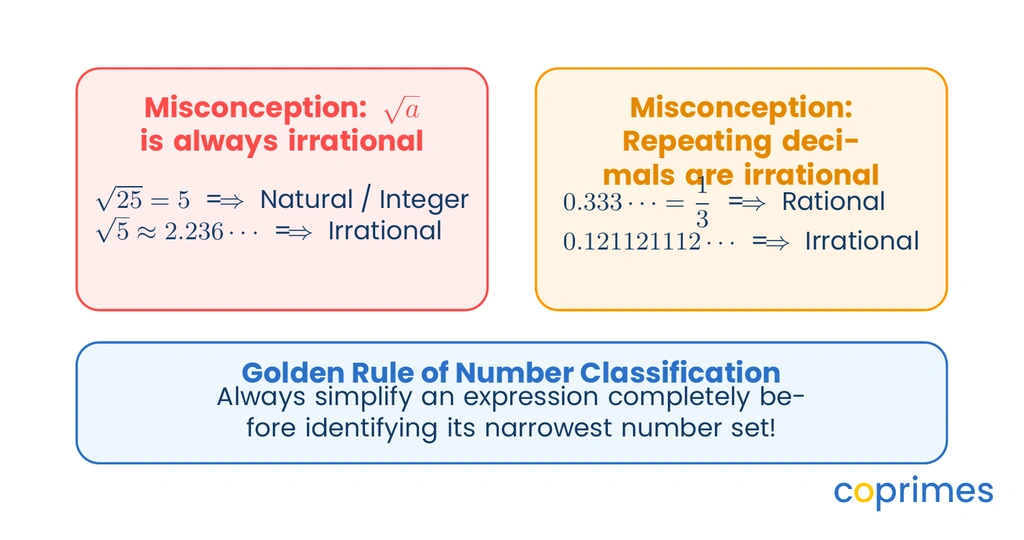
- Unsimplified Expressions: Classifying as irrational simply because it contains a radical symbol. Always simplify first: , which is a natural number.
- Repeating Decimals: Assuming that repeating decimals like are irrational because they go on forever. Because , it is a rational number.
- Confusing Zero's Membership: Forgetting that is a whole number, integer, rational number, and real number, but is not a natural number.
- Negative Fraction Confusion: Assuming is an integer because it contains integers. Integers cannot contain fractional parts.
Always simplify numerical expressions fully before assigning number sets
Another key concept is the algebraic closure property. A number set is "closed" under an operation if performing that operation on elements within the set always yields a result within the same set.
For example, natural numbers are closed under addition (), but are not closed under subtraction ().
Applications
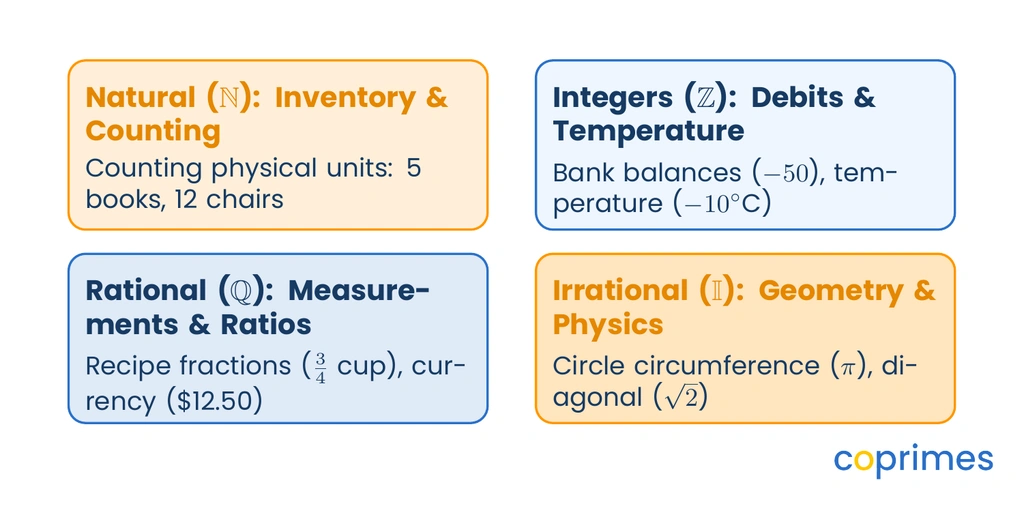
Understanding number classifications is essential across science, computing, finance, and engineering:
- Computer Science & Programming: Software languages define data types based on number sets: unsigned integers represent natural numbers (), signed integers represent integers (), and floating-point types store rational approximations ().
- Accounting & Finance: Financial balance sheets rely on integers to distinguish positive revenue () from negative debts (), while interest calculations use rational decimal percentages.
- Physical Measurement & Construction: Physical measurements require rational numbers for fractional dimensions (such as meter) and irrational numbers like or for calculating circular areas and diagonal structural supports.
- Discrete Mathematics: Algorithms that index items or count steps rely on sequences of consecutive numbers within the set of natural numbers.

Practice questions
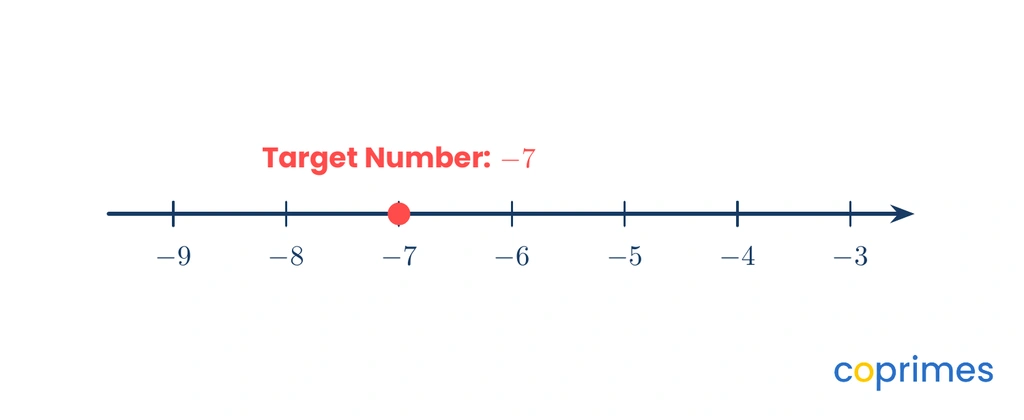
Which is the narrowest number set that contains the target number ?
Natural numbers
Whole numbers
Integers
Irrational numbers
Integers
Which of the following numbers is classified as an irrational number?
Why is classified as a natural number?
It simplifies to , which is a positive counting integer.
Any expression written under a square root symbol is automatically natural.
It is a fraction with a non-zero denominator.
It includes negative values when evaluated under principal radical notation.
It simplifies to , which is a positive counting integer.
Which statement correctly describes the nested relationship between number sets?
Every whole number is an integer, but not every integer is a whole number.
Every rational number is a whole number, but not every whole number is rational.
Irrational numbers contain all negative integers.
Real numbers consist only of integers and natural numbers.
Every whole number is an integer, but not every integer is a whole number.
Consider and . To which narrowest number set does the sum belong?
Natural numbers
Whole numbers
Integers
Irrational numbers
Integers