
Natural Numbers: Sets, Properties, and Examples
Natural numbers are the counting numbers used to quantify objects. Some conventions begin the set at , while others include , so the specific convention must always be stated. Because they represent complete items, they do not include fractions, decimals, or negative values.
What Are Natural Numbers?
Natural numbers are the positive integers we use to count things in the real world.
When asking what is natural numbers, it helps to think of them as the most basic numbers learned in early mathematics. The natural number set is typically represented by the letter .
Depending on the region or mathematical context, the set of natural numbers is written in one of two ways. The most common convention starts at :
Some mathematical conventions include as the first counting number:
Here are some natural numbers examples: , , , and . Values such as or are never natural numbers because they represent negative quantities or parts of a whole.
Key Ideas and Vocabulary
The natural number system is organized into specific types and follows predictable mathematical properties.
Numbers can be grouped into even and odd numbers. Even numbers are divisible by without a remainder, while odd numbers leave a remainder of . Natural numbers are also classified as prime or composite, depending on how many distinct factors they have.
There are four essential properties that natural numbers follow:
- Closure Property: When applying the closure property to addition and multiplication, the result is always another natural number. For example, . This property does not always hold for subtraction or division.
- Commutative Property: The order of values does not change the result in addition and multiplication. For example, .
- Associative Property: Grouping values differently does not change the sum or product. For example, .
- Distributive Property: Multiplying a sum by a number gives the same result as multiplying each addend separately and adding the products. For example, .
Visual Explanation
Visual models illustrate how natural numbers are positioned on a number line and how they relate to other mathematical sets.
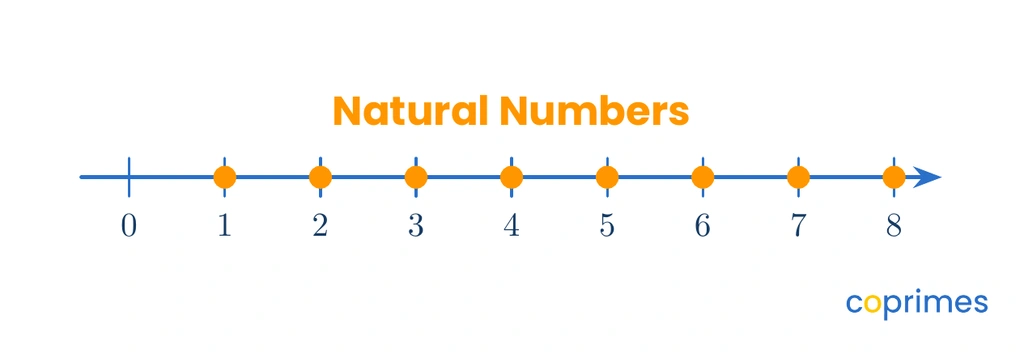
A number line provides a clear way to see natural numbers. When we start counting from , every subsequent natural number is spaced equally, representing an increase by exactly one unit.
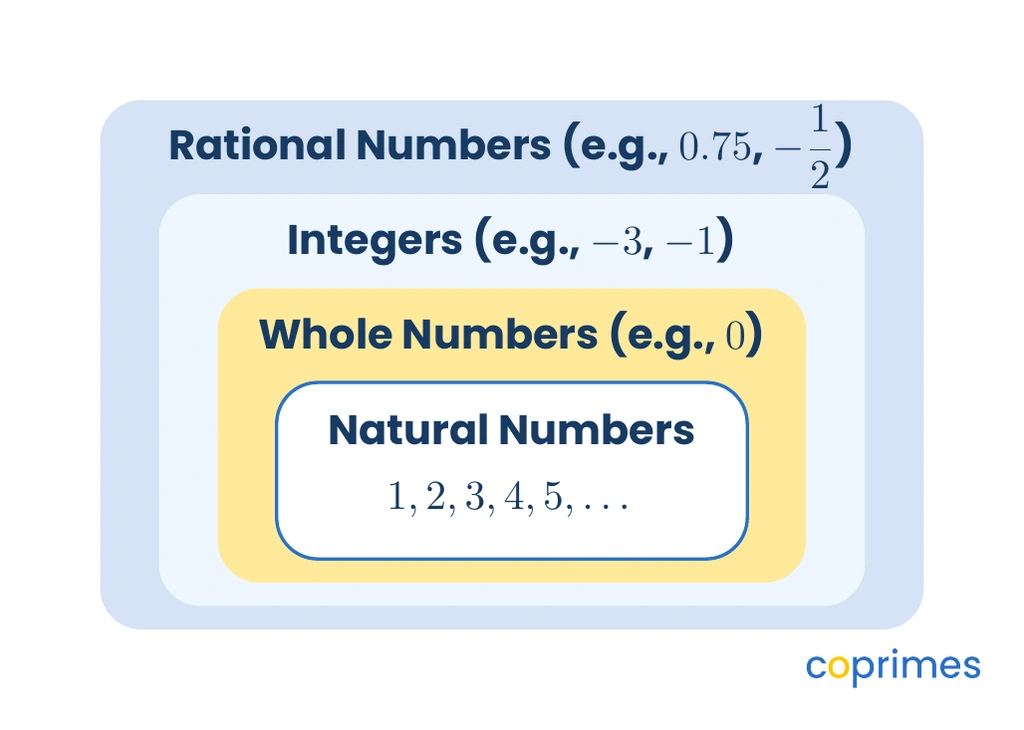
Understanding types of numbers becomes easier when we compare their sets. Natural numbers are a subset nested entirely inside the whole numbers, which in turn are part of the integers and rational numbers.

Worked Examples
Practicing with different properties and set notations builds a stronger understanding of natural numbers.
Example 1: Identifying a natural number
Question: Is or a natural number?
Method:
- Define natural numbers: they are positive counting numbers.
- Evaluate the first value: is a negative integer, so it is not a natural number.
- Simplify the second value: .
- Check the simplified value: is a positive counting number.
Answer: The value is not a natural number, but is a natural number.
Check: A fraction that simplifies to a positive integer belongs to the natural number set.
Example 2: Applying mathematical properties
Question: Which property is demonstrated by ?
Method:
- Observe the operation. Only addition is used.
- Check the order of the numbers. The sequence remains unchanged.
- Look at the grouping. The parentheses shift from the first pair of numbers to the second pair.
- Recall the property rules. Grouping numbers differently without changing their sequence demonstrates the associative property.
Answer: This demonstrates the associative property of addition.
Check: Calculate both sides to verify equality. and .
Example 3: Checking the closure property
Question: Is the set of natural numbers closed under the subtraction problem ?
Method:
- Identify the two starting numbers. Both and are natural numbers.
- Perform the operation: .
- Check the result. The answer is a negative integer, not a natural number.
- Compare against the rule. The closure property states that an operation on two natural numbers must result in a natural number.
Answer: No, the natural numbers are not closed under subtraction because the result is not a natural number.
Check: This single counterexample proves that subtraction does not satisfy the closure property for natural numbers.
Common Mistakes and Non-Examples
Recognizing what is not a natural number is just as important as knowing what is.
A frequent question is, is zero a natural number?
The answer depends entirely on the mathematical convention being used. In many strict definitions, natural numbers begin at , meaning zero is excluded. When zero is included, it is often to ensure the set represents all non-negative whole quantities.
Always check which rule your course follows.
Another common mistake is thinking all integers are natural numbers. While natural numbers are part of the integer family, negative integers like and are excluded.
Finally, do not assume that fractions and decimals are natural numbers. Numbers such as or represent parts of a whole. Since natural numbers are used for counting complete items, they can never include fractional parts.
Real-World Connections
Natural numbers are the most practical numbers in daily life because they are used for counting items, organizing data, and indicating sequences.
When you count the number of books on a shelf or students in a classroom, you are using natural numbers to represent a quantity. In this context, they act as cardinal numbers.
Natural numbers are also used for ordering. When athletes finish a race, they are ranked in st, nd, and rd place. Here, natural numbers act as ordinal numbers, providing a clear and organized sequence.
A learning plan shaped by your child, not the class
State-aligned Math plus our own Logic and English curriculum. An adaptive baseline test finds the gaps and fills them.
Practice questions
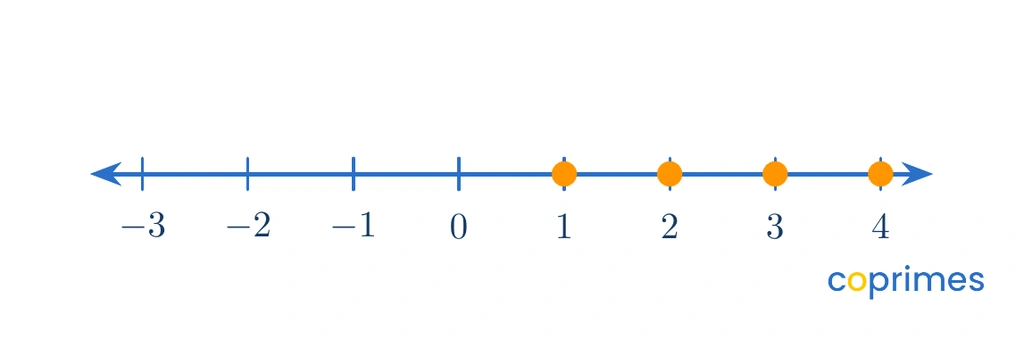
Which set of numbers is highlighted on the number line?
Natural numbers
Negative integers
All integers
Fractional numbers
Natural numbers
Which of the following values is a natural number?
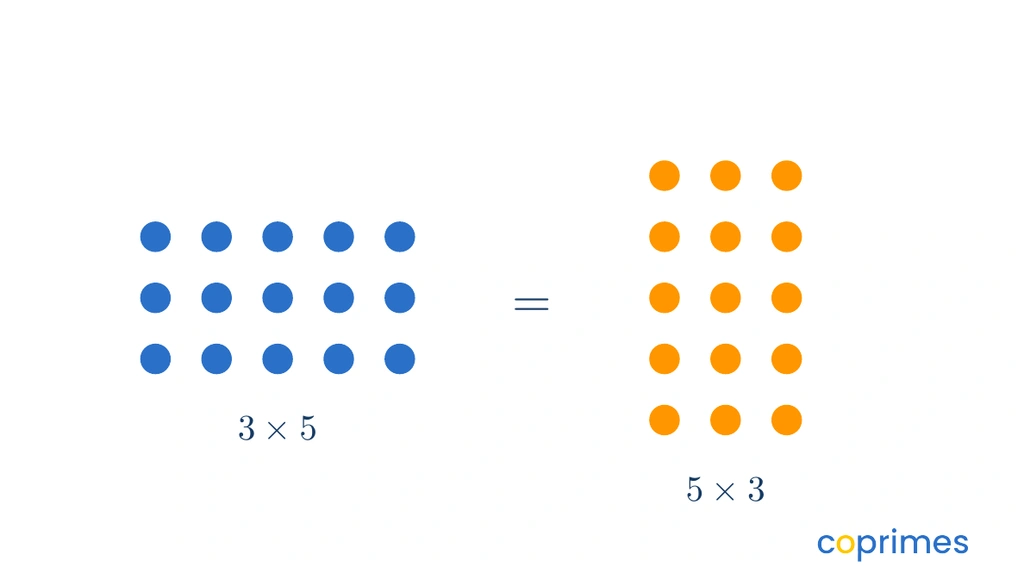
Which property of natural numbers is represented by the visual?
Distributive property
Associative property
Closure property
Commutative property
Commutative property
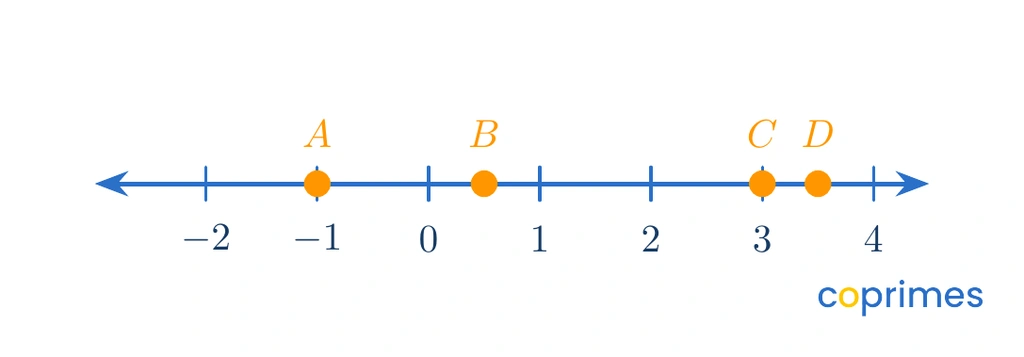
A student plotted four values labeled , , , and on the number line. Which plotted point represents a natural number?
Point
Point
Point
Point
Point
When applying the distributive property to the expression , which equivalent expression is correct?