
Writing Ratios: Notation, Methods and Examples
Write a ratio by naming the quantities in the requested order and separating them with a colon, such as , which is read as " to ". The exact same relationship can also be expressed in words or as a fraction, but the labels and order must always stay clear.
A ratio compares two or more quantities of the same kind. Mastering writing ratios allows us to communicate proportional relationships accurately in mathematics, everyday recipes, and scaled maps.
What is ratio notation?
Ratio notation is the mathematical way to express how much of one quantity there is compared to another. It uses specific formatting to make comparisons clear without writing full sentences.
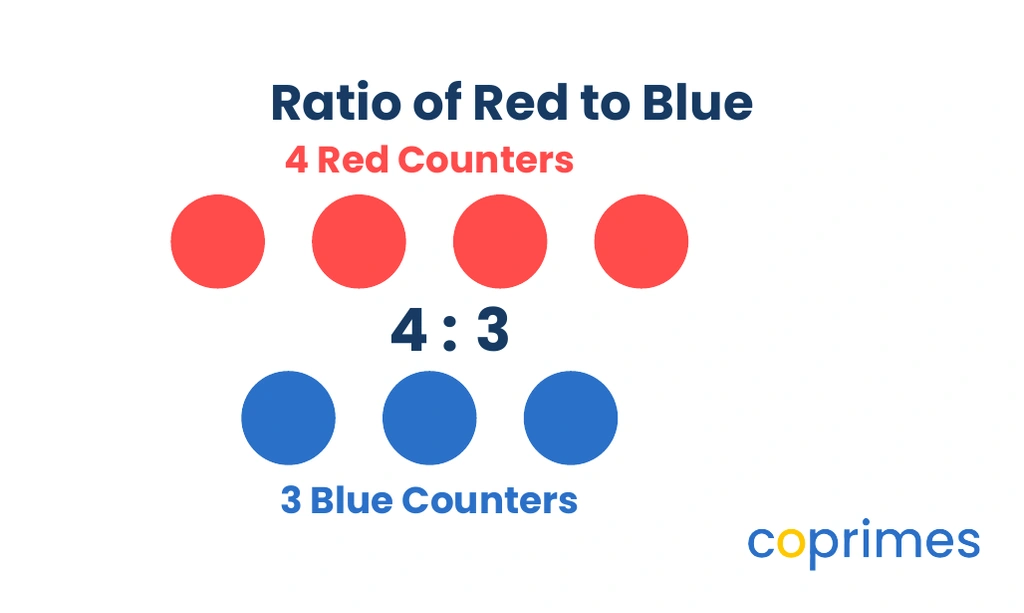
When describing a relationship, the notation acts as a mathematical shorthand. Instead of saying "there are four red counters for every three blue counters," we write the numerical comparison directly.
Name quantities in the requested order
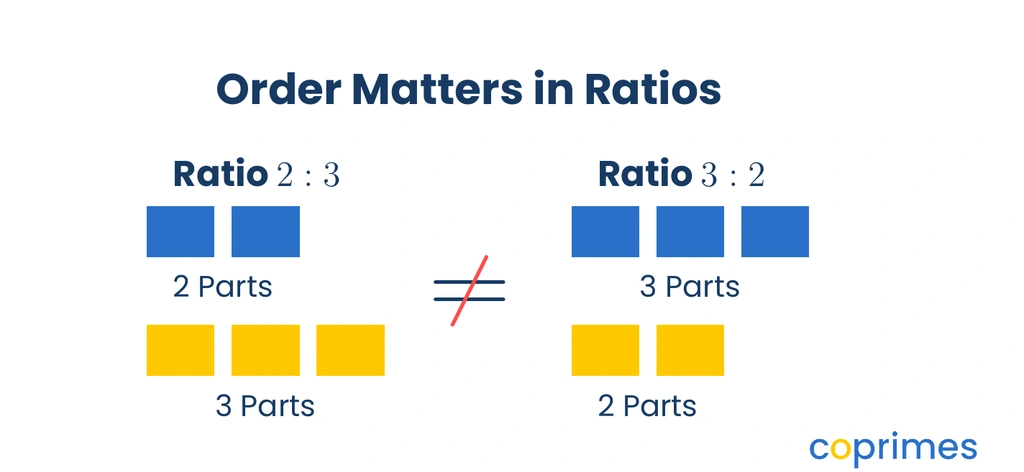
The sequence of the numbers in a ratio must exactly match the sequence of the items requested. Reversing the numbers describes a completely different relationship.
The order of the values in a ratio is not interchangeable.
If a bowl has apples and oranges, the ratio of apples to oranges is . Writing would incorrectly mean there are apples and oranges. Always read the problem carefully to identify the requested order before writing the numbers.
Write ratios with words, a colon and a fraction
There are three standard ways to write a ratio comparing a value to a value . All three forms represent the exact same mathematical relationship.
- Word form: to
- Colon notation:
- Fraction form:
These fractions behave mathematically like division. Fraction form is typically used when comparing a part to a whole, but it is also widely used in algebra for part-to-part comparisons.
A learning plan shaped by your child, not the class
State-aligned Math plus our own Logic and English curriculum. An adaptive baseline test finds the gaps and fills them.
Use labels and units correctly
When comparing measurements, the units must be identical before writing the ratio. If one length is given in centimeters and another is given in meters, convert them to the same unit first.
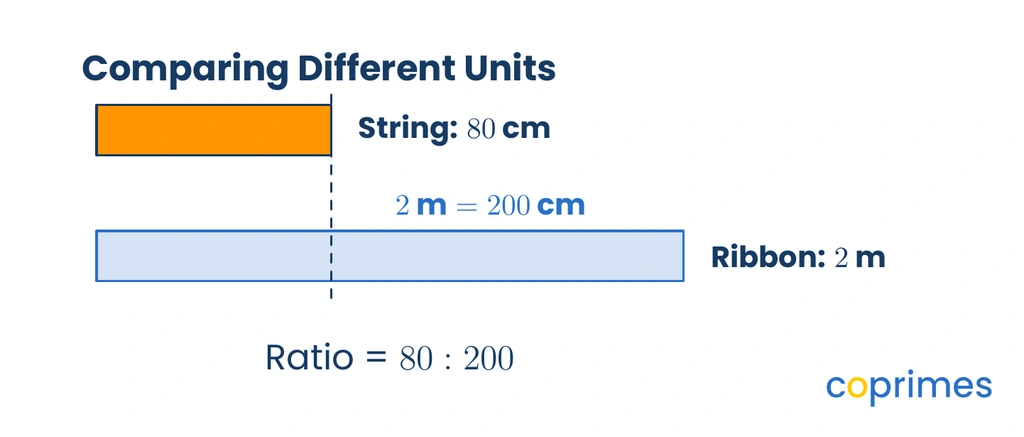
Ratios themselves do not have units. Because a ratio compares quantities of the exact same unit, the units mathematically cancel each other out during the comparison, leaving a pure relative size.
Simplify a written ratio
Ratios are usually written in their simplest form to make the relationship as clear as possible. To simplify a ratio, find the greatest common factor of both numbers and divide each side by that factor.
For an in-depth look at this procedure, explore simplifying ratios.
Worked examples
Here are three examples demonstrating how to write and simplify ratios correctly.
Example 1: Labelled counters
Question: A box contains red counters and yellow counters. Write the ratio of red counters to yellow counters in three different ways.
Method:
- Identify the requested order: red then yellow.
- Count the red counters () and yellow counters ().
- Write the ratio using words, a colon, and a fraction.
Answer: The ratio is to , , or .
Check: The visual order correctly matches the word order requested.
Example 2: Recipe amounts
Question: A pancake recipe uses cups of milk and cups of flour. Write the simplified ratio of milk to flour.
Method:
- Identify the order: milk to flour.
- Write the initial ratio: .
- Divide both numbers by their greatest common factor, which is .
Answer: The simplified ratio is .
Check: and . The proportion is maintained.
Example 3: Lengths with unit conversion
Question: A string is long and a ribbon is long. What is the simplified ratio of the string's length to the ribbon's length?
Method:
- Identify the different units: centimeters and meters.
- Convert meters to centimeters so the units match: .
- Write the initial ratio in the requested order: .
- Simplify by dividing both numbers by their greatest common factor, which is .
Answer: The simplified ratio is .
Check: and . The simplified ratio accurately scales back to the original measurements.

Common mistakes
The most common error is assuming the order of a ratio does not matter. Reversing the order describes a completely different situation.
Another frequent mistake is failing to convert units before comparing quantities. If you compare directly to as , the mathematical relationship will be completely wrong. Always convert to identical units first.
Frequently asked questions
What is a part-to-part ratio compared to a part-to-whole ratio?
A part-to-part ratio compares two distinct groups, like cars to trucks. A part-to-whole ratio compares one group to the total, like cars to all vehicles. Learn more about part-to-part and part-to-whole ratios.
Can a ratio have three numbers?
Yes. If a recipe calls for parts sugar, parts flour, and part butter, the ratio is written as . Fraction form is generally not used for ratios with three or more parts.
Why does a ratio have no units?
Because a ratio compares quantities of the exact same unit, the units mathematically cancel each other out. The final ratio represents a pure multiplier rather than a physical measurement.
Practice questions

What is the ratio of circles to triangles?
A bag contains green marbles and purple marbles. How is the ratio of green marbles to purple marbles written as a fraction?
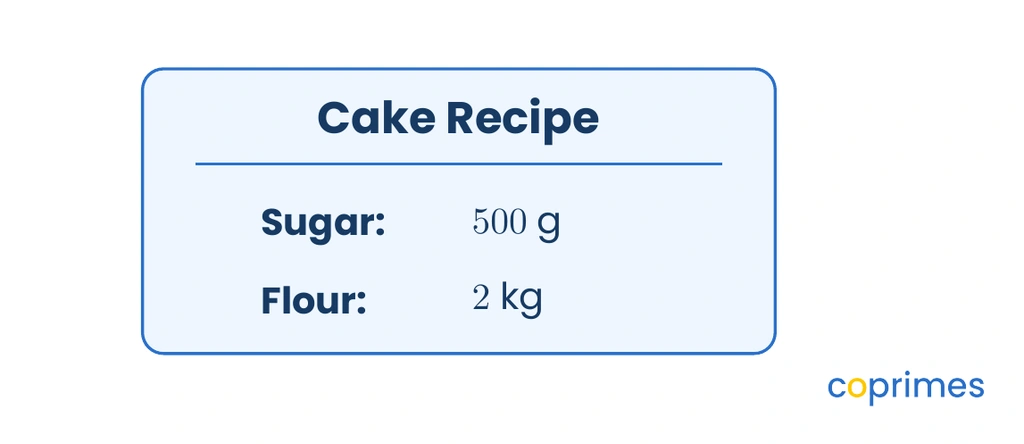
What is the simplified ratio of sugar to flour?
A student incorrectly writes the ratio of cats to dogs as . Which statement best explains this error?
The student reversed the order and simplified the ratio of dogs to cats.
The student wrote the ratio of dogs to the total number of animals.
The student divided by the wrong common factor when simplifying the numbers.
The student wrote the ratio of cats to the total number of animals.
The student reversed the order and simplified the ratio of dogs to cats.
A class has students and of them are girls. What is the simplified ratio of boys to girls?