
Part-to-Part and Part-to-Whole Ratios: Definition, Method and Examples
A part-to-part ratio compares one group with another group, while a part-to-whole ratio compares one group with the total of all groups. Read the words carefully when solving problems, because the second ratio term changes when the whole is involved.
What are part-to-part and part-to-whole ratios?
A ratio describes the quantitative relationship between two or more amounts. These relationships can compare separate groups to each other, or they can compare one specific group to the entire collection.
A part-to-part ratio compares the size of one specific category to the size of another distinct category within the same set. For example, in a bowl of fruit, comparing the number of apples to the number of oranges is a part-to-part comparison.
A part-to-whole ratio compares the size of one specific category to the total size of all categories combined. In the same bowl of fruit, comparing the number of apples to the total pieces of fruit is a part-to-whole comparison.
Find the whole
To write a part-to-whole relationship, you often need to calculate the total amount first. If you are only given the sizes of the individual parts, you can find the whole by adding all the separate parts together.
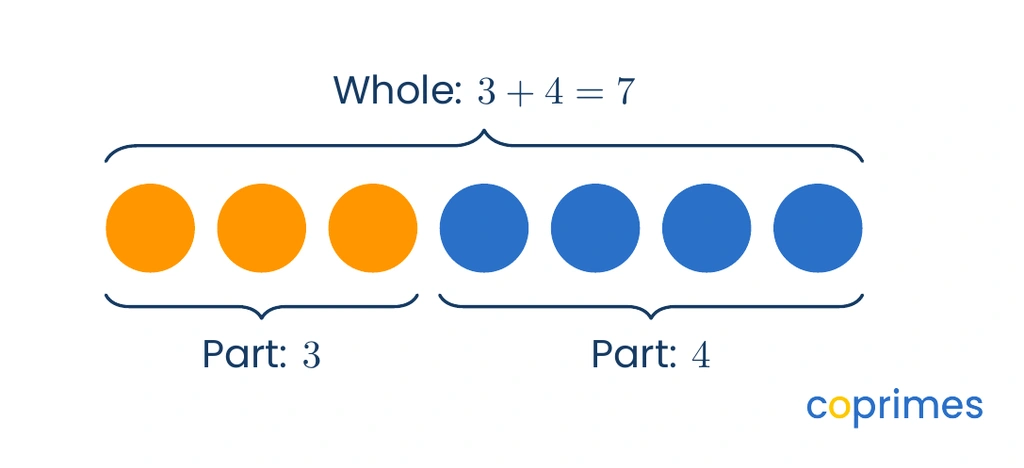
When writing ratios, always identify whether the problem provides the total or if you need to calculate it. If a team has defenders and attackers, the parts are and . The whole is their sum, which is .
The whole is always the sum of all the individual parts.
Represent both ratio types with a model
Visualizing relationships helps clarify what is being compared. Using bar models or tape diagrams is an effective way to see the relationship between the parts and the whole simultaneously.
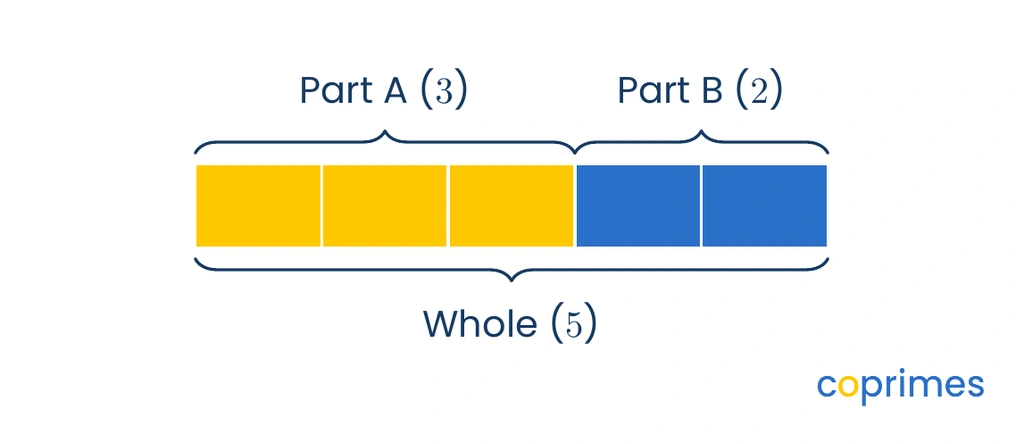
In this model, the part-to-part ratio of yellow blocks to blue blocks is . The part-to-whole ratio of yellow blocks to the total number of blocks is .
Notice that the same set of items generates different ratios depending on which relationships you choose to describe.

Connect ratios and fractions carefully
Ratios and fractions are closely related, but they are not always interchangeable. A fraction naturally represents a part-to-whole relationship, where the numerator is the part and the denominator is the total.
A part-to-whole ratio like can be written directly as the fraction . This means out of every items belong to that specific part.
However, a part-to-part ratio cannot be written as a fraction of the whole without recalculating. If the ratio of cats to dogs is , the fraction of cats in the whole group is not . The whole is , so the correct fraction of cats is .
A part-to-part ratio does not directly represent a fraction of the whole.
Choose the requested comparison
Word problems will often provide one type of ratio but ask for another. You must read the wording carefully to determine which numbers to use in your final answer.
If a question states, "For every winning tickets, there are losing tickets," it has provided a part-to-part ratio of . If the question then asks for the ratio of winning tickets to total tickets, you must switch to a part-to-whole comparison.
Calculating the whole () allows you to form the new ratio of . You can then scale this up or down to find equivalent ratios if the problem involves a larger total number of tickets.
Worked examples
Review these examples to see how to extract the correct numbers for each type of ratio.
Example 1: Using two-colour counters
Question: A group of counters contains yellow counters and blue counters. What is the ratio of blue counters to the total number of counters?
Method:
- Identify the requested comparison. The question asks for "blue counters" (a part) to "total counters" (the whole).
- Count or identify the specific part. There are blue counters.
- Calculate the whole by adding the parts. The total is .
- Write the ratio of the part to the whole.
Answer: The ratio of blue counters to total counters is .
Check: The parts ( and ) add up to the whole (), confirming the logic.
Example 2: Converting a fraction to a part-to-part ratio
Question: In a fish tank, of the fish are tetras, and the rest are guppies. What is the ratio of tetras to guppies?
Method:
- Identify the meaning of the fraction. The fraction is a part-to-whole relationship where the part (tetras) is and the whole is .
- Find the missing part (guppies). Subtract the known part from the whole: .
- Write the requested part-to-part ratio. The ratio of tetras to guppies is .
Answer: The ratio of tetras to guppies is .
Check: The parts are and . Their sum is , which matches the denominator of the original fraction.
A learning plan shaped by your child, not the class
State-aligned Math plus our own Logic and English curriculum. An adaptive baseline test finds the gaps and fills them.
Common mistakes
When working with ratios, watch out for these frequent errors.
Using a part-to-part ratio as a fraction
Writing the ratio of cars to trucks () as the fraction to represent the portion of vehicles that are cars is incorrect. The total number of vehicles is . The correct fraction of cars is .
Mixing up the order of the ratio
Order matters. If a question asks for the ratio of girls to boys, writing the number of boys first makes the ratio incorrect. Always match the order of the numbers to the order of the words in the question.
Forgetting to add the parts
When asked for a total but only given the parts, some learners mistakenly use one of the parts as the whole. Always verify if the total has been explicitly given or if it needs to be calculated.
Frequently asked questions
Can a ratio compare more than two parts?
Yes. A part-to-part ratio can compare multiple groups, such as a recipe calling for flour, sugar, and butter in a ratio of . To find the whole, you simply add all the parts together
().
Are proportions used for both types of ratios?
Yes. You can set up a proportion using equivalent ratios regardless of whether they are part-to-part or part-to-whole, as long as you are consistent on both sides of the equals sign.
Is a fraction always a ratio?
Yes, a fraction is a specific type of ratio (part-to-whole) that represents a division relationship. However, not all ratios are best written as fractions, especially part-to-part ratios.
Practice questions

What is the part-to-whole ratio of triangles to all shapes?
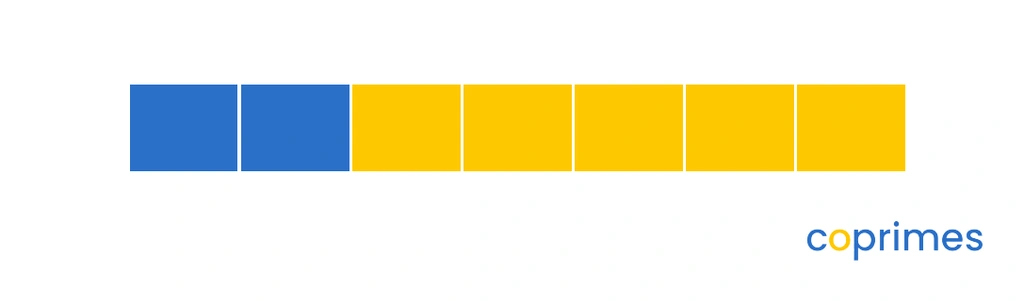
A box contains blue and yellow blocks in a ratio of . What fraction of the blocks are blue?
Which of the following statements describes a part-to-part ratio?
Comparing the number of vowels to the total letters in a word.
Comparing the number of left-handed students to right-handed students.
Comparing the volume of juice to the total volume of a drink.
Comparing the number of correct answers to the total questions on a test.
Comparing the number of left-handed students to right-handed students.

What is the ratio of unshaded squares to shaded squares?
A mixture uses litres of blue paint for every litre of white paint. If you need litres of the mixture in total, how many litres of white paint do you need?
litre
litres
litres
litres
litres