
Addends and Sum: Understanding the Parts of Addition
In mathematics, a sum is the total result when two or more numbers are added together. The numbers being added to create this total are called addends. Understanding what is a sum in math and what are addends helps you write mathematical sentences correctly and solve missing-number puzzles. By learning the parts of an addition equation, you build a strong foundation for all basic arithmetic.
What are addends and the sum?
When you combine two groups of items into one large group, you perform addition. The numerical values representing the groups you start with are the addends. The final total you get after combining them is the sum.
Addends are the numbers being added, and the sum is the result.
Every addition problem must have at least two addends, but it can have many more. Whether you add two numbers or ten numbers, the final answer is always called the sum.
Parts of an addition sentence
An addition sentence is a mathematical equation that shows how parts combine to make a whole. It includes the addition terms, a plus sign, and an equal sign.
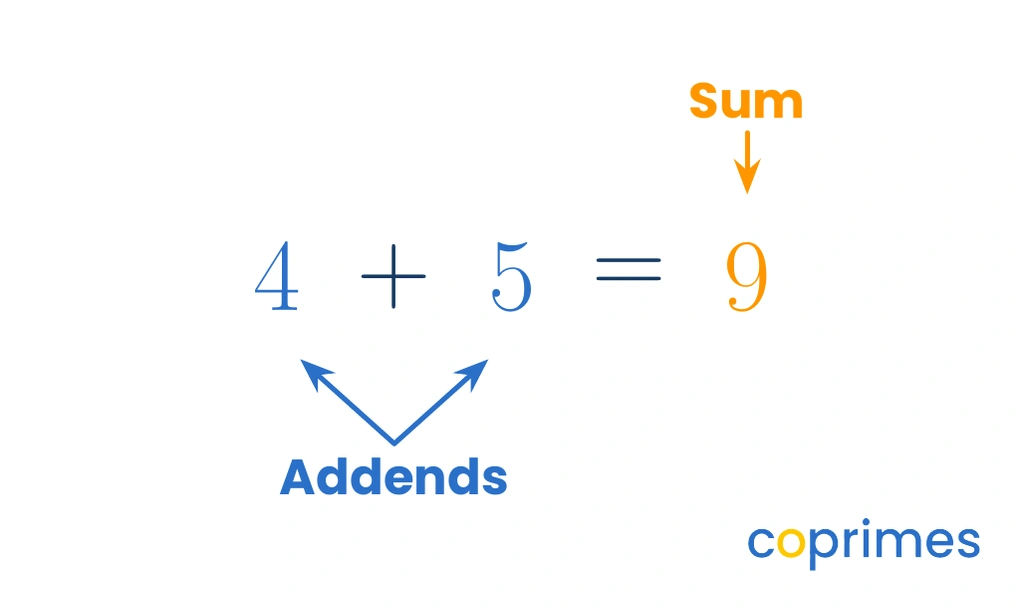
In a horizontal sentence like , the plus sign separates the addends. The equal sign shows that the total value on the left is the same as the sum on the right.
Addition can also be written vertically. When written in a column, the parts of addition remain the same, but they are stacked to make adding large numbers easier.
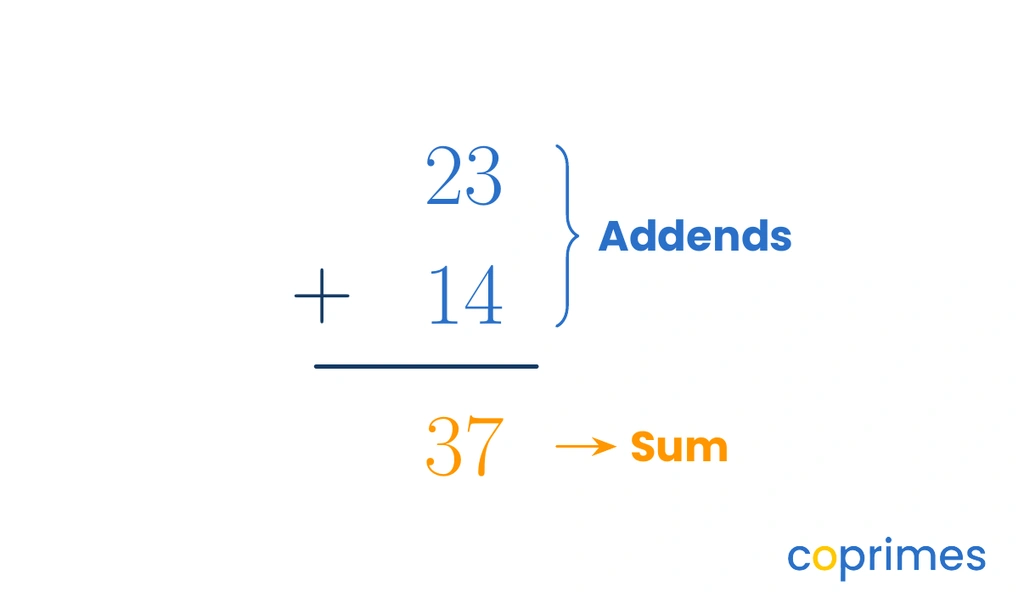
In this vertical format, the line underneath the addends acts just like an equal sign. The number below the line is the sum.
How to identify addends
To find the addends in an equation, look for the plus sign (). The numbers on either side of the plus sign are the addends. In the equation , the values and are the numbers being added, making them the addends.
Sometimes, an addition problem has a missing part, such as . In this case, is a known addend, is the sum, and you must find the missing addend. You can find it by using inverse operations. Because addition and subtraction are opposites, you can subtract the known addend from the sum to find the missing addend: .
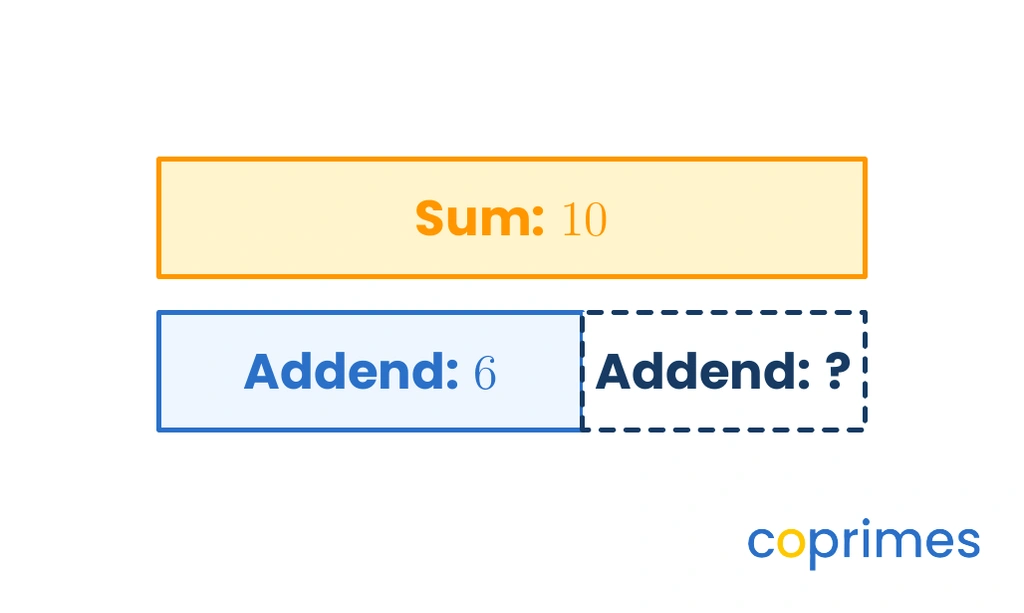
This bar model visually explains the relationship: the two addends are the smaller parts that physically combine to equal the total sum at the top.

How to find a sum
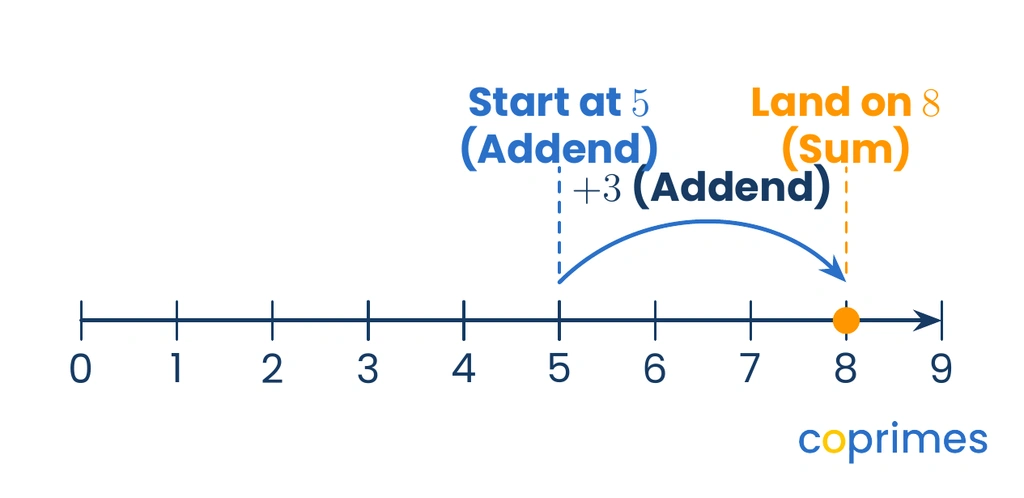
To find the sum, you must combine the values of the addends. A clear way to do this is by using a number line. Start at the first addend, and jump forward by the value of the second addend.
For larger numbers, standard column addition is the most effective method. Write the addends vertically, aligning the units column, tens column, and hundreds column. Add each column starting from the right to calculate the final sum.
Worked examples
Let's practice identifying the parts of addition and finding the missing pieces using three different types of math problems.
Example 1: Finding a basic sum
Question: What is the sum of the addends and ?
Method:
- Write the addition equation horizontally:
- Align the place values mentally or on paper.
- Add the units: .
- Add the tens: .
- Combine the parts: .
Answer: The sum is .
Check: You can count on from by adding ten to get , and then adding one more to get .
Example 2: Identifying addends in word problems
When solving addition word problems, you must read carefully to extract the numbers that need to be combined.
Question: A baker makes blueberry muffins and banana muffins. How many muffins are there in total? Identify the addends and the sum.
Method:
- Find the parts that are being grouped together. The blueberry muffins and banana muffins are the parts.
- Label these parts as the addends.
- Write the vertical addition: .
- Calculate the total by adding the columns: for the units, and for the tens.
Answer: The addends are and . The sum is .
Check: Reverse the addition order to . The result is still , confirming the sum is correct.
Example 3: Finding a missing addend
Question: In the equation , what is the missing addend?
Method:
- Identify the given parts: is a known addend, and is the sum.
- Use the inverse operation (subtraction) to find the missing part.
- Subtract the known addend from the sum: .
- , and .
Answer: The missing addend is .
Check: Substitute back into the original equation: . The equation is true, so the missing addend is correct.
Common mistakes
One frequent mistake is mixing up the vocabulary of different mathematical operations. Remember that a "sum" is strictly the answer to an addition problem.
The answer to a subtraction problem is the difference, the answer to a multiplication problem is the product, and the answer to a division problem is the quotient. Do not use "sum" as a general word for any math answer.
Another common misconception is believing that the order of the addends changes the sum. According to the commutative property of addition, the order does not matter. The equation gives exactly the same sum as . The parts remain the same regardless of which addend is written first.
A learning plan shaped by your child, not the class
State-aligned Math plus our own Logic and English curriculum. An adaptive baseline test finds the gaps and fills them.
Frequently asked questions
Can there be more than two addends?
Yes. An addition equation can have three, four, or even hundreds of addends. For example, in , the numbers , , and are all addends.
What are other words for sum?
In math word problems, keywords that mean you should find the sum include "total," "all together," "combined," and "in all."
What happens if one of the addends is zero?
If you add zero to any number, the sum is identical to the other addend. For example, in , the sum is . This is known as the zero identity property of addition.
Practice questions
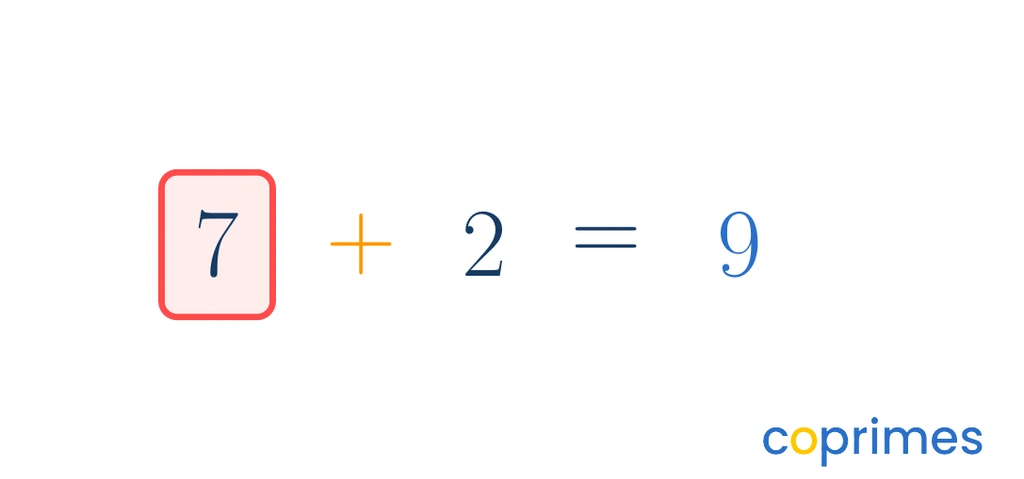
Look at the mathematical equation in the visual. What vocabulary word describes the number highlighted in the red box?
Sum
Difference
Addend
Product
Addend
Find the sum of the addends and .
Maria has red blocks and blue blocks. She wants to know the total number of blocks. Which numbers are the addends in this word problem?
and
and
and
Only
and
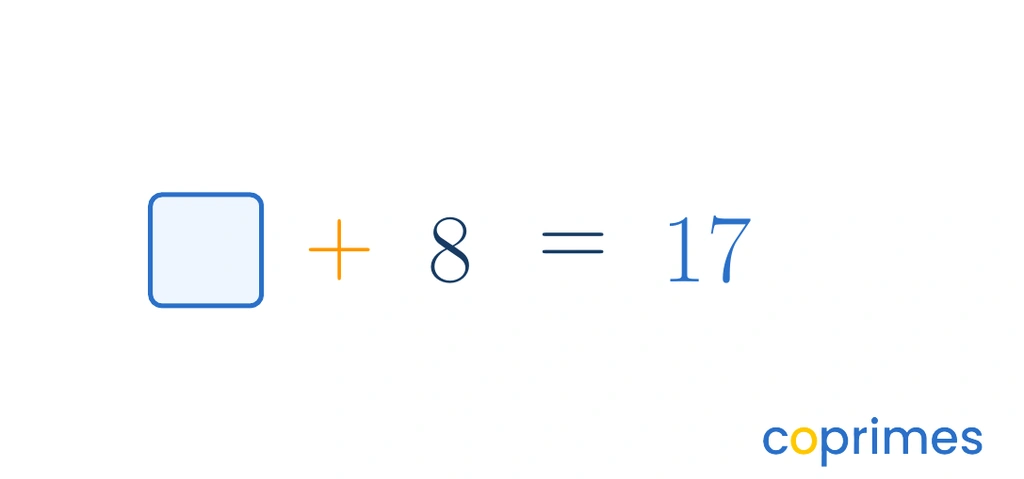
Look at the visual equation. What is the value of the missing addend?
Can an addition equation have more than two addends? Choose the correct answer and example.
No, addition equations can only ever have exactly two addends.
Yes, but only if the extra addends are zeros, like .
Yes, you can have three or more addends, such as .
Yes, but the word "sum" changes to "product" when there are more than two addends.
Yes, you can have three or more addends, such as .