
Addition Word Problems: Definition, Method and Examples
An addition word problem is a mathematical story that asks for a combined total, an increase, or an unknown part. These problems describe real-world situations that can be solved by adding quantities together. Identifying the structure of the story helps determine when addition is the correct mathematical operation.
What is an addition word problem?
An addition word problem provides numerical information within a descriptive context instead of simply presenting a mathematical equation. It requires interpreting the story, identifying the relevant values, and recognizing that the quantities must be joined.
An addition word problem translates a real-world scenario into a mathematical equation.
Before calculating the answer, the core challenge is determining that addition is the necessary operation. Once the operation is identified, the descriptive text is converted into standard mathematical notation to find the solution.
Addition problem structures
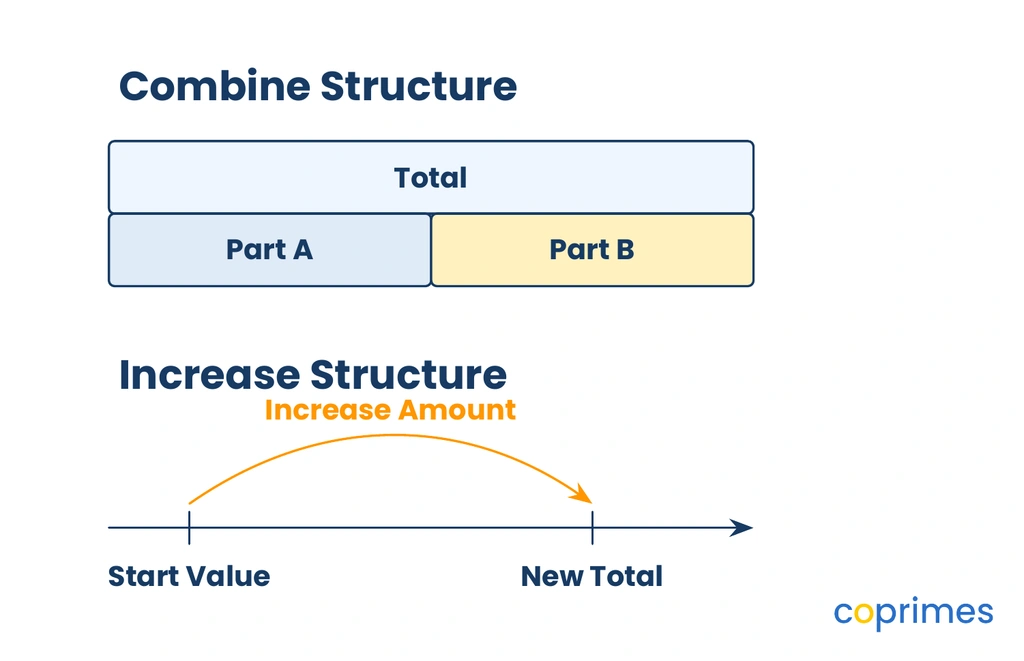
Addition word problems typically fall into three main structures. Recognizing these structures helps map the descriptive story to the correct mathematical model.
- Combine: Two or more distinct groups are brought together to form a total. For example, adding the number of red cars and blue cars in a parking lot.
- Increase: A starting quantity grows or increases by a specific amount over time. For example, a plant that is a certain height and grows taller.
- Compare: One quantity is described as being a specific amount more than another known quantity. For example, finding the height of a building that is taller than another structure by a given amount.
How to choose addition
To choose addition as the correct operation, look for context clues indicating that quantities are being joined or are growing. Certain words frequently signal that an addition structure is present.
Signal Word | Example Context |
Sum | Find the sum of the two weights. |
Total | What is the total number of students? |
Altogether | How many items do they have altogether? |
Combined | What is the combined distance? |
More than | The tree is meters more than the house. |
Always read the entire problem instead of relying entirely on keywords.
Keywords can sometimes be misleading if the broader context of the sentence implies a different operation. Verifying the underlying structure of the story is the most reliable way to choose addition.
A learning plan shaped by your child, not the class
State-aligned Math plus our own Logic and English curriculum. An adaptive baseline test finds the gaps and fills them.
Bar models and equations
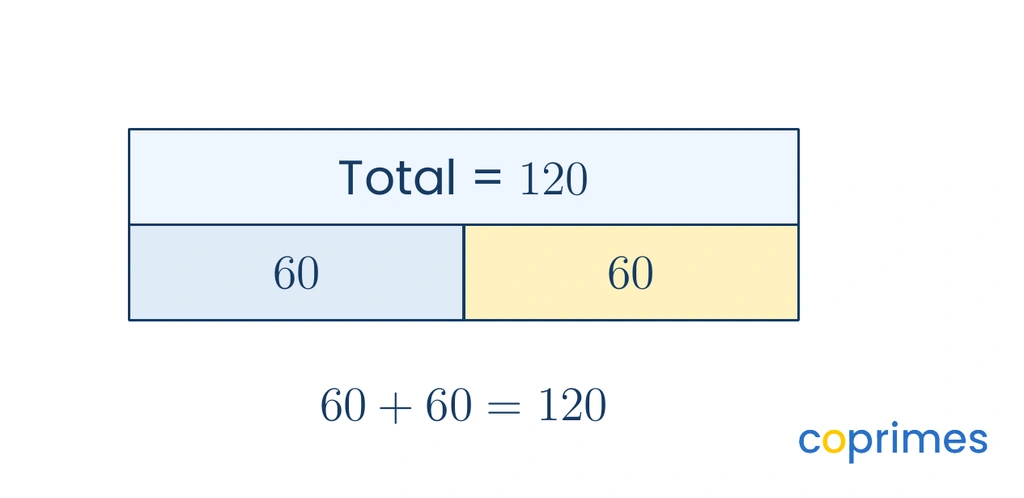
A bar model is a visual tool that translates the descriptive text of a word problem into clear rectangular blocks. The blocks display how the known and unknown quantities relate to each other.
Once the bar model is drawn, writing the mathematical equation becomes straightforward. The smaller blocks represent the individual parts being added, and the full width of the combined blocks represents the total sum.
Step-by-step solving method
Solving an addition word problem accurately involves breaking the process into manageable steps. This organized approach prevents careless errors and ensures the correct operation is applied.
- Read the problem carefully to understand the story.
- Identify the given values and the unknown quantity.
- Determine the structure (combine, increase, or compare) to confirm addition is required.
- Draw a visual model to map out the relationship between the quantities.
- Write the equation.
- Calculate the sum using a reliable method, such as column addition.
- Check the final answer against the original story to ensure it makes sense.
Worked examples
These examples demonstrate how to apply the step-by-step method to different addition structures, moving from foundational grouping to practical applications.
Example 1: Combining two groups
Question: A library has fiction books and nonfiction books in a display. How many books does the library have in total on the display?
Method:
- Identify the given values ( and ) and the unknown total.
- Write an equation to represent combining the parts: .
- Calculate the sum of the units, tens, and hundreds.
Answer: The library has books in total.
Check: Ensure is a reasonable combined size for the two groups. Subtracting one part from the total verifies the calculation: .
Example 2: An increase structure
Question: A school band has raised dollars for new equipment. During a weekend concert, they raise an additional dollars. How much money do they have now?
Method:
- Identify the starting value ( dollars) and the increase amount ( dollars).
- Recognize that "an additional" means the starting amount has grown.
- Write the equation: .
- Calculate the sum.
Answer: The school band has dollars.
Check: is a quick estimate of . The exact answer of is close to this estimate, confirming it is reasonable.
Example 3: A compare structure
Question: A local bakery sold pastries on Friday. On Saturday, they sold more pastries than they did on Friday. How many pastries did they sell on Saturday?
Method:
- Identify the reference quantity ( pastries).
- Identify the difference ( more).
- Set up the equation to find the larger unknown quantity: .
- Add the quantities together.
Answer: The bakery sold pastries on Saturday.
Check: , which matches the number of pastries sold on Friday.

Common mistakes
One common error is indiscriminately adding every number found in the word problem. Descriptive text often includes extraneous information, such as dates, times, or irrelevant measurements. It is critical to filter out any numbers that do not contribute to the mathematical question being asked.
Another frequent mistake occurs during calculation when numbers are not aligned correctly by their place value. When using column addition, misaligning the units column with the tens column will produce an entirely incorrect sum. Finally, forgetting to include the correct units of measurement in the final answer can leave the solution ambiguous.
Frequently asked questions
Do signal keywords guarantee that a problem requires addition?
No. While keywords like "total" and "more than" are helpful hints, they do not guarantee addition is required. A problem asking "How many more items are needed to reach a total of ?" uses the word "total" but actually requires subtraction to solve.
How do you check an addition word problem?
The most effective way to check is to use the inverse operation. Subtract one of the parts from the final sum. If the result equals the other starting part, the calculation is correct. Estimating the sum by rounding the numbers first also helps verify the magnitude of the answer.
What comes after single-step addition problems?
Once single-step addition is mastered, the next steps are learning subtraction word problems to handle decreases, and two-step word problems, which combine multiple operations into one complex story.
Practice questions
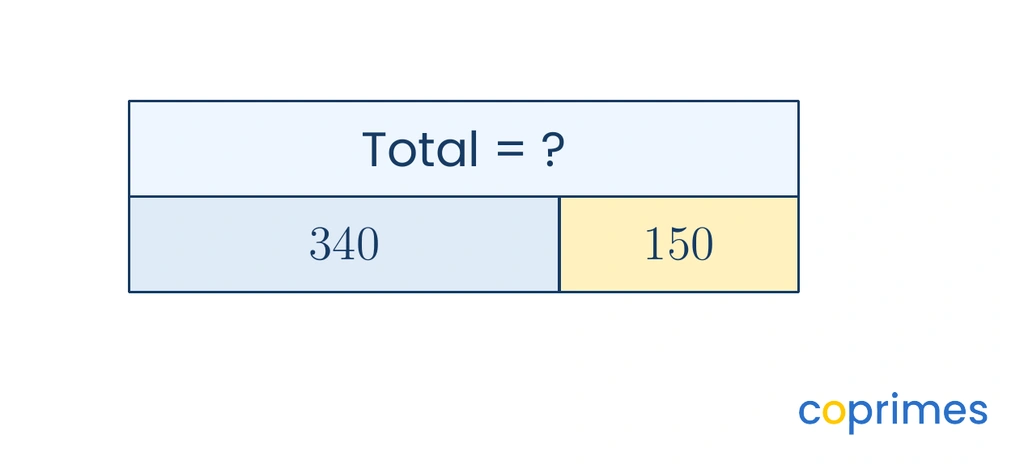
Which equation correctly matches the bar model shown?
A farmer harvests apples in the morning and apples in the afternoon. What is the total number of apples harvested?
A train departs the station at 9:00 with passengers. At the next stop, more passengers board the train. How many passengers are on the train now?
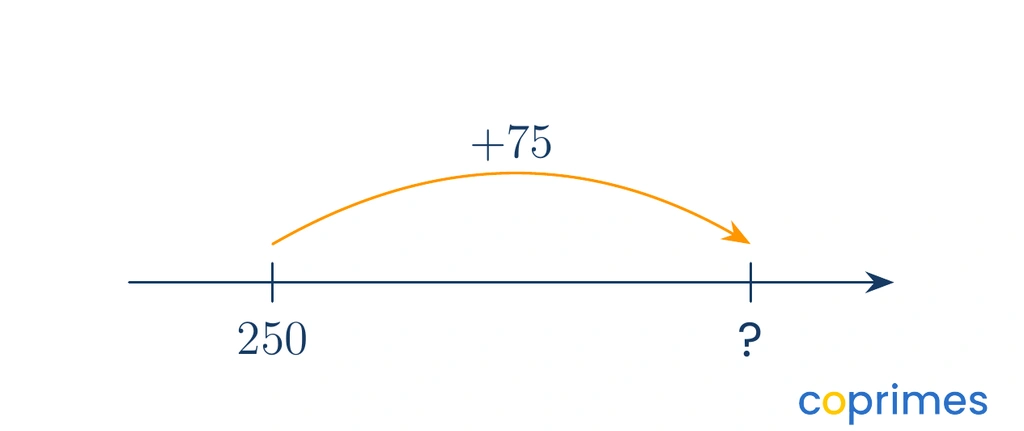
Which word problem can be solved using the number line model above?
A store has items and successfully sells items.
A plant is centimeters tall and grows another centimeters.
Two ropes are centimeters and centimeters long.
A cyclist travels kilometers and then returns kilometers.
A plant is centimeters tall and grows another centimeters.
A school raised dollars on Monday and dollars on Tuesday. How much money was raised in total?
dollars
dollars
dollars
dollars
dollars