
Column Addition: Definition, Method and Examples
Column addition aligns numbers by place value and adds each column vertically, starting from the right. It provides a structured way to add multi-digit numbers, regrouping whenever a column total is ten or more.
Column addition is also known as vertical addition or the standard addition algorithm.
What is column addition?
Column addition is a formal written method used to find the sum of two or more numbers. Instead of adding numbers horizontally, you stack them vertically.
By arranging numbers in columns, you can focus on adding one place value at a time. This breaks a large, complex addition problem into a series of simple, single-digit calculations.
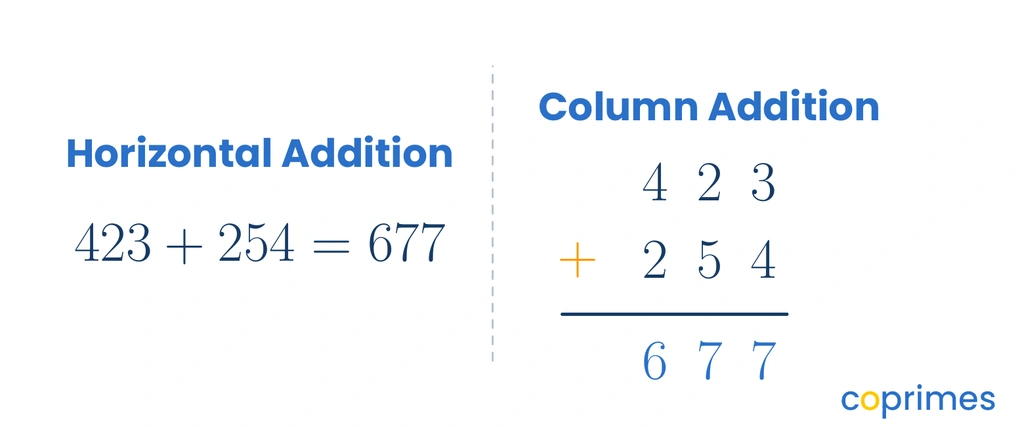
The vertical arrangement guarantees that you always add ones to ones, tens to tens, and hundreds to hundreds.
How to set out column addition
The most critical step in column addition is alignment. The numbers must be stacked so that their rightmost digits line up vertically.
A place value chart can help you visualize this alignment. The ones must be directly above the ones, the tens above the tens, and so on.
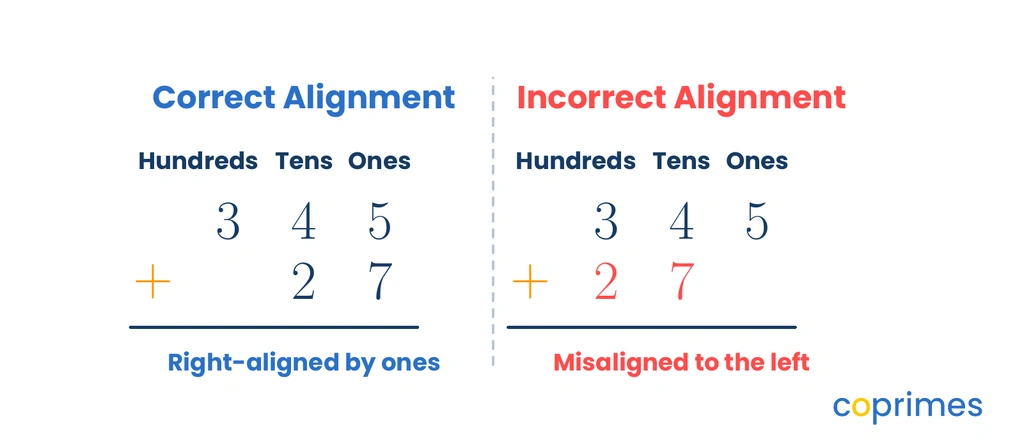
If you align the numbers to the left instead of the right, you will accidentally add ones to hundreds or tens. This completely changes the values being added and results in the wrong answer.
Step-by-step algorithm
The standard written addition method follows a strict, repeatable sequence.
- Write the numbers vertically, ensuring the ones digits are aligned in the same right-hand column.
- Draw a line underneath the bottom number to create a space for the answer.
- Begin at the rightmost column (the ones column). Add the digits in this column.
- If the sum of the column is less than , write it beneath the line in that column.
- If the sum is or more, write the ones digit beneath the line and regroup (carry) the tens digit to the top or bottom of the next column to the left.
- Move left to the next column. Add the digits, including any number you regrouped from the previous step.
- Repeat this process for every column, moving from right to left, until all columns have been added.
A learning plan shaped by your child, not the class
State-aligned Math plus our own Logic and English curriculum. An adaptive baseline test finds the gaps and fills them.
Column addition without regrouping
When no column adds up to or more, the calculation is straightforward. You simply add the digits in each column and write the total below the line without carrying any values.
This happens when the digits in every place-value column have a sum of or less.
Example 1: Adding without regrouping
Question: Calculate using column addition.
Method:
- Align the numbers vertically.
- Add the ones: .
- Add the tens: .
- Add the hundreds: .
Answer: .
Check: Subtract one of the original numbers from the sum: .
Column addition with regrouping
Often, a column total reaches or more. When this happens, you must use addition with regrouping, which is also commonly called carrying.
Because you can only place a single digit in each answer space, a sum of or more must be split.
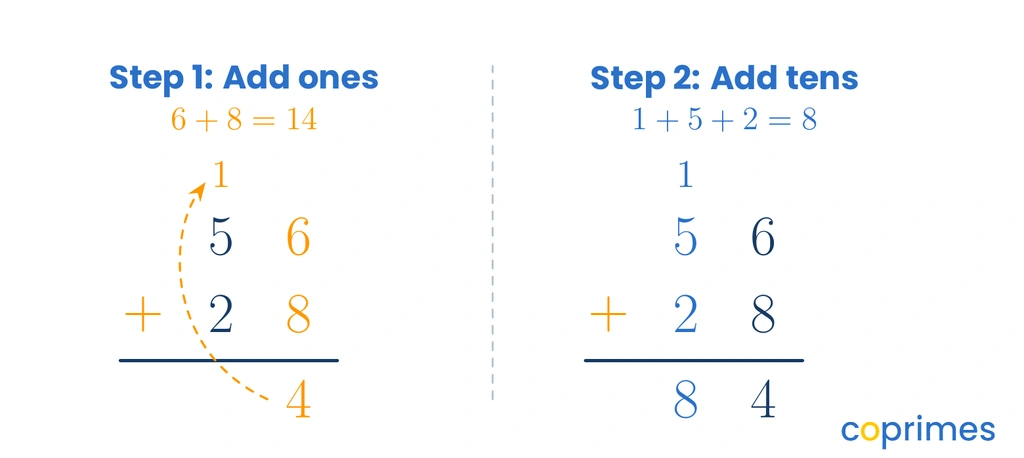
The ones part of the sum stays in the answer space for that column. The tens part of the sum is grouped together and moved over to the next column on the left.
Adding numbers of different lengths
When the numbers have a different amount of digits, place-value alignment is especially important. A common mistake is aligning the numbers on the left.
Always align numbers so the ones digits are stacked vertically. This means the layout will be flush on the right side, but may have empty spaces on the left.
Example 2: Adding numbers of different lengths
Question: Calculate .
Method:
- Align the numbers vertically on the right.
- Add the ones: . Write , carry the to the tens column.
- Add the tens: . Write , carry the to the hundreds column.
- Add the hundreds: .
- Add the thousands: plus nothing is .
Answer: .
Check: Estimation provides a quick check. . The answer is very close, meaning place values were likely aligned correctly.

Worked examples
Once you master standard addition, you can use the same logical steps to solve more complex challenges, such as finding unknown digits within a calculation or solving addition word problems.
Example 3: Missing digit check
Question: In the column addition calculation below, one digit is missing, represented by a box . Find the missing digit.
Method:
- Check the ones column: . This is correct and involves no regrouping.
- Check the tens column: .
- Solve for the missing number: The number that adds to to make is .
- Check the hundreds column: . This matches the final answer.
Answer: The missing digit is .
Check: Add . The sum is exactly .
Common mistakes
When using the written method, small errors can lead to incorrect answers. Watch out for these common pitfalls:
- Misaligning columns: Left-aligning numbers of different lengths instead of lining up the ones column.
- Adding left-to-right: You must start from the right (the ones column). Adding from left-to-right makes regrouping impossible to manage accurately.
- Forgetting the carried digit: Always include the regrouped number when adding the next column.
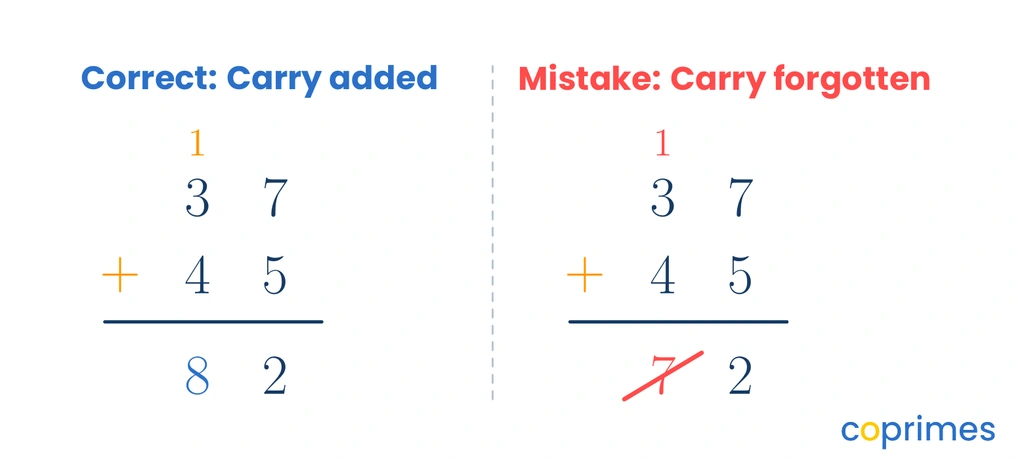
A good habit is to write the carried digit clearly and cross it out slightly once you have added it to the total.
Frequently asked questions
Does the order of the numbers matter in column addition?
No. Addition is commutative, meaning is the same as . However, writing the larger number on top can sometimes make the alignment visually easier.
How can I check if my column addition is correct?
A reliable method of checking addition is to use the inverse operation (subtraction). Subtract one of the original numbers from your final answer. If the result matches the other original number, your calculation is correct.
What should I do if a column adds up to 20 or more?
If a column totals or more, you write down the ones digit and carry the tens digit. For example, if a column adds to , write the in the answer space and carry the to the next column.
Practice questions
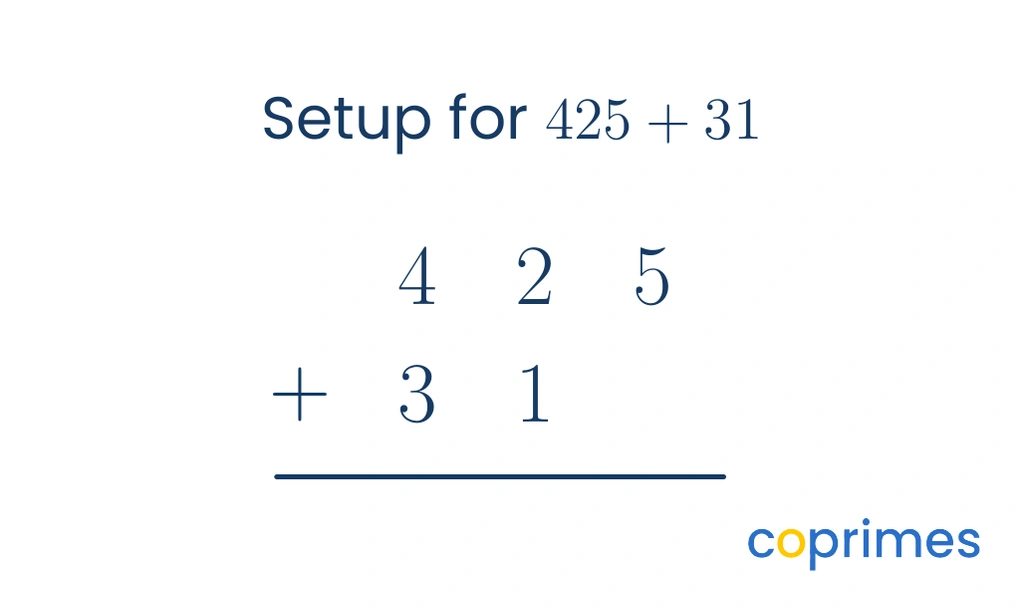
Look at the column addition setup shown in the visual. What mistake has been made?
The numbers are not aligned on the right.
The addition symbol is placed in the wrong spot.
The bottom line is drawn incorrectly.
There is no mistake; the setup is perfectly correct.
The numbers are not aligned on the right.
What is the sum of ?
Calculate .
A student uses column addition to calculate . They write as their final answer. What mistake did they most likely make?
They added from left to right instead of right to left.
They misaligned the place values.
They wrote both digits of in the answer space.
They forgot to add the carried digit.
They forgot to add the carried digit.
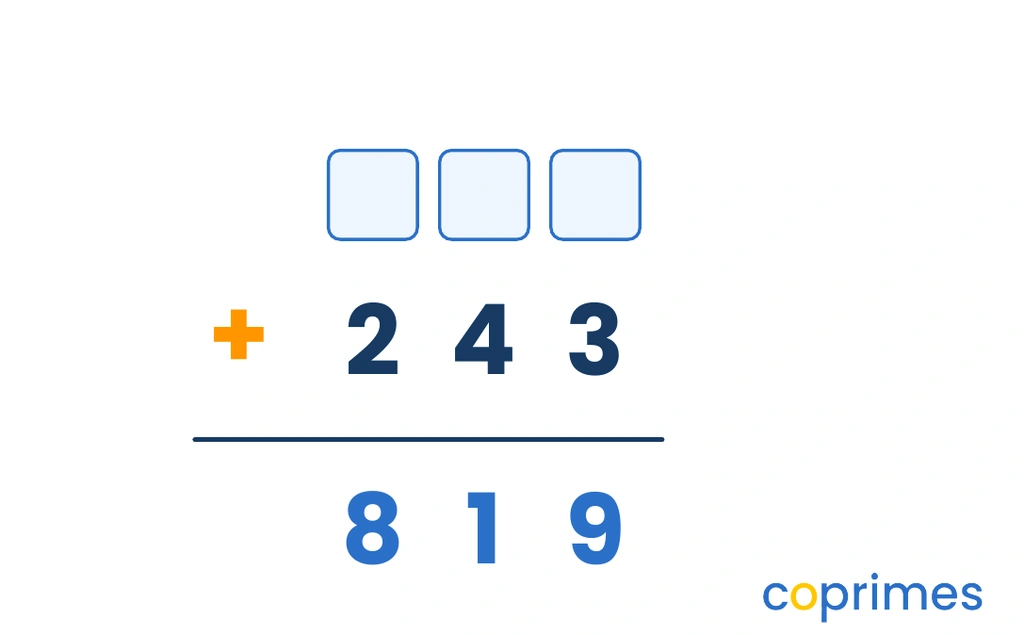
Look at the column addition calculation in the visual. What is the missing three-digit number?