
Adding and Subtracting Positive and Negative Numbers
Adding or subtracting positive and negative numbers can be understood as movement on a number line. Addition combines values, while subtraction finds the difference or takes values away. The signs of the numbers determine whether the final direction of the change is positive or negative.
Positive and negative signs
Numbers can be either positive, negative, or zero. Positive numbers represent values greater than zero, while negative numbers represent values less than zero.
If a number has no sign in front of it, it is a positive number.
When writing numbers, a positive sign is often assumed. For example, means exactly the same as . However, a negative sign must always be written, such as .
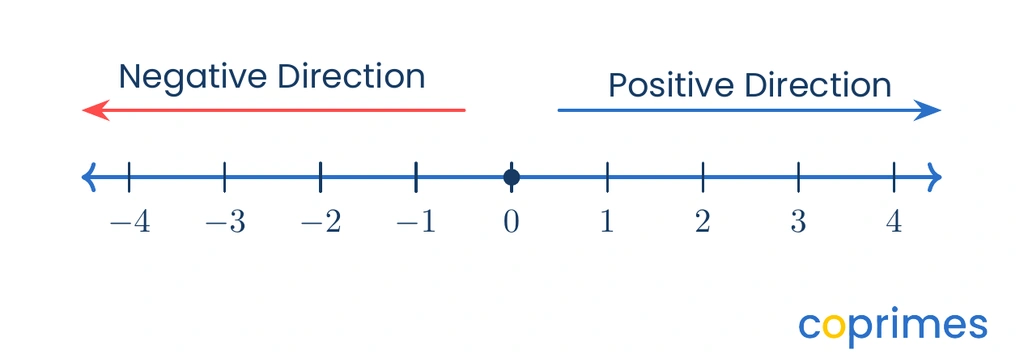
Zero is neither positive nor negative; it is the neutral center point of the number line.
Adding signed numbers
Adding two numbers means combining their values. The direction of movement on a number line depends on the sign of the number being added.
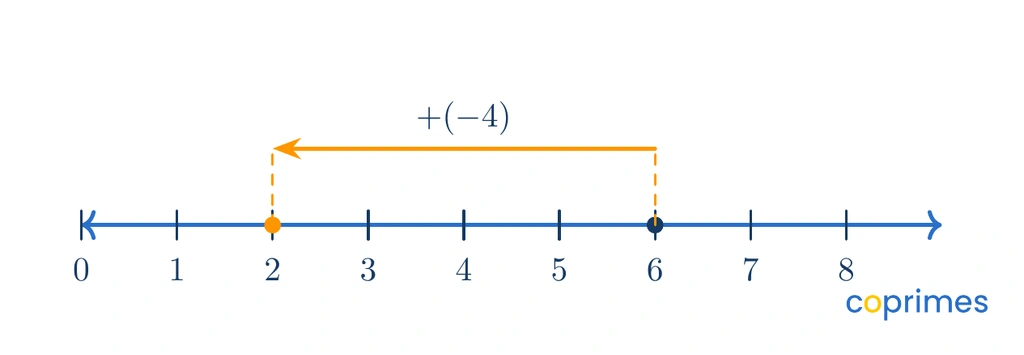
Before adding integers or decimals with mixed signs, remember that adding a positive number moves the value to the right. Adding a negative number moves the value to the left.
When you add a negative number, it is mathematically identical to subtracting a positive number. For example, produces the same result as . Both operations move the value units to the left.
- Like signs simplified: becomes .
- Unlike signs simplified: becomes .
Subtracting signed numbers
Subtracting a number means taking its value away. The rules for subtracting integers or signed decimals reverse the direction of addition.
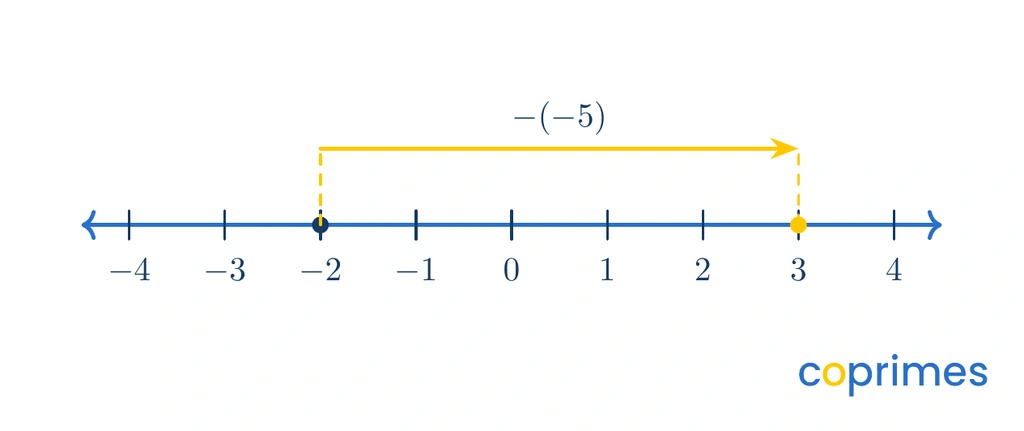
Subtracting a positive number moves the value to the left, which decreases the total. Subtracting a negative number moves the value to the right, which increases the total.
When you subtract a negative number, it is mathematically identical to adding a positive number. For example, produces the same result as . Both operations move the value units to the right.
- Unlike signs simplified: becomes .
- Like signs simplified: becomes .
When two like signs are next to each other, they simplify to a positive sign. When two unlike signs are next to each other, they simplify to a negative sign.
A learning plan shaped by your child, not the class
State-aligned Math plus our own Logic and English curriculum. An adaptive baseline test finds the gaps and fills them.
Number-line model
Drawing number lines provides a reliable way to visualize any addition or subtraction problem involving signed numbers.
Start at the first number in the expression. Then, use the simplified sign to determine which way to move. Move right for a positive simplified sign, and move left for a negative simplified sign.
Why subtracting a negative adds
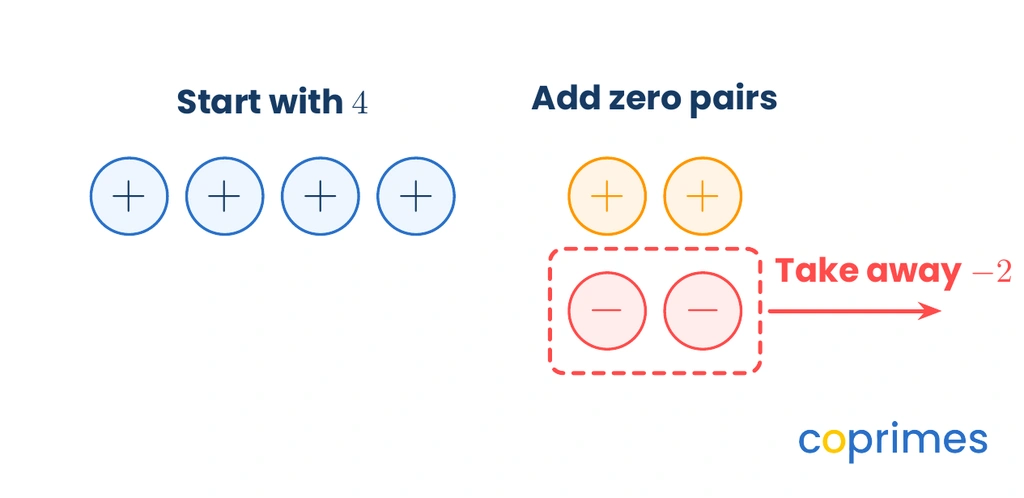
Subtracting a negative number often feels counterintuitive, but it can be modeled mathematically using zero pairs. A zero pair consists of one positive unit and one negative unit, which together equal zero.
Suppose you want to calculate . You start with positive units, but you cannot take away negative units because you do not currently have any.
To solve this, add zero pairs to your starting group. Your total value is still exactly , but you now have negative units available to remove. When you take away those negative units, the positive units from the zero pairs are left behind, leaving a final total of .
Worked examples
Applying the sign rules systematically makes calculations reliable. These operations are essential when solving integer word problems.
Example 1: Adding a negative number
Question: What is ?
Method:
- Identify the adjacent signs. Here, a positive and a negative sign are next to each other, forming .
- Simplify the unlike signs into a single negative sign. The expression becomes .
- Start at on a number line and move units to the left.
Answer: .
Check: Adding a negative value means the starting number should decrease. Since is less than , the result makes sense.
Example 2: Subtracting a negative number
Question: Calculate .
Method:
- Identify the adjacent signs. Here, two negative signs are next to each other, forming .
- Simplify the like signs into a positive sign. The expression becomes .
- Add the numbers normally.
Answer: .
Check: Subtracting a negative is the same as adding its opposite. The opposite of is , and .
Example 3: Multiple signed operations
Question: Evaluate .
Method:
- Simplify the first pair of adjacent signs, , which become a negative sign, leaving .
- Simplify the second pair of adjacent signs, , which become a positive sign, leaving .
- Rewrite the complete simplified expression as .
- Calculate from left to right. First, find .
- Finally, calculate .
Answer: .
Check: Starting at and moving left units reaches . Moving right units from reaches .

Common mistakes
Avoiding simple sign errors is crucial for accurate calculations.
- Treating the starting sign as an operation: The sign of the first number is just a starting position. Do not apply the "two negatives make a positive" rule to . There are no adjacent signs to simplify here. The calculation simply starts at and moves units left, resulting in .
- Ignoring the minus sign during substitution: When substituting a negative number into an expression with a minus sign, you must keep both signs. For example, if , then becomes , which simplifies to .
- Moving the wrong direction on the number line: Always double-check whether the final simplified operation is addition (move right) or subtraction (move left).
Frequently asked questions
Understanding why signs interact the way they do is foundational for all operations with negative numbers.
Do these sign rules apply to fractions and decimals?
Yes. The rules for adjacent signs are universal and apply to fractions, decimals, algebraic terms, and all real numbers.
Why do two negatives make a positive when adding and subtracting?
When a negative sign means "the opposite of," then a double negative means "the opposite of the opposite." The opposite of moving left is moving right, which is the positive direction on a number line.
What happens if there are three signs together?
Simplify them in pairs from the inside out. For example, simplifies step by step. The inner becomes a positive, turning the expression into , which further simplifies to .
Practice questions
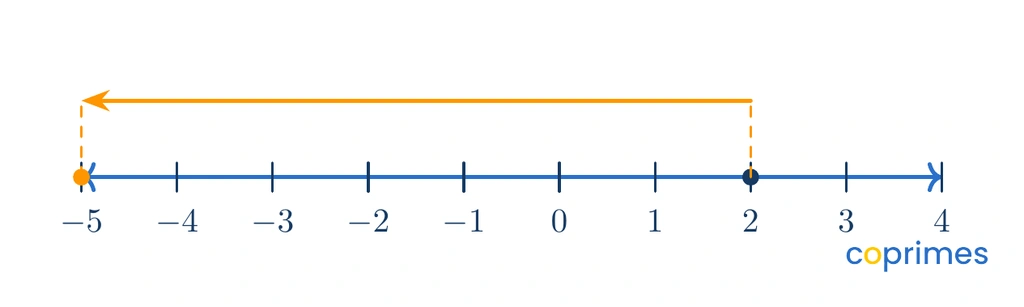
Which expression is represented by the arrow on this number line?
Evaluate the expression: .
Evaluate the expression: .
Which of the following is mathematically equivalent to ?
A diver is at an elevation of meters. They descend an additional meters. What is their new elevation?