
Operations With Negative Numbers: Definition, Rules, and Examples
Operations with negative numbers use the same arithmetic operations as positive numbers, but signs, absolute values, and the order of operations determine whether the result increases, decreases, is positive, or is negative. Learning these rules allows you to track directions, temperatures, and financial balances accurately.
Before combining multiple operations, you need a solid foundation in adding and subtracting positive and negative numbers.
What are negative number operations?
Negative numbers are values strictly less than zero, represented with a minus sign (). Numbers greater than zero are positive, and zero itself is neither positive nor negative.
Arithmetic with negative numbers applies standard addition, subtraction, multiplication, and division, but introduces specific rules for interpreting the signs. The final value depends on the combination of positive and negative inputs.
Add and subtract negatives
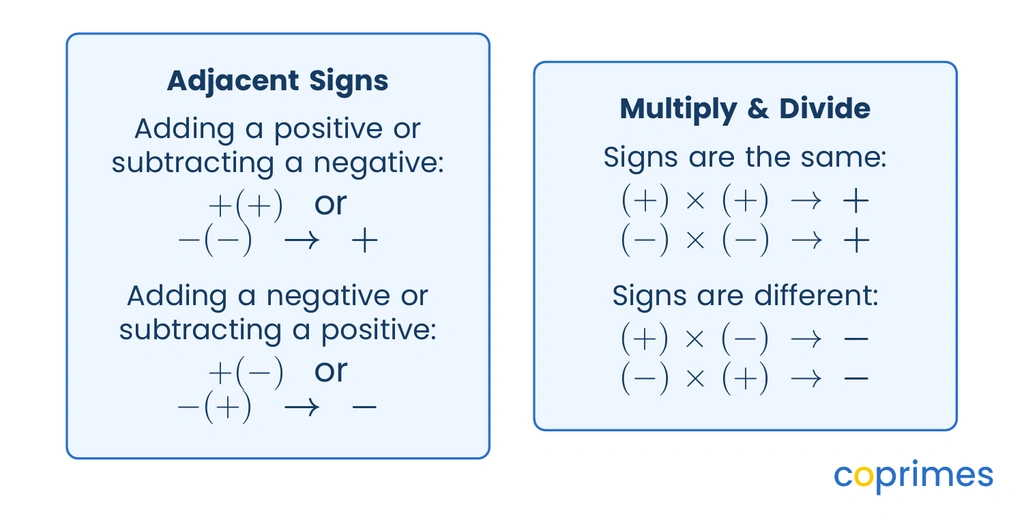
When an addition or subtraction problem contains adjacent signs, simplify the signs before evaluating the math.
If you add a positive number or subtract a negative number, the result moves in the positive direction. Two negative signs directly next to each other simplify to a single positive sign.
Subtracting a negative number is exactly the same as adding a positive number.
If you add a negative number or subtract a positive number, the result moves in the negative direction. A positive and a negative sign directly next to each other simplify to a single negative sign.
Multiply and divide negatives
When multiplying and dividing integers or decimals, complete the calculation as if both numbers were positive, then apply the sign rules to your final answer.
If both numbers have the same sign (both positive or both negative), the result is always positive.
If the numbers have different signs (one positive and one negative), the result is always negative.
A learning plan shaped by your child, not the class
State-aligned Math plus our own Logic and English curriculum. An adaptive baseline test finds the gaps and fills them.
Powers and parentheses
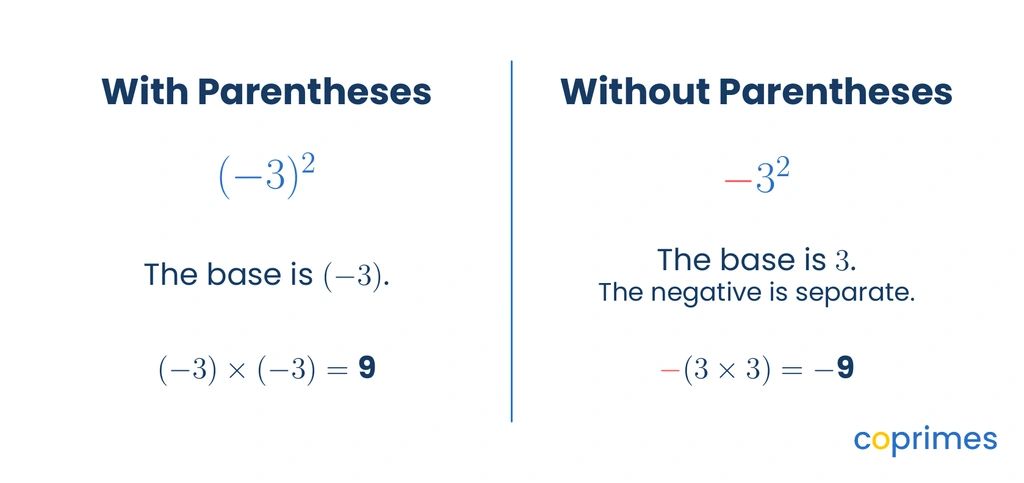
When you evaluate an exponent with a negative base, the presence of parentheses completely changes the meaning and the result. This step is critical when following the order of operations with integers.
If the negative number is enclosed in parentheses, the entire negative value is the base. If there are no parentheses, the exponent applies only to the number, and the negative sign is attached afterward. Negative bases are evaluated differently than negative exponents, which deal with reciprocals and fractions rather than changing the base's sign.
Use a number line and context
A number line is a visual tool that tracks addition and subtraction. Moving to the right increases the value, while moving to the left decreases the value.
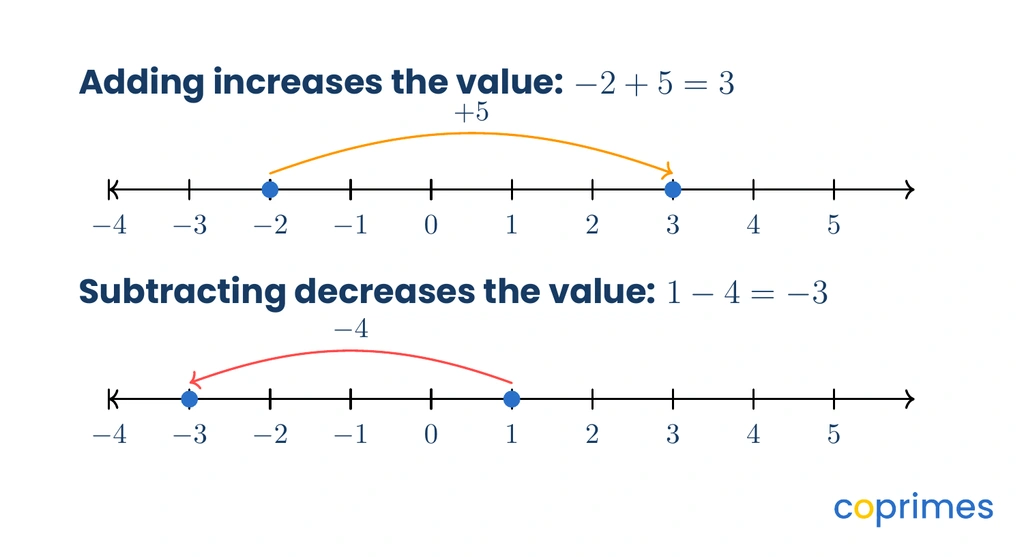
Translating real-world scenarios into integer word problems helps lock in the rules. Bank overdrafts, dropping temperatures, and elevations below sea level all require negative number operations to find the correct differences and totals.
Worked examples
Example 1: Subtracting a negative number
Question: Evaluate .
Method:
- Identify adjacent signs. The two negative signs are next to each other.
- Replace the adjacent negative signs with a positive sign. Subtracting a negative is the same as adding a positive.
Answer: .
Check: On a number line, starting at and removing a negative direction means moving to the right, landing at .
Example 2: Multiplying and dividing negatives
Question: Evaluate .
Method:
- Follow the order of operations, starting inside the parentheses.
- Divide by . The signs are different, so the quotient is negative: .
- Multiply the result by .
- The signs are now the same (both negative), so the product is positive.
Answer: .
Check: Reverse the operations: , and . The result is correct.
Example 3: Evaluating mixed operations with exponents
Question: Evaluate .
Method:
- Evaluate the exponent first. Notice there are no parentheses around the , so the base is . The negative sign applies after the exponent is evaluated: .
- Perform the multiplication. Multiply by to get . The expression is now .
- Simplify the adjacent signs. Subtracting is the same as adding , so the expression becomes .
- Add the final values.
Answer: .
Check: Since is further from zero than , adding moves the value closer to zero but remains negative. The result is reasonable.

Common mistakes
Treating a larger digit as a greater number
A common mistake is assuming that is greater than because is larger than . On a number line, is further to the left, which means it represents a smaller, or lesser, value.
Applying multiplication rules to addition
Students often remember the phrase "two negatives make a positive" and incorrectly apply it to addition, thinking that equals . This rule applies only to multiplication, division, and simplifying adjacent signs. Adding two negative numbers together results in a more negative number.
Do not change the signs of negative numbers during addition unless the signs are adjacent.
Frequently asked questions
Is zero a positive or a negative number?
Zero is neither positive nor negative. It represents a neutral center point on the number line.
Can you have a negative fraction?
Yes. A negative sign can be placed in the numerator, in the denominator, or in front of the entire fraction. All three positions represent the same negative value, though placing the sign in front or in the numerator is standard mathematical practice.
What happens when you multiply three negative numbers?
When you multiply an odd amount of negative numbers, the result is negative. The first two negative numbers multiply to create a positive product, and multiplying that positive product by the third negative number yields a negative result.
Practice questions
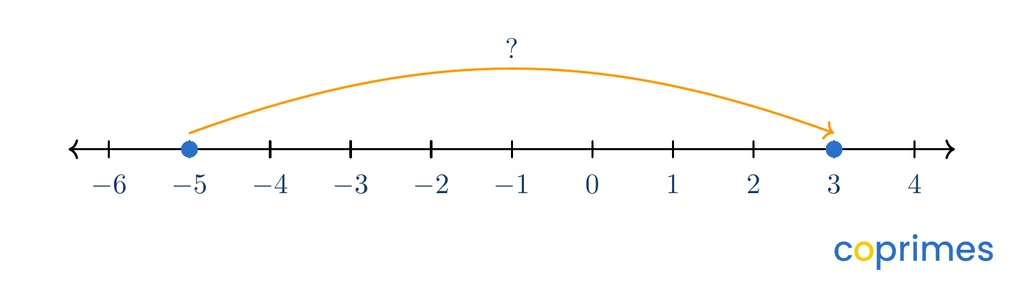
Which mathematical expression represents the operation shown on the number line?
Calculate .
What is the result of ?
Evaluate .
The temperature at midnight is . By noon, the temperature rises by and then drops by evening. What is the final temperature?