
Integer word problems: Definition, methods, and examples
Integer word problems are solved by identifying quantities that can be positive, negative, or zero, translating the situation into a mathematical expression, calculating with the appropriate operation, and checking that the result fits the context. These real-world scenarios help learners solve integer word problems using addition, subtraction, multiplication, and division.
What are integer word problems?
Integer word problems describe mathematical situations that involve positive whole numbers, negative whole numbers, and zero. These problems require readers to interpret real-world language, assign positive or negative values to quantities, and use integer operations to find a final amount or the difference between amounts.
Understanding negative number word problems involves connecting everyday events to mathematical concepts. For instance, gaining money, rising temperatures, or ascending in altitude represent positive values. Losing money, dropping temperatures, or descending below sea level represent negative values.
Choose a sign convention
In signed number word problems, deciding which direction represents a positive value and which represents a negative value is called choosing a sign convention. This choice determines the correct numbers for the calculation.
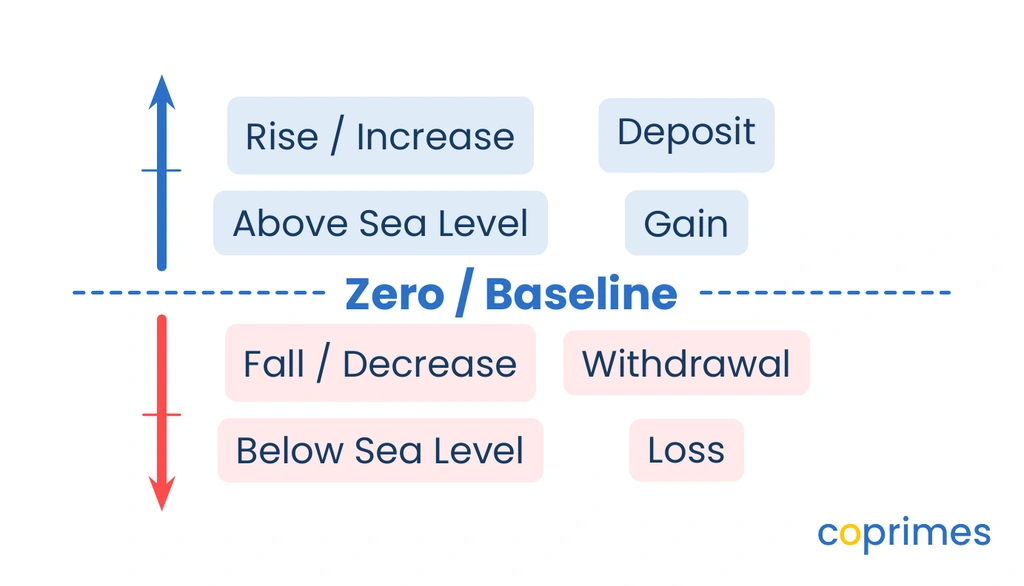
Often, standard conventions are already established:
- Upward movement or increase: Positive ()
- Downward movement or decrease: Negative ()
- Above a baseline (like sea level or zero degrees): Positive ()
- Below a baseline: Negative ()
For financial contexts, receiving money or making a deposit is considered positive, while spending money or making a withdrawal is negative. Establishing these signs early ensures that combining the numbers accurately reflects the real-world situation.
Translate words into expressions
Translating integer operations word problems into a mathematical equation requires recognizing key vocabulary that indicates both the sign of the integer and the operation to perform. A clear translation step organizes the given information into numerical expressions that can be evaluated.
Consider the common terms and their mathematical meanings:
- Addition: Combined, total, sum, rose by.
- Subtraction: Difference, dropped, fell, change in.
- Multiplication: Times, product, groups of.
- Division: Shared, split, per.
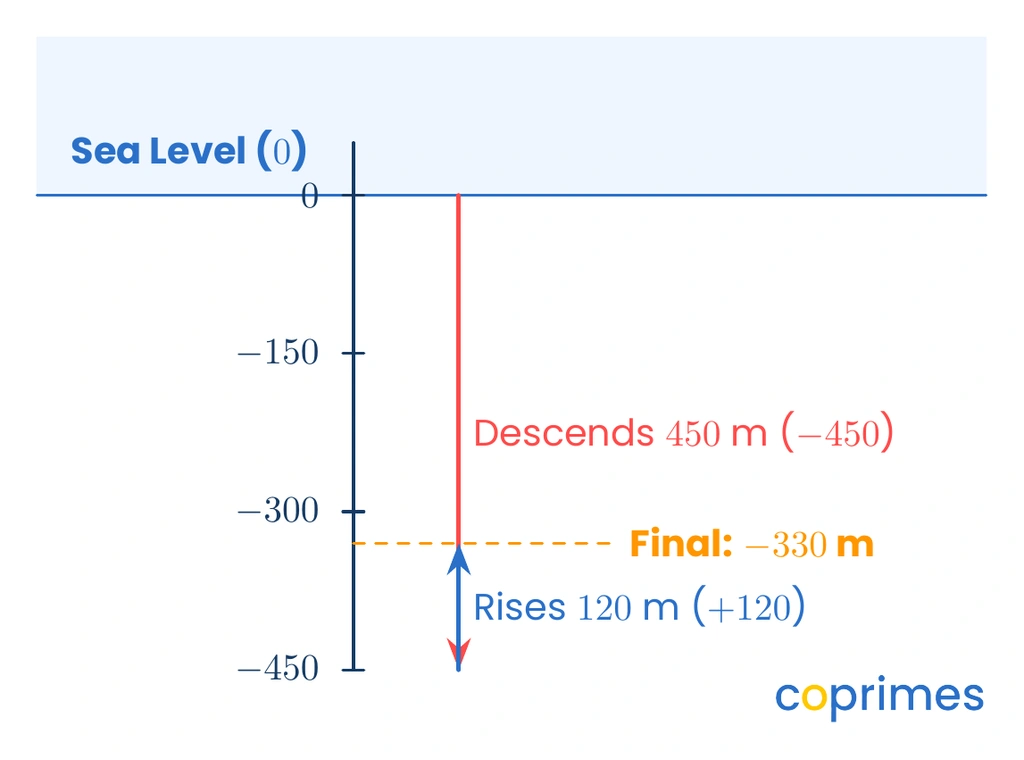
For example, if a submarine descends meters from the surface and then rises meters, the descent is translated as and the rise as . Finding the final position requires adding and subtracting positive and negative numbers, creating the expression .

Solve temperature, elevation and change problems
Temperature, elevation, and financial change problems are the most common applications of integer calculations. In these scenarios, a starting value is given, followed by a sequence of changes, leading to a final value.
Temperature: A temperature might start above zero, drop below zero, and rise again. If the temperature is and drops by , the new temperature is .
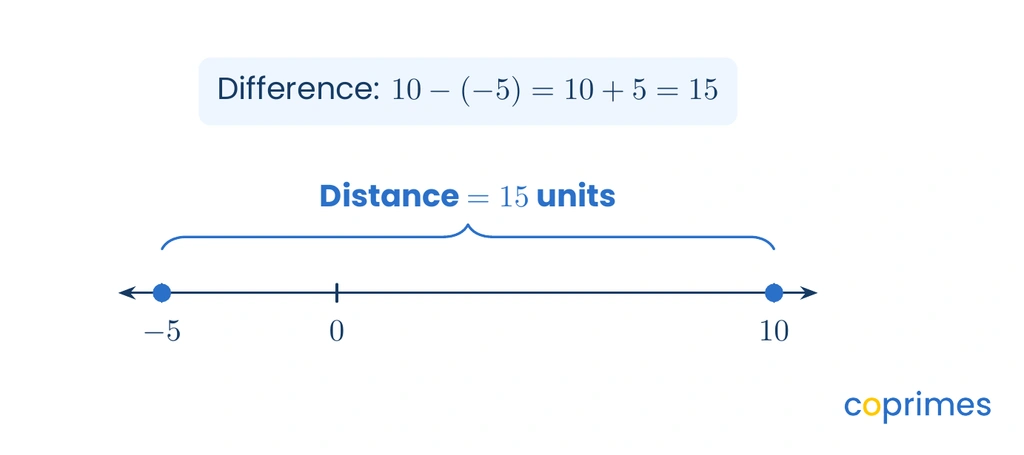
Elevation: Elevation is measured relative to sea level, which is assigned a value of . A mountain peak at meters is , while a trench meters below sea level is . The total distance between them is the difference: meters.
Financial Changes: Bank accounts track deposits (positive) and withdrawals (negative). A balance can drop below zero into a negative overdraft. If an account has dollars and a withdrawal of dollars is made, the new balance is dollars.
Check the context
After performing the arithmetic, the final step is interpreting the mathematical result back into the real-world situation. A correct numerical answer might not be a complete answer to the word problem.
Checking the context ensures the answer makes logical sense. If a question asks for a distance or a total change in magnitude, the answer must be a positive number, even if the calculation resulted in a negative integer. For instance, the difference in elevation between meters and meters is meters, not meters. Learning checking reasonableness of answers helps verify whether a negative result correctly describes a depth, debt, or temperature, or if a positive value is needed for an absolute distance.
Worked examples
Applying a step-by-step method helps organize information and prevents sign errors when translating problems into mathematical equations.
Example 1: Calculating temperature change
Question: The temperature at dawn was . By noon, the temperature had risen by . What was the temperature at noon?
Method:
- Identify the starting value and its sign: .
- Identify the change and its sign: a rise indicates addition, .
- Write the expression: .
- Calculate the result.
Answer: . The temperature at noon was .
Check: A rise from a negative temperature should move closer to zero or cross into positive values. is larger than the distance to zero (), so a positive result is correct.
Example 2: Finding a difference in elevation
Question: A cliff is meters above sea level. Directly below it, a shipwreck sits on the ocean floor at meters below sea level. What is the total vertical distance between the cliff and the shipwreck?
Method:
- Assign signs to the elevations: the cliff is , and the shipwreck is .
- To find the vertical distance between two points, subtract the lower value from the higher value.
- Write the expression: .
- Subtracting a negative is equivalent to adding a positive: .
Answer: . The vertical distance is meters.
Check: The distance must be greater than because the shipwreck is further down than sea level. The distance must be positive.
Example 3: Multiple financial transactions
Question: A bank account has a starting balance of dollars. The owner deposits dollars, then withdraws dollars to pay a bill. What is the final account balance?
Method:
- Identify the starting value: .
- Translate the transactions: a deposit is , and a withdrawal is .
- Write the full expression: .
- Perform the operations from left to right.
- First, .
- Next, .
Answer: The final account balance is dollars.
Check: The total spent ( dollars) is greater than the total money available ( dollars). The account must be overdrawn, so a negative balance makes sense.
A learning plan shaped by your child, not the class
State-aligned Math plus our own Logic and English curriculum. An adaptive baseline test finds the gaps and fills them.
Common mistakes
When working with operations with negative numbers, certain errors frequently occur in translation and calculation.
- Ignoring the starting sign: If a temperature starts below zero, ignoring the initial negative sign will result in an incorrect final value.
- Confusing distance with position: Distance is always a positive quantity (absolute value). The distance between and is , not or .
- Subtracting incorrectly: When finding the difference between a positive and a negative value, subtracting a negative number must be treated as addition. Forgetting to change the sign often leads to an answer that is too small.
- Misinterpreting keywords: Words like "drop," "descend," or "withdraw" must correctly translate to negative values or subtraction in the working expression.
Frequently asked questions
How do you determine if a number should be positive or negative?
Look for context clues. Words indicating an increase, height, or gain imply a positive integer. Words indicating a decrease, depth, or loss imply a negative integer. Sea level, a starting balance of zero, or a freezing point of zero usually represent the baseline.
Can an answer to a word problem be negative?
Yes, if the question asks for a final state that falls below the baseline. A final temperature can be negative, an account balance can be overdrawn, and a final position can be below sea level.
Why does subtracting a negative number increase the value?
Subtracting a negative number is mathematically the same as adding a positive number. In real terms, taking away a debt or removing a penalty leaves you with a higher net value.
Practice questions
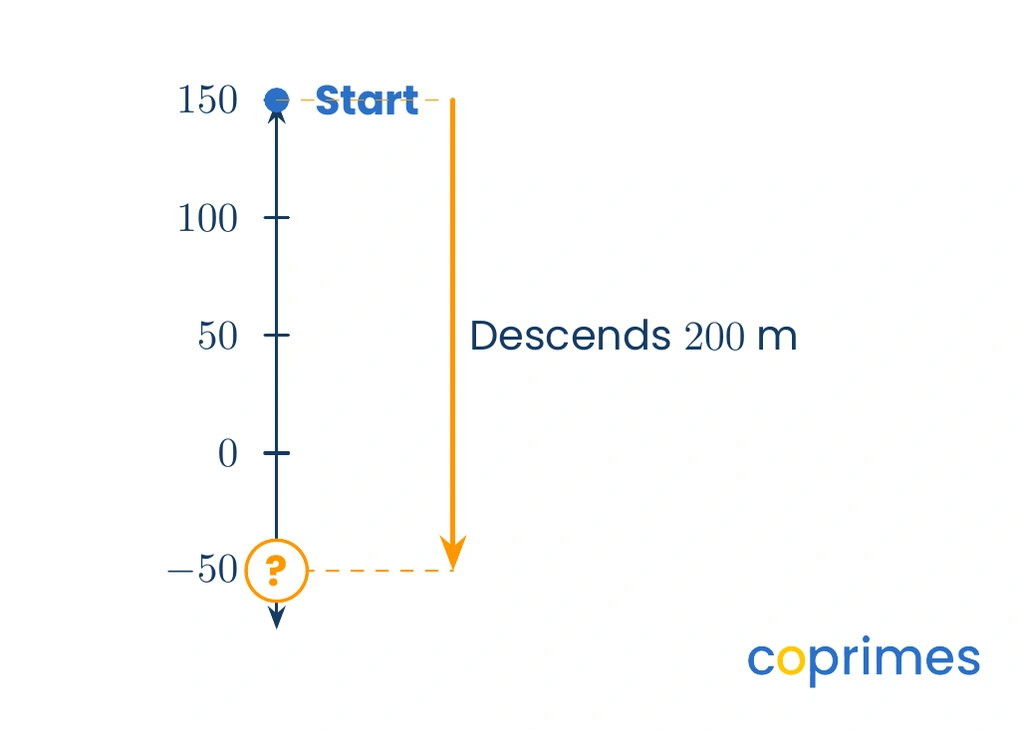
A climber starts at an elevation of meters and climbs down meters. The diagram represents the climber's path. What is the climber's final elevation?
meters
meters
meters
meters
meters
A liquid is cooled to . It is then heated, and the temperature rises by . What is the new temperature?
A bank account has a balance of dollars. The owner deposits dollars and then withdraws dollars. What is the final balance?
dollars
dollars
dollars
dollars
dollars
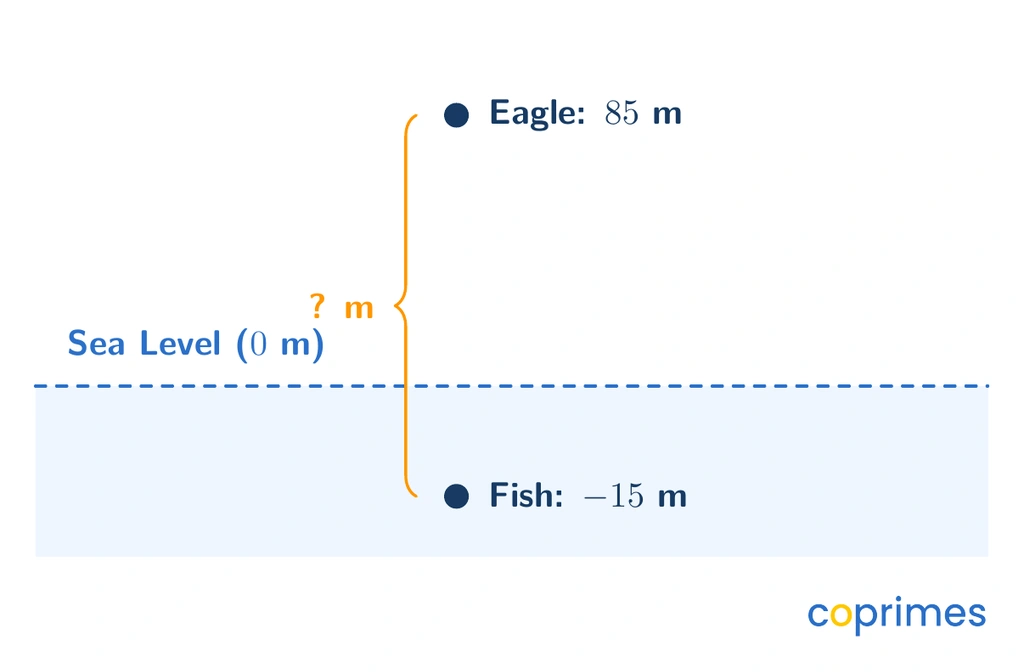
An eagle is flying at an altitude of meters above sea level. A fish is swimming directly below the eagle at a depth of meters below sea level. What is the vertical distance between the eagle and the fish?
meters
meters
meters
meters
meters
Which mathematical expression correctly calculates the final temperature if the morning temperature was and it dropped by ?