
Associative Property of Addition: Concept, Formula, and Examples
The associative property of addition states that regrouping three or more addends does not change their sum. When adding numbers together, you can change where the parentheses are placed, and the final total will remain exactly the same.
This rule is one of the most useful properties of addition, because it allows us to group numbers in ways that make mental mathematics faster and easier.
What is the associative property of addition?
To associate means to connect or join together. In mathematics, grouping is the practice of bringing two or more terms together, usually by placing them inside parentheses.
The associative property tells us that no matter which numbers we join together first, the sum of the entire expression is unchanged.
The parentheses tell us which part of the addition to calculate first.
For example, when adding , we can group the first two numbers: . We calculate to get .
Alternatively, we can group the last two numbers: . We calculate to get .
Both groupings result in the same exact total.
Formula and grouping model
The formula for the associative property of addition uses variables to show that the grouping of addends does not matter.
For any three numbers , , and , the property is written algebraically as:
We can visualize this using a grouping calculation tree.
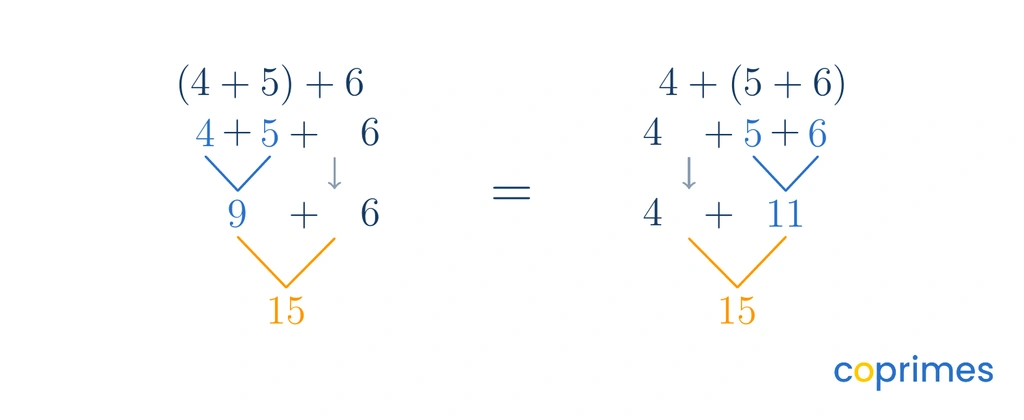
The diagram demonstrates that the grouping does not matter. The final answer remains in both calculations.
Why the property works
When you perform basic addition, you are combining quantities into a single total amount. Because addition simply counts the total number of items, the order and the grouping do not affect the final count.
Whether you place the first two items in a box and add the third later, or you place the last two items in a box and add the first later, you still possess the identical number of items.
The associative property is closely related to the commutative property. The commutative property states that you can move numbers around physically (). The associative property states that you can change the grouping while leaving the physical order exactly the same (). Together, these rules let you add a long string of numbers in whichever way is most convenient.
A learning plan shaped by your child, not the class
State-aligned Math plus our own Logic and English curriculum. An adaptive baseline test finds the gaps and fills them.
How to choose helpful groups
You can use the associative property of addition to create mental-friendly pairs. By shifting the parentheses, you can group numbers that make a multiple of ten.
For example, evaluate the expression .
Written from left to right, you might naturally group the first two numbers: .
Because and are number bonds that make , this grouping is highly helpful. You simply calculate .
If the original expression was , you can still confidently regroup the and together first because the property guarantees the sum will not change.
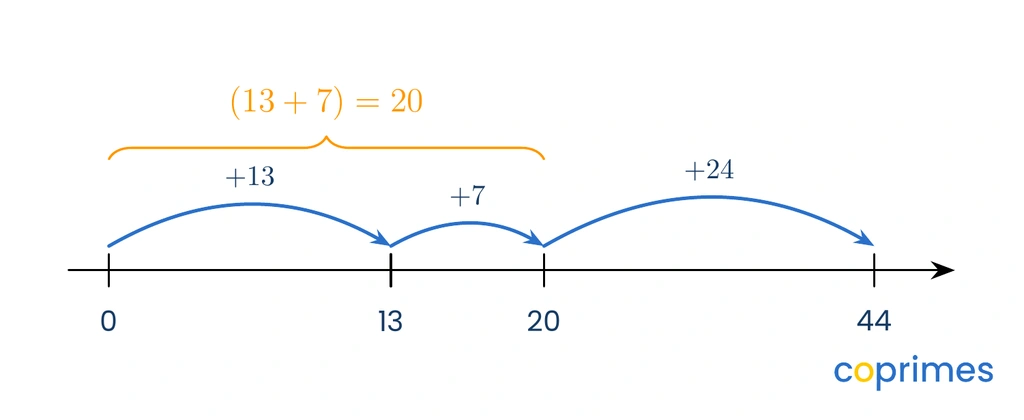
Using the associative property avoids the harder mental jump of calculating , letting you work with round numbers instead.
What is not associative?
The associative property works perfectly for addition, but it does not work for subtraction. Changing the grouping in a subtraction problem will change the final answer.
Consider the expression .
If you evaluate the parentheses first, you calculate , which gives a final answer of .
Now consider grouping the last two numbers instead: .
Evaluating the parentheses first gives . The expression becomes , which gives a final answer of .
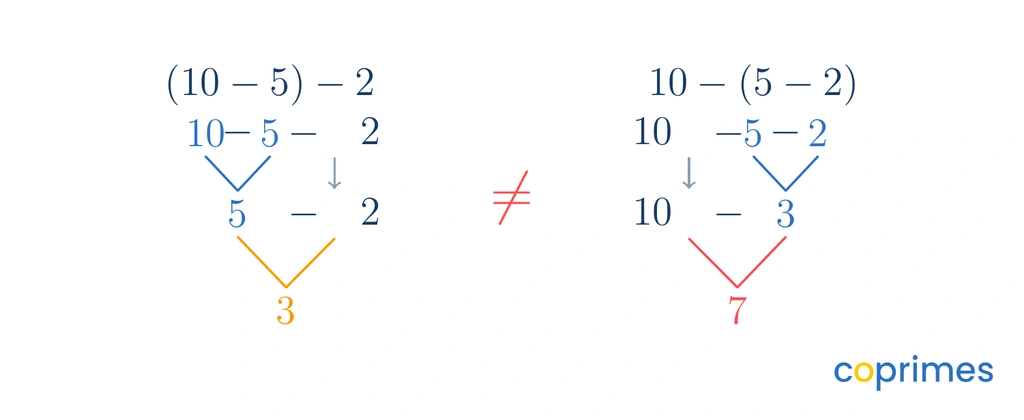
Because does not equal , we know that subtraction is strictly sensitive to grouping. You must subtract precisely from left to right, evaluating any parentheses exactly as written.
Subtraction and division do not follow the associative property.
Worked examples
Example 1: Identifying the property
Question: Which of the following equations shows the associative property of addition?
A)
B)
C)
Method:
- Recall that the associative property involves changing the grouping of three or more numbers using parentheses.
- Check equation A. It changes the order of the numbers. This demonstrates the commutative property.
- Check equation B. The numbers , , and stay in the exact same physical order, but the parentheses move to form a different group. This demonstrates the associative property.
- Check equation C. It shows adding zero to a number. This demonstrates the identity property.
Answer: Equation B shows the associative property.
Check: Evaluate both sides of equation B to ensure they match. . The right side is . Both sides are equal.
Example 2: Using mental-friendly pairs
Question: Use the associative property to calculate in the most efficient way.
Method:
- Identify the current grouping. The parentheses group , which equals . Adding requires some mental effort.
- Look for numbers that combine easily to make a multiple of ten. The numbers and are highly mental-friendly.
- Shift the parentheses to group the first two numbers: .
- Calculate the new parentheses first. .
- Add the remaining number. .
Answer: The sum is .
Check: Add the original grouping to verify the sums are equivalent. . Then . The answers match.
Example 3: Adding four variables
Question: How can you rewrite the algebraic expression by shifting the grouping parentheses to the middle?
Method:
- The associative property states that we can regroup the terms in any continuous sequence of addition.
- The current expression groups the first pair together and the second pair together.
- To shift the grouping to the middle, remove the outer parentheses and place new parentheses around the middle two variables, and .
- The new expression leaves and ungrouped on the outside.
Answer: The rewritten expression is .
Check: Substitute the values , , , and . The original is . The new expression is . Both forms are equivalent.

Frequently asked questions
What is the difference between the associative property and the commutative property?
The associative property deals with changing the grouping of numbers using parentheses, keeping the numbers in the same physical order. The commutative property deals with moving or swapping the physical order of the numbers.
Does the associative property apply to multiplication?
Yes. Just like addition, multiplication is associative. For example, equals . Changing the grouping to equals . Both strategies give the exact same product.
What is the identity property of addition?
After learning about grouping, you might explore the identity property. This property states that adding zero to any number leaves that number unchanged, such as .
Practice questions
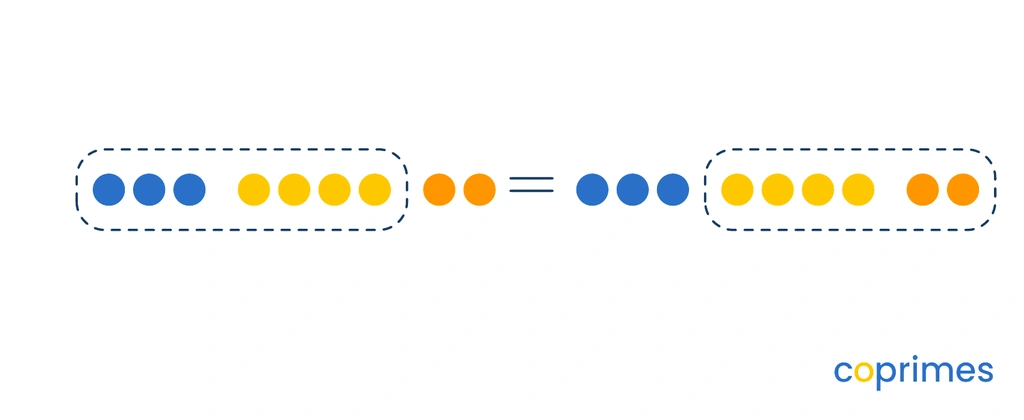
Which equation represents the associative property of addition shown in the diagram?
Which of the following equations accurately demonstrates the associative property of addition?
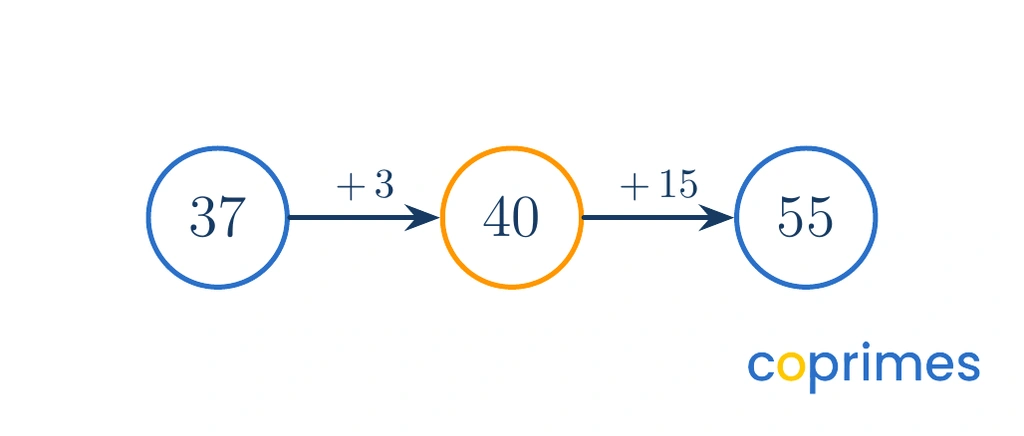
The diagram shows a mental mathematics strategy to find the sum of , , and . Which expression uses the associative property to match this strategy for evaluating ?
A student rewrites the equation as . Why is the second equation considered an easier mental calculation?
Because the order of the numbers has been reversed.
Because subtraction is calculated first.
Because forms a multiple of ten.
Because zero is added to the expression.
Because forms a multiple of ten.
Which mathematical operation, besides addition, also follows the associative property?
Subtraction
Division
Multiplication
None of the above
Multiplication