
Identity Property of Addition
The identity property of addition states that adding zero to any number leaves the number unchanged. Whether you add zero to a whole number, a decimal, or a fraction, the original value remains exactly the same. This basic mathematical rule guarantees that combining any amount with nothing will not alter its size or identity.
What is the identity property of addition?
The identity property is one of the most fundamental properties of addition. It confirms that zero is a unique number that can be added to any value without altering its identity.
Because addition means joining groups or moving forward on a number line, adding a group that contains nothing means the total quantity stays exactly as it was. Zero acts as the identity element for addition.

Why zero is the additive identity
Zero represents an empty set or an absence of quantity. It is mathematically known as the additive identity because it is the only number that maintains the starting value's identity when added.
When you add positive numbers, the value increases. When you add negative numbers, the value decreases. Zero is the only number that causes no change at all. This property simplifies multi-step calculations, especially when grouping numbers differently using the associative property.
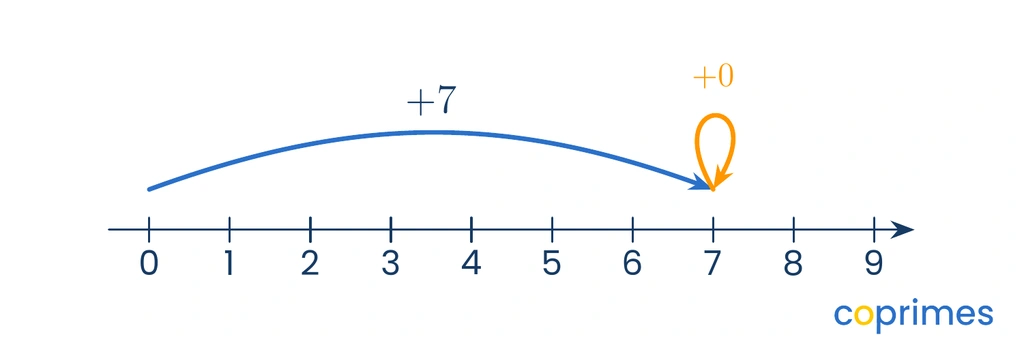
Formula and visual model
The identity property of addition can be written as a general formula using a variable. If represents any number, the property states:
Because addition is commutative, meaning the order of the numbers does not matter, the property can also show zero added on either side:
0 + a = a
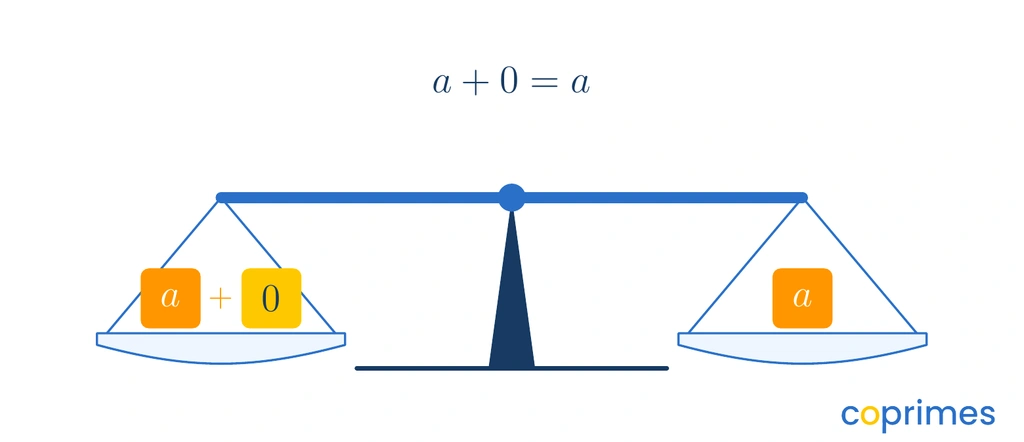

Identity with whole numbers and decimals
The identity property applies uniformly across all types of real numbers. Adding zero will never change the number's mathematical value, regardless of its format.
- Whole numbers: Adding zero to a large whole number does not change it. For example, .
- Decimals: The rule applies directly to decimals and money values. If you have dollars and add nothing, the result is .
- Fractions: Adding zero to a fraction leaves the fraction completely unchanged, such as .
- Negative numbers: Adding zero to a negative integer keeps it negative. For example, .
Common confusions
The most common mistake is confusing the identity property of addition with the zero property of multiplication.
When you add zero to a number, the number stays the same. However, when you multiply any number by zero, the result is always zero.
Adding zero preserves the number, but multiplying by zero results in zero.
It is also important not to confuse this identity rule with opposites and additive inverses. The additive inverse of a number is the opposite value you add to it to reach zero, such as adding to . The additive identity is zero itself.
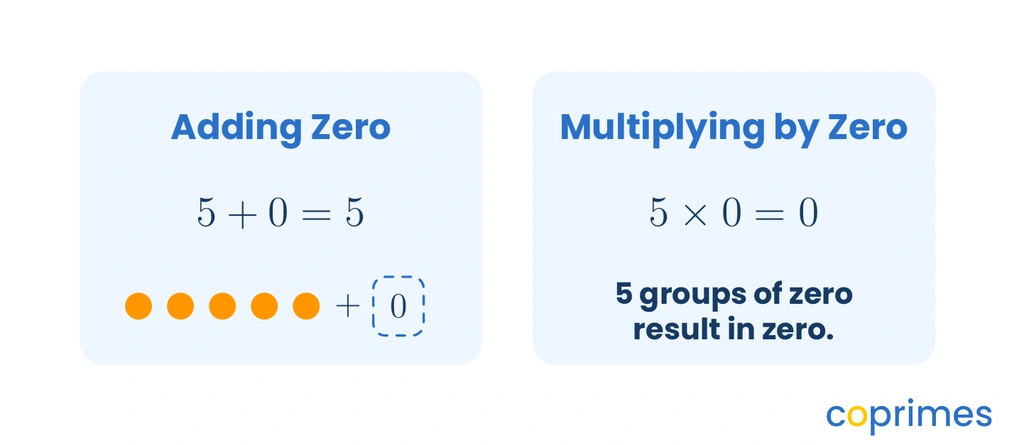
Worked examples
Example 1: Finding a missing number
Question: What number belongs in the blank to make the equation true?
Method:
- Observe the starting number on the left and the final sum on the right.
- Notice that the sum is identical to the starting number.
- Apply the identity property of addition, which states that adding leaves any number unchanged.
Answer: The missing number is .
Check: . The equation is balanced.
Example 2: Identifying the property
Question: Which of these three equations shows the identity property of addition: , , or ?
Method:
- Evaluate the first equation, which adds two non-zero numbers to get a completely new sum.
- Evaluate the second equation, which shows multiplication by zero instead of addition.
- Evaluate the third equation, which shows a fraction being added to zero to yield the original fraction.
Answer: The equation shows the property.
Check: The chosen equation perfectly matches the additive identity formula .
A learning plan shaped by your child, not the class
State-aligned Math plus our own Logic and English curriculum. An adaptive baseline test finds the gaps and fills them.
Frequently asked questions
What is the additive identity element?
The additive identity element is . It is the only number that can be added to any other value without changing that value.
Does the identity property apply to negative numbers?
Yes. The property applies to all real numbers, including negative integers. For instance, adding zero to gives .
Is there an identity property for subtraction?
Subtracting zero from a number leaves the number unchanged, as in . However, because subtraction is not commutative and does not equal , there is no formal two-way identity property for subtraction.
What is the difference between additive identity and multiplicative identity?
The additive identity is , because adding zero leaves a number unchanged (). The multiplicative identity is , because multiplying any number by one leaves the number unchanged ().
Practice questions
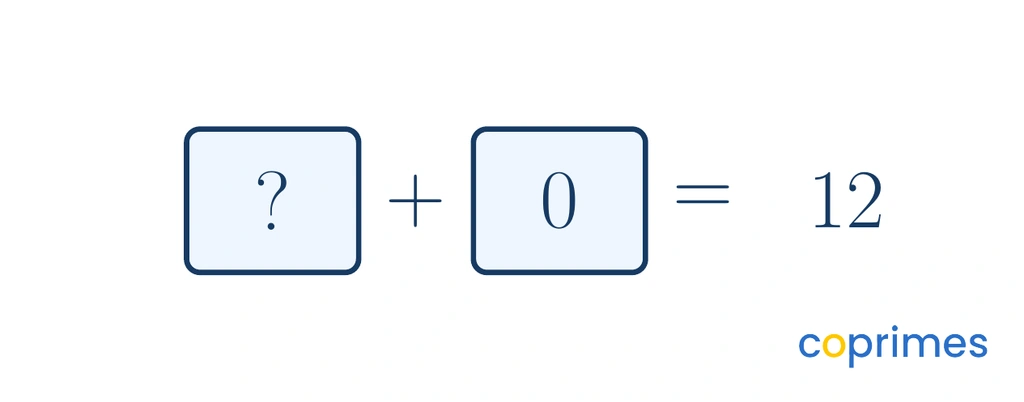
What value replaces the question mark in the model to make the equation true?
Which equation correctly demonstrates the identity property of addition?
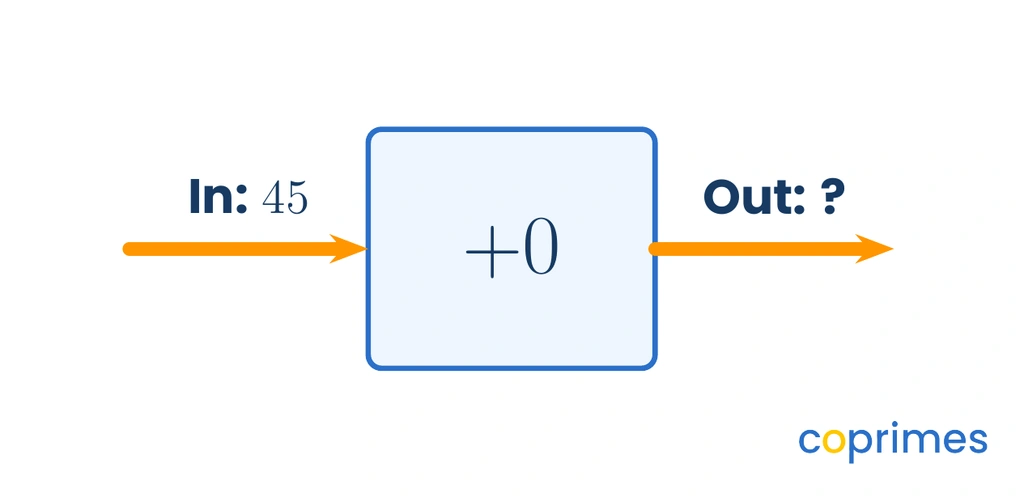
What is the output of this function machine?
If , what is the value of ?
A student wrote on a mathematics test. What mistake did the student make?
They incorrectly applied the addition identity rule to a multiplication problem.
They should have added the numbers together to get .
They subtracted zero instead of multiplying by zero.
They forgot that multiplying any number by zero always results in one.
They incorrectly applied the addition identity rule to a multiplication problem.