
Properties of Addition: Definition, Rules, and Examples
Addition is the method of combining two or more numbers to find a total. The numbers being added are called addends, and the final value is called the sum.
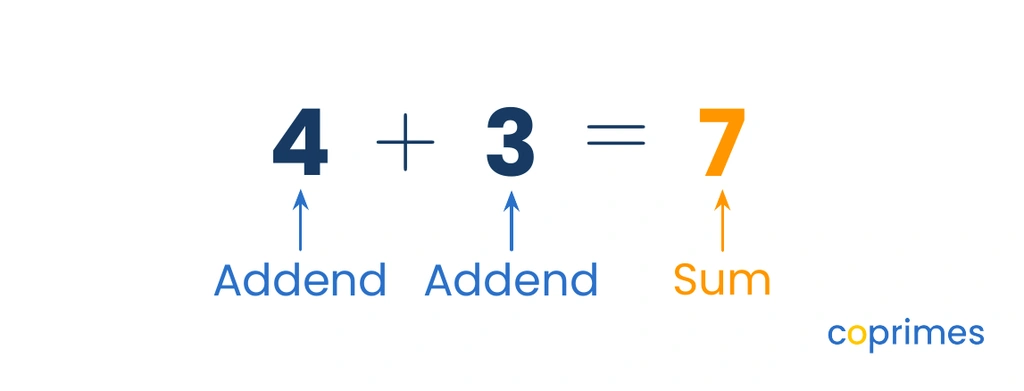
The properties of addition are mathematical rules that describe how these numbers behave when they are added together. They prove that you can change the order or grouping of numbers without changing the final total, making it easier to solve problems and simplify calculations.
What are the properties of addition?
The main addition rules help us calculate sums more quickly and mentally rearrange complex equations.
These core rules include the commutative property, the associative property, the identity property, and the closure property. Each property defines a specific mathematical truth about how addition works, which remains consistent across whole numbers, fractions, and decimals.
Commutative property
The commutative property states that changing the order of the addends does not change the sum. You can add two numbers in any order and get the exact same result.
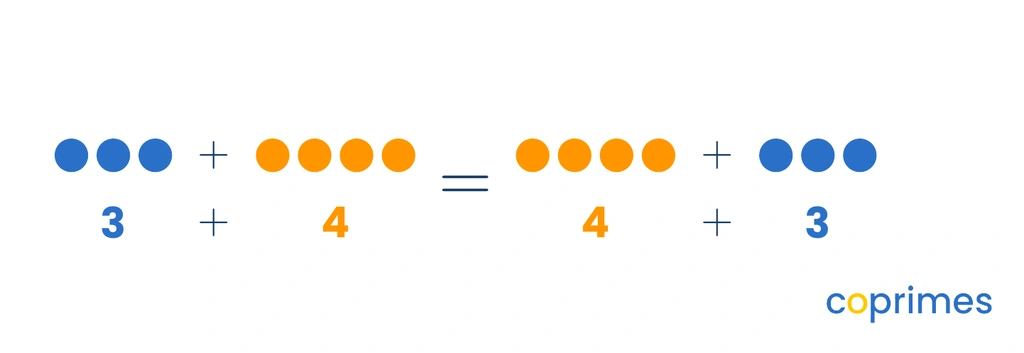
Symbolically, this is written as .
Numerically, we see this property in action because , and .
Subtraction does not follow this rule. If you change the order of numbers during subtraction, the answer changes completely. For instance, , but .
Associative property
The associative property states that changing the grouping of the addends does not change the sum. When adding three or more numbers, you can group them differently using parentheses, and the final total remains the same.
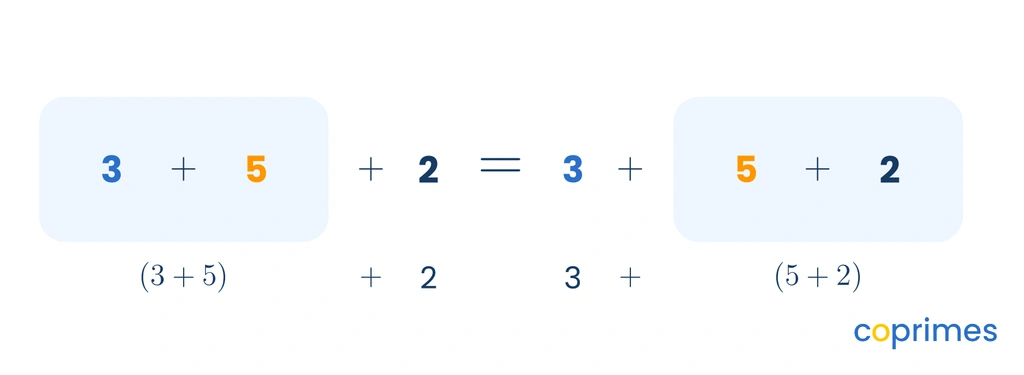
Symbolically, this is written as .
Numerically, grouping different numbers first gives the same total:
Subtraction is not associative. If you group subtracted numbers differently, you arrive at different answers. For example, , but .

Identity property
The identity property states that adding zero to any number does not change the value of that number. Because it preserves a number's identity, zero is known as the additive identity.
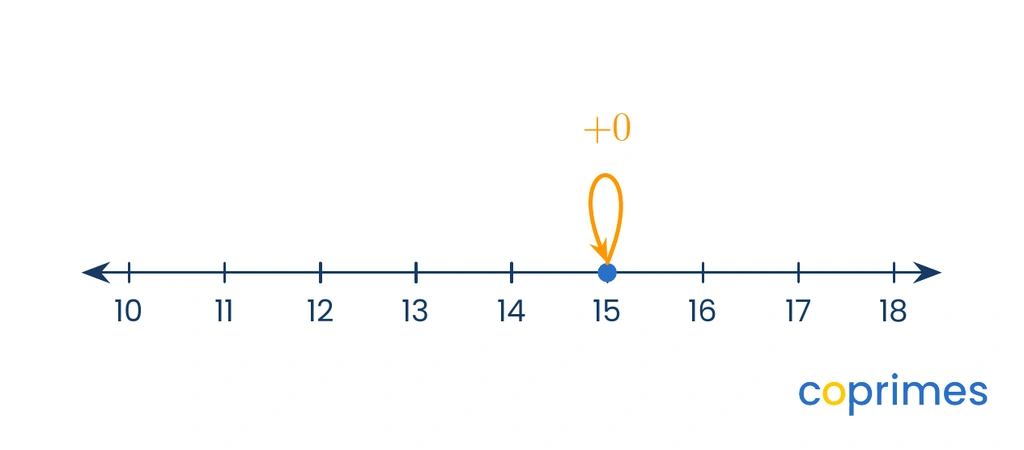
Symbolically, this is written as and .
Numerically, adding zero ensures the value remains completely unchanged: .
Closure property
The closure property states that when you add two numbers from a specific group, the resulting sum will always belong to that exact same group.
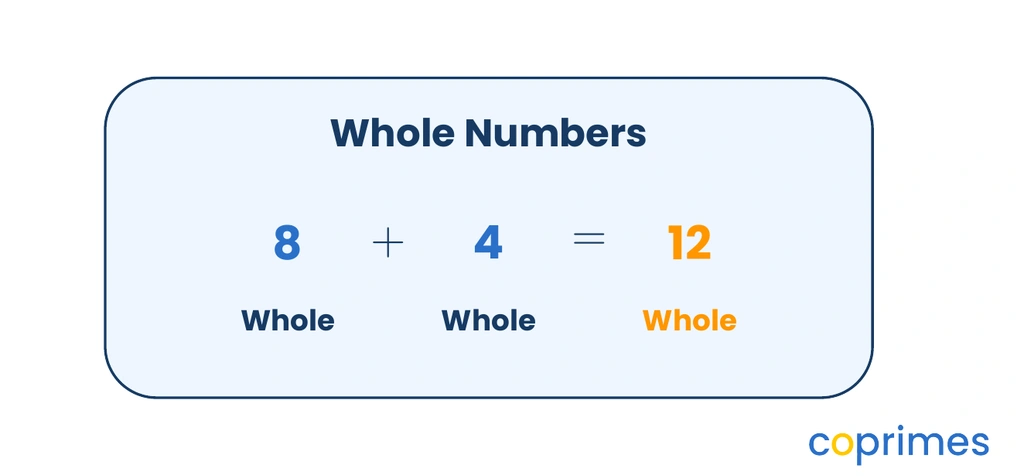
For example, when you add two whole numbers, the result is always a whole number. You will never add two whole numbers and somehow produce a fraction or a decimal.
Numerically, . Since and are whole numbers, and their sum is also a whole number, addition is considered closed for whole numbers.
How properties simplify calculations
We can use the commutative and associative properties together to simplify a multi-addend calculation. By rearranging and grouping numbers that are easy to add, we can often solve long problems mentally.
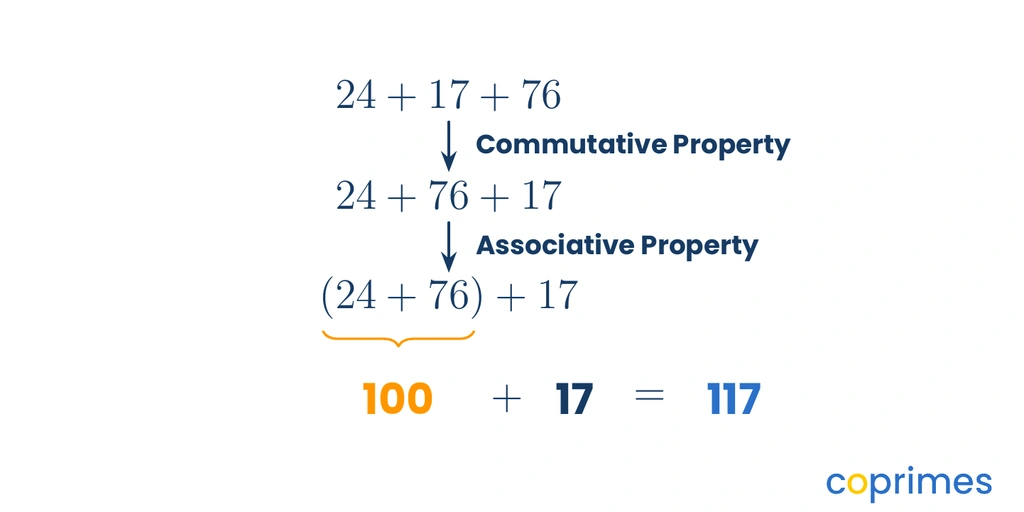
Suppose we want to add .
First, we use the commutative property to rearrange the numbers so that compatible values sit directly next to each other. This creates the expression .
Next, we use the associative property to group and , because they combine to make a perfect multiple of . This creates .
Finally, we add the grouped numbers and the remaining amount to reach .
A learning plan shaped by your child, not the class
State-aligned Math plus our own Logic and English curriculum. An adaptive baseline test finds the gaps and fills them.
Worked examples
Example 1: Identifying the property used
Question: Which property is shown in the equation ?
Method:
- Observe the numbers used in the equation.
- Notice that zero is being added to a number.
- The sum is exactly the original number, meaning its identity has not changed.
Answer: This shows the identity property of addition.
Check: The identity property states that , which matches the structure of .
Example 2: Finding a missing number
Question: Find the missing number using the associative property:
Method:
- Identify the addends on the left side of the equation: , , and .
- The associative property states that the exact same numbers can be grouped differently without changing the total sum.
- The right side already has and . The missing number must be the remaining addend.
Answer: The missing number is .
Check: Calculate both sides manually. . On the right side, . Both sides are equal.
Example 3: Simplifying a multi-addend sum
Question: Use the properties of addition to simplify .
Method:
- Look for addends that easily combine to make a multiple of . Here, and combine to perfectly make .
- Use the commutative property to rearrange the numbers to place those addends together: .
- Use the associative property to group the compatible numbers: .
- Add the grouped numbers first: .
Answer: The simplified sum is .
Check: Adding from left to right gives , and . The result is the exact same.
Frequently asked questions
What is the additive inverse?
The additive inverse is the mathematical opposite of a number. When you add a number and its additive inverse, the result is zero. For example, the additive inverse of is , because .
What is the difference between additive identity and additive inverse?
The additive identity is always zero, because adding zero to a number leaves the original number unchanged. The additive inverse is the opposite of a specific number, which is added to that number to intentionally yield zero.
What is the zero property of addition?
The zero property is simply another name for the identity property. It states that any number added to zero equals the original number itself.
Practice questions
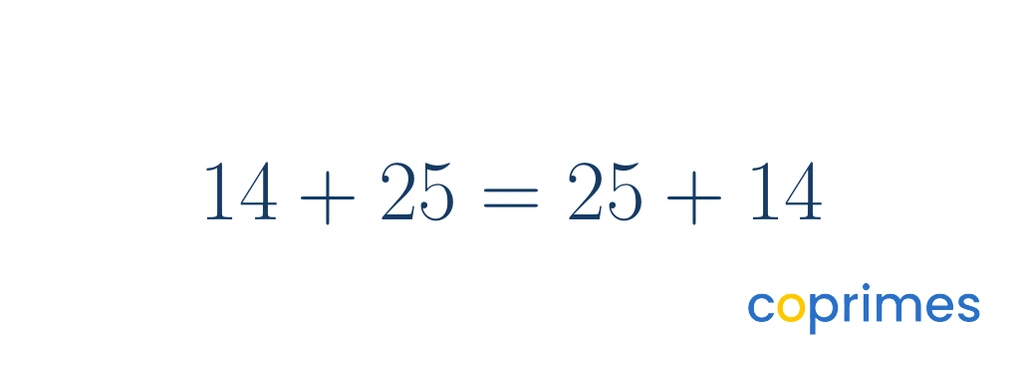
Which property of addition is shown in the model above?
Commutative property
Associative property
Identity property
Closure property
Commutative property
Which equation correctly shows the associative property of addition?
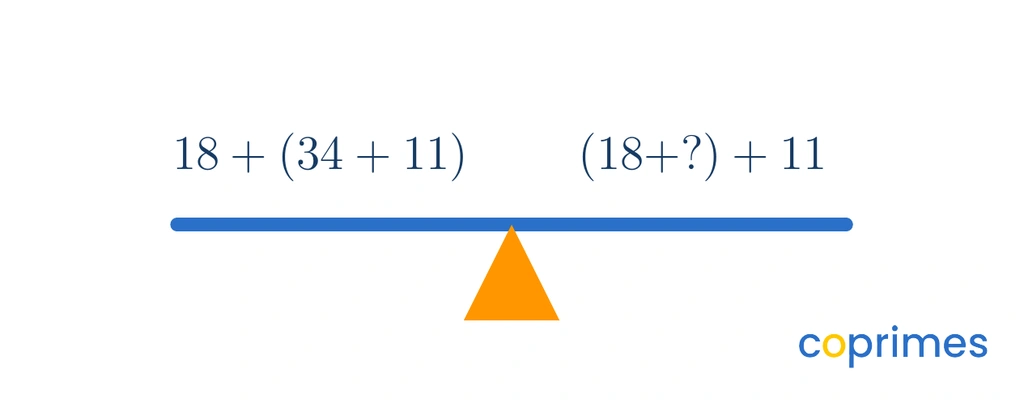
Find the missing number needed to make the balance scale equal using the associative property.
Why does the commutative property not apply to subtraction?
Because subtracting zero leaves the number unchanged.
Because changing the order of the numbers changes the result.
Because subtraction does not involve grouping with parentheses.
Because the difference is always a whole number.
Because changing the order of the numbers changes the result.
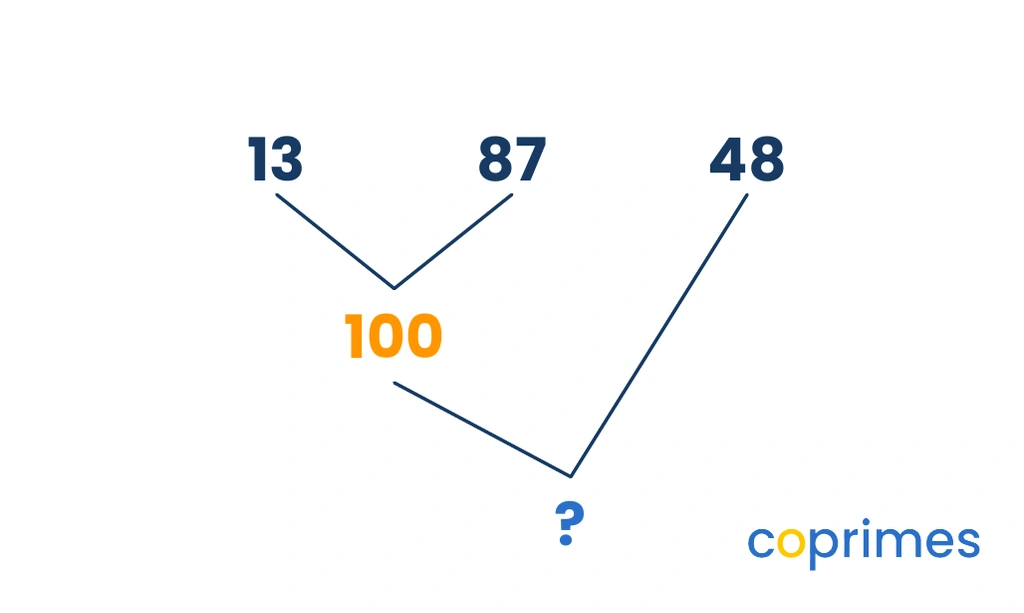
What is the final sum in this simplified calculation?