
Comparing Whole Numbers: Guide and Examples
Whole numbers are compared first by their number of digits and then, when needed, digit by digit from the greatest place value. Comparing numbers helps us determine which quantity is larger, which is smaller, or whether two quantities are exactly the same.
Always count the digits first before looking at the individual numbers.
What Is Comparing Whole Numbers?
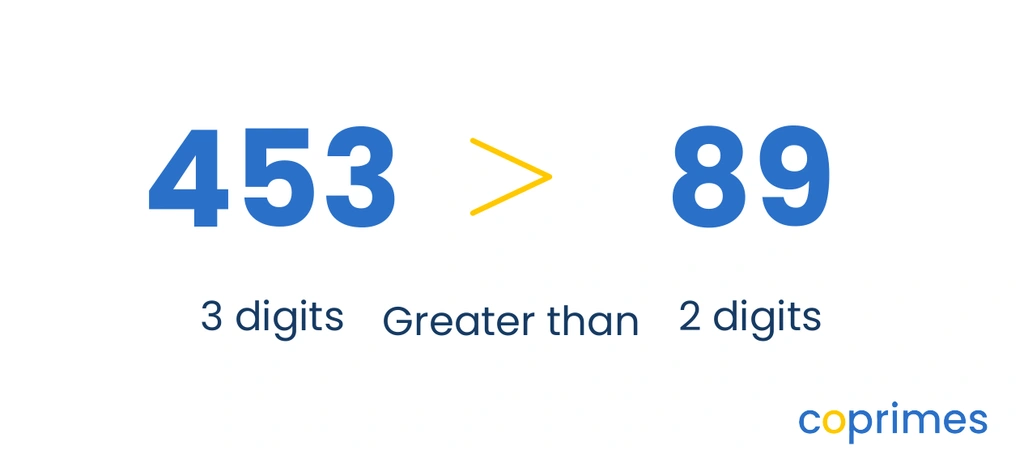
Comparing whole numbers is the mathematical process of evaluating two values to see their size relationship. When we compare values, we express the result using standard mathematical symbols.
We write the relationship using one of three primary signs: greater than less than equal to.
- The greater than symbol () opens toward the larger number on the left.
- The less than symbol () opens toward the larger number on the right.
- The equal to symbol () shows both values represent the exact same quantity.
When to Use It
Comparing numbers is an essential daily skill. You use it to determine which item costs less, which journey takes longer, or who achieved the highest score in a game.
Mastering this skill is the direct foundation for ordering numbers from least to greatest in long lists.
It is also a necessary step before comparing integers, where you will learn to apply these same rules to values that fall below zero.
Step-by-Step Method
To compare any two whole numbers, apply these two rules in order. Relying on place value alignment is the most reliable way to find the larger number.
- Count the digits. The number with more digits is always greater. A four-digit number represents thousands, which is intrinsically larger than any three-digit number representing hundreds.
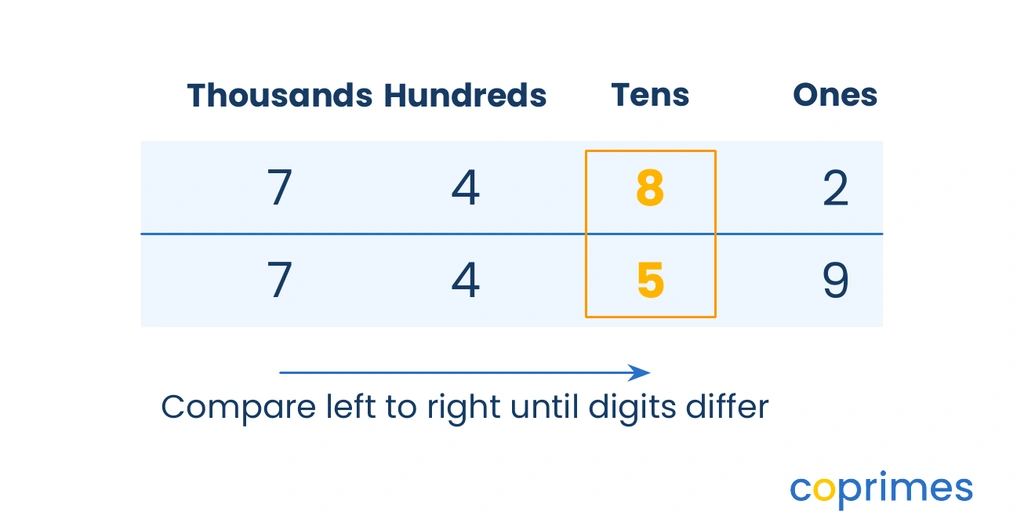
- Compare left to right. If both numbers have the same number of digits, compare the digits in the greatest place value first (the far left).
- Move one place right. If the leading digits are the same, move to the right and compare the next digits. Keep moving right until you find two digits that are different.
When dealing with extremely large values, using estimation in math can help you perform a quick initial check before applying this strict step-by-step method.

Visual Worked Examples
Example 1: Unequal digit counts
Question: Compare and . Which number is greater?
Method:
- Count the digits in the first number: has digits.
- Count the digits in the second number: has digits.
- Compare the counts. A -digit number reaches the ten-thousands place, while a -digit number only reaches the thousands place.
Answer: is greater. We write this as .
Check: Since is larger than and is smaller than , the conclusion is correct.
Example 2: Equal digits, different first digit
Question: Compare and using the correct symbol.
Method:
- Count the digits. Both numbers have digits.
- Compare the greatest place value (thousands).
- The first number has a in the thousands place. The second number has a .
- Since is greater than , the first number is greater.
Answer: .
Check: is close to , and is close to . Since is greater than , the relationship holds true.
Example 3: Equal leading digits and internal zeros
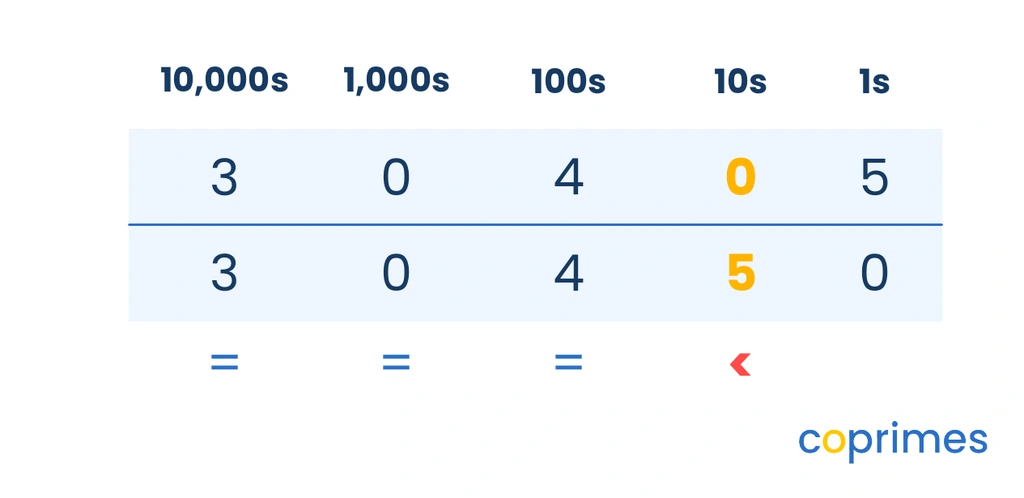
Question: Compare and .
Method:
- Count the digits. Both have digits.
- Compare left to right. The ten-thousands digits () are equal.
- Move to the right. The thousands digits () are equal.
- Move to the right again. The hundreds digits () are equal.
- Move to the right. In the tens place, the first number has a , and the second number has a .
- Since , the first number is smaller.
Answer: .
Check: Read the numbers aloud. "Thirty thousand, four hundred five" is less than "Thirty thousand, four hundred fifty."
How to Check the Answer
You can verify your comparison using a reverse check. Read the relationship backward, swapping the symbol direction. If you determined that , reading it backward yields . Both statements must make logical sense.
Another reliable check is plotting the numbers mentally on a number line. Numbers further to the right on a standard horizontal number line are always larger.
Common Mistakes
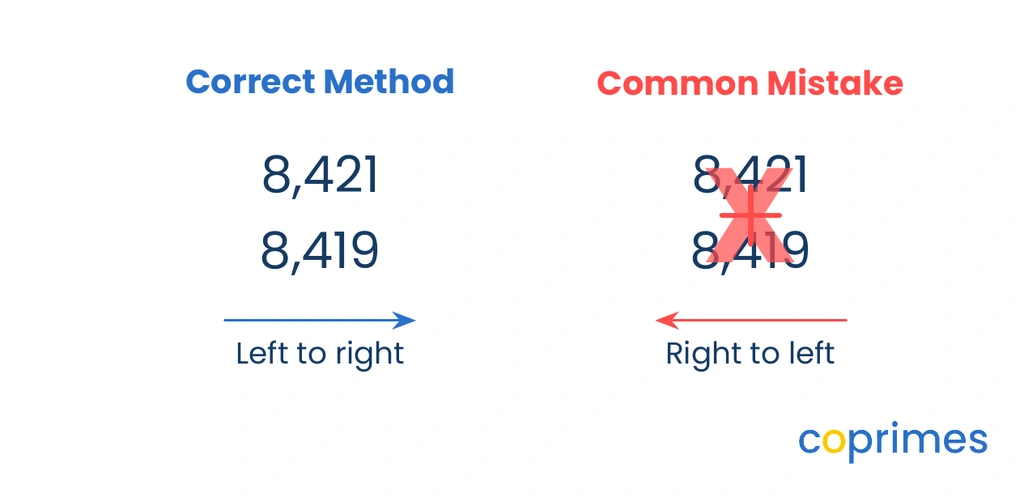
A major misconception is starting the digit comparison from the ones place (the far right). When adding or subtracting, we start from the right, but when comparing, we must start from the greatest place value (the far left).
Another frequent error is ignoring the number of digits. A student might look at and and mistakenly think is larger because the leading digit is greater than . You must count the total digits first.
A learning plan shaped by your child, not the class
State-aligned Math plus our own Logic and English curriculum. An adaptive baseline test finds the gaps and fills them.
Practice questions
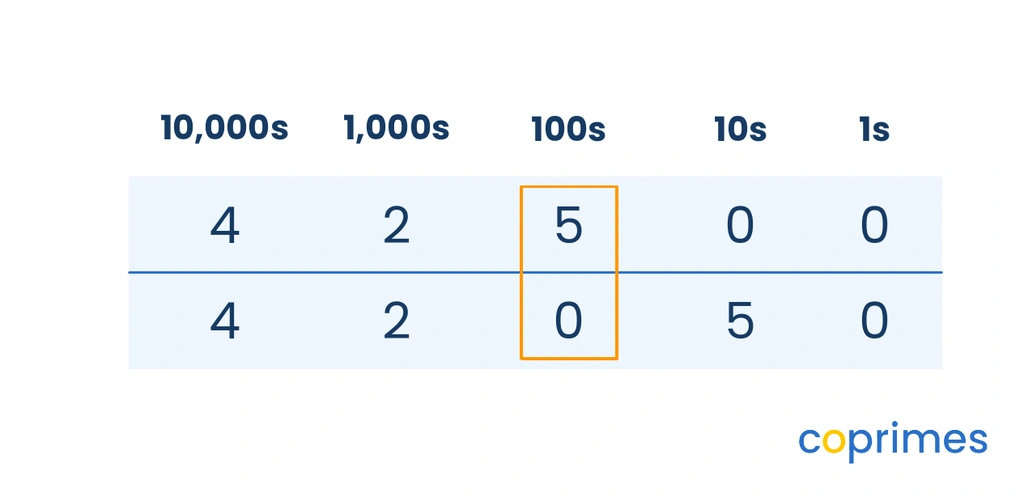
Based on the place value chart, which symbol correctly compares and ?
Compare the numbers and . Which statement is true?
Which of the following numbers is the greatest?
A student compared and by looking at the ones place first. They saw that is less than and wrote . Why is this reasoning incorrect?
The student used the wrong symbol for their conclusion.
Comparison must start from the greatest place value on the left, not the ones place.
The student should have counted the digits first, which would reveal the answer.
The student should have added the digits together to find the larger number.
Comparison must start from the greatest place value on the left, not the ones place.
City A has a population of . City B has a population of . Which city has the larger population?
City A
City B
They are equal.
Cannot be determined.
City A