
Understanding Unit Rate: Definition, Methods, and Examples
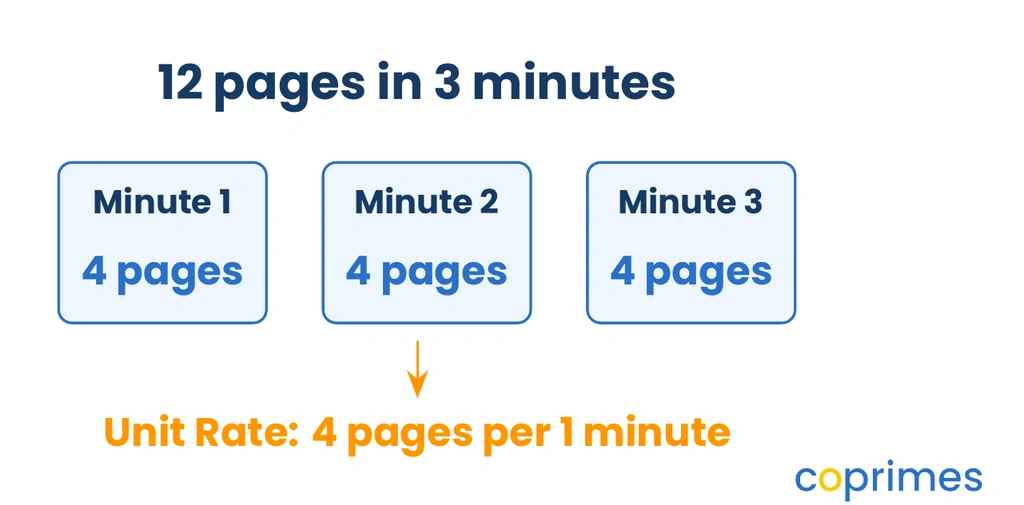
A unit rate is a rate written for one unit of the second quantity. For example, pages in minutes is pages per minute, so the unit rate is pages per minute.
When comparing two different measurements, expressing them as a single-unit value makes them easier to understand and compare.
What is a unit rate?
A rate is a mathematical comparison of two quantities with different units, such as miles and hours. A unit rate simplifies this comparison so that the second quantity—the denominator—is exactly .
Because it measures the amount for just one unit, it is sometimes called a per-one rate, a rate for one unit, or a unitary rate. Common unit rate examples include speed measured in meters per second, earnings measured in dollars per month, and density measured in grams per cubic centimeter.
Find the value for one unit
To calculate a unit rate, write the initial comparison as a fraction. Then, divide both the numerator and the denominator by the denominator's value. This forces the bottom number to become .
For example, if a cyclist travels miles in hours, write this as . Divide both quantities by :
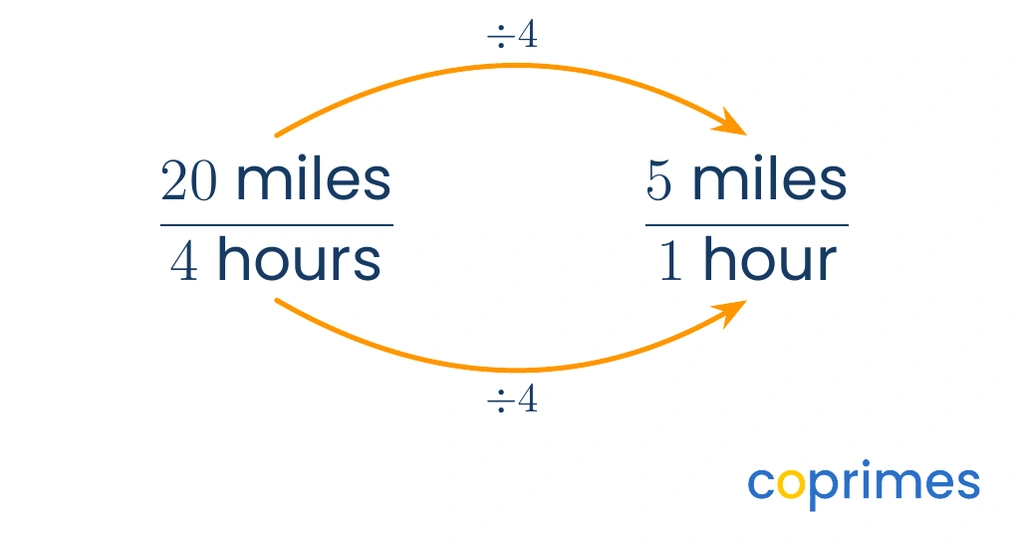
The result is , or a unit rate of miles per hour.
Keep units in the answer
A number by itself does not communicate a rate. The units are essential because they explain exactly what two quantities are being compared.
When writing the final answer, use the word "per" or a slash to separate the two units. The word "per" means "for every one." For instance, an answer of is incomplete, but words per minute clearly describes a typing speed. Always read the original problem carefully to ensure the units in the numerator and denominator match the final statement.
A learning plan shaped by your child, not the class
State-aligned Math plus our own Logic and English curriculum. An adaptive baseline test finds the gaps and fills them.
Use a diagram or table
Visual models make it easier to see how quantities change together. You can use ratio tables or double number lines to scale rates down to a single unit.
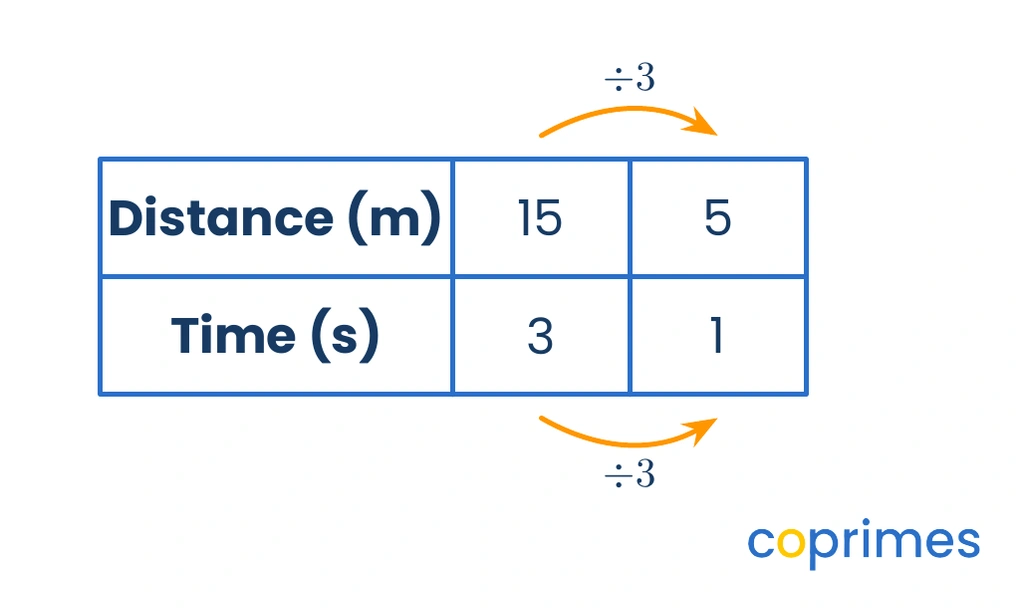
In a ratio table, you place the two quantities in separate rows or columns. By applying the same division operation to both parts, you can step down from a larger rate until the second quantity reaches .
Connect unit rates and equivalent ratios
A unit rate is fundamentally a special type of ratio. When you divide the numerator and the denominator of a rate by the same value, you are creating equivalent ratios.
The ratio represents the same relationship as . They are equivalent because they simplify to the same value. Finding a unit rate is the process of scaling a ratio down to its simplest possible denominator. This principle is why rates can be expanded back up to solve broader proportion problems.
Worked examples
Example 1: Exact whole-number rate
Question: A baker makes muffins in hours. What is the unit rate?
Method:
- Write the given rate as a fraction: .
- Divide both the numerator and the denominator by to find the value for hour.
- Calculate: .
Answer: The unit rate is muffins per hour.
Check: .
Example 2: Decimal rate and unit price
Question: A grocery store sells avocados for dollars. What is the unit price per avocado?
Method:
- Draw a double number line to represent the cost and the number of avocados.
- Write the rate with the cost on top: .
- Divide both values by : .
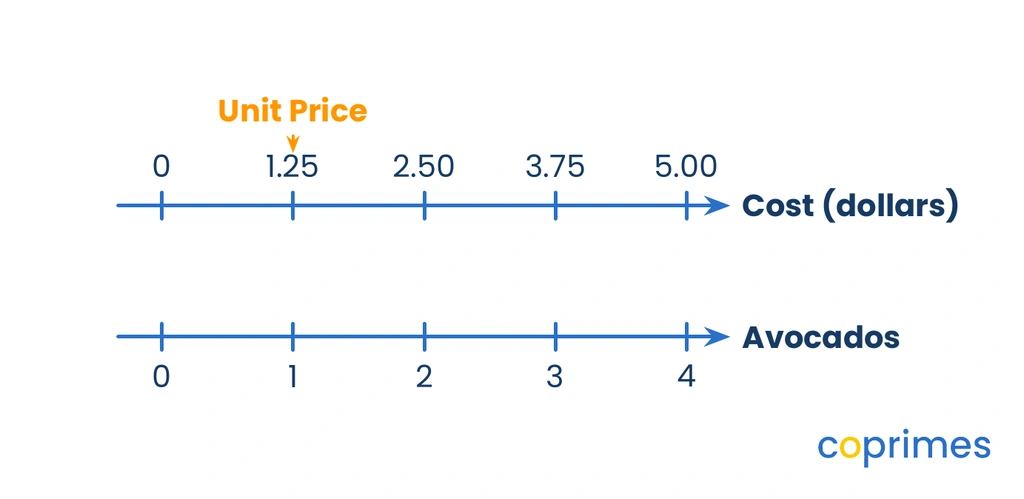
Answer: The unit rate is dollars per avocado.
Check: dollars.
Example 3: Fraction-rate extension
Question: A snail crawls of a meter in of an hour. What is the snail's speed in meters per hour?
Method:
- Set up the rate as a complex fraction.
- Divide the numerator by the denominator. Dividing by a fraction is the same as multiplying by its reciprocal.
- Calculate: .
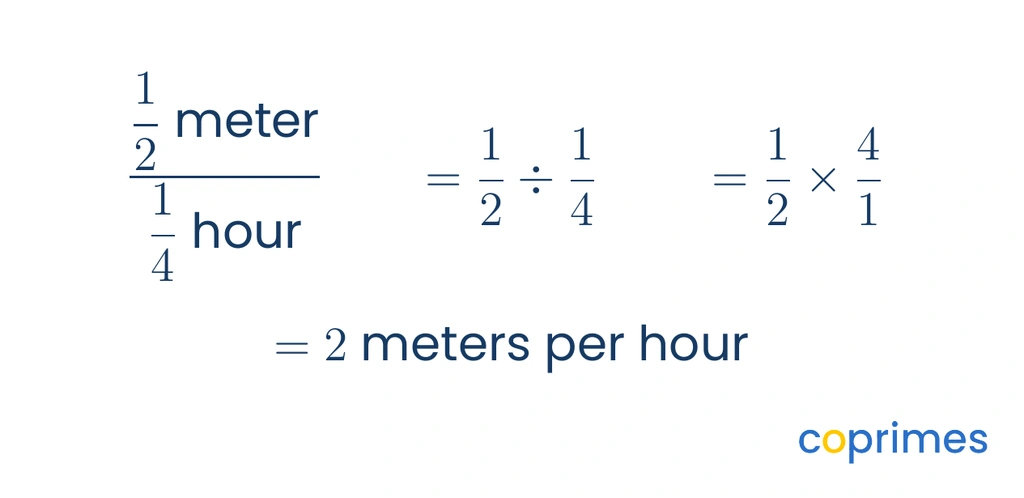
Answer: The unit rate is meters per hour.
Check: .

Common mistakes
Swapping the numbers in division
A common error is dividing the second quantity by the first quantity. If a car travels miles in hours, dividing by gives hours per mile. While this is mathematically valid for a different purpose, the standard unit rate for speed is miles per hour. Always identify which unit should be and make that the denominator.
Believing a unit rate cannot be a decimal
Some learners think a unit rate must always be a whole number. In reality, unit rates are frequently decimals or fractions, especially when dealing with money, weight, or precise measurements.
Frequently asked questions
What is the difference between a rate and a unit rate?
A rate compares any two quantities with different units, such as miles in hours. A unit rate is a specific type of rate where the second quantity is exactly , such as miles per hour.
Can a unit rate have a fraction in the answer?
Yes. If a recipe calls for cup of sugar per batch, the unit rate is a fraction.
How is a unitary rate used in real life?
Stores use them to display the price per item or ounce, helping shoppers find the best deal. Engineers use them to measure speed, efficiency, and flow.
Now that you understand these foundations, you can focus on finding a unit rate in more complex word problems.
Practice questions
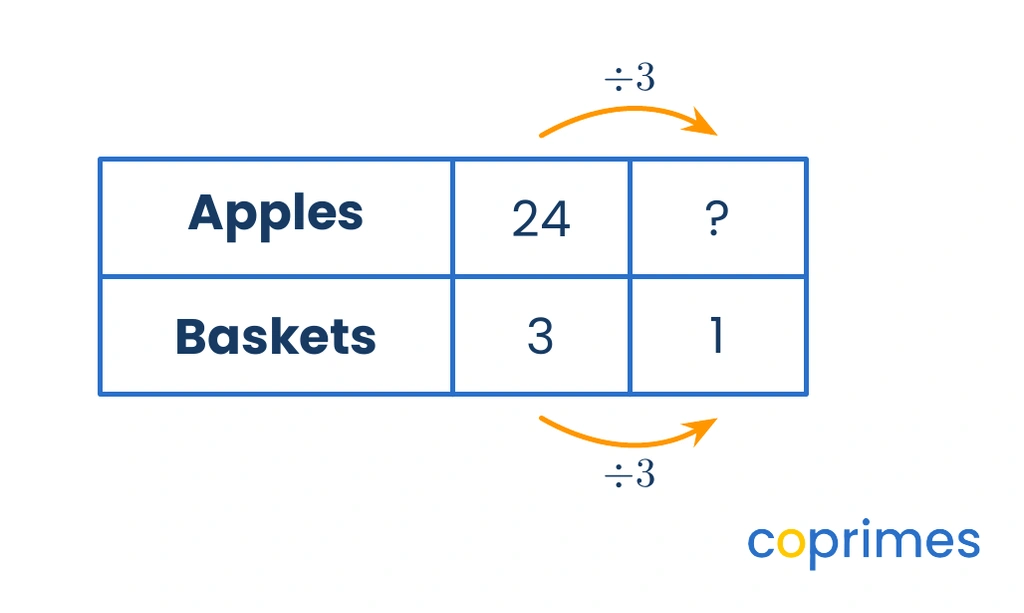
Which option describes the missing unit rate in the ratio table?
8 apples per basket
3 baskets per apple
24 apples per basket
1 basket per 8 apples
8 apples per basket
A machine prints posters in minutes. What is the unit rate in posters per minute?
750
30
5
145
30
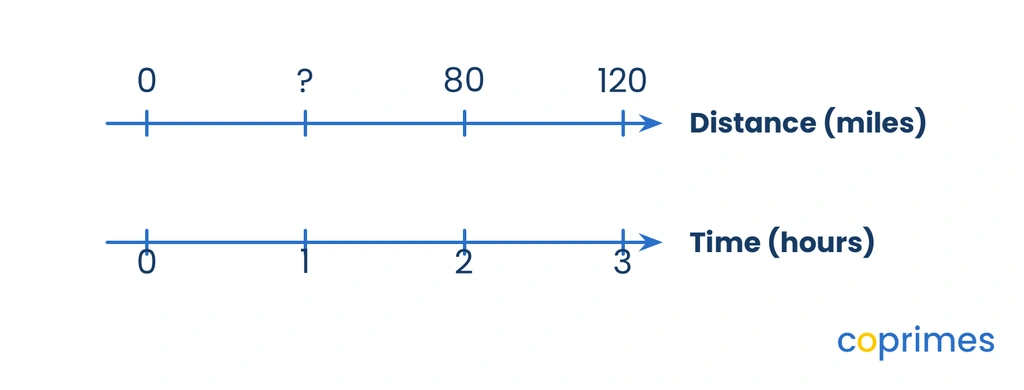
The double number line shows a vehicle travelling at a constant speed. What is the missing unit rate at hour?
80 miles per hour
60 miles per hour
20 miles per hour
40 miles per hour
40 miles per hour
A runner completes a -kilometer race in hours. A student calculates the unit rate as hours per kilometer. Why is this usually considered an incorrect representation for speed?
A unit rate must always be a whole number, so is invalid.
The student should have added the quantities instead of dividing them.
Speed is measured in distance per unit of time, not time per unit of distance.
The student divided correctly but forgot to multiply by the total distance.
Speed is measured in distance per unit of time, not time per unit of distance.
Store A sells liters of juice for dollars. Store B sells liters of the same juice for dollars. Which store has the lower unit price, and what is it?
Store B at 3 dollars per liter
Store A at 6 dollars per liter
Store A at 2 dollars per liter
Store B at 15 dollars per liter
Store A at 2 dollars per liter