
Missing Number Problems
Missing number problems ask for an unknown value in an equation, pattern, diagram, or word problem. To find missing numbers in math, use the operational relationship between the given values, apply the correct inverse operation, or draw a model to find and verify the unknown.
What are missing number problems?
Missing number problems ask you to find an unknown value in a calculation to make the mathematical statement true.
These unknown amounts can be represented by a question mark, a blank line, an empty box, or a letter. Often, these problems test your understanding of how numbers balance perfectly on either side of an equals sign.
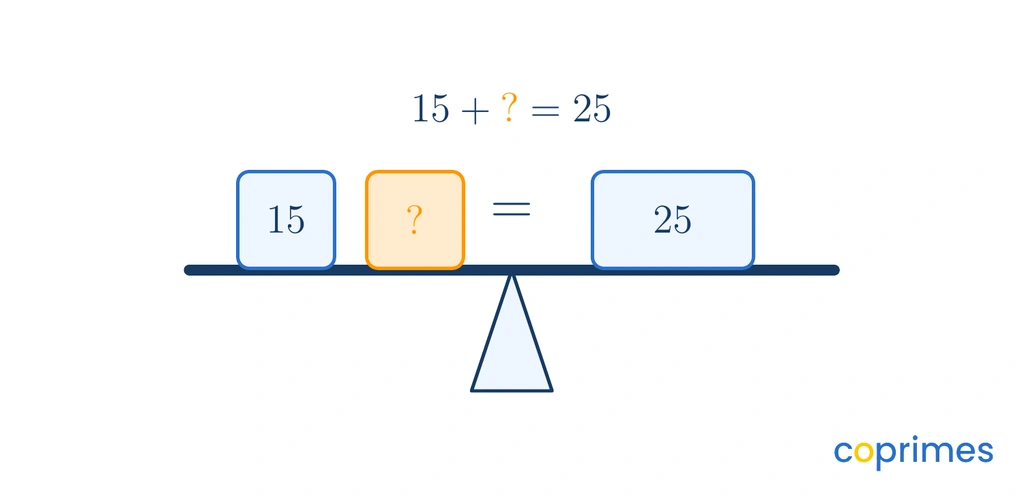
Identify the unknown
The first step in solving a missing value problem is identifying exactly which part of the equation is missing.
An unknown value could be a starting total, an added part, a multiplier, or a divisor. When working with sentences instead of standard equations, translating words into math helps reveal which part of the relationship needs to be calculated.
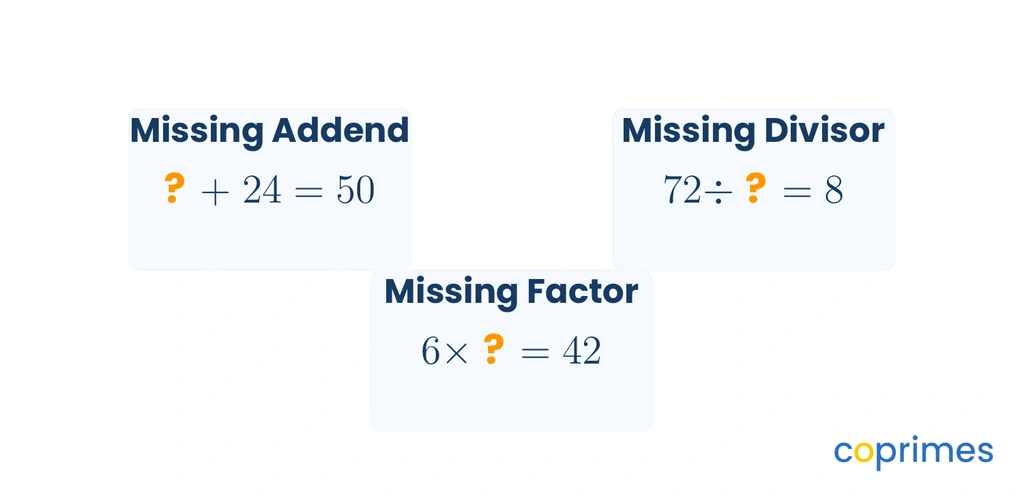
Use inverse operations
You can often find an unknown number by working backward using the opposite mathematical operation.
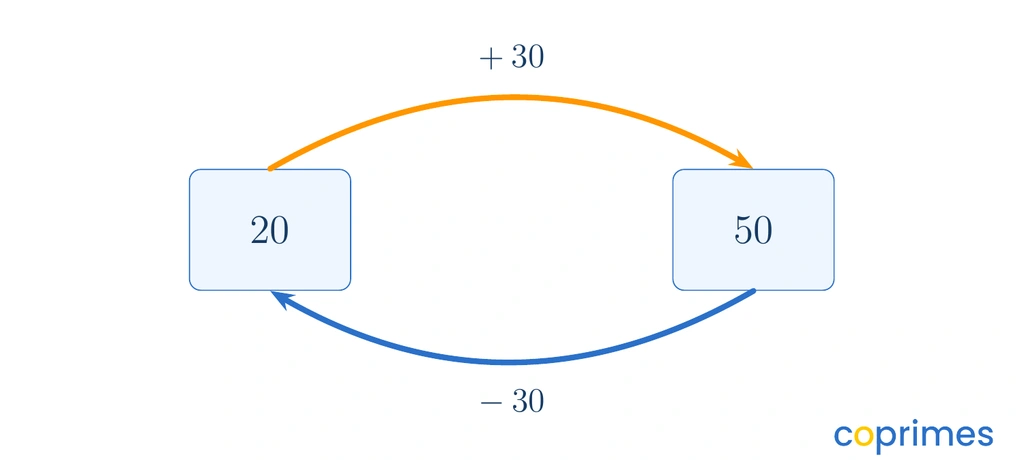
Inverse operations are opposite actions that undo each other.
Addition and subtraction undo each other, which relies on the inverse relationship between addition and subtraction. If an equation adds a number, you subtract that same number to isolate the unknown.
Similarly, multiplication and division undo each other. Mastering multiplication and division fact families allows you to quickly switch between these operations to solve for the missing number.

Use a diagram or bar model
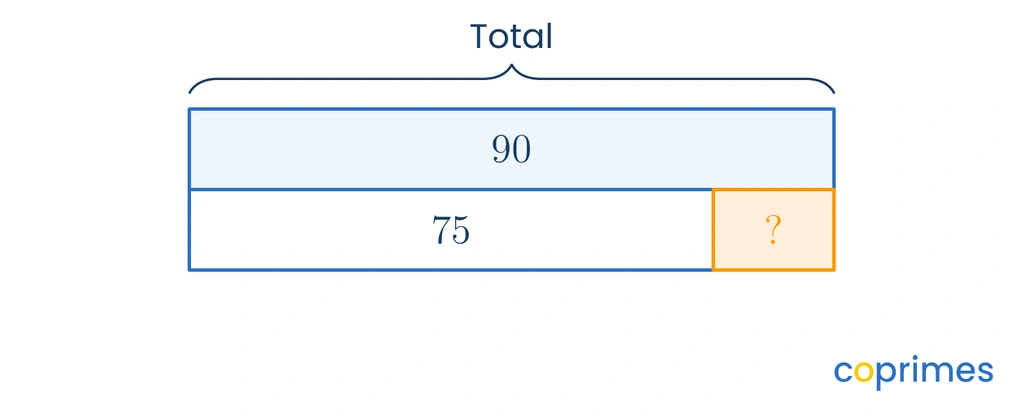
Diagrams turn abstract numbers into visible relationships, making it clear whether you need to add or subtract.
When you encounter math word problems, drawing bar models in math organizes the information visually. A bar model splits a total value into smaller parts. If the total is missing, you add the parts together. If a part is missing, you subtract the known part from the total.
Check by substitution
Always verify your final result by testing it in the original calculation.
Once you calculate the unknown number, substitute it back into the equation in place of the question mark. If the calculation is correct, the equation will balance perfectly. For example, if you decide the missing number in is , you check it by calculating . Since that equals , your answer is verified.
Worked examples
Practise identifying the missing element and choosing the correct inverse operation.
Example 1: Finding a missing subtrahend
Question: What is the missing number in ?
Method:
- Recognise that a part is being taken away from the whole to leave .
- Find the difference between the starting amount and the final amount.
- Calculate .
Answer: The missing number is .
Check: Substitute the answer back into the equation: . The calculation is correct.
Example 2: Finding a missing factor
Question: Find the unknown value in .
Method:
- Identify the opposite operation. The inverse of multiplication is division.
- Divide the product by the known factor.
- Calculate .
Answer: The unknown value is .
Check: Substitute into the original equation: . The result matches perfectly.
Example 3: Solving a missing value word problem
Question: A baker makes muffins. After selling some, there are muffins left. How many muffins did the baker sell?
Method:
- Write the word problem as an equation: .
- Identify that finding the difference between the starting total and the remaining total gives the missing amount.
- Calculate .
Answer: The baker sold muffins.
Check: Substitute the sold amount into the original story: minus equals . The result is correct.
A learning plan shaped by your child, not the class
State-aligned Math plus our own Logic and English curriculum. An adaptive baseline test finds the gaps and fills them.
Common mistakes
Watch out for these common errors when solving for unknown values.
First, avoid simply applying the operation shown in the problem. If a problem reads , students sometimes mistakenly add and instead of using the inverse operation to subtract.
Second, be careful with the order of subtraction. When finding a missing subtrahend, you must subtract the remaining amount from the starting total, rather than just reading from left to right.
Frequently asked questions
Here are clear answers to common questions about finding missing numbers.
What is a missing value problem?
A missing value problem is any mathematical equation where at least one number is unknown. The goal is to determine that specific value to make the mathematical statement true.
How do you solve missing number word problems?
To solve missing number word problems, first read the story carefully and write down the numbers you know. Determine the relationship between the starting amount, the change, and the final result. Then, use inverse operations or a bar model to find the unknown.
Do unknown number problems always use a question mark?
No. While a question mark is common in early grades, unknown number problems can also use blank lines, empty boxes, or letters like and to represent the missing amount.
Practice questions
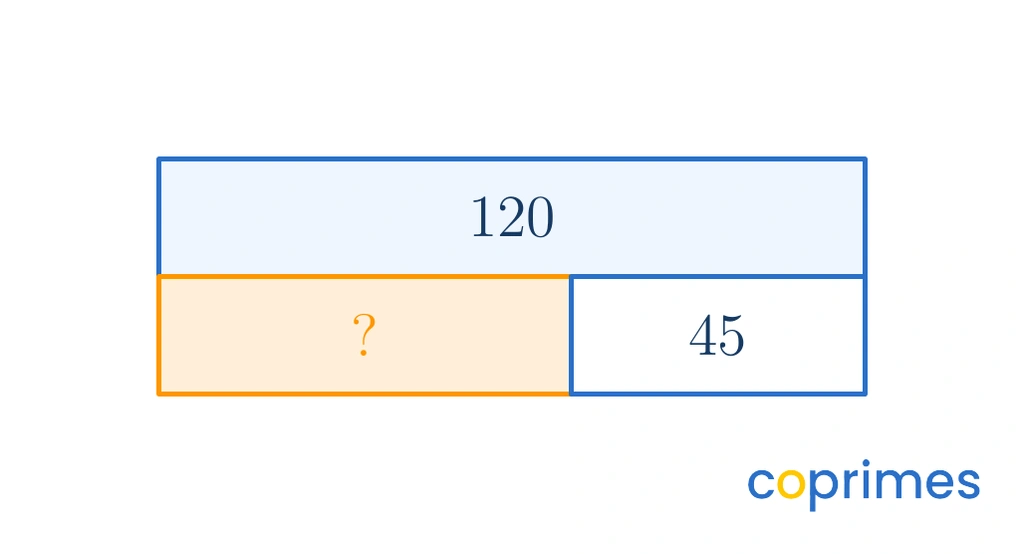
Which missing number problem mathematically matches this bar model?
What is the unknown number in ?
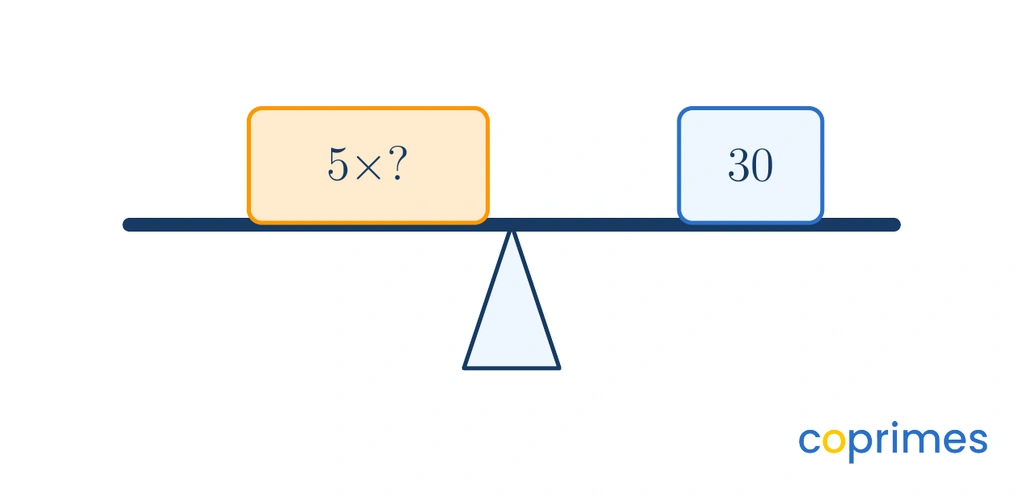
What missing value balances the scale?
Find the missing number in .
A gardener plants equal rows of seeds. They plant seeds in total. If there are seeds in each row, how many rows are there?