
Math Word Problems: Solving Strategies and Methods
Math word problems describe a situation in words and ask you to use mathematical ideas, operations, and reasoning to find and explain an answer. They bridge everyday scenarios with mathematical equations, requiring you to carefully extract information, plan a logical method, and verify your results.
What are math word problems?
Word problems are mathematical puzzles disguised as short stories.
They challenge you to extract the mathematics from a written scenario. Unlike a direct equation like , a word problem presents a context, such as calculating the total cost of groceries or finding the distance traveled. Solving them successfully requires applying effective problem-solving strategies in math.
A reliable method for tackling any applied mathematics question is the four-step process: read the situation, plan a strategy, solve the math, and check the answer.
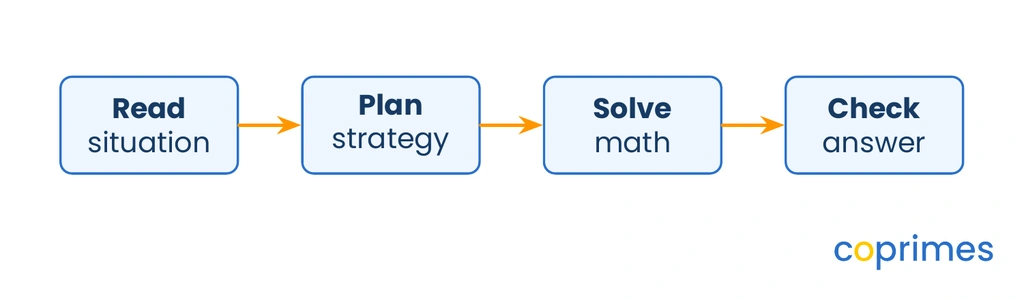
Read for the mathematical situation
The first step is to read the complete problem to understand the real-world context before touching any numbers.
Many mistakes happen when learners rush to combine numbers without understanding the underlying story. Read the problem slowly from start to finish. Visualize the scenario in your mind. Ask yourself what is happening and what final goal or question is being asked. Ignoring the context can lead to calculating something the question never requested.
Identify knowns and the unknown
Next, extract the specific numerical information and pinpoint the missing value you need to find.
Once you understand the story, identify the knowns (the facts and numbers given) and the unknown (the final answer required). Look for vocabulary that hints at the relationships between the quantities. This vocabulary is essential for choosing operations in word problems.
Operation | Common Mathematical Vocabulary |
Addition | altogether, total, sum, combined, more than |
Subtraction | difference, remaining, left, fewer than, take away |
Multiplication | product, times, each, per, twice, total of equal groups |
Division | quotient, shared equally, split, per item, half |
A learning plan shaped by your child, not the class
State-aligned Math plus our own Logic and English curriculum. An adaptive baseline test finds the gaps and fills them.
Choose a representation
Organize the knowns and the unknown using a visual or structural model.
Sometimes a problem is too complex to translate straight into an equation in your head. Drawing a diagram helps arrange the information logically. You might sketch a simple picture, plot points on a number line, or use bar models in math to show exactly how parts combine to make a whole.
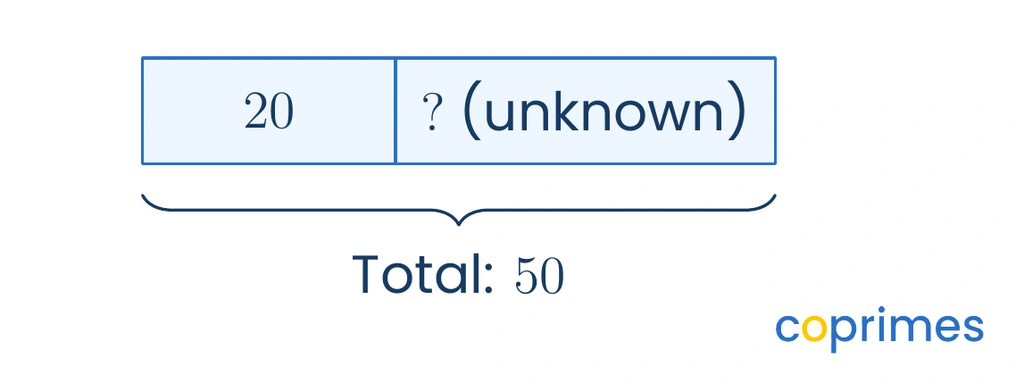
Write and solve the math
Translate your model into a mathematical equation and perform the calculations.
Write a math sentence using numbers, variables, and operation symbols. Once the equation is set up, solve it step-by-step. Keep your work neat, and always attach the correct units to your final number. An answer of could mean , , or , so the unit provides the necessary context.
Check the answer
Verify that your numerical result makes sense in the context of the original story.
After finding a value, ask yourself if the size of the number is reasonable. If a question asks for the number of passengers remaining on a bus, the answer cannot be greater than the number of passengers who boarded. Use estimation or reverse operations when checking word problem answers to confirm your accuracy.

Worked examples
Review these step-by-step solutions to see the complete problem-solving process in action.
Example 1: Solving a basic subtraction problem
Question: Elena has stickers. She gives stickers to her brother. How many stickers does Elena have left?
Method:
- Identify the total () and the amount removed ().
- The keyword "left" indicates subtraction. The math sentence is .
Answer: Elena has stickers left.
Check: Add the remaining stickers back to the given stickers: . The total matches.
Example 2: Translating equal groups
Question: A classroom has tables. Each table can seat exactly students. What is the total number of students that can be seated?
Method:
- Identify the knowns ( tables, students per table).
- The keywords "each" and "total" referring to equal groups indicate multiplication. The math sentence is .
Answer: The tables can seat a total of students.
Check: Use repeated addition to confirm: . The result is verified.
Example 3: Solving a multi-step word problem
Question: A baker makes muffins. She sells muffins in the morning. In the afternoon, she packages the remaining muffins equally into boxes. How many muffins are in each box?
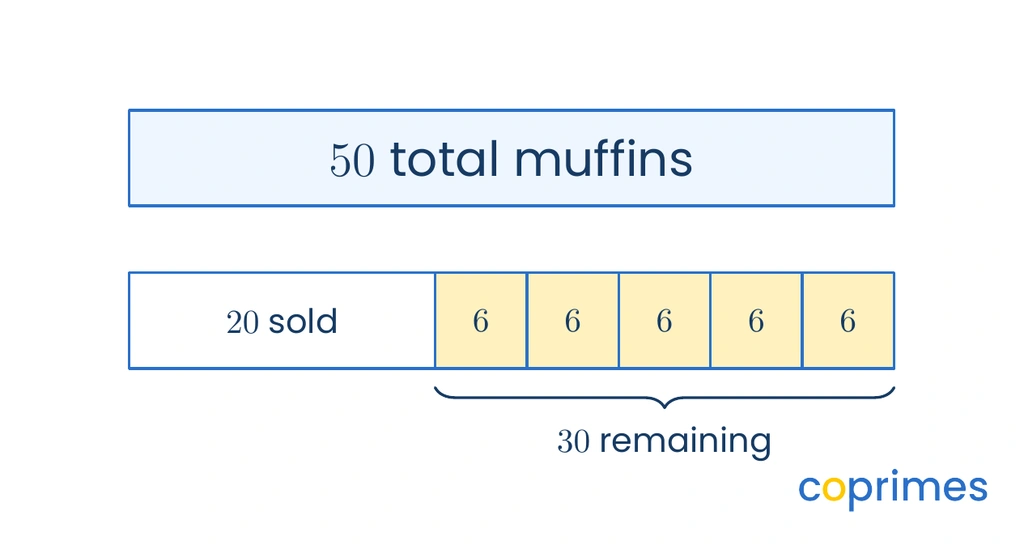
Method:
- Identify the knowns ( total, sold, equal boxes) and the unknown (muffins per box).
- This requires solving two-step word problems. First, find the remaining muffins using subtraction: .
- Second, divide the remaining muffins into equal groups: .
Answer: There are muffins in each box.
Check: Multiply muffins by boxes to get muffins. Add the sold muffins: original muffins. The answer is confirmed.
Frequently asked questions
Get answers to common questions about decoding and solving mathematical word problems.
Why are math word problems so difficult?
Word problems require multiple skills at once. You must read fluently, comprehend the real-world scenario, translate English words into mathematical symbols, and then accurately perform the arithmetic. A mistake in any one of these steps can lead to an incorrect answer.
Do keywords always mean the exact same operation?
No, keywords are helpful clues but not strict rules. For example, the word "more" often means addition, but in a question like "How many more does Alice have than Bob?", you must use subtraction to find the difference. Always rely on the complete story context rather than searching for one word blindly.
What should I do if I get stuck on a word problem?
If you are stuck, draw a picture of what is happening. Replace large or complicated numbers with smaller, simpler numbers to see if the required operation becomes clearer. Once you know whether to add, subtract, multiply, or divide the small numbers, apply the exact same mathematical operation to the original numbers.
Practice questions
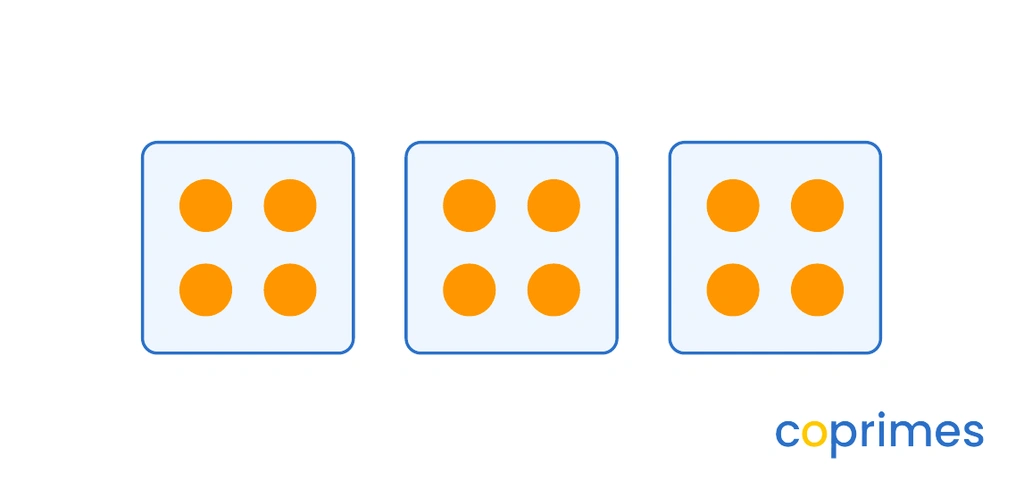
Which math sentence correctly matches the visual model?
A librarian shelves books equally onto empty shelves. Which keyword helps you decide to divide?
Equally
Shelves
Books
Empty
Equally
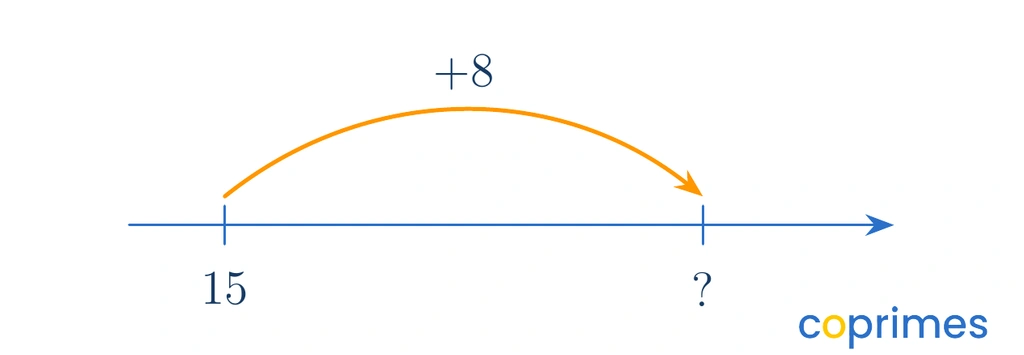
Mark has dollars. He earns dollars more. Which equation represents how to find Mark's total amount of money?
A plant is tall. It grows each week for weeks. What is a common mistake when finding the final height?
Adding and before multiplying by
Multiplying and then adding
Multiplying and then adding
Adding and then multiplying by
Adding and before multiplying by
Sarah buys notebooks for dollars each. She pays with a -dollar bill. How much change does she receive?