
Multiplication and Division Fact Families
A multiplication and division fact family uses the same three numbers to write two multiplication facts and two related division facts.
Understanding these families helps you see how multiplication and division connect, making it much faster to solve math problems mentally.
What is a multiplication and division fact family?
A multiplication and division fact family is a group of four mathematical equations created using the exact same set of three numbers.
These related facts show the permanent relationship between the parts of a multiplication problem and the parts of a division problem. When you know one fact in the family, you automatically know the other three.
Every complete fact family shares the exact same three numbers.
For example, the numbers , , and form a fact family because you can multiply the two smaller numbers to reach the largest number, and you can divide the largest number by either smaller number.
The four related facts
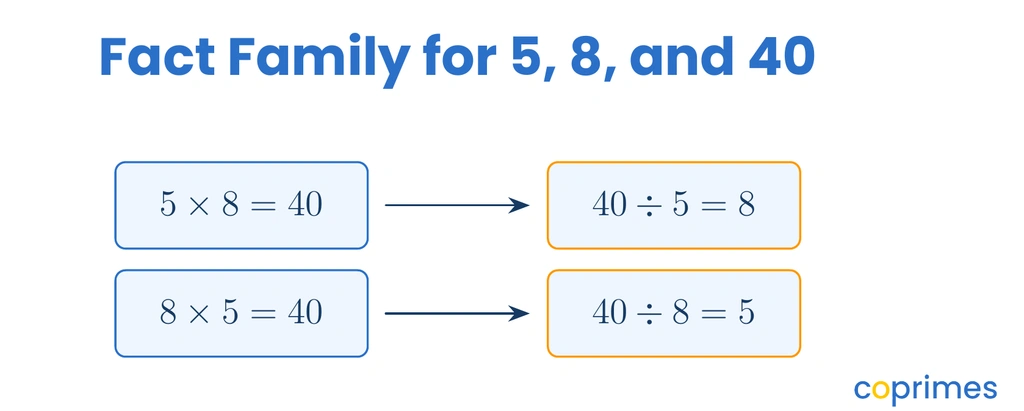
Every standard multiplication and division fact family contains exactly four equations. Let us build the family for the numbers , , and .
The four facts are constructed by reversing the factors for multiplication and alternating the divisors for division:
- First multiplication fact:
- Second multiplication fact:
- First division fact:
- Second division fact:
The only exception to the four-fact rule happens when you multiply a number by itself. For doubles like , reversing the factors produces the exact same equation. Because of this, the family for , , and only has two facts: and .
How multiplication and division undo each other
Multiplication and division are inverse operations, meaning they run in opposite directions to undo each other.
When you learn multiplication, you combine equal groups to find a total product. When you use division, you split that exact total back into the original equal groups.
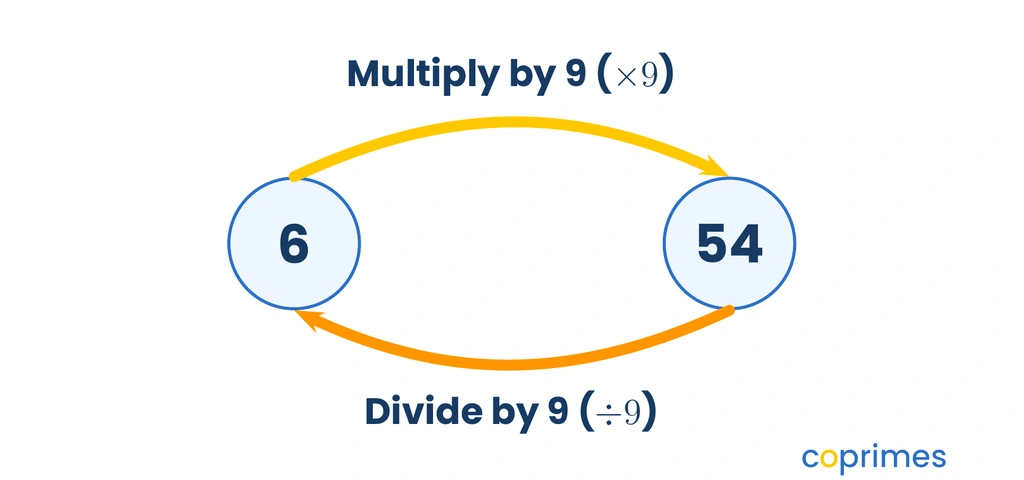
If you start with and multiply it by , you get . If you immediately divide by , you arrive right back at . They are part of the same connected loop.

Fact-family triangles and arrays
Visual models help you see why the three numbers in a fact family always stay together.
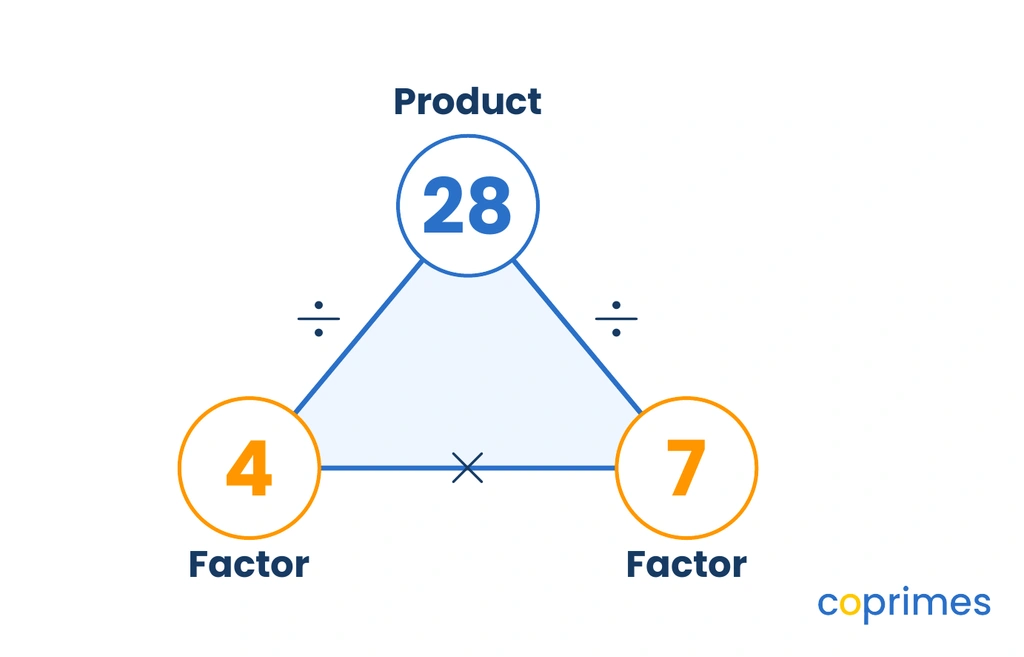
A fact triangle places the largest number (the product) at the top vertex and the two smaller numbers (the factors) at the bottom vertices. You multiply across the bottom to find the top number, and you divide the top number by a bottom number to find the other side.
An array proves the fact family is true by organizing items into rows and columns.
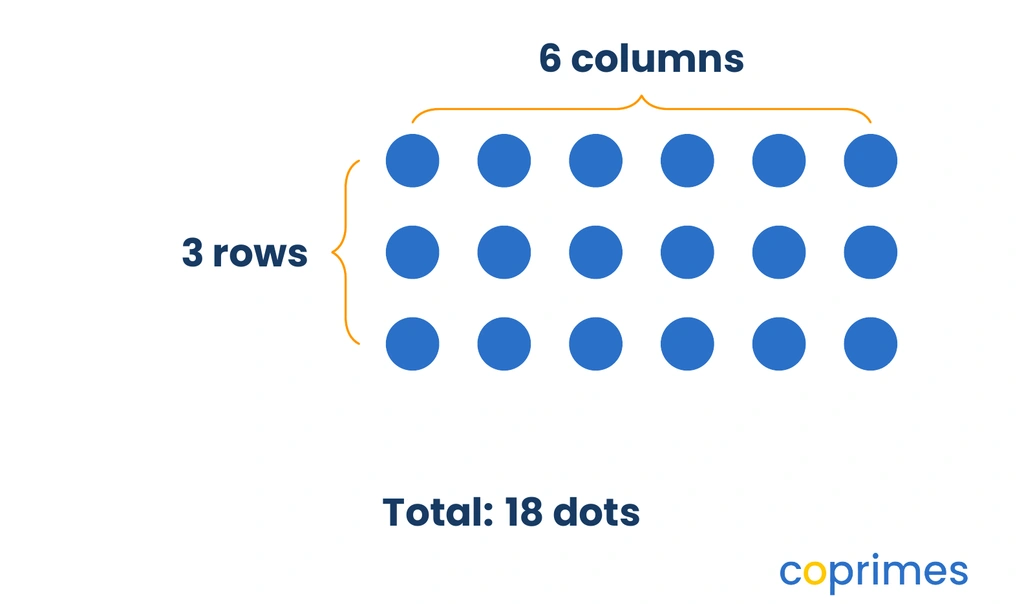
In this array, rows multiplied by columns equals dots. Reversing it, columns multiplied by rows equals dots. Taking the total dots and dividing them into rows leaves in each row, or dividing them into columns leaves in each column.
Solve missing-number equations
When you face an equation with a missing number, rely on related facts. You do not need to guess; just rewrite the problem using the inverse operation.
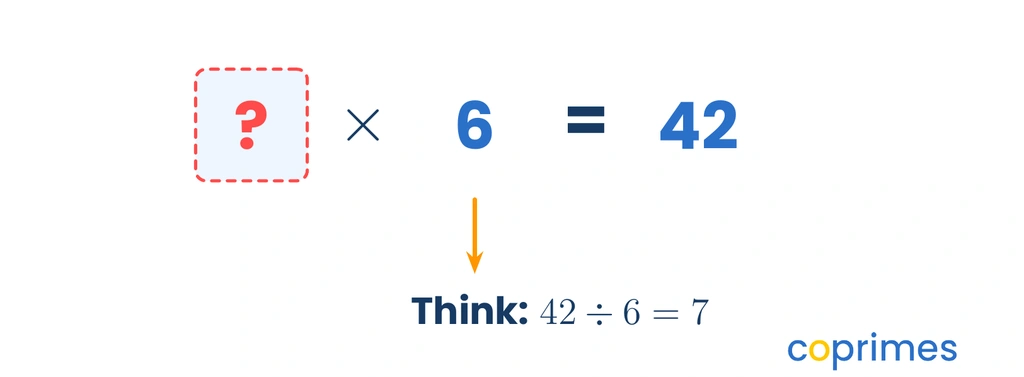
If you need to solve , write the related division fact that isolates the missing number: . Because they belong to the same family, the missing factor is .
Check an answer
Fact families give you a built-in method to catch mistakes. You can always check the result of a division problem by using the related multiplication fact.
If you calculate , verify it by running the numbers backward through multiplication. Multiply your answer by the divisor: . Because matches your original starting number, the division is correct. This is the foundation of the standard division algorithm and checking process.
A learning plan shaped by your child, not the class
State-aligned Math plus our own Logic and English curriculum. An adaptive baseline test finds the gaps and fills them.
Worked examples
Example 1: Writing the related facts
Question: Write the four related facts for the numbers , , and .
Given: A set of three numbers belonging to a fact family: , , and .
Method:
- Write two multiplication facts using the two smaller numbers as factors.
- Write two division facts starting with the largest number as the dividend.
Answer: The four facts are , , , and .
Check: Verify that all four equations use only the numbers , , and , and that each equation mathematically works.
Example 2: Finding a missing factor
Question: Solve for the missing number: .
Given: A multiplication equation with a product of , a known factor of , and a missing factor.
Method:
- Identify the given information: The product is and one factor is .
- Write the related division fact that isolates the missing number.
- Calculate .
Answer: The missing number is .
Check: Substitute back into the original equation: . The answer is correct.
Example 3: Using a fact family in a word problem
Question: A teacher has markers and distributes them equally among tables. Write a related fact that shows how many markers each table receives.
Given: The total number of markers () and the number of groups ().
Method:
- Identify the operation needed to share equally, which is division.
- Write the division equation: .
- Think of the related multiplication fact to solve it: .
- Determine the missing factor, which is .
Answer: The related fact is , meaning each table receives markers.
Check: Multiply the number of tables by the markers per table: . This matches the starting total.
Frequently asked questions
How do fact families help me memorize times tables?
Learning fact families reduces the amount of information you need to memorize. If you confidently know your multiplication facts and times tables, you automatically know the matching division facts without having to memorize a second list.
Do all fact families have four equations?
Almost all fact families have four equations. The only exceptions are doubles (like ), which have only two equations because reversing identical factors does not create a new math sentence.
Can zero be part of a fact family?
Zero acts differently. While you can write and , you cannot divide by zero. Because division by zero is undefined, zero cannot form a complete, standard four-equation fact family.
Practice questions

Which multiplication and division fact family does this array represent?
, , and
, , and
, , and
, , and
, , and
Why does the fact family for the numbers , , and only contain two equations instead of four?
The two factors are identical, so reversing them does not create a new equation.
The number can only be divided by even numbers.
Fact families for even numbers always have exactly two equations.
You cannot use the same number twice in a fact family.
The two factors are identical, so reversing them does not create a new equation.
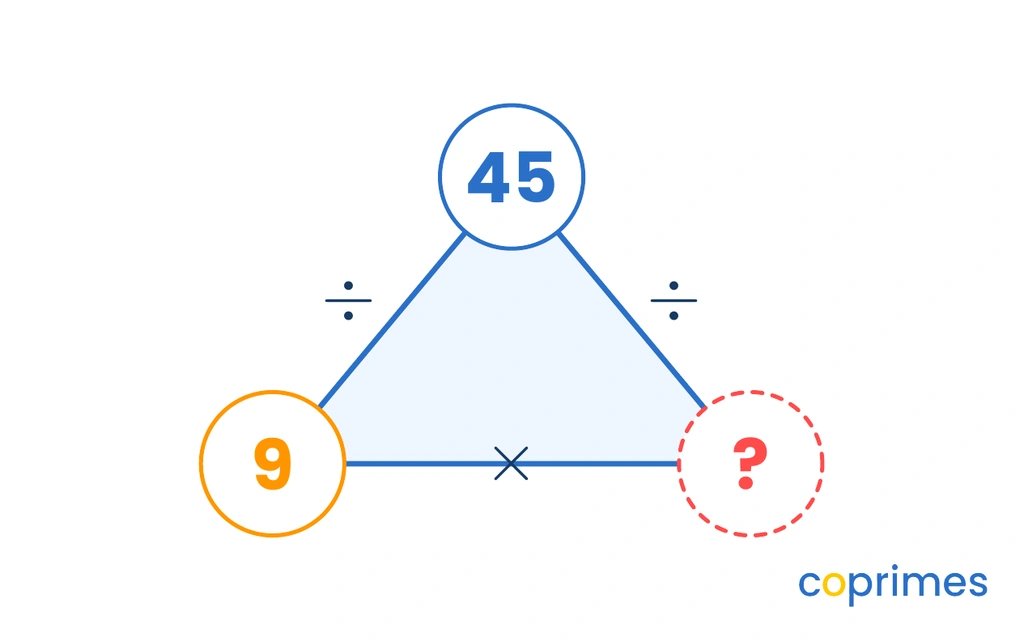
What is the missing number in this fact-family triangle?
If you know that , which of the following is the related multiplication fact?
A gardener plants seeds in equal rows. She uses the related facts for , , and . Which equation shows how to find the number of seeds in each row?