
PEMDAS: Order of Operations Definition and Examples
PEMDAS is a memory aid for the order of operations. It outlines the correct sequence to follow when evaluating mathematical expressions containing multiple operations.
Following the PEMDAS rule ensures that everyone who solves an expression arrives at the same accurate result, instead of calculating values randomly.
What does PEMDAS mean?
The PEMDAS meaning comes from the six mathematical operations it represents: parentheses, exponents, multiplication, division, addition, subtraction.
These words describe the priority sequence used to evaluate expressions. Operations at the top of the hierarchy must be completed before operations at the bottom. Multiplication and division share the identical priority rank, as do addition and subtraction.
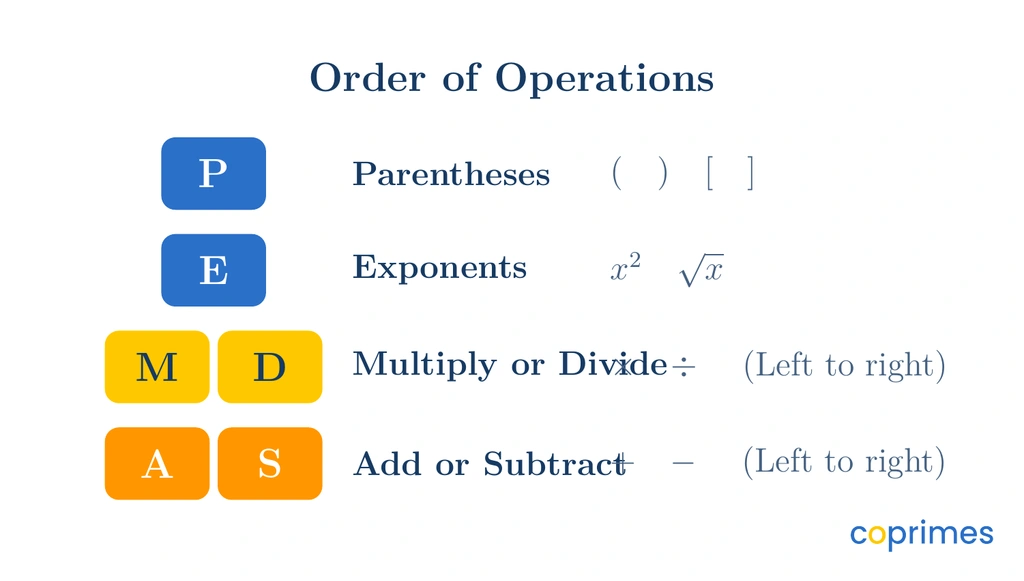
The PEMDAS rule
The PEMDAS rule states that you must evaluate mathematical expressions step by step in a strict, unbreakable order.
- Parentheses: Calculate operations inside any brackets and parentheses first. If there are nested parentheses, start with the innermost set.
- Exponents: Calculate any exponents and powers, including square roots.
- Multiplication and Division: Perform all multiplication and division as they appear from left to right.
- Addition and Subtraction: Perform all addition and subtraction as they appear from left to right.
Multiplication and division share the same rank. Addition and subtraction share the same rank.
Why multiplication is not always before division
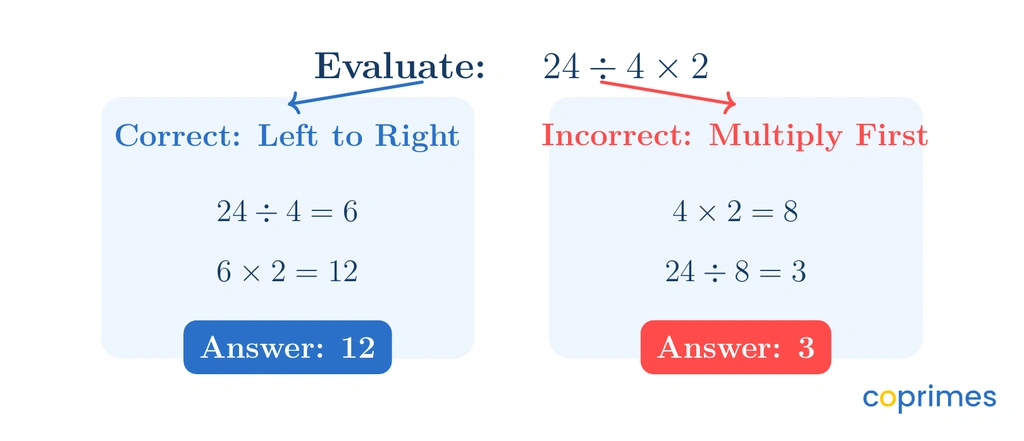
A common misconception is that multiplication must always be performed before division because the letter M comes before D in the acronym. However, multiplication and division are operations with equal priority.
When both operations appear in the same expression, you must solve them in sequence from left to right. If a division sign comes first, you divide first. Treating multiplication as a strictly higher priority will result in an incorrect calculation.

Why addition is not always before subtraction
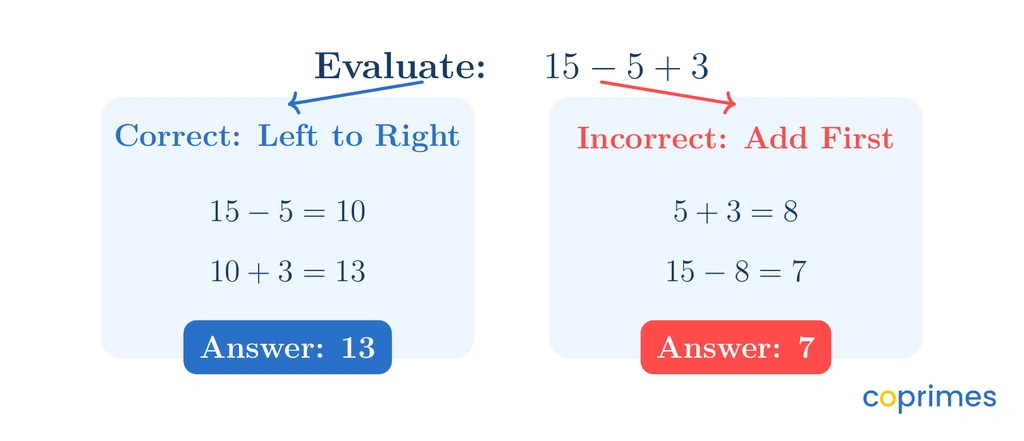
Just like multiplication and division, addition and subtraction are equal in rank. The letter A appearing before S does not mean addition always happens first.
When evaluating an expression containing only addition and subtraction, calculate the values from left to right. If you add before subtracting when a subtraction sign appears first, you will calculate the wrong answer.
PEMDAS versus other acronyms
Different regions use different memory aids, but they all describe the identical mathematical rules.
In the United States, PEMDAS is standard. In other countries, students might learn BODMAS and BIDMAS or BEDMAS. The acronyms change because different terms are used for the same mathematical structures, such as "brackets" instead of "parentheses" or "indices" instead of "exponents."
Acronym | Level 1 | Level 2 | Level 3 | Level 4 |
PEMDAS | Parentheses | Exponents | Multiplication Division | Addition Subtraction |
BODMAS | Brackets | Order | Division Multiplication | Addition Subtraction |
BIDMAS | Brackets | Indices | Division Multiplication | Addition Subtraction |
Worked examples
Here are step-by-step PEMDAS examples demonstrating how to evaluate complex expressions efficiently.
Example 1: Using operations without parentheses
Question: Evaluate .
Method:
- Exponents first. Calculate to get , leaving .
- Multiplication next. Calculate to get , leaving .
- Subtraction last. Calculate .
Answer: .
Check: Ensure exponents were evaluated before the coefficient was multiplied.
Example 2: Expressions with nested grouping symbols
Question: Evaluate .
Method:
- Start inside the innermost parentheses. Calculate to get , leaving .
- Evaluate the exponent inside the brackets. Calculate to get , leaving .
- Complete the operation inside the brackets. Calculate to get , leaving .
- Divide. Calculate .
Answer: .
Check: Reverse the calculation: .
Example 3: Expressions with variables
Question: Evaluate when .
Method:
- Substitute for every in the expression to get .
- Parentheses first. Calculate to get , leaving .
- Exponents next. Calculate to get , leaving .
- Multiplication next. Calculate to get , leaving .
- Addition last. Calculate .
Answer: .
Check: Add the two evaluated components together: .
A learning plan shaped by your child, not the class
State-aligned Math plus our own Logic and English curriculum. An adaptive baseline test finds the gaps and fills them.
Common mistakes
Ignoring the left-to-right rule
The most frequent error is treating multiplication and division as strict sequential steps instead of equal partners. Always read multiplication and division from left to right. Do the same for addition and subtraction.
Distributing exponents incorrectly
When an exponent sits outside parentheses, such as , you must complete the addition inside the parentheses first to get . Do not square the individual terms first, as violates the order of operations.
Forgetting hidden multiplication
A number placed immediately next to a set of parentheses indicates multiplication. For example, means . The operations inside the parentheses still happen first, but the final step is to multiply the result by .
Frequently asked questions
How do you remember PEMDAS?
Many students use mnemonics to recall the acronym. A popular phrase is "Please Excuse My Dear Aunt Sally," where the first letter of each word matches the operations in sequence.
What is GEMS?
GEMS is an alternative memory aid that stands for Groupings, Exponents, Multiplication/Division, and Subtraction/Addition. It functions interchangeably with PEMDAS but groups the equal-priority operations more clearly.
Do you multiply or divide first when using PEMDAS?
You perform whichever operation appears first when reading the mathematical expression from left to right. Because they share equal priority, multiplication does not automatically precede division.
Practice questions
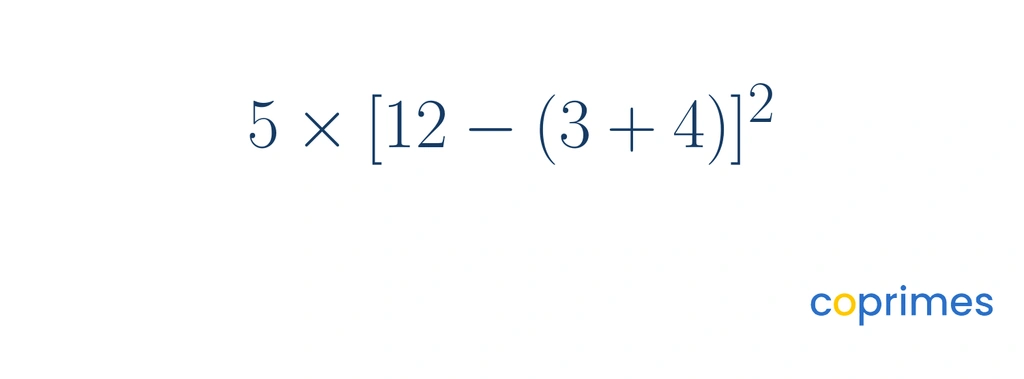
Which operation must be calculated first according to the PEMDAS rule?
Evaluate the expression using the PEMDAS rule:
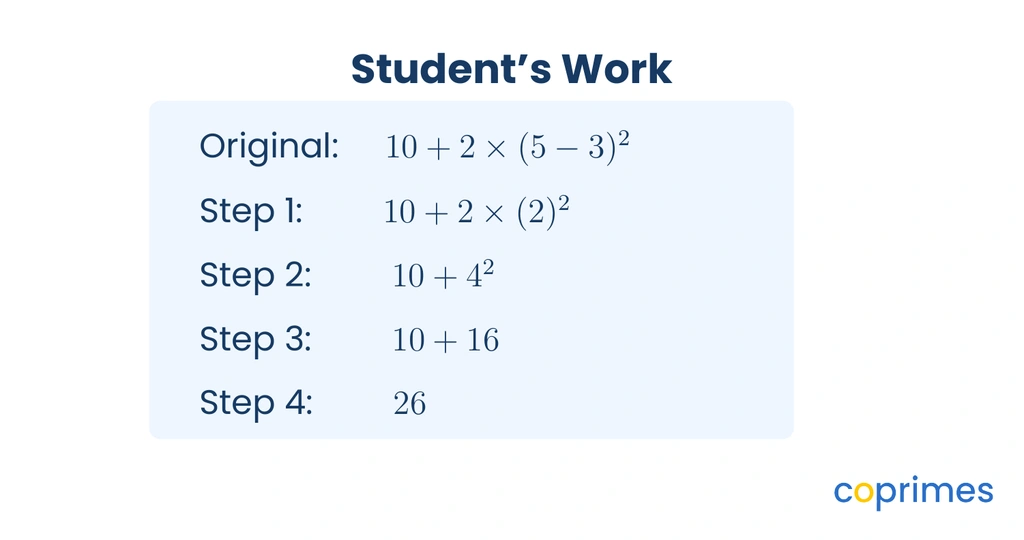
In which step did the student make their first mistake?
Step 1
Step 2
Step 3
Step 4
Step 2
A fraction bar acts as a grouping symbol. What is the value of the expression below?
Which set of parentheses makes the equation true?