
Exponents and Powers: Guide and Examples
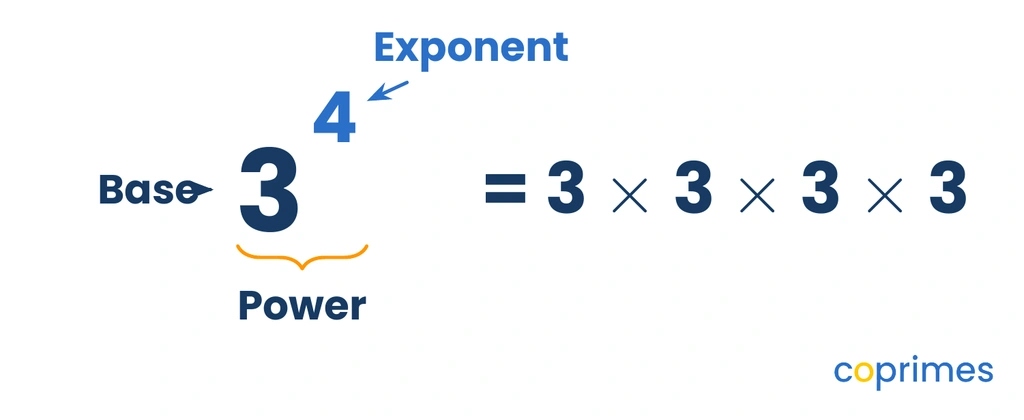
In mathematics, an exponent tells how many times a base is used as a factor, and the complete expression is known as a power.
When learning about exponents and powers, you are learning a shorthand way to write repeated multiplication. This mathematical tool allows you to write, calculate, and understand very large or very small numbers efficiently.
What Are Exponents and Powers?
A power is a mathematical expression consisting of two parts: a base and an exponent. It represents the concept of multiplying a number by itself a specific number of times.
Depending on where you live, you might hear exponential notation referred to by different names, such as indices or index notation. Regardless of the term used, the mathematical rules remain exactly the same.
Key Ideas and Vocabulary
To properly read and write exponents and powers, you must understand the relationship between three distinct vocabulary terms.
Base: The base is the large number written on the main line. It represents the value that will be repeatedly multiplied by itself.
Exponent: The exponent, or index, is the small number written slightly higher and to the right of the base. It indicates the exact number of times the base appears as a factor in the multiplication sequence.
Power: The entire mathematical expression is the power.
When a base is raised to the exponent of , we commonly call the results square numbers. When a base is raised to the exponent of , we refer to the results as cube numbers. For instance, is read as "five squared," and is read as "five cubed."
Visual Explanation
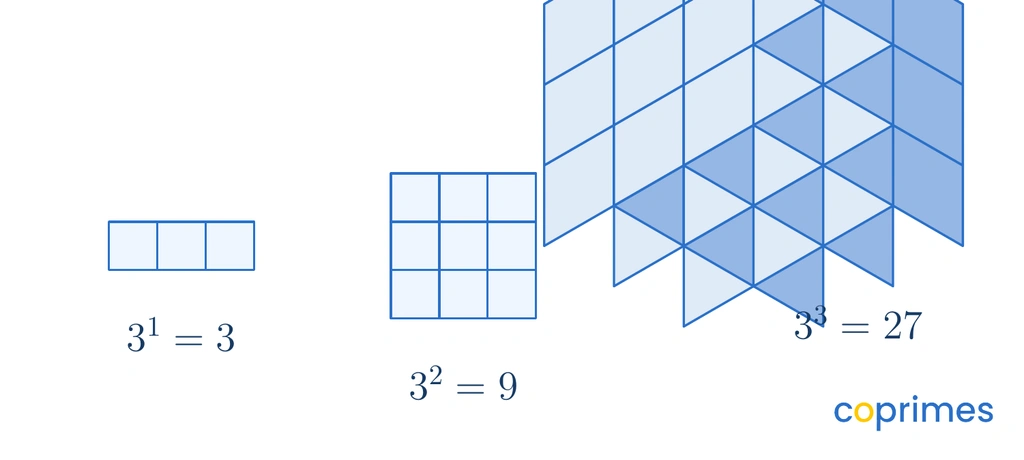
Exponents model rapid growth. A visual model shows how quickly the total value increases as the exponent grows, transforming from a single line into a flat area, and then into a larger structure.
A learning plan shaped by your child, not the class
State-aligned Math plus our own Logic and English curriculum. An adaptive baseline test finds the gaps and fills them.
Worked Examples
Review these exponents and powers examples to understand how to correctly translate and calculate expressions.
Example 1: Evaluating a basic power
Question: What is the value of ?
Method:
- Identify the base () and the exponent ().
- Write the base as a factor times.
- Multiply the factors progressively from left to right.
Answer: .
Check: Multiply in groups to confirm: .
Example 2: Negative bases and parentheses
Question: Evaluate and compare and .
Method:
- When a negative number is in parentheses, the negative sign is part of the base. means .
- Multiplying two negative numbers produces a positive product, so .
- When there are no parentheses, the exponent applies only to the number, not the negative sign. means .
- Apply the multiplication first, then attach the negative sign. .
Answer: , but .
Check: Use the order of operations. Exponents are calculated before subtraction or negation, which proves why results in a negative value.
Example 3: Translating to exponential form
Question: Write the expression using exponents.
Method:
- Group the identical factors together. The first group has the base , and the second group has the base .
- Count how many times the base is multiplied by itself. It appears times, which translates to .
- Count how many times the base is multiplied by itself. It appears times, which translates to .
- Combine the results without the multiplication signs, following standard algebra notation.
Answer: .
Check: Expand the expression back out: and . Combining them restores the original question perfectly.
Common Mistakes and Non-Examples
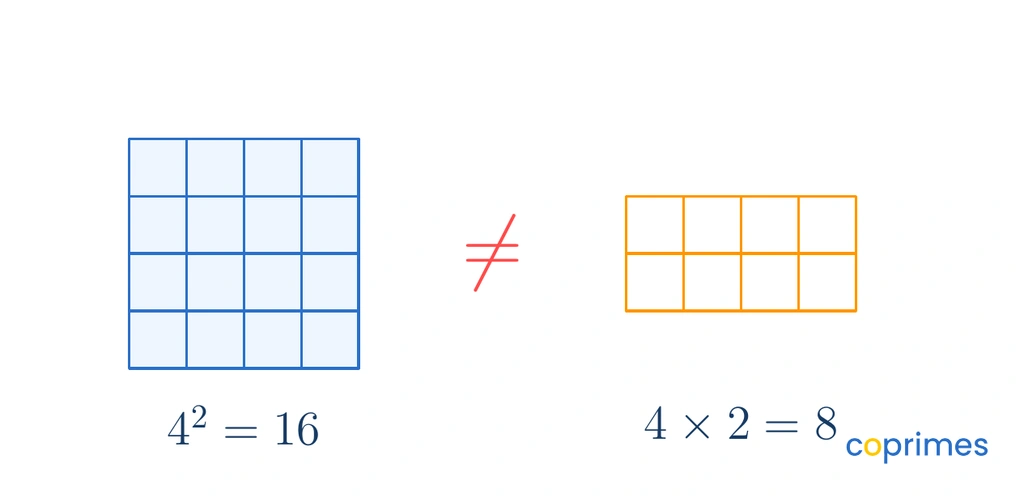
The most frequent mistake when learning exponential notation is multiplying the base by the exponent instead of multiplying the base by itself.
For example, is often mistakenly calculated as . However, means , which correctly equals .
Another common error is applying an exponent to a negative sign when it is not enclosed in parentheses. Remember that exponents only apply to the immediate number directly to their left.
Real-World Connections
Understanding exponents is essential in fields like science, engineering, and computer programming. Scientists use exponential notation when writing powers of ten to neatly document the massive distance between stars or the microscopic size of a single cell.
In computer science, memory storage relies entirely on powers of , which is why devices have capacities like , , , or gigabytes. As you advance in algebra, you will discover how to manipulate these expressions efficiently using the laws of exponents and reverse them completely when simplifying radicals.

Practice questions

Which exponential expression perfectly represents the total number of circles shown in the grid?
What is the correct mathematical value of the expression ?
Which of the following statements accurately describes the difference between calculating and ?
Both expressions result in , but one is written in scientific notation.
equals , while equals .
involves multiplying to get , while yields only .
is solved by multiplying the base and the exponent together, yielding .
involves multiplying to get , while yields only .
In the expression , which statement is true regarding the vocabulary of exponents and powers?
The number is the exponent and is the base.
The number is the base, and it will be used as a factor times.
The number is the power, and it will be multiplied by .
The base and the exponent will be multiplied together to equal .
The number is the base, and it will be used as a factor times.
A special type of bacteria doubles its population every single hour. If a scientist starts an experiment with exactly bacterium, which exponential expression shows how many bacteria will exist after exactly hours?