
BODMAS, BIDMAS and BEDMAS: Order of Operations Rules
BODMAS, BIDMAS and BEDMAS are regional memory aids for the same order-of-operations structure as PEMDAS: grouping symbols first, then powers or indices, then multiplication and division left to right, then addition and subtraction left to right. Following these rules ensures everyone evaluates mathematical expressions consistently and arrives at the same exact answer.
What do BODMAS, BIDMAS and BEDMAS mean?
These acronyms summarize the standard mathematical order of operations. While the letters vary by region, the mathematical sequence they represent is identical.
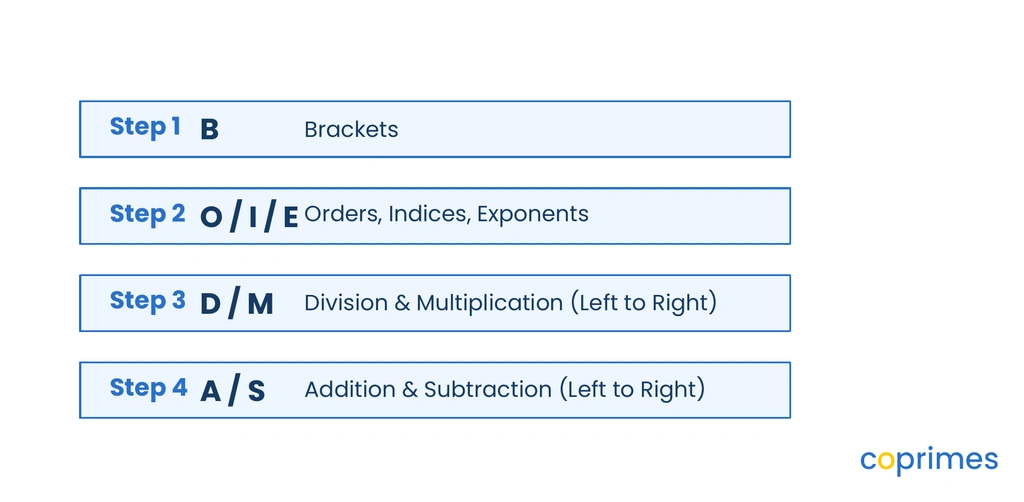
- B stands for Brackets. Always evaluate anything inside brackets first.
- O, I, or E stands for Orders, Indices, or Exponents. This includes powers and roots.
- D and M stand for Division and Multiplication. These have equal priority and are evaluated from left to right.
- A and S stand for Addition and Subtraction. These also share equal priority and are evaluated from left to right.
How these acronyms match PEMDAS
The acronym PEMDAS is commonly used in North America, while BODMAS, BIDMAS, and BEDMAS are used in the UK, Australia, Canada, and other regions. The acronyms simply use different vocabulary for the same mathematical symbols.
BODMAS / BIDMAS / BEDMAS | PEMDAS | Mathematical Meaning |
B: Brackets | P: Parentheses | Grouping symbols like , , and . |
O / I / E: Orders, Indices, Exponents | E: Exponents | Powers like and roots like . |
D / M: Division and Multiplication | M / D: Multiplication and Division | Left-to-right priority. |
A / S: Addition and Subtraction | A / S: Addition and Subtraction | Left-to-right priority. |
Whether an acronym places D before M or M before D, multiplication and division always share the exact same mathematical rank.
Grouping symbols and powers
The first step in any order-of-operations problem is evaluating expressions inside brackets and parentheses. When an expression contains multiple sets of brackets, always resolve the innermost pair first and work outward.
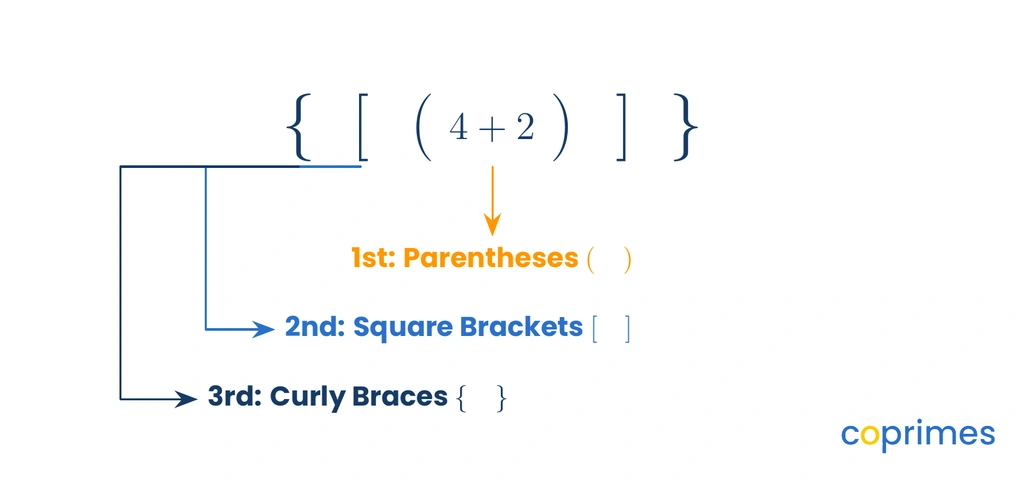
Once all operations inside brackets are complete, evaluate the powers, indices, or exponents. This includes squares, cubes, higher powers, and square roots. If an expression contains an exponent raised to another exponent, such as , evaluate the top exponent first: , making the expression .
A learning plan shaped by your child, not the class
State-aligned Math plus our own Logic and English curriculum. An adaptive baseline test finds the gaps and fills them.
Equal-priority operations
A common misconception is that division must always happen before multiplication because D comes before M in BODMAS. However, division and multiplication have equal priority. The same rule applies to addition and subtraction. When operations of equal rank appear consecutively, evaluate them strictly from left to right.
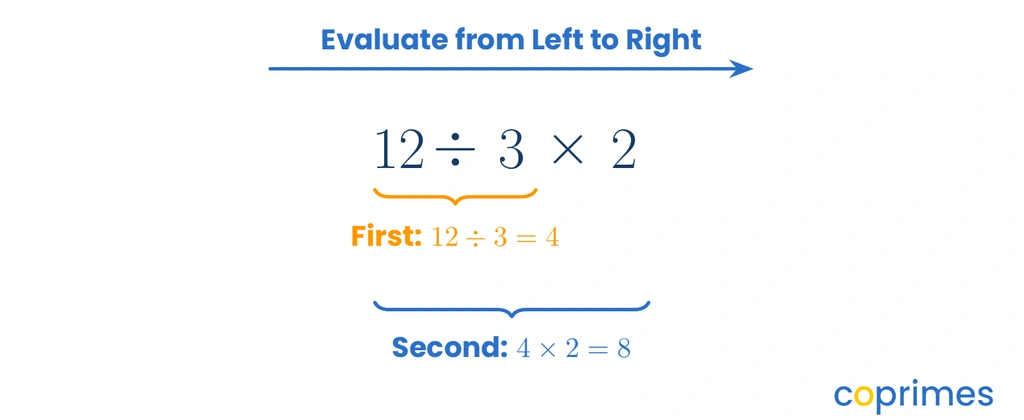
Here are three verified examples demonstrating left-to-right handling:
- Multiplication and Division: Evaluate . Correct (left-to-right): , then . Incorrect (multiplication first): , then .
- Addition and Subtraction: Evaluate . Correct (left-to-right): , then . Incorrect (addition first): , then .
- Consecutive Division: Evaluate . Correct (left-to-right): , then . Incorrect (right-to-left): , then .
How to use the rule
When evaluating numerical expressions, scan the entire problem before calculating. Use the acronym as a structured checklist.
- Brackets: Locate all grouping symbols. Evaluate the expressions inside them, starting with the innermost brackets.
- Orders (Indices/Exponents): Find any powers or roots and evaluate them.
- Division and Multiplication: Scan the expression from left to right. Perform any multiplication or division exactly as you encounter it.
- Addition and Subtraction: Scan the expression from left to right again. Perform any addition or subtraction exactly as you encounter it.
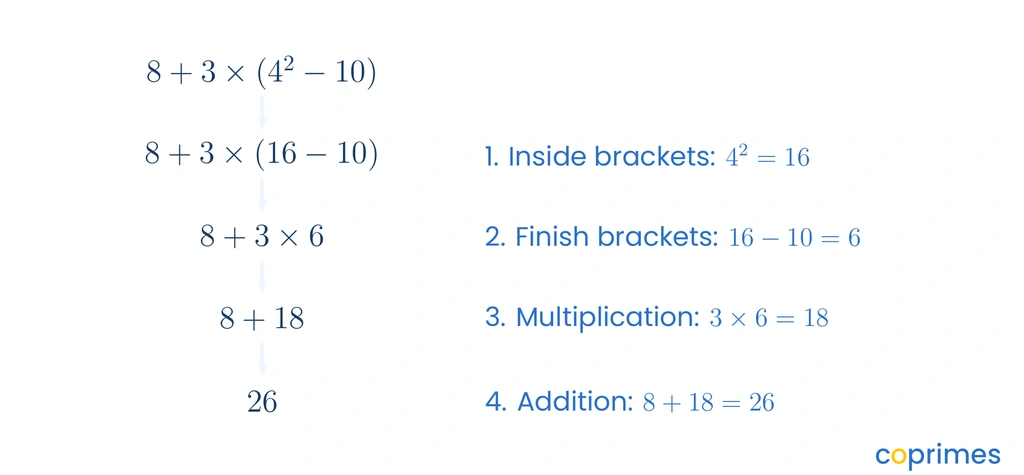
Always rewrite the entire expression on a new line after performing a single step.
Worked examples
Example 1: Applying indices before multiplication
Question: Evaluate the expression .
Method:
- Check for brackets. There are none.
- Evaluate orders (indices). The power is . . The expression becomes .
- Perform multiplication and division from left to right. . The expression becomes .
- Perform addition and subtraction from left to right. .
Answer: .
Check: Ensure you did not mistakenly add first, which would yield the incorrect answer of .
Example 2: Left-to-right evaluation
Question: Evaluate the expression .
Method:
- Check for brackets and orders. There are none.
- Scan for multiplication and division. Because they share equal priority, evaluate them from left to right. First, . The expression becomes . Next, . The expression becomes .
- Scan for addition and subtraction. .
Answer: .
Check: Verify that multiplication was not performed before division merely because of the acronym's spelling.
Example 3: Nested brackets
Question: Evaluate the expression .
Method:
- Identify the innermost brackets: .
- Apply the order of operations inside these brackets. Evaluate the index first. . The expression becomes .
- Finish the inner brackets by subtracting. . The expression becomes .
- Evaluate the outer brackets. . The expression becomes .
- Perform the final addition. .
Answer: .
Check: Reverse the steps to confirm the arithmetic: , and , which matches .

Common mistakes
Many mistakes happen when the rules are interpreted too rigidly or applied out of sequence.
- Treating division as strictly prior to multiplication: Even though D comes before M in BODMAS and BEDMAS, neither operation outranks the other. You must calculate whichever comes first when reading from left to right.
- Adding before subtracting automatically: Similar to multiplication and division, addition and subtraction are equal-rank partners. Evaluating as is incorrect. From left to right, , and .
- Ignoring brackets around a negative base: Remember that means , but means . Brackets change how an exponent is applied.
Frequently asked questions
Is BODMAS or BEDMAS correct?
Both are mathematically correct. They are regional memory aids that describe the exact same sequence. The only difference is the word used for exponents (Orders versus Exponents).
Why do multiplication and division have equal priority?
Division is simply multiplication by a fraction (dividing by is exactly the same as multiplying by ). Because they represent the same core mathematical concept, they share the same priority level.
What happens if an expression has multiple operations inside brackets?
You apply the sequence again inside those brackets. First solve any inner brackets, then indices, then multiplication and division, and finally addition and subtraction, all before moving outside the grouping symbol.
Practice questions

Look at the expression above. According to the order of operations, which part must be evaluated first?
Subtracting from
Multiplying and
Adding and
Evaluating the power
Evaluating the power
Evaluate the expression .
Why is and not ?
Addition is always performed last.
Multiplication has a higher priority than addition.
You must always evaluate from right to left.
The number is larger than .
Multiplication has a higher priority than addition.
Evaluate the expression .
Evaluate the expression .