
Order of Operations: Rules, Steps, and Examples
The order of operations is the agreed sequence for evaluating an expression: work inside grouping symbols, evaluate powers and roots, then multiply or divide from left to right, and finally add or subtract from left to right. Without this standard method, a single mathematical problem could have multiple conflicting answers.
What is the order of operations?
The order of operations is a universal set of rules that tells you which calculation to perform first in a mathematical problem.
Mathematics is a universal language. To ensure everyone gets the exact same answer when solving numerical expressions, mathematicians agreed on a standard sequence. These rules dictate the priority of operations such as addition, subtraction, multiplication, and division when they appear together in the same problem.
Why the order matters
If you do not follow the order of operations, you will calculate the wrong answer.
Because we read English from left to right, it is natural to want to solve math problems the same way. However, calculating strictly from left to right without respecting operational priority often leads to incorrect results.
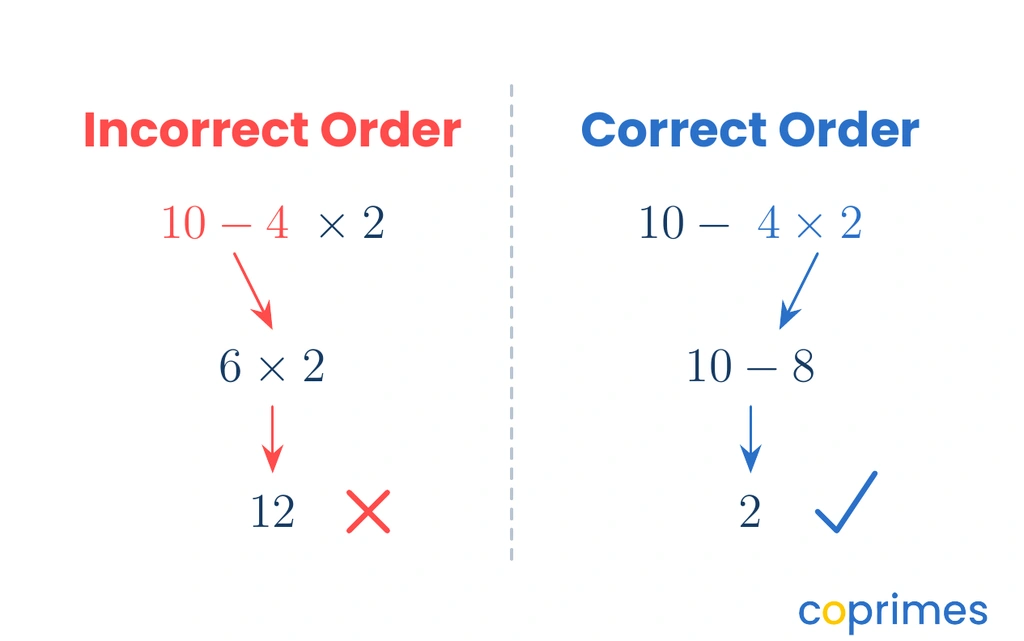
In the example above, performing the multiplication before the subtraction reveals the true mathematical value of the expression. Evaluating operations out of order changes the mathematical meaning of the entire problem.
The operation order rule
To find the correct answer, you must evaluate expressions following a strict four-step sequence.
- Grouping Symbols: Always start by evaluating operations inside brackets and parentheses.
- Roots and Powers: Next, evaluate any exponents and powers, as well as square roots.
- Multiplication and Division: Perform all multiplication and division from left to right.
- Addition and Subtraction: Finally, perform all addition and subtraction from left to right.
Acronyms such as PEMDAS and BODMAS and BIDMAS are frequently used to help learners memorize these four essential steps.
A learning plan shaped by your child, not the class
State-aligned Math plus our own Logic and English curriculum. An adaptive baseline test finds the gaps and fills them.
Equal-priority operations
Multiplication does not take priority over division, and addition does not take priority over subtraction.
When two operations share the same priority step, you simply complete whichever one appears first as you read from left to right.
Multiplication and division have equal priority. Evaluate them strictly from left to right.
For example, in the expression , division comes first. You must calculate , and then . If you incorrectly multiplied first, you would calculate , which is wrong.
How to solve an expression step by step
Applying the rules requires simplifying the expression one operation at a time until only a single number remains.
When you solve a multi-step expression, rewrite the entire line after each calculation. This creates a funnel shape that helps you track your progress and avoid skipping steps.
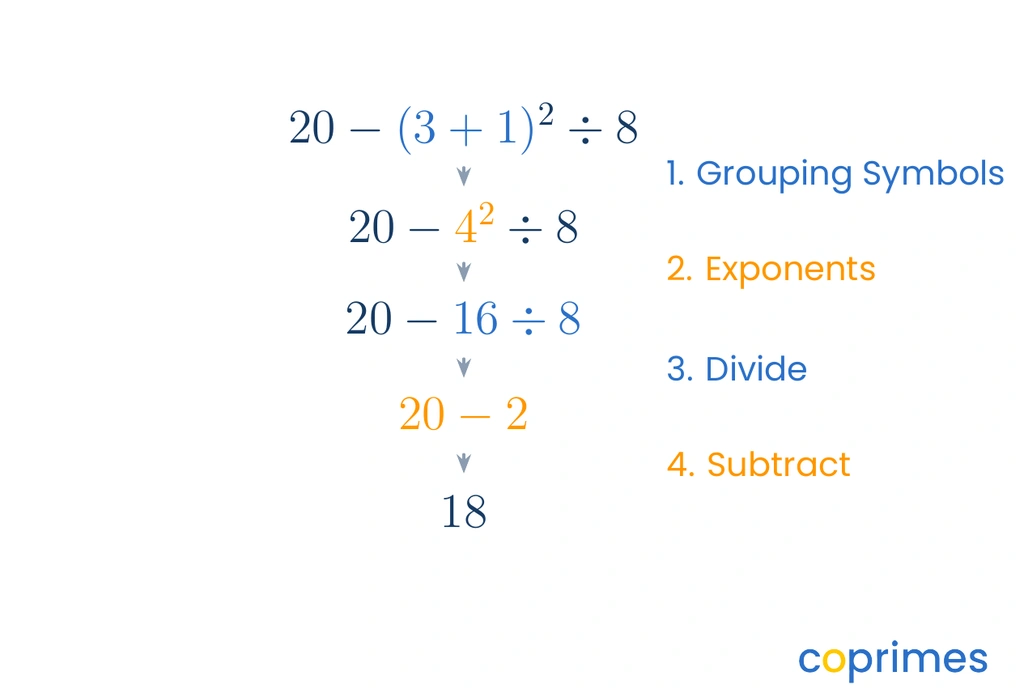
Notice how every operation follows the hierarchy rule, ensuring a single accurate outcome.
Worked examples
Review these examples to see how the sequence applies to increasingly complex problems.
Example 1: Basic expressions
Question: Evaluate .
Method:
- Check for grouping symbols and exponents. There are none.
- Divide first, because division takes priority over subtraction. Calculate .
- Substitute the result back into the expression: .
- Subtract to find the final value.
Answer: .
Check: Confirming the priority: division strictly precedes subtraction. The sequence is correct.
Example 2: Grouping and exponents
Question: Evaluate .
Method:
- Evaluate the operation inside the grouping symbols: . The expression becomes .
- Evaluate the exponent: . The expression becomes .
- Multiply before subtracting: . The expression becomes .
- Subtract to finish: .
Answer: .
Check: The sequence of Parentheses, Exponents, Multiplication, then Subtraction matches the established rules perfectly.
Example 3: Equal priority operations
Question: Evaluate .
Method:
- Multiplication and division have equal priority, so work from left to right. Divide first: . The expression becomes .
- Multiply next: . The expression becomes .
- Addition and subtraction also have equal priority. Work from left to right. Add first: . The expression becomes .
- Subtract to find the final value: .
Answer: .
Check: By correctly evaluating equal-priority operations left to right, we avoided the common mistake of multiplying first.

Common mistakes
Recognizing standard pitfalls makes it easier to calculate accurately every time.
Adding before subtracting strictly
Many students assume addition must always happen before subtraction because the letter "A" comes before "S" in common acronyms. Addition and subtraction actually have the same priority. You must calculate whichever comes first reading left to right.
Multiplying before dividing strictly
Similarly, multiplication and division share the same rank. If division appears to the left of multiplication, you must divide first. Calculating by multiplying and then dividing is incorrect. The correct left-to-right approach yields .
Ignoring hidden multiplication
When a number is placed immediately next to a parenthesis, such as , it implies multiplication. This multiplication follows the standard priority rules and occurs after the expression inside the parenthesis has been simplified.
Frequently asked questions
Here are answers to common questions about prioritizing calculations.
What do acronyms like BODMAS or PEMDAS stand for?
These acronyms help students remember the hierarchy of operations. BODMAS stands for Brackets, Orders, Division or Multiplication, and Addition or Subtraction. PEMDAS stands for Parentheses, Exponents, Multiplication or Division, and Addition or Subtraction. Both systems dictate the exact same mathematical rules.
Do you always multiply before you divide?
No. Multiplication and division have equal priority. When evaluating an expression, you perform whichever operation comes first reading from left to right.
Which math operation always comes first?
Always complete whatever operation is inside the brackets or parentheses first. If there are multiple operations inside the grouping symbols, apply the standard priority rules within those symbols.
Practice questions
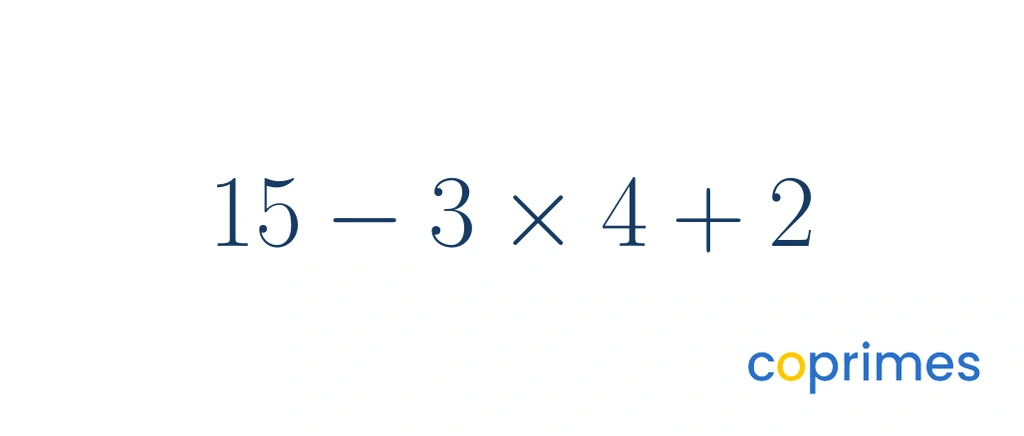
Which operation must be performed first when evaluating the expression shown?
Multiply
Subtract
Add
Multiply
Multiply
Evaluate the expression:
Which of the following expressions equals ?
A student evaluates the expression and gets a final answer of . What mistake did the student make?
The student added and before subtracting.
The student subtracted from .
The student subtracted from first.
The student ignored the addition sign.
The student added and before subtracting.
Which placement of brackets makes the expression equal to ?