
Fractions, Decimals and Percents Conversion: Definition, Method and Examples
Fractions, decimals and percents are equivalent ways to show the same value: convert them using place value, equivalent fractions, division or multiplication by one hundred, then compare only after using a common form.
How are fractions, decimals and percents connected?
Fractions, decimals and percents represent identical portions of a whole, but they use different structural frameworks to communicate that proportion.
A fraction displays the number of equal parts we have (the numerator) over the total number of equal parts that make up a whole (the denominator). Decimals rely on the base-ten place value system, representing whole numbers alongside parts divided into tenths, hundredths, and thousandths. Percentages express a quantity specifically as a fraction of one hundred, denoted by the percent symbol ().
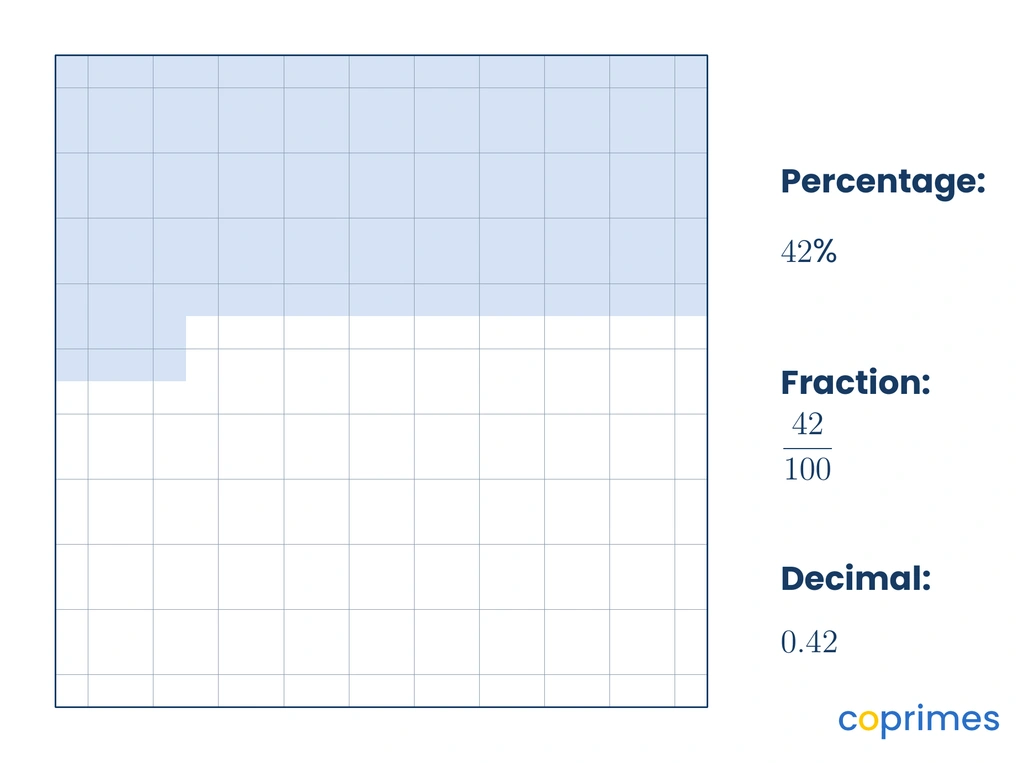
Because all three forms measure identical proportions, transitioning between them is a foundational mathematical skill that allows us to interpret data appropriately, calculate discounts, and compare quantities efficiently.
Use denominator one hundred
The word "percent" translates literally to "per one hundred," making a denominator of one hundred the most direct method for converting between formats.
When converting decimals to fractions, place value directly dictates the denominator. For example, represents seventy-five hundredths, which translates instantly to , equivalent to .
If a fraction has a denominator that is a factor of one hundred, you can use equivalent fractions to scale it up. By multiplying both the numerator and the denominator by the same value, the proportion is maintained, making the transition to a decimal or percentage completely seamless.
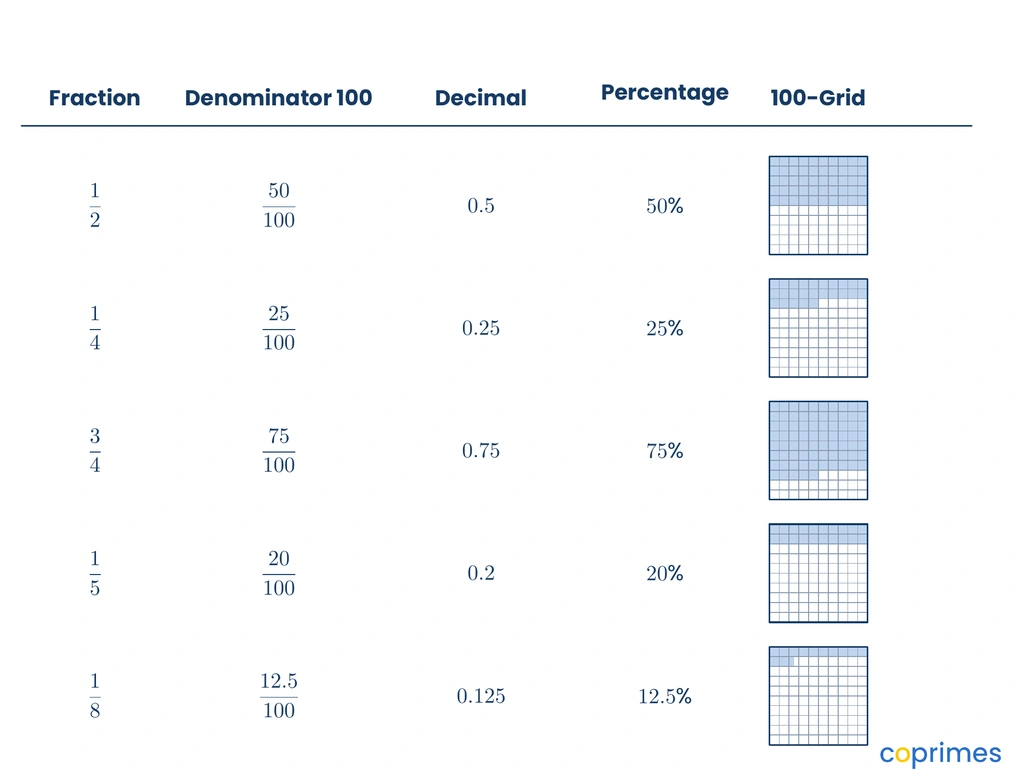
Notice that for one eighth, scaling the denominator to one hundred results in a decimal numerator (). While proper fractions strictly use integers, this conceptual step proves
exactly why translates precisely to and .
Convert among all three forms
Each conversion direction requires specific mathematical operations based on equivalent fractions, place value, multiplication, or division.
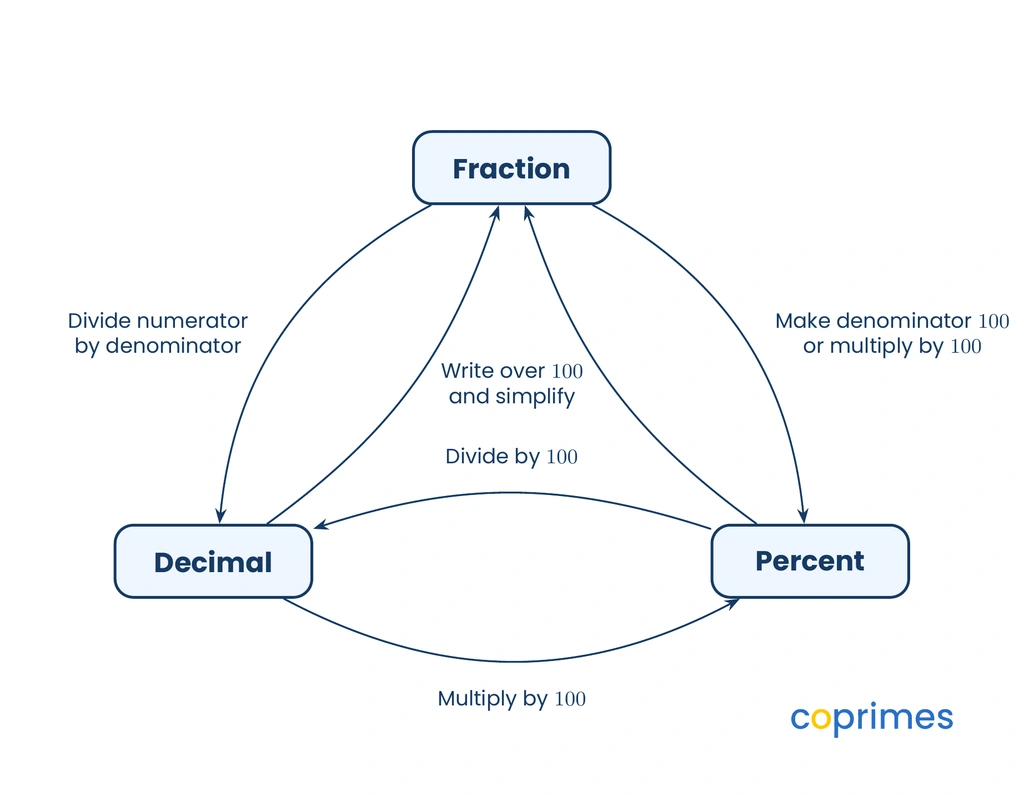
To transform fractions to decimals, treat the fraction bar as a division symbol. Use standard long division to divide the numerator by the denominator. For example, becomes .
When taking a fraction to percent, you can either find an equivalent fraction with a denominator of one hundred, or perform division to find the decimal first, then multiply that decimal by one hundred.
To switch a decimal to percent, multiply the decimal value by one hundred, which shifts the digits two places to the left across the decimal point. For example, . Conversely, to turn a percent back into a decimal, divide by one hundred.

Compare and order mixed forms
Comparing numbers presented in a mixture of representations requires converting all numbers into a single, common format before evaluating their size.
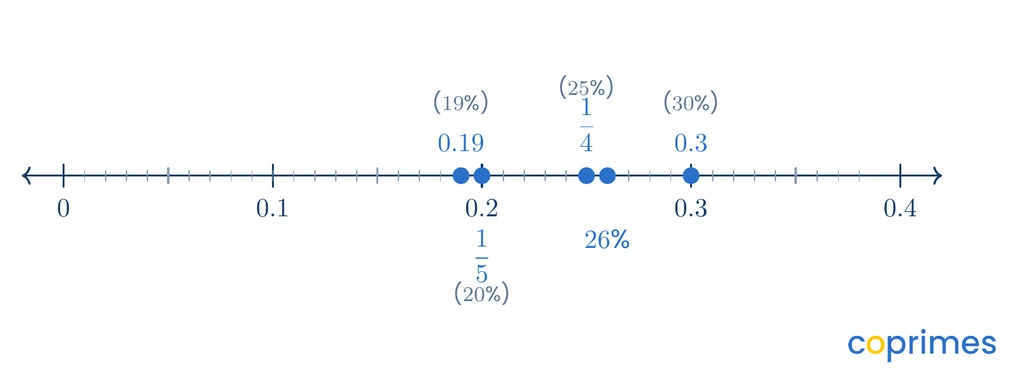
Decimals or percentages are usually the most straightforward formats to use, as they align easily along a number line. Once the items are successfully converted to your chosen format and ordered logically, you must always substitute the original forms back into the final ordered sequence.
Consider ordering this set from least to greatest: , , , , .
First, convert all values to percentages:
- remains
Now, safely order the standardized percentages: , , , , .
Finally, replace them with their respective original forms: , , , , .
Use benchmark values
Familiarity with common benchmark conversions drastically improves the speed and accuracy of proportional reasoning, allowing you to bypass manual calculation.
When you encounter values frequently used in mathematics, recalling them instantly from memory builds a strong foundation. Some vital benchmark values to master include:
- Halves:
- Quarters: and
- Tenths:
- Fifths:
- Thirds:
Establishing conceptual confidence with these values means you can easily estimate more difficult comparisons. For instance, knowing that is exactly immediately reveals that is slightly less than one third of a whole.
Worked examples
Practicing the conversion rules across different formats builds fluency and prevents careless ordering errors.
Example 1: Convert to a common form
Question: Convert the values , , and into fractions with a denominator of .
Method:
- Identify the target format as a standard fraction out of .
- Convert the fraction using equivalent ratios. Multiply the numerator and denominator by : .
- Convert the percentage to a fraction. The definition of a percentage is a fraction of , so .
- Convert the decimal using place value. represents eight tenths, which is proportionally equal to eighty hundredths, making it .
Answer: The converted values are , , and .
Example 2: Convert mixed numbers into decimals and order
Question: Write the values , , and in descending order (greatest to least) by first converting them to decimals.
Method:
- Convert the percentage to a decimal by dividing by : .
- Convert the fraction to a decimal using long division: This produces a repeating decimal, , which rounded to two decimal places is .
- Compare the decimal values. The decimals to evaluate are , , and . Ordered from greatest to least: , , .
- Return to the original forms by matching the ordered decimals back to their original states.
Answer: The descending order is , , .
Example 3: Compare advanced fractions, decimals, and percents
Question: List the numbers from least to greatest: , , , , .
Method:
- Choose a common format. Converting everything to decimals allows for precise comparison.
- Convert all numbers to decimals: ; is already a decimal; ; ; is already a decimal.
- Order the standard decimal values. Align the place values with placeholder zeros for clarity: , , , , . In ascending order: , , , , .
- Restore the original values and match the original forms. Note that and hold identical geometric values.
Answer: The ordered list is , , (and ), .
A learning plan shaped by your child, not the class
State-aligned Math plus our own Logic and English curriculum. An adaptive baseline test finds the gaps and fills them.
Common mistakes
One of the most persistent misconceptions is the belief that conversion changes the mathematical value of the number. It fundamentally does not. Converting from a fraction to a percentage merely changes the notation; the actual quantity remains exactly the same. The figures and refer to the precise same amount of a whole.
Another frequent error involves failing to utilize a true denominator of . When converting a decimal like to a fraction, students sometimes write it as but then incorrectly evaluate it as instead of scaling it up to to reveal the mathematically accurate .
Finally, omitting the return to original values creates an invalid answer. If you are asked to order a specific list, presenting your final answer using only the decimal conversions you calculated—rather than the original forms provided in the prompt—will usually be marked incorrect on formal assessments.
Frequently asked questions
Is there a way to change a repeating decimal directly into a fraction?
Yes, there is an algebraic process you can use to rigorously convert repeating decimals directly into fractions. By setting the repeating decimal equal to a variable and multiplying by a power of ten that aligns with the repeating block, you can subtract the original variable to completely eliminate the repeating portion and then easily solve for the exact fraction.
Do you always move the decimal point when converting between decimals and percents?
Yes, relying on the base-ten system, multiplying by one hundred to change a decimal to a percent strictly shifts the digits two places to the left over the decimal point. Dividing by one hundred to change a percent to a decimal applies the exact inverse movement.
Can you convert improper fractions to percents?
Yes, you convert improper fractions to percents using the exact same equivalent ratio methods as proper fractions. Because the numerator is larger than the denominator, the resulting percent will simply be greater than . For example, converted with equivalent ratios becomes , which mathematically equals .
Practice questions
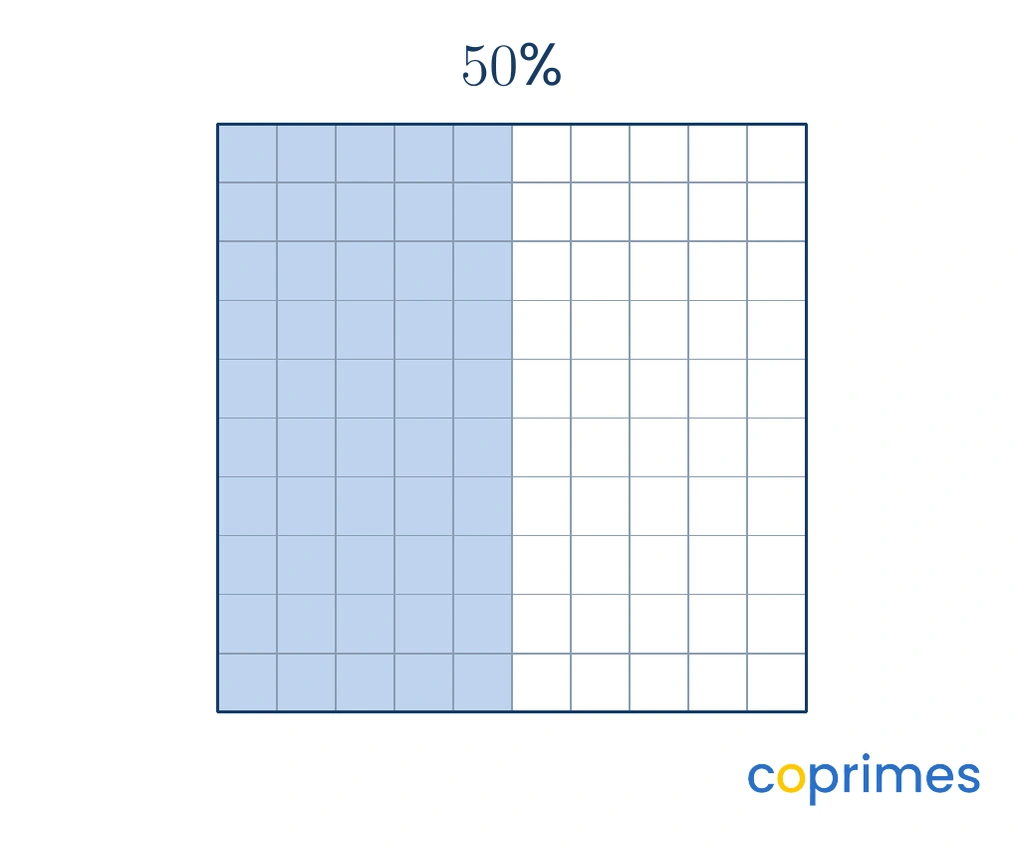
Which of the following values is not mathematically equivalent to the percentage modeled in the grid?
Which of the following representations is accurately equivalent to ?
Which equation correctly shows an accurate set of equivalent fractions, decimals, and percents?
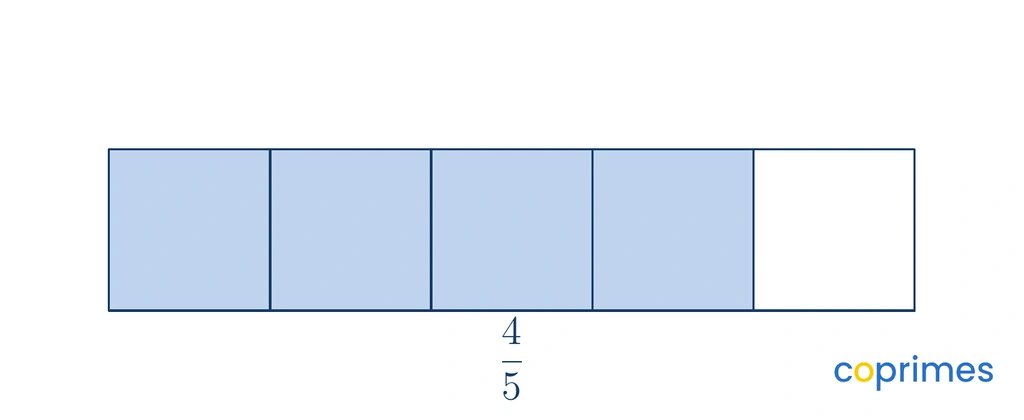
Which of the following values is strictly greater than the fraction shown in the visual?
Put the following numbers in ascending order (least to greatest): , , .
, ,
, ,
, ,
, ,
, ,