
Ratio to Fraction: Complete Guide and Conversions
To write a part-to-whole ratio as a fraction, add all ratio parts to find the total amount, which becomes the denominator. The requested part becomes the numerator. A part-to-part ratio uses a different denominator, so always read the question carefully to ensure you identify the correct whole before converting.
What does ratio to fraction mean?
A ratio compares the sizes of different parts to one another, while fractions compare a specific part to the entire whole. Converting a ratio to a fraction allows you to see exactly what portion of the total group each part represents.
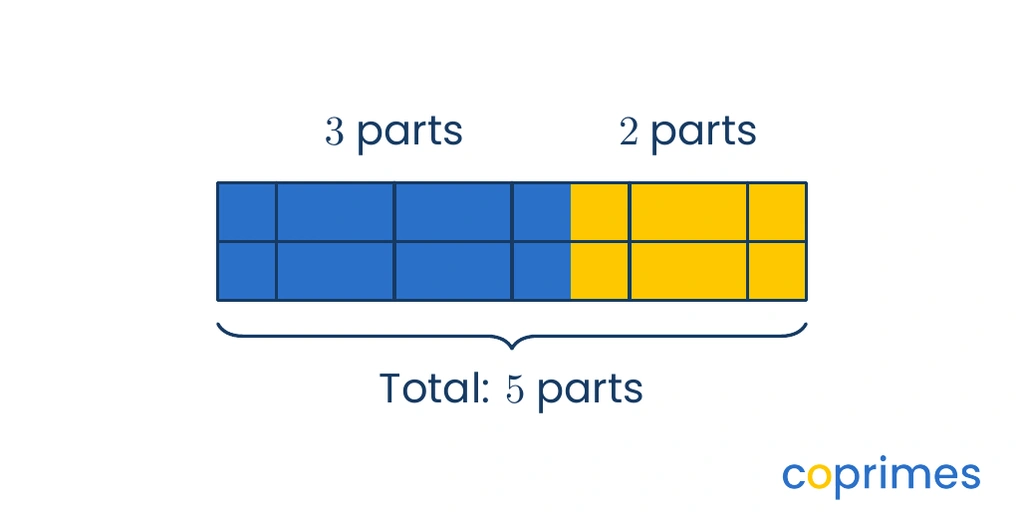
When a ratio fraction conversion is required, you change the mathematical comparison from part-to-part into part-to-whole. This reveals the proportion of the entire set that belongs to one specific category.
Identify part-to-whole and part-to-part
Before calculating, you must distinguish between part-to-part and part-to-whole ratios. The type of ratio provided in a question determines what numbers represent the denominator.
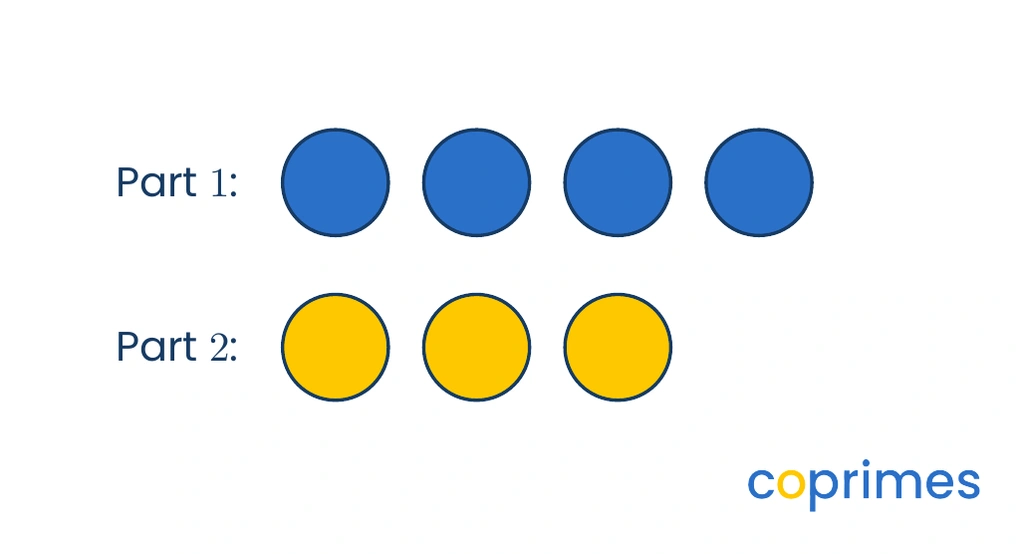
A part-to-part ratio compares distinct groups, such as blue counters to yellow counters, written as . A part-to-whole ratio compares one specific group to the entire collection, such as blue counters out of total counters. The denominator of every ratio fraction is the total.
Find the whole
To convert a ratio into a fraction, you must first determine the whole. When given a part-to-part ratio, the total number of parts is the sum of all individual parts in the ratio.
Add all the parts of the ratio together to calculate the denominator.
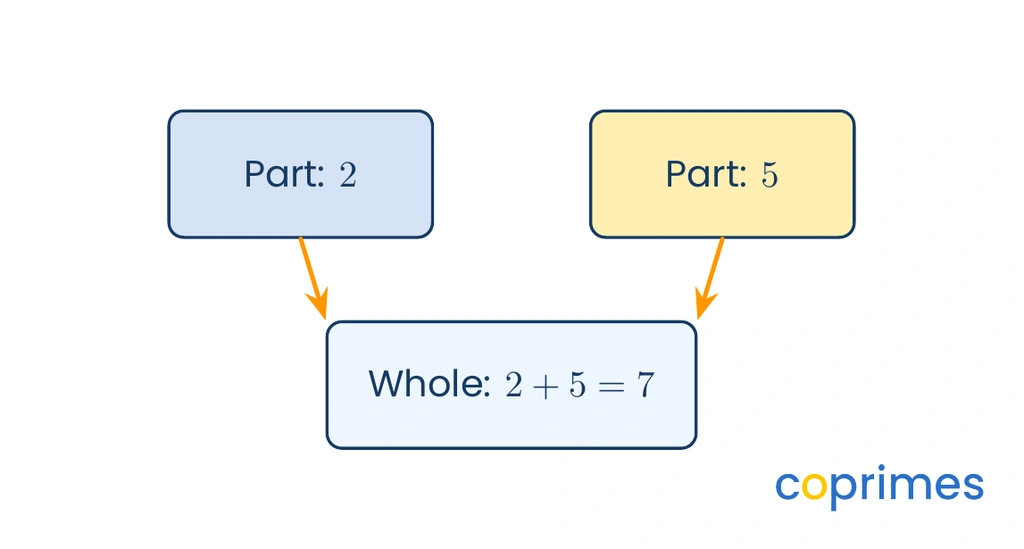
For a ratio of , the whole is . This sum becomes the denominator for any fraction created from that ratio. If a mixture has a ratio of , the total parts are .

Write and simplify the fraction
Once the whole is found, write the requested part as the numerator and the total as the denominator.
For the ratio , the fraction for the first part is , and the fraction for the second part is . Always check if the fraction can be simplified. Applying your knowledge of equivalent fractions, divide both the numerator and denominator by their greatest common factor to express the fraction in its simplest form.
Convert a fraction back to a ratio
Converting from a fraction back to a ratio reverses the process. The numerator represents the first part of the ratio, and the denominator represents the whole. To find the remaining part, subtract the numerator from the denominator.
If a specific part represents of the whole, the first part is . The remaining part is . Therefore, the part-to-part ratio is .
Worked examples
Review these examples to understand how to convert a ratio to a fraction across different scenarios.
Example 1: Converting a two-part ratio to a fraction
Question: A bag contains red and blue tokens in the ratio . What fraction of the tokens are red?
Method:
- Identify the parts. The red tokens represent parts, and the blue tokens represent parts.
- Find the whole by adding the parts together. The total is .
- Write the fraction. The red tokens are parts out of the total .
Answer: The fraction of red tokens is .
Check: The fraction for the blue tokens is . Since , the whole is complete and the denominator is correct.
Example 2: Converting a three-part ratio to a fraction
Question: A recipe mixes flour, sugar, and butter in the ratio . What fraction of the mixture is sugar?
Method:
- Identify the specific part requested. Sugar is the second part of the ratio, which is .
- Calculate the total number of parts by adding all three values. The total is .
- Form the fraction with the sugar part as the numerator and the total as the denominator, which gives .
- Simplify the fraction by dividing both the numerator and denominator by their greatest common factor, which is .
Answer: The fraction of sugar is .
Check: The original unsimplified fractions are , , and . Adding them gives , confirming the denominator is correct before simplification.
Example 3: Finding a ratio from a fraction
Question: In a classroom, of the students play an instrument. What is the ratio of students who play an instrument to students who do not?
Method:
- Identify the part and the whole from the fraction. The part playing an instrument is , and the whole is .
- Subtract the numerator from the denominator to find the remaining part. The students who do not play are .
- Write the ratio of the first part to the second part.
Answer: The ratio is .
Check: Adding the parts of the ratio equals the original fractional denominator .
A learning plan shaped by your child, not the class
State-aligned Math plus our own Logic and English curriculum. An adaptive baseline test finds the gaps and fills them.
Common mistakes
A frequent error is using one of the ratio parts as the denominator instead of finding the total sum. For a ratio of , the fraction is not . The correct denominator requires adding , making the correct fraction .
Another common mistake is forgetting to simplify the final fraction, or simplifying incorrectly when dividing ratios. Always ensure the numerator and the denominator share no common factors other than .
Frequently asked questions
Here are common questions learners ask when working with ratio fraction conversions.
Can a ratio be written as a fraction?
Yes. A part-to-whole ratio is identical to a fraction. A part-to-part ratio can be easily converted into a fraction by adding the parts together to find the denominator, then using the specific requested part as the numerator.
What is the denominator of a ratio fraction?
The denominator of a fraction derived from a ratio is the total sum of all the parts in the ratio. This represents the complete whole.
How does ratio to fraction relate to percentages?
Once a ratio is written as a fraction, you can divide the numerator by the denominator to find a decimal, which easily converts the ratio to percent.
Practice questions

What fraction of the shapes shown in the visual are stars?
A metal alloy is made of copper, zinc, and tin in the ratio . What fraction of the alloy is zinc?
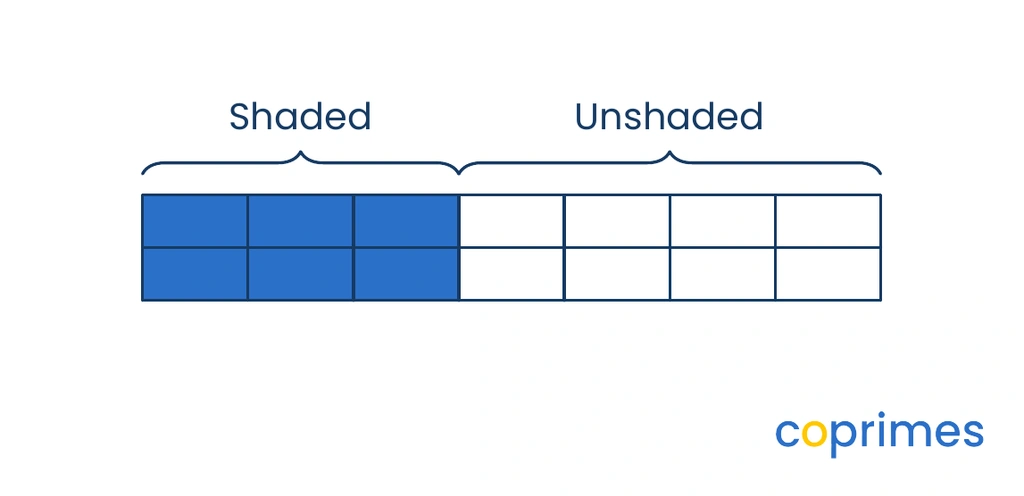
The visual shows the fraction of a bar that is shaded. What is the ratio of shaded segments to unshaded segments?
A recipe uses oil and vinegar in the ratio . Which statement correctly describes the fraction of oil in the dressing?
The fraction is because oil is parts out of parts.
The fraction is because oil is parts out of total parts.
The fraction is because vinegar is the larger part.
The fraction is because you divide the second part by the first part.
The fraction is because oil is parts out of total parts.
In a school, of the students walk to school. What is the ratio of students who walk to school to students who use other transport?