
Rounding Decimals: Guide and Examples
To round a decimal, identify the final place to keep and use the next digit to decide whether that place stays the same or increases by one. This process reduces the number of digits in a decimal while keeping its value close to the original.
What Is Rounding Decimals?
Rounding decimals means shortening a number to a specific place value, such as the nearest tenth or hundredth. The rules are exactly the same as rounding whole numbers.
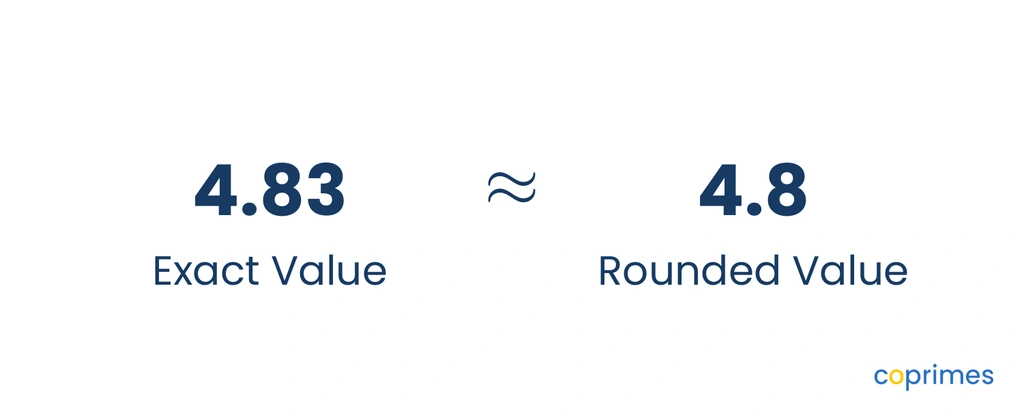
When a decimal is rounded, it becomes an approximation. We use the approximately equal symbol () to show that the exact value has been adjusted. For example, .
If the digit used to decide the rounding is small, the target digit remains unchanged, which is called rounding down. If the decision digit is large, the target digit increases by one, which is called rounding up.
When to Use It
Rounding decimals is an essential tool for estimation in math, allowing you to work with simpler numbers when exact values are unnecessary.
In everyday life, money is usually rounded to two decimal places, representing dollars and cents. Measurements such as distance, weight, or temperature are often rounded to one or two decimal places so they are easier to read and communicate. Rounding is also frequently used to shorten repeating decimals produced by a calculator.
Step-by-Step Method
Follow these numbered steps to round any decimal number:
- Identify the target place value, such as the nearest whole number, tenth, or hundredth.
- Look at the decision digit immediately to the right of the target place.
- If the decision digit is , , , , or , keep the target digit the same to round down.
- If the decision digit is , , , , or , add to the target digit to round up.
- Remove all digits to the right of the target place.
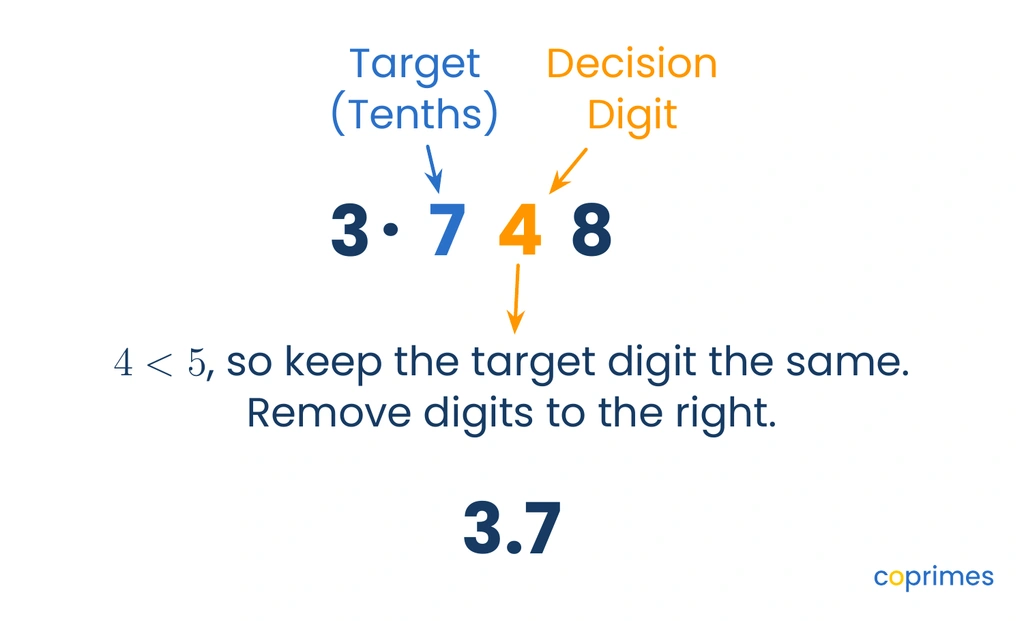
decision digit is always exactly one place to the right of the target digit.

Visual Worked Examples
Example 1: Rounding to the nearest whole number
Question: Round to the nearest whole number.
Method:
- The target place is the nearest whole number, which is the ones place containing .
- The decision digit to the right is .
- Because the decision digit is , round up by adding to the .
- The becomes a .
- Remove the decimal point and all digits to the right.
Answer: .
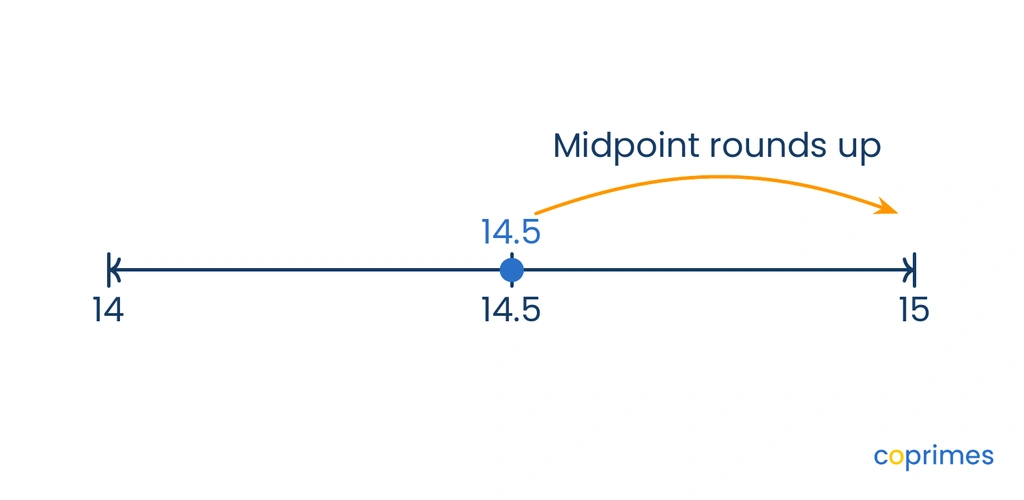
Check: On a number line, is exactly halfway between and . By mathematical convention, a midpoint always rounds up.
Example 2: Rounding to the nearest tenth with a 9
Question: Round to the nearest tenth.
Method:
- The target place is the tenths place, which contains .
- The decision digit to the right is .
- Because the decision digit is , round up by adding to the .
- Adding to tenths makes tenths, which regroups as whole. The becomes a , and the becomes a .
- Remove all digits to the right of the tenths place.
Answer: .
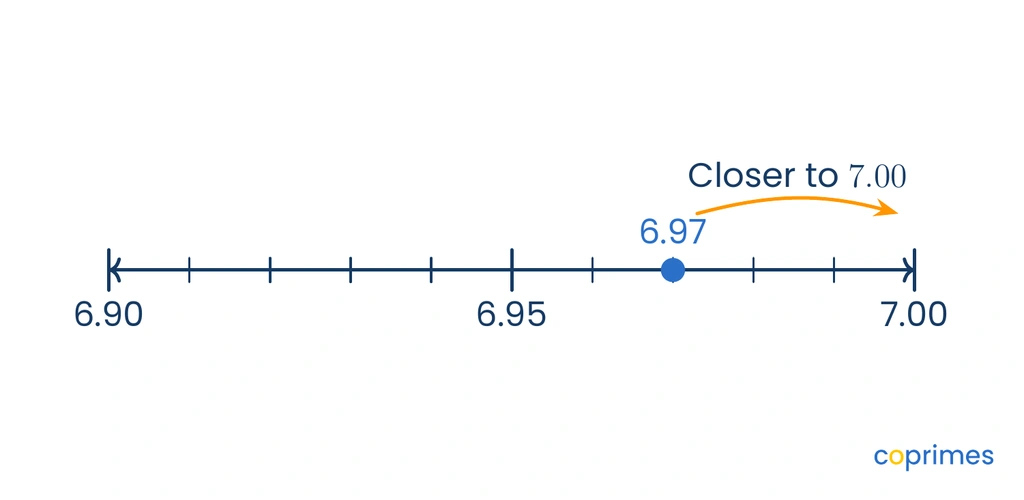
Check: The number is closer to than to . The zero must be written to show the number was rounded to the tenths precision.
Example 3: Rounding to the nearest hundredth and thousandth
Question: Round to the nearest hundredth, and then round the original number to the nearest thousandth.
Method:
- To round to the nearest hundredth, the target digit is and the decision digit is .
- Because is less than , keep the and remove the following digits to get .
- To round to the nearest thousandth, the target digit is the in the thousandths place and the decision digit is .
- Because the decision digit is , round up by adding to the target digit to get .
- Remove the digits after the thousandths place to get .
Answer: The nearest hundredth is . The nearest thousandth is .
Check: The number is closer to than to .
How to Check the Answer
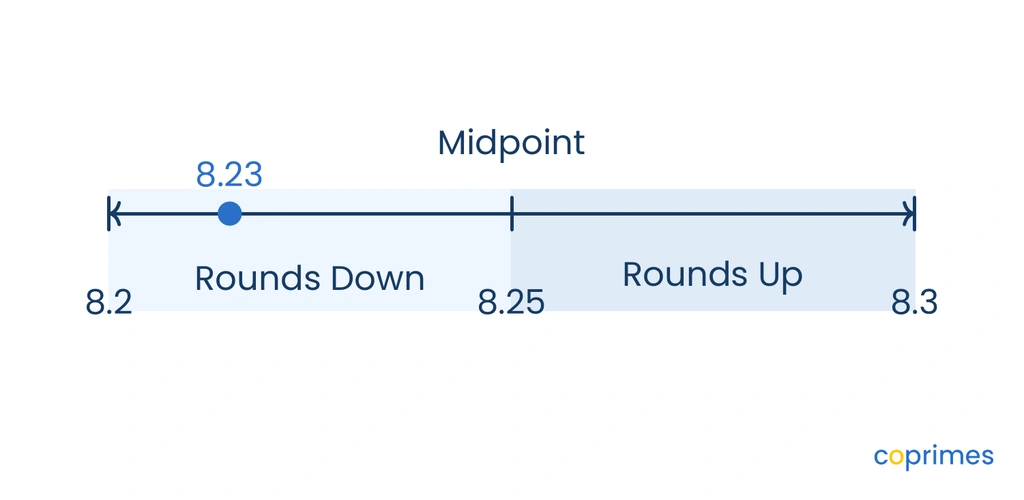
The most reliable way to check a rounded decimal is to find the exact midpoint between the two possible rounded values. A number line check helps you determine if the original number is greater than less than equal to the halfway mark.
If you are rounding to the nearest tenth, the two possible answers are and . The exact midpoint is . Compare the original number to the midpoint. Because is less than , it sits on the lower half of the number line and rounds down to .
Common Mistakes
A frequent error is chain-rounding, where a student looks too far to the right and rounds multiple times. To round to the nearest tenth, you must look only at the hundredths digit, which is . The number rounds down to . You should never round the up to just because of the .
Another mistake occurs when students incorrectly drop trailing zeros. If a calculation requires rounding to the nearest tenth, rounding up changes the to a and carries to the whole number, giving . Writing the answer merely as changes the precision of the result. Retaining the correct number of decimal places becomes critical when evaluating significant figures in later mathematics.
Finally, take care when comparing and ordering numbers that have been rounded. Rounding changes the exact value slightly, meaning two different numbers might round to the same decimal, or a previously smaller number could appear equal to a larger one.
A learning plan shaped by your child, not the class
State-aligned Math plus our own Logic and English curriculum. An adaptive baseline test finds the gaps and fills them.
Practice questions
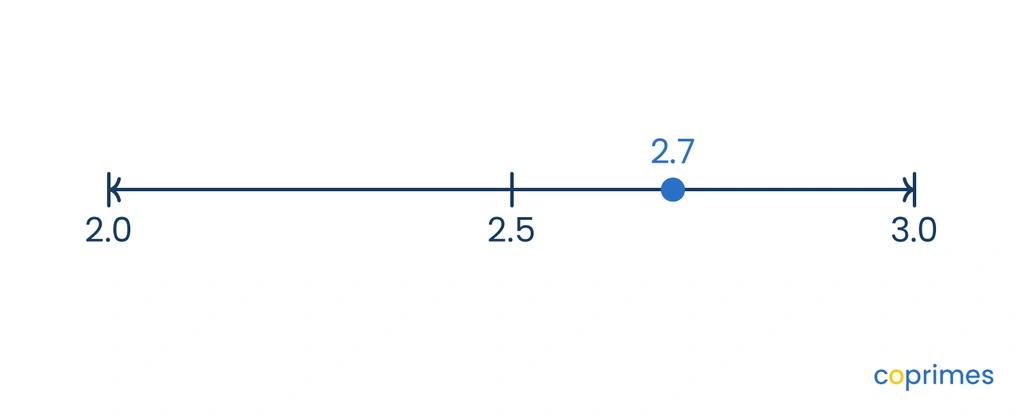
Based on the number line, what does round to when rounded to the nearest whole number?
Round to the nearest tenth.
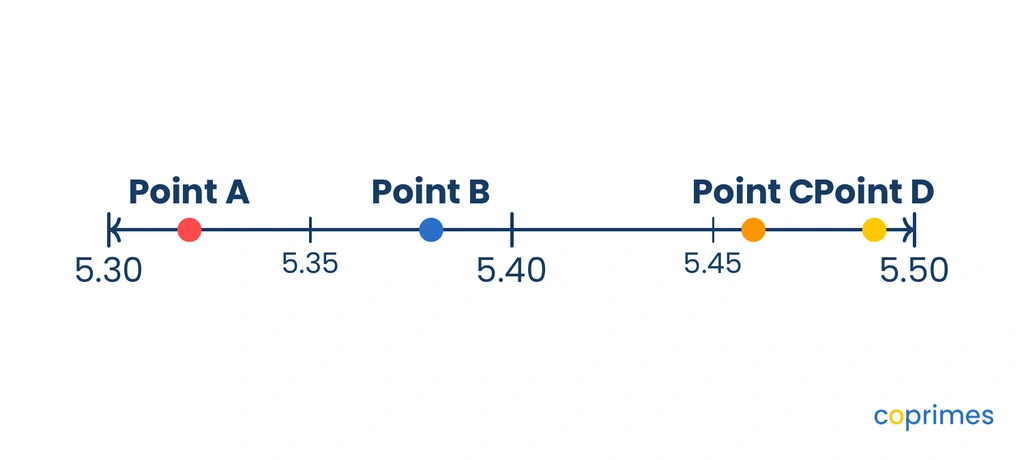
Which point on the number line represents a value that rounds to when rounded to the nearest tenth?
Point A
Point B
Point C
Point D
Point B
Round to the nearest tenth.
A scientist records a mass of grams. What is this mass rounded to the nearest hundredth?