
Significant Figures: Guide and Examples
Significant figures are the digits that communicate a number's precision, counted from the first nonzero digit. They help simplify calculations and measurements while maintaining a meaningful scale.
What Is Significant Figures?
Significant figures, sometimes called significant digits or sig figs, are the specific digits in a number that contribute to its accuracy. The first significant figure is always the first non-zero digit when reading a number from left to right.
Identifying which digits are significant requires following specific rules, especially when dealing with zeros.
- Non-zero digits are always significant.
- Leading zeros at the start of a decimal are never significant; they are only placeholders.
- Captive zeros caught between non-zero digits are always significant.
- Trailing zeros at the end of a decimal number are always significant because they show deliberate precision.
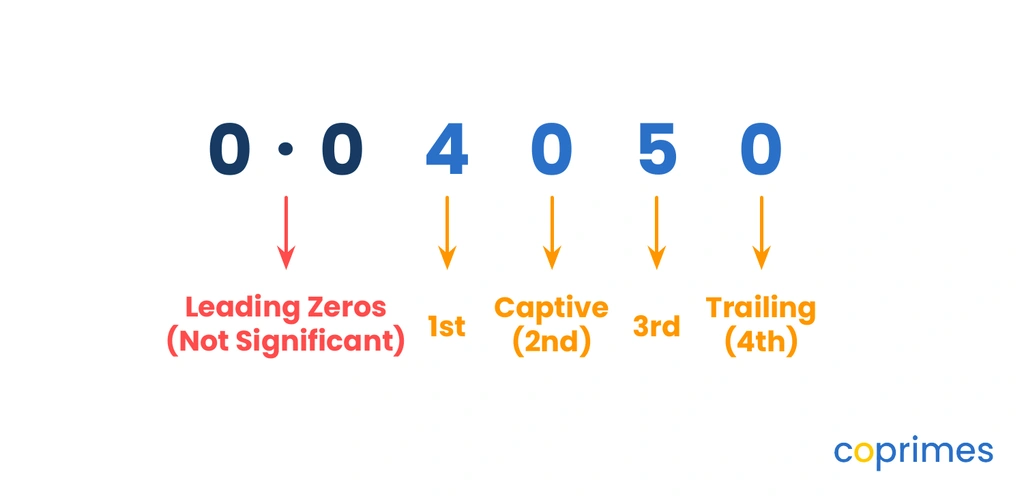
Trailing zeros in a whole number without a decimal point (like ) are usually considered non-significant placeholders. However, if a measurement demands exactness, placing a decimal point at the end () makes them significant.
When to Use It
Rounding to significant figures is highly useful in science, engineering, and statistics where measurements have limits on their accuracy. It prevents you from reporting an answer that looks more precise than the tools used to measure it.
Significant figures share the same foundation as scientific notation, which specifically isolates the significant digits of a number. You will also use this concept frequently for estimation in math to find quick, reliable approximations for complex calculations.
Step-by-Step Method
To round a number to a requested number of significant figures, follow this systematic method. The logic is identical to rounding whole numbers and rounding decimals, but you must find the correct starting digit first.
- Locate the first non-zero digit from the left. This is the first significant figure.
- Count to the right to find the target significant figure.
- Look at the decider digit immediately to the right of your target.
- If the decider digit is or greater, round the target digit up by one. If it is or less, keep the target digit the same.
- Replace any remaining digits before the decimal point with placeholder zeros to keep the number's magnitude intact. Drop any remaining digits after the decimal point.
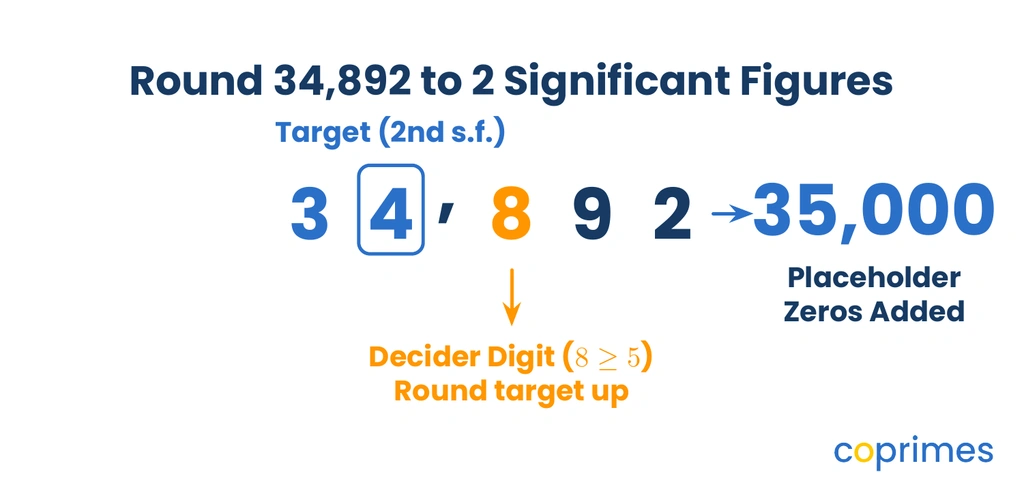
Always count significant figures starting from the first non-zero digit, regardless of where the decimal point is.
A learning plan shaped by your child, not the class
State-aligned Math plus our own Logic and English curriculum. An adaptive baseline test finds the gaps and fills them.
Visual Worked Examples
Use the rounding method carefully, keeping track of placeholder zeros and cascade rounding when a rounds up to a .
Example 1: Rounding a large whole number
Question: Round to significant figure.
Method:
- Locate the first significant figure: The first non-zero digit is .
- Identify the target digit: Since we need significant figure, is the target.
- Look at the decider digit: The digit to the right of is .
- Apply rounding rules: Because is less than , keep the target digit as .
- Add placeholders: Replace the remaining digits before the decimal with zeros to keep the magnitude.
Answer: .
Check: The original number is close to sixty thousand, so the rounded magnitude makes sense.
Example 2: Rounding a decimal with leading zeros
Question: Round to significant figures.
Method:
- Locate the first significant figure: Skip the leading zeros. The first non-zero digit is .
- Identify the target digit: The second significant figure is .
- Look at the decider digit: The digit immediately to the right is .
- Apply rounding rules: Because is less than , keep the target digit as .
- Finalize the decimal: Drop the entirely. Keep the leading zeros because they establish the decimal's size.
Answer: .
Check: The number has exactly two non-zero digits, and the leading zeros correctly position them in the thousandths place.
Example 3: Rounding that creates a new trailing zero
Question: Round to significant figures.
Method:
- Locate the first significant figure: .
- Identify the target digit: The second significant figure is .
- Look at the decider digit: The digit to the right is .
- Apply rounding rules: Because is or more, round the up.
- Carry over: Rounding up makes it . Write in the target position and carry the to the , making it .
Answer: .
Check: We must write , not just , because the zero in the tenths place proves we rounded the number accurately to exactly two significant figures.
How to Check the Answer
You can verify your rounding by checking the magnitude of the final number. If you round to one significant figure and get , you have forgotten to add placeholder zeros. Using greater than less than equal to reasoning, is close to the original amount, whereas is vastly smaller.
You can also check your work by counting the significant figures in your final answer from left to right. Your final answer must contain exactly the number of significant figures requested in the problem.
Common Mistakes
A frequent mistake is confusing significant figures with decimal places. Decimal places are counted starting immediately after the decimal point, including zeros. Significant figures are counted starting from the first non-zero digit anywhere in the number.
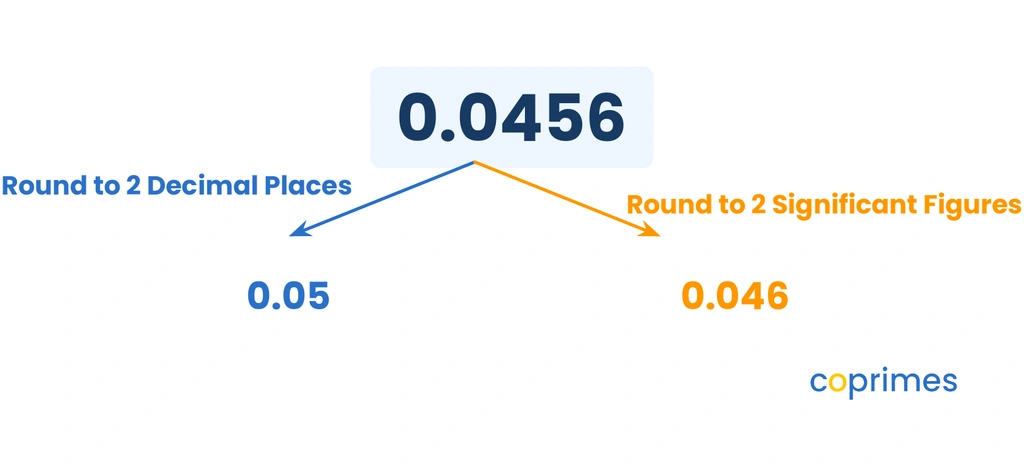
Rounding to two decimal places means the target digit is the , and the answer is . But rounding the same number to two significant figures means the target digit is the , resulting in . Always identify the first non-zero digit before you start counting significant figures.

Practice questions

How many significant figures are in the measurement shown on the digital scale?
Round to significant figure.
Which statement is mathematically true about the zeros in the number ?
All zeros in the number are significant figures.
Only the leading zeros before the are significant figures.
Only the captive zero between the and the is significant.
None of the zeros in the number are significant figures.
Only the captive zero between the and the is significant.
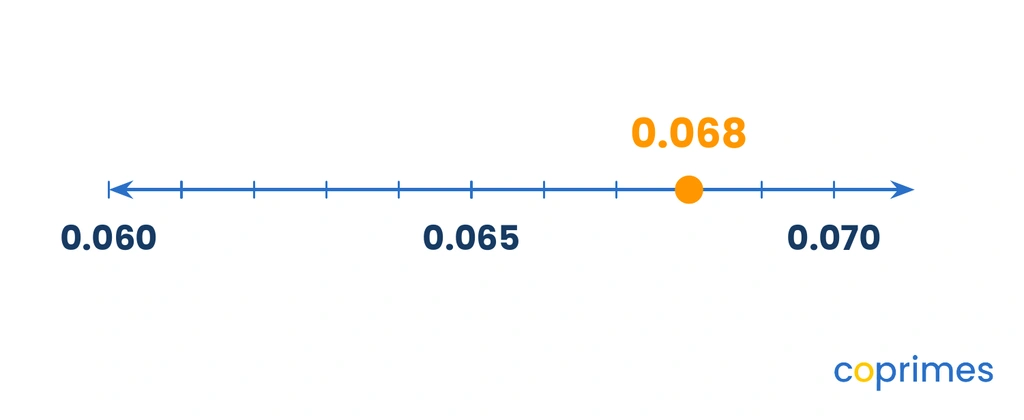
Based on the number line, what is rounded to significant figure?
Round to significant figures.