
Rounding Whole Numbers: Guide and Examples
To round a whole number, keep the chosen place and use the digit immediately to its right to decide whether to round down or up. Rounding whole numbers creates a simpler value that is easier to work with while remaining close to the original amount.
What Is Rounding Whole Numbers?
Rounding off whole numbers means adjusting a number to its nearest multiple of , , , or another specified place value. Instead of using a highly specific quantity, you find the closest clean boundary value.
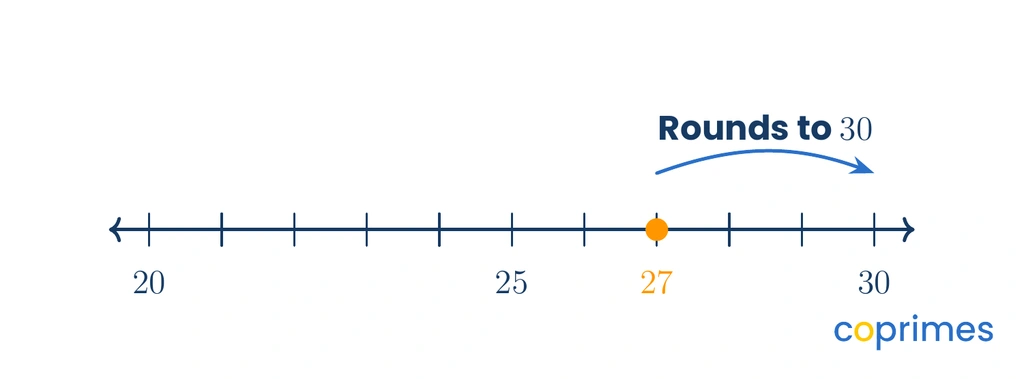
On a number line, rounding means finding the boundary that the exact number sits closest to. For example, sits between and . Because its physical distance to is shorter than its distance to , rounded to the nearest ten is .
When to Use It
Rounding is used whenever an exact calculation is unnecessary or too complex to calculate mentally. When ordering numbers for a quick comparison, rough estimates are often sufficient.
Rounding builds the foundation for determining significant figures in science, where measurements are rarely exact. It is a critical skill for everyday life, such as estimating the total cost of groceries or deciding approximately how much time is needed for a trip.
Step-by-Step Method
Rather than drawing a number line for large values, you can use the place value rules.
- Identify the rounding digit: Find the digit in the place value you are rounding to (tens, hundreds, thousands, etc.).
- Look at the deciding digit: Look exactly one place to the right of your rounding digit.
- Apply the rule: Determine if you should keep the rounding digit the same or increase it.
- Change remaining digits: Turn every digit to the right of the rounding digit into a zero.
If the deciding digit is 4 or less, keep the rounding digit the same. If the deciding digit is 5 or more, increase the rounding digit by 1.
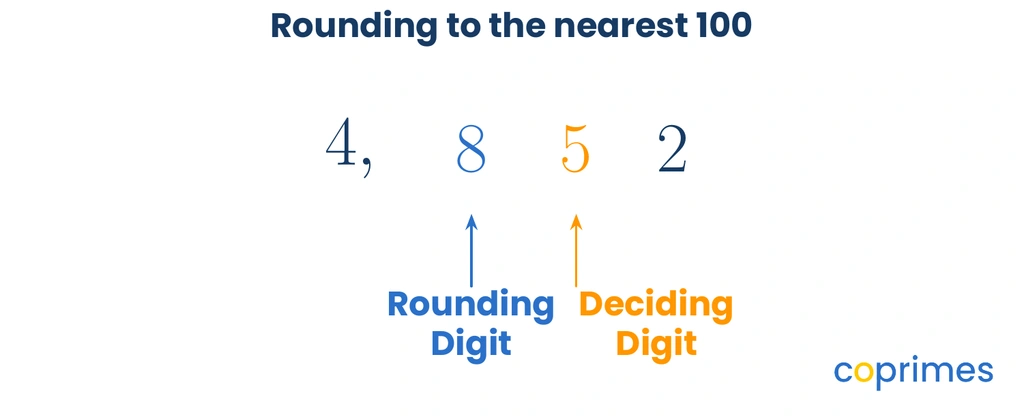
The number is exactly halfway between two boundaries. In mathematics, the standard rule is to round up whenever the deciding digit is exactly .
A learning plan shaped by your child, not the class
State-aligned Math plus our own Logic and English curriculum. An adaptive baseline test finds the gaps and fills them.
Visual Worked Examples
Applying the place value method correctly will work for numbers of any size.
Example 1: Rounding to the nearest 10
Question: Round to the nearest .
Method:
- The rounding digit is (in the tens place).
- The deciding digit is (in the ones place).
- Since is less than , keep the exactly as it is.
- Change the to a .
Answer: rounded to the nearest is .
Check: On a number line, is only units away from , but it is units away from .
Example 2: Rounding halfway cases to the nearest 100
Question: Round to the nearest .
Method:
- The rounding digit is (in the hundreds place).
- The deciding digit is (in the tens place).
- Since the deciding digit is or more, increase the by to make it .
- Change the tens and ones digits to zeros.
Answer: rounded to the nearest is .
Check: The original number is exactly in the middle of and . The rule confirms that middle values always round up to the higher boundary.
Example 3: Rounding with a carrying digit
Question: Round to the nearest .
Method:
- The rounding digit is (in the thousands place).
- The deciding digit is (in the hundreds place).
- Because is or more, we must increase the by .
- Adding to gives . Write in the thousands place and carry the to the ten-thousands place, turning the into a .
- Change the hundreds, tens, and ones digits to zeros.
Answer: rounded to the nearest is .
Check: is bounded by and . It is past the halfway mark of , so it sits closer to .
How to Check the Answer
You can verify any rounded value using greater than less than equal to reasoning. Identify the two boundaries your original number falls between.
If you are rounding to the nearest , your boundaries are and . Calculate the midpoint, which is . Since , the number belongs closer to the lower boundary of .
Common Mistakes
A major misconception occurs when students look at the wrong deciding digit. If you are asked to round to the nearest , the rounding digit is and the correct deciding digit is .
Some students mistakenly look at the in the ones place, round the up to a , and then round the up to a . This creates a chain reaction of errors.
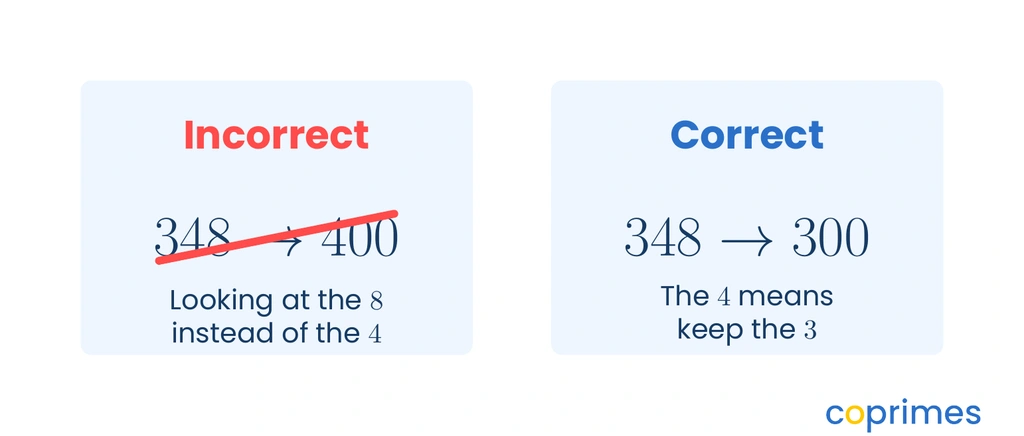
Never look more than one place value to the right. The remaining digits do not matter.
Another error is forgetting to change the trailing digits to zeros, leaving a number like rounded to . Just like when comparing integers, every place value holds importance. Once you master the method for whole numbers, the same principles transfer naturally to rounding decimals.

Practice questions
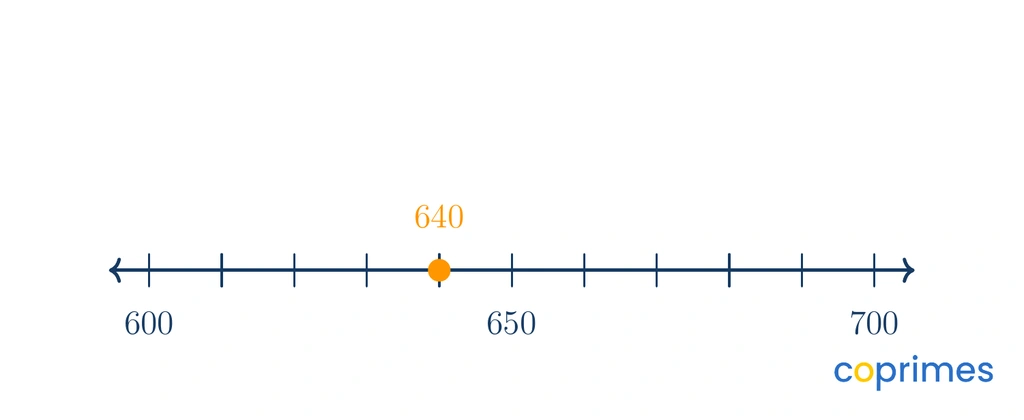
Based on the visual above, what is rounded to the nearest ?
Round to the nearest .
What is rounded to the nearest ?
Which of the following numbers will round to when rounded to the nearest ?
A student rounded to the nearest and got . What was their reasoning?
The student looked at the , which made the round down.
The deciding digit rounded the up to , which carried over to make .
The student made a mistake because the answer should be .
They changed all digits to zero because the thousands digit was already a .
The deciding digit rounded the up to , which carried over to make .