
Standard, Word and Expanded Form: Guide and Examples
Standard form uses digits, word form spells the number in words, and expanded form shows the value contributed by each digit in an addition sentence. Understanding standard word and expanded form helps us connect how a number looks with how much it is actually worth, giving us flexibility when solving mathematical problems.
What Are Standard, Word and Expanded Form?
Every number can be written in multiple ways depending on what we need to do with it. These three common number forms represent the exact same quantity but display it differently.
- Standard form numbers: The everyday way we write numbers using the digits through . It is compact and efficient (for example, ).
- Expanded form numbers: A stretched-out addition sentence that reveals the hidden value of each digit based on its position (for example, ).
- Word form numbers: The number written out entirely in text, exactly as you would read it aloud (for example, four thousand, two hundred seventy-five).
A place value chart serves as the perfect translation tool between these forms. By dropping a standard number into the chart, you instantly see the values needed for its expanded and word forms.
Key Differences
The primary difference between these forms is their mathematical focus.
Standard form focuses on speed and efficiency. When we perform calculations like addition or multiplication, standard form keeps our columns organized and our work manageable.
Expanded form focuses on structural transparency. It forces us to acknowledge place value by breaking a number apart into its thousands, hundreds, tens, and ones components.
Word form focuses on literacy and communication. It ensures that numbers are spoken and recorded unambiguously in formal settings, bridging the gap between mathematical notation and written language.
Comparison Table
Here is how a single number transforms across the three formats.
Number Form | Example | Mathematical Purpose |
Standard Form | Best for calculating, comparing, and organizing data quickly. | |
Expanded Form | Best for identifying the true value of individual digits. | |
Word Form | Eight thousand, three hundred nine | Best for reading aloud and formal writing. |
A learning plan shaped by your child, not the class
State-aligned Math plus our own Logic and English curriculum. An adaptive baseline test finds the gaps and fills them.
Visual Examples
We can map the direct translation from standard form to expanded form to word form visually. Notice how the single digits in standard form grow into their full place values in expanded form.
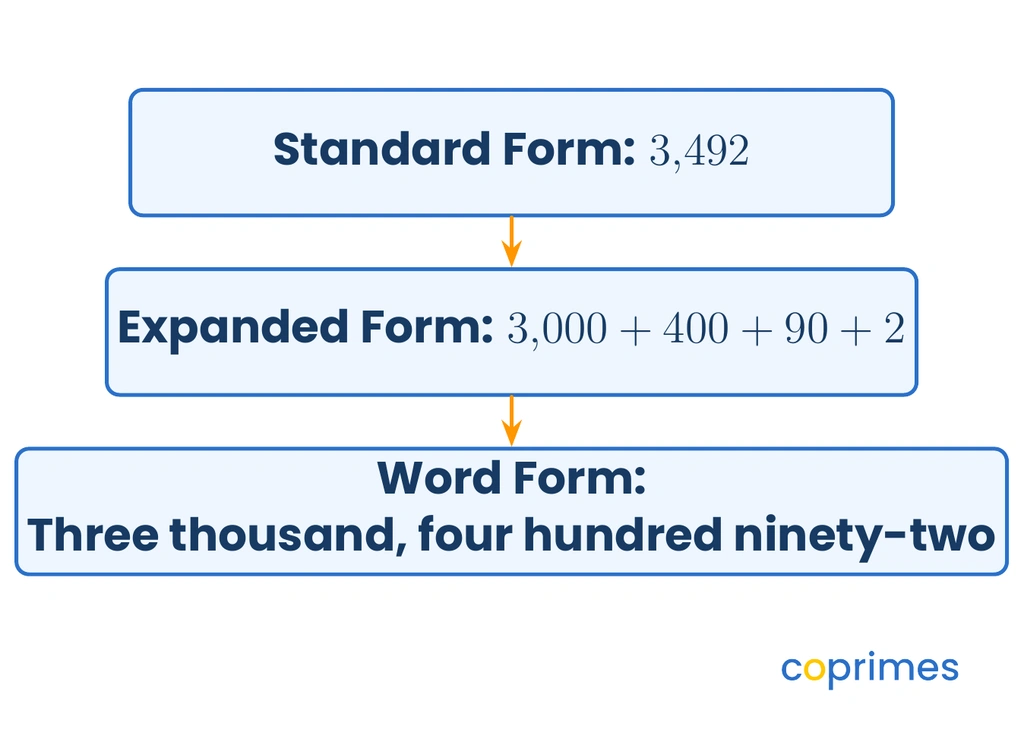
Practicing conversions between these formats builds foundational number sense.
Example 1: Converting whole numbers with internal zeros
Question: Write the number in word form and expanded form.
Method:
- Identify the value of each non-zero digit moving from left to right.
- The is in the ten thousands place (). The zero in the thousands place contributes nothing to the addition sentence, so we skip it.
- The is in the hundreds place (), and the is in the ones place ().
- Write the expanded form as an addition sentence.
- Read the standard number aloud to determine the word form.
Answer: The expanded form is . The word form is fifty thousand, four hundred two.
Check: Add the expanded form values together in columns: . This matches the original standard form perfectly.
Decimal numbers can also be translated into expanded notation. We represent the decimal parts as either fractions or smaller decimals.
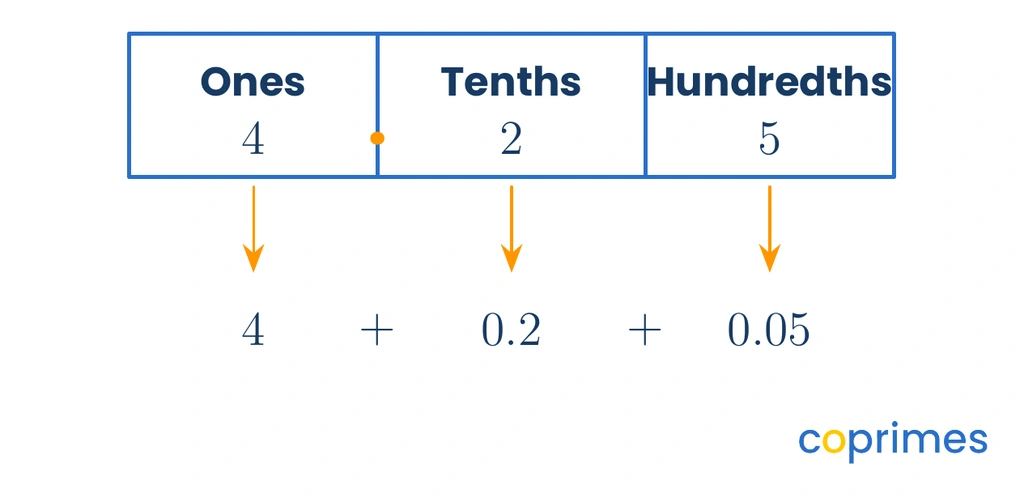
Example 2: Decimals in expanded form
Question: Write the number in expanded form using both decimals and fractions.
Method:
- Identify the whole number part and the decimal fractions. The is in the ones place ().
- The is in the tenths place, representing or .
- The is in the hundredths place, representing or .
- Connect these values using addition.
Answer: Using decimals, the expanded form is . Using fractions, it is .
Check: Recombine the decimal version: .
Sometimes, an expanded form equation is written out of order. You must reorganize it mentally or on paper to write the standard form safely.
Example 3: Rebuilding standard form from mixed order
Question: What is the standard form of ?
Method:
- Identify the highest place value first to determine the total size of the number. The largest part is .
- Place the digit in the thousands column.
- Because there are no hundreds listed in the addition sentence, use as a placeholder in the hundreds column.
- Place the in the tens column and the in the ones column.
Answer: The standard form is .
Check: Rewrite the standard number into proper expanded form order from largest to smallest: .
How to Choose or Classify
Deciding which form to use depends on the context of the problem. We strictly use standard form when executing algorithms, reading data tables, or plotting a value precisely on a number line.
Word form is required in legal and financial contexts, such as writing a bank check, to prevent numbers from being easily altered. It relates heavily to literacy and differs slightly from how we state cardinal and ordinal numbers in rank order.
Expanded form is primarily an educational tool used for reading and writing large numbers. It trains the brain to see the hidden magnitude behind digits.
However, not all numbers should be converted into these formats. Non-examples of place value include telephone numbers, zip codes, and computer passwords. Because these strings of digits are used for identification rather than representing an actual mathematical quantity, writing a telephone number in expanded form does not make logical sense.
Common Mistakes
The most frequent mistake in converting to standard form is forgetting placeholders. If you expand and write it as , the accidentally drops from the thousands place to the hundreds place. You must insert a zero in any empty column.
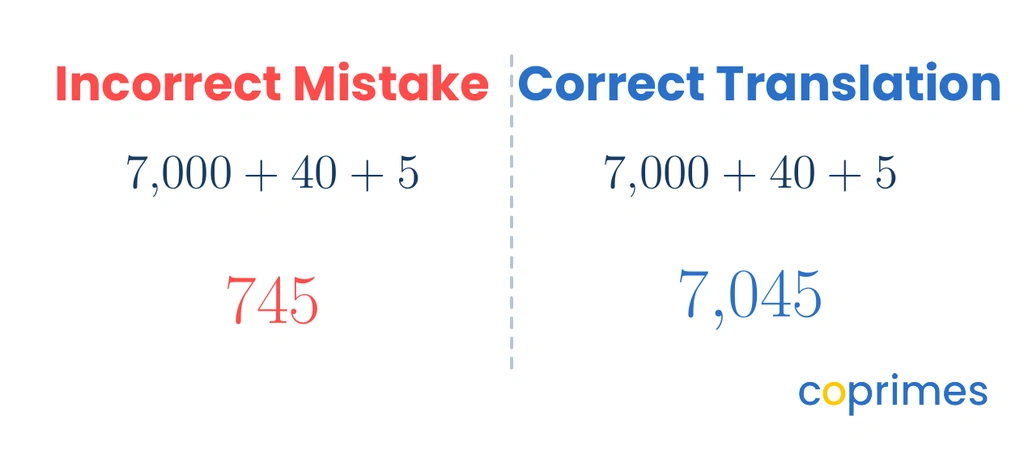
Another common issue is using the word "and" incorrectly in word form. In formal mathematics, "and" signifies the decimal point. Writing "three hundred and four" can cause confusion; the correct whole-number format is "three hundred four".

Practice questions

Which of the following is the correct expanded form for the number represented by the blocks in the visual?
What is the standard form of the number "nine thousand, forty-one"?
Which equation correctly shows the expanded form of the decimal ?
A student wrote the expanded form of a number as . What mistake did they likely make when trying to expand the standard number ?
They wrote instead of .
They wrote instead of .
They included an instead of .
They forgot to include the placeholder zero as an addition step.
They wrote instead of .
What is the correct word form for the number created by combining ?
Five thousand, thirty-nine
Five thousand, three hundred nine
Thirty-five thousand, nine
Five thousand, ninety-three
Five thousand, thirty-nine