
Place Value Chart: Guide and Examples
A place value chart organizes digits by position so learners can see the value of each digit and how values change by factors of ten. By placing a number into the grid, you can easily determine whether a specific digit represents millions, tens, ones, or decimal fractions. Before using a chart, it is essential to understand foundational place value.
Place Value Chart: Definition and Notation
A place value chart, sometimes called a place value table or place value grid, is a visual tool that separates a number into its individual digit values.
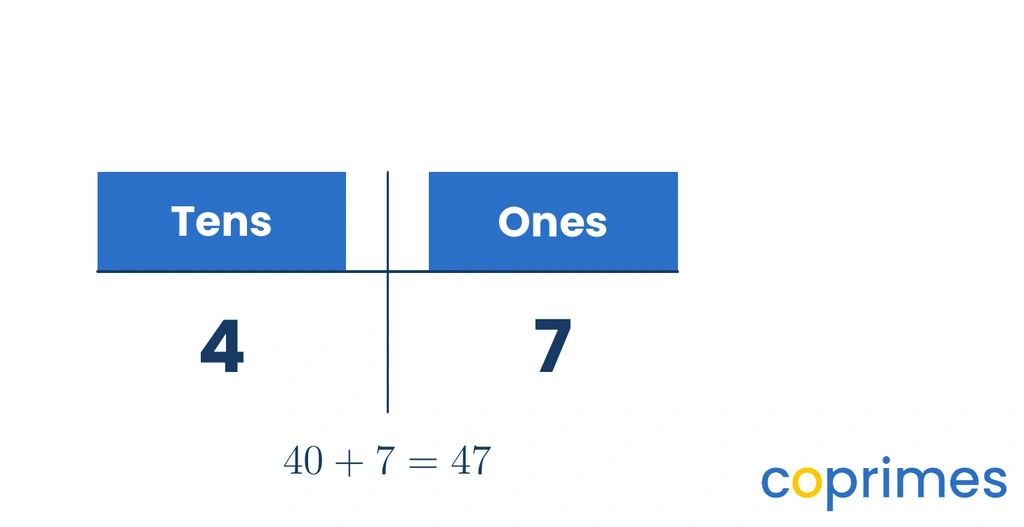
Each column in the chart represents a specific magnitude. For example, placing the digits and into their respective columns makes it clear that the number consists of four tens and seven ones, which combine to make .
Rules or Reference Table
A standard chart arranges columns from the largest values on the left to the smallest values on the right, separated by a decimal point for fractional parts.
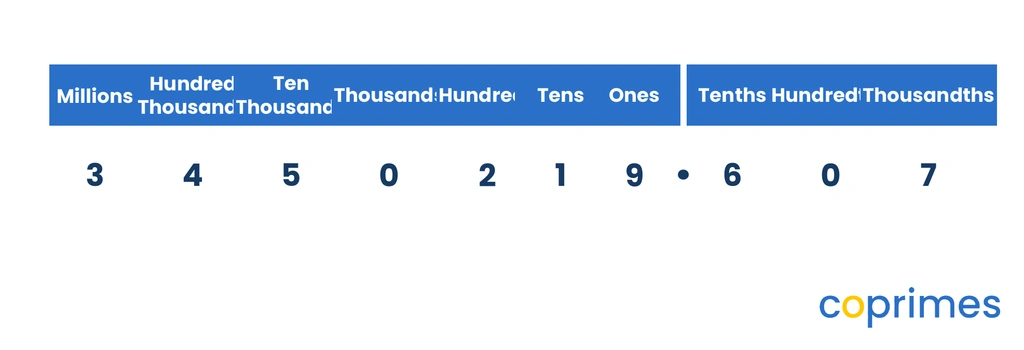
When numbers are organized in this robust structure, writing them in standard word and expanded form becomes a straightforward process. The decimal point always sits permanently between the ones column and the tenths column to separate whole numbers from fractional pieces.
Why It Works
The chart reflects our base-ten number system, where every column is exactly ten times larger than the column to its immediate right.
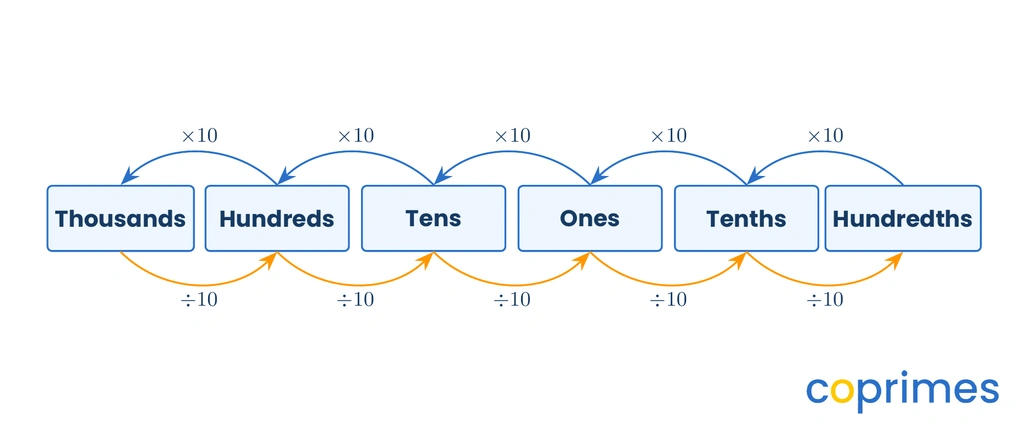
Because of this strict base-ten relationship, moving a digit one column to the left multiplies its value by . Conversely, moving a digit one column to the right divides its value by . This continuous multiplying and dividing applies endlessly in both directions, extending completely into decimal values.
A learning plan shaped by your child, not the class
State-aligned Math plus our own Logic and English curriculum. An adaptive baseline test finds the gaps and fills them.
Visual Worked Examples
Using the chart methodically helps correctly identify digit values, shift numbers during multiplication, and reconstruct numbers from scattered clues.
Placing a large number into a grid makes it immediately clear which positional value each digit holds.

Example 1: Identifying digit values
Question: What is the value of the digit in ?
Method:
- Place the number into a place value chart aligning the rightmost whole digit in the ones column.
- Locate the digit .
- Identify the heading of that column. The is in the ten thousands column.
Answer: The value is .
Check: Read the number aloud: "Three million, seven hundred forty-two thousand..." The spoken word confirms the forty thousand value.
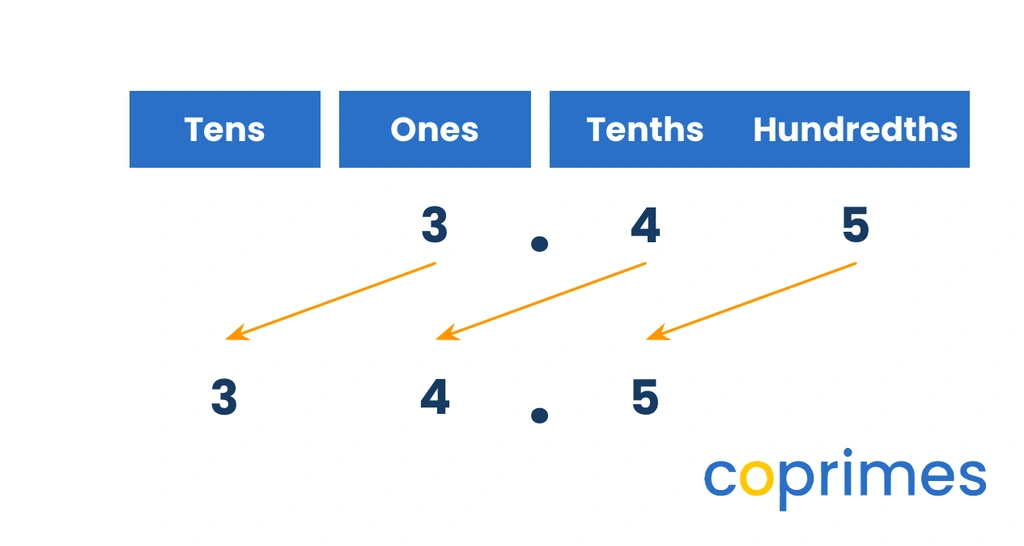
When multiplying by , the visual below shows how every digit shifts exactly one place to the left, which handles decimals naturally without resorting to shortcuts.
Example 2: Multiplying a decimal
Question: Multiply by .
Method:
- Place into the chart.
- Multiplying by means every digit increases in value by exactly one base-ten step.
- Move every non-zero digit exactly one column to the left.
Answer: .
Check: , and . Added together, the result is exactly .
Example 3: Constructing a number
Question: A number has a in the thousands place, an in the hundredths place, a in the tens place, and in all other columns between its largest digit and the hundredths. What is the number?
Method:
- Identify the largest column needed (thousands) and the smallest (hundredths).
- Place the given non-zero digits into their assigned columns.
- Fill all empty columns between the thousands and the hundredths with placeholder zeros.
Answer: .
Check: Write the answer in expanded form to verify each non-zero digit: .
Common Mistakes and Exceptions
A widespread misconception is assuming that multiplying any number by ten simply means adding a zero to the end of it.
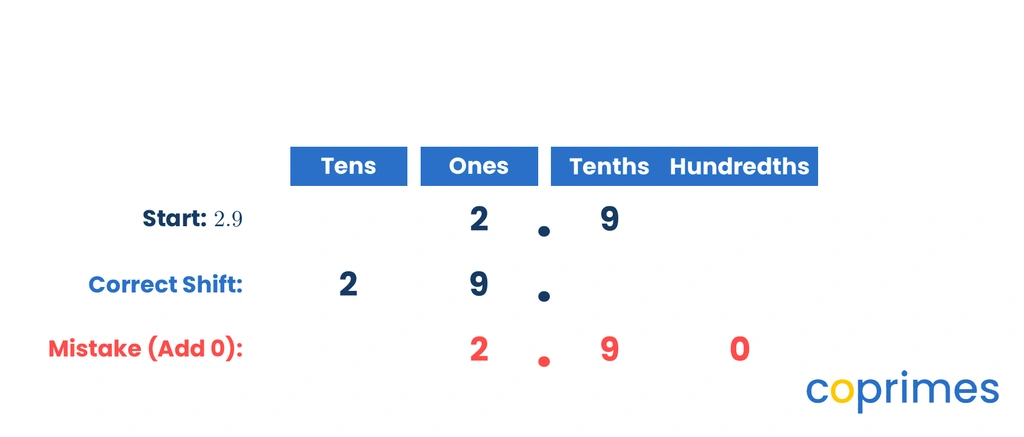
While the visual shortcut of adding a zero appears to work for whole numbers (such as ), this shortcut fails completely for decimal numbers. As the chart demonstrates, adding a zero to the end of creates . The digit remains stuck in the ones column and the digit remains in the tenths column, meaning the mathematical value has not changed at all. To correctly multiply by ten, you must physically shift every digit one column to the left, which correctly transforms into .
Applications
Using a place value grid strengthens essential numerical skills extending beyond basic arithmetic.
A solid grasp of this visual tool prepares learners for reading and writing large numbers with accuracy. By organizing digits sequentially, it provides a reliable structure for safely rounding decimals by locating the target rounding digit and its immediate neighbor to the right. Furthermore, understanding the distinct values of numbers serves as the underlying foundation for other mathematical classifications, including distinguishing cardinal and ordinal numbers.

Practice questions
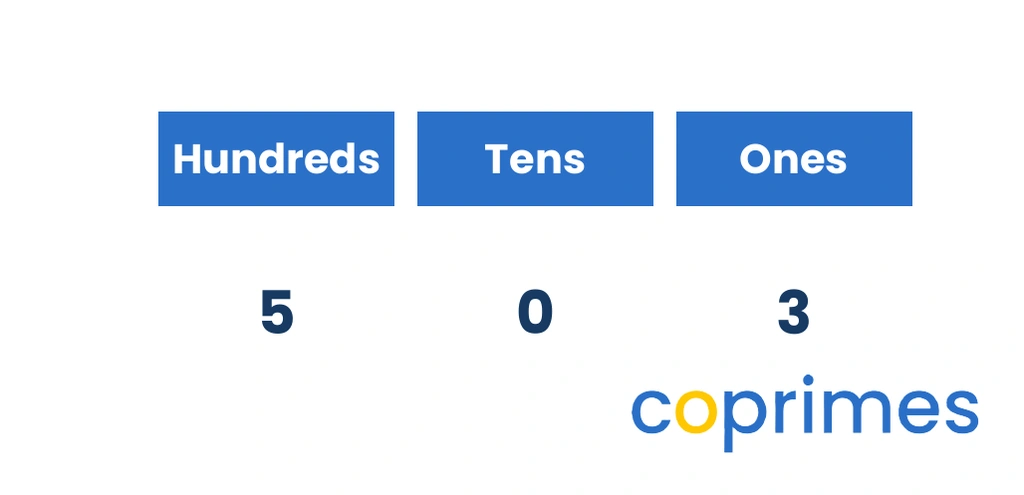
What number is shown in this place value chart?
What is the value of the digit in the number ?
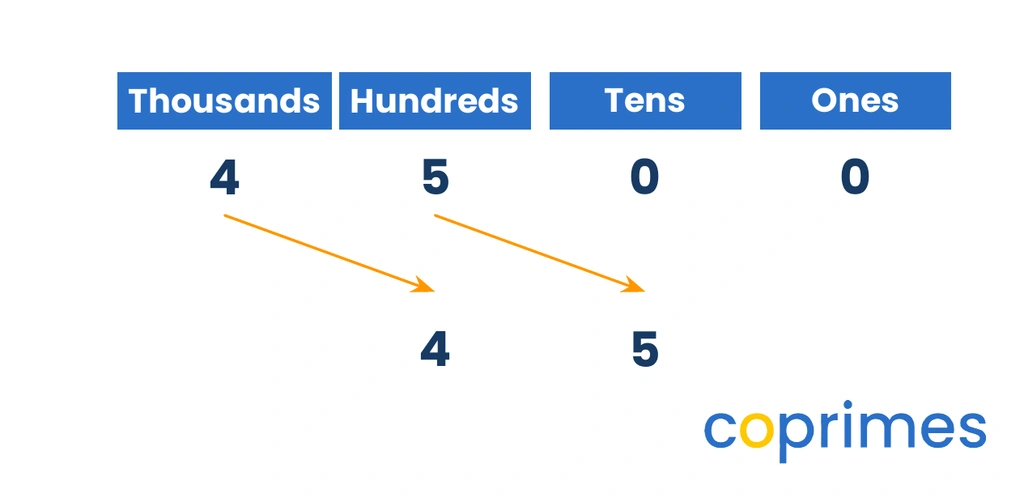
The visual shows the non-zero digits of a number being moved exactly two columns to the right. Which operation was performed on the original number?
The number is multiplied by .
The number is divided by .
The number is divided by .
The number is divided by .
The number is divided by .
A student multiplies by and writes the final answer as . Why is this reasoning incorrect?
Multiplying by moves the digits one column to the right, so the answer is .
Multiplying by moves the digits one column to the left, so the answer is .
The extra zero should be placed in front of the , making it .
Adding a zero before the decimal makes the number .
Multiplying by moves the digits one column to the left, so the answer is .
A number has a in the ten thousands place, a in the hundreds place, and a in the tenths place. All other unmentioned digits between the largest column and the tenths column are zero. What is the number?