
Two-Step Addition and Subtraction Word Problems for Grades 3-7
A two-step addition and subtraction word problem requires two connected calculations, with the first result used to complete the second step. These problems combine basic addition and subtraction operations into a single scenario, requiring careful reading to determine which values to use first.
What is a two-step word problem?
A two-step word problem is a mathematical puzzle that takes two separate operations to solve.
In a two-step addition and subtraction problem, you must complete one calculation to find a hidden intermediate value. Only after finding this middle number can you complete the second calculation to find the final answer. These problems build directly on foundational addition word problems and subtraction word problems.
How to identify both steps
Identify both steps by breaking the story into smaller events and finding the hidden question that must be answered first.
Read the problem chronologically. Ask yourself what information is missing before the final question can be answered. Often, keywords like "then," "more," "gave away," or "left" signal different actions in the timeline. Circle or underline the numbers and their associated actions to help separate the first event from the second event.
Choose the operation order
The order of operations depends on the sequence of events in the story.
Determine whether the first action adds to a starting amount or takes away from it. Then, look at the second action. A problem might require two additions, two subtractions, or one of each. It is essential to use the result of the first operation as the starting point for the second operation.

Bar models and equation chains
Bar models visually organize the parts and the whole in a two-step problem, making it easier to build an equation chain.
A bar model is a drawing that represents numbers as rectangles. In a two-step addition and subtraction problem, the model often shows a total broken into three parts. An equation chain connects the two calculations, often using a letter to represent the unknown intermediate value.
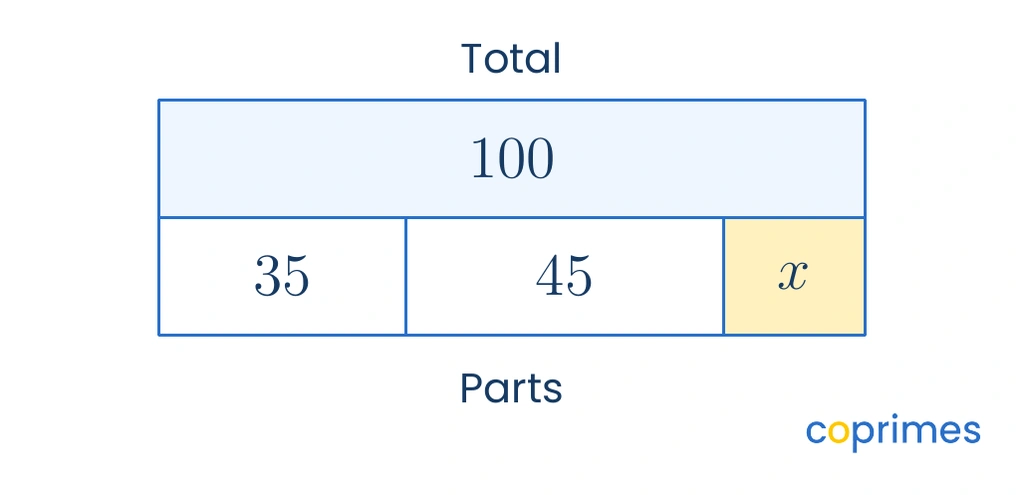
By adding the first two parts to find an intermediate sum, and then subtracting that sum from the total, the problem is solved in two steps.
Step-by-step solving method
Solve a two-step problem by writing two equations and solving them in order.
- Identify the first step: Find the hidden question. Write an addition or subtraction equation to solve it, using a letter for the unknown intermediate result.
- Identify the second step: Use the intermediate result from the first step to write the final equation.
- Solve in order: Calculate the first answer, then substitute it into the second equation to find the final answer.
- Check: Verify the answer makes sense in the context of the story using estimation or reverse calculations.
Always use the answer from the first step in the second step.
Worked examples
Review these worked examples to see how two-step addition and subtraction word problems are solved using models and checks.
Example 1: Addition followed by subtraction
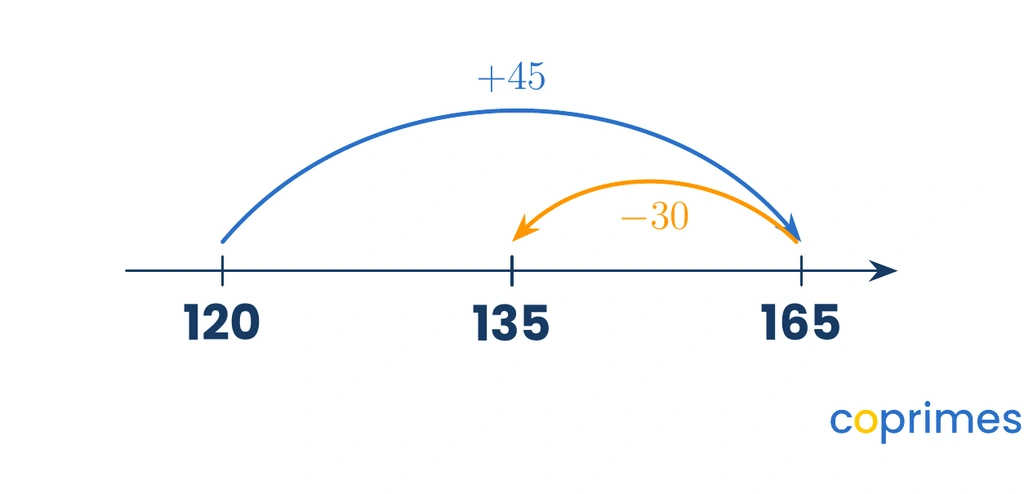
Question: A farmer has apples. He picks more apples in the morning and sells apples in the afternoon. How many apples does the farmer have left?
Method:
- Identify the first step. The farmer picks more apples, so add to find the intermediate total. Let be the total before selling. The equation is .
- Identify the second step. The farmer sells some apples, so subtract from the intermediate total to find the final amount left, . The equation is .
- Solve in order. Calculate . Substitute into the second equation to find .
Answer: The farmer has apples left.
Check: Estimate the final answer by rounding to the nearest ten: , and . The answer is close to , making it reasonable.
Example 2: Two subtractions
Question: A bakery starts the day with muffins. They sell muffins in the morning and muffins in the afternoon. How many muffins remain?
Method:
- Identify the first step. Find how many muffins remain after the morning by subtracting from . Let represent the remaining muffins. The equation is .
- Identify the second step. Subtract the afternoon sales from to find the final number of muffins, . The equation is .
- Solve in order. Calculate . Substitute into the second equation to find .
Answer: There are muffins remaining.
Check: Add the parts to check the whole. Total sold is . Add the remaining amount to the total sold: . The answer matches the starting amount.
Example 3: Working backward from the final result
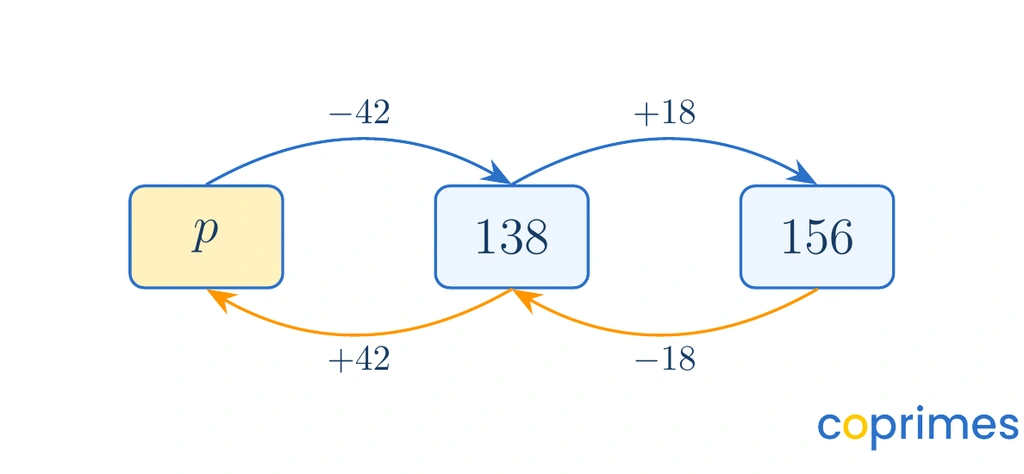
Question: A train is carrying some passengers. At the first stop, passengers get off. At the second stop, passengers get on. There are now passengers on the train. How many passengers were on the train to begin with?
Method:
- Identify the sequence of events. Let be the starting number of passengers. The train loses , then gains , leaving . The equation is .
- Work backward from the final amount. Step one: Subtract the passengers who just got on. The calculation is .
- Step two: Add back the passengers who got off earlier to find the starting amount, . The calculation is .
Answer: There were passengers on the train to begin with.
Check: Follow the original story forward using the answer. Start with , subtract to get . Then add to get . The final result matches the problem description.
A learning plan shaped by your child, not the class
State-aligned Math plus our own Logic and English curriculum. An adaptive baseline test finds the gaps and fills them.
Checking both steps
Check both steps by working backward or using estimation to ensure the final result is reasonable.
If you used addition to solve a step, use subtraction to verify the calculation. This process relies on checking addition and subtraction through inverse operations. Alternatively, round the given numbers to the nearest ten or hundred to estimate the outcome quickly before solving the problem exactly.
Common mistakes
Common mistakes include skipping the first step, performing operations in the wrong order, and misaligning place values.
- Skipping the hidden step: Trying to combine all numbers in a single mental calculation often leads to errors. It is better to write out the intermediate value first.
- Wrong operation: Misinterpreting a keyword like "more" or "left" can cause you to add when you should subtract, or subtract when you should add.
- Not checking the answer: Failing to read the question again to confirm the final answer makes sense in the context of the story.
Reread the question to ensure you answered the final step, not the hidden step.
Frequently asked questions
Find answers to common questions about two-step addition and subtraction problems.
Can a two-step problem have the same operation twice?
Yes. A word problem can require two additions, such as finding the total cost of three different items, or two subtractions, such as spending money twice from a single starting amount.
Do I always have to draw a bar model?
While bar models are an excellent tool for understanding the relationship between the parts and the whole, they are not strictly required. Writing an equation chain and solving it step-by-step is also mathematically valid.
What should I do if my final answer seems too large?
If your final answer is unreasonably large, check your operations. You may have added during a step that required subtraction. Reread the keywords in the problem to verify whether the amounts were joining or separating.
Practice questions
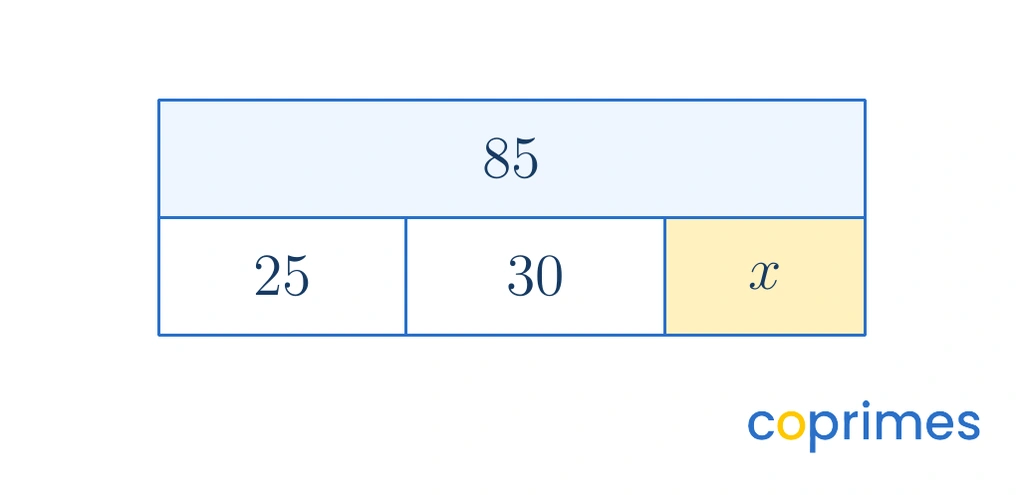
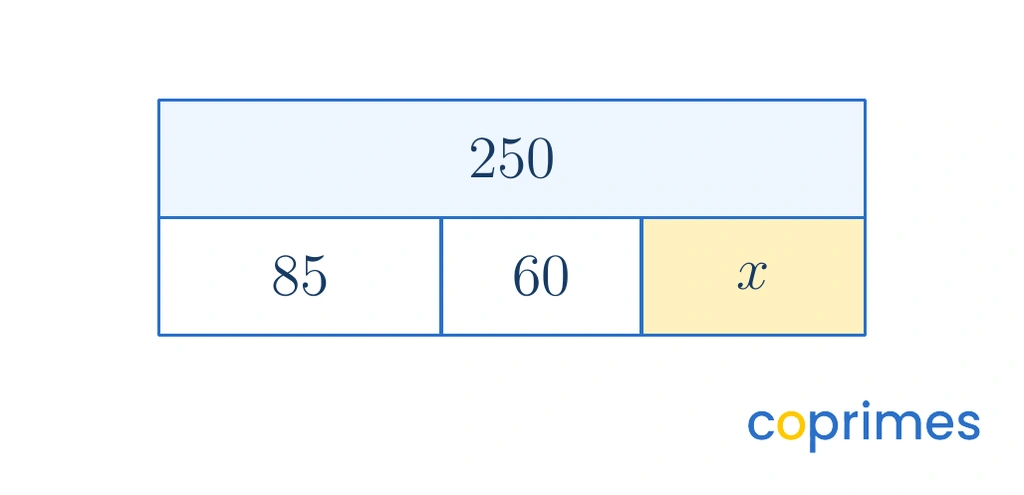
Which problem can be solved using this bar model?
A book has pages. Liam reads pages on Monday and pages on Tuesday. How many pages does he have left to read?
Liam reads pages on Monday, pages on Tuesday, and pages on Wednesday. How many pages did he read in total?
Liam has books. He sells books and buys more. How many books does he have now?
Liam reads pages. Then he reads more pages. How many pages did he read altogether?
A book has pages. Liam reads pages on Monday and pages on Tuesday. How many pages does he have left to read?
A toy store had puzzle boxes in stock. On Saturday, they sold boxes. On Sunday, they sold another boxes. How many puzzle boxes does the store have left?
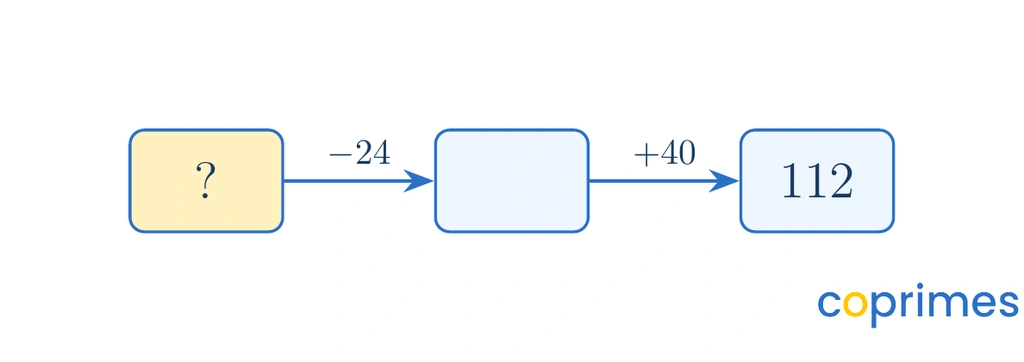
An aquarium had some fish in a large tank. The staff moved fish to a smaller tank. Later, they added new fish to the large tank. There are now fish in the large tank. How many fish were in the large tank to begin with?
Leo had trading cards. He bought more cards, and then gave cards to a friend.
To find how many cards he has left, Leo wrote this equation chain: .
What error did Leo make?
He should have added all three numbers together.
He subtracted the cards he bought and added the cards he gave away.
He should have subtracted both numbers from his starting amount.
He wrote the equation correctly but used the wrong variable.
He subtracted the cards he bought and added the cards he gave away.
A school is raising dollars for new sports equipment. In the first week, they raised dollars. In the second week, they raised dollars. How much more money do they need to raise to reach their goal?