
Adding and Subtracting Mixed Numbers
To add or subtract mixed numbers, convert them to improper fractions when that makes the calculation clearer, create common denominators if needed, calculate, simplify, and convert back to a mixed number when useful.
How do you add and subtract mixed numbers?
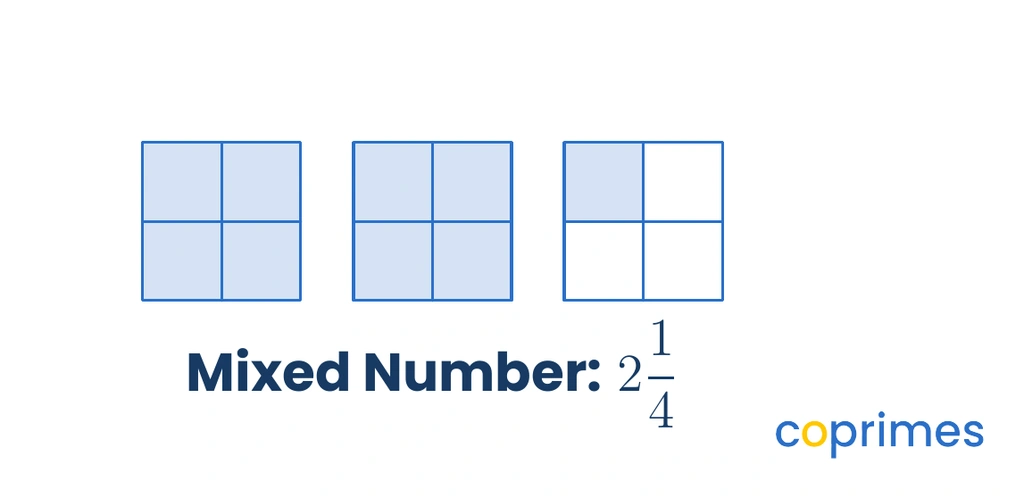
Mixed numbers represent a whole number combined with a proper fraction. To combine them, you must account for both the whole and fractional parts.
The most reliable approach is to change the format of the numbers before performing the operation. By treating the entire value as pieces of the same size, you avoid the complications that arise when a fractional part needs regrouping.
Choose a method
There are two common methods for operating on mixed numbers.
Method 1: Separate the parts
You can add or subtract the whole numbers separately from the fractions. This works well for simple addition. However, during subtraction, if the fraction you are taking away is larger than the starting fraction, you must regroup one whole unit into fractional parts.
Method 2: Improper fractions
You can convert every mixed number into an improper fraction first. This creates a single fraction for each value, removing the need to separate the whole numbers and eliminating the complex regrouping step entirely.
Converting to improper fractions prevents the most common subtraction mistakes.
We will use Method 2 because it provides a consistent, mathematically reliable process for every problem.
Convert to improper fractions
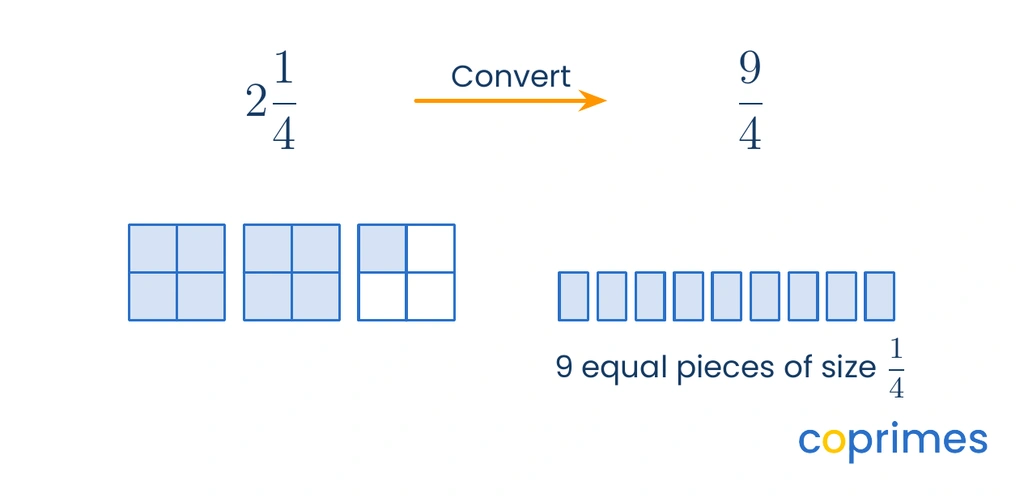
The first step is to convert mixed numbers to improper fractions. Multiply the whole number by the denominator, then add the numerator. Place this total over the original denominator.
For example, to convert , multiply by to get . Add the to get . The improper fraction is .
A learning plan shaped by your child, not the class
State-aligned Math plus our own Logic and English curriculum. An adaptive baseline test finds the gaps and fills them.
Find a common denominator
Before you can add or subtract, the fractions must share a common denominator. This ensures all the fractional pieces are the same size.
If the denominators are already the same, proceed to the next step. If they are different, find a common multiple for both denominators. Multiply the numerator and denominator of each fraction by the factor needed to reach that common denominator.
For example, to add and , use the common denominator :
- Multiply by to get .
- Multiply by to get .
Add or subtract and simplify
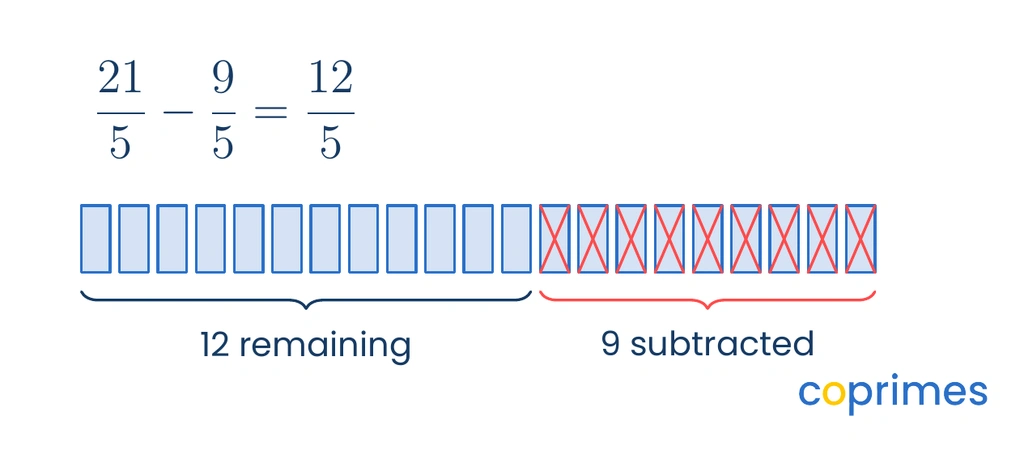
Once the denominators match, perform the operation on the numerators while keeping the denominator exactly the same.
This uses the standard rules for adding fractions and subtracting fractions.
After finding the result, simplify the fraction if possible. If your answer is an improper fraction, you will often convert it back into a mixed number to make the final answer easier to read.
Never add or subtract the denominators together.
Worked examples
Example 1: Adding mixed numbers
Question: Calculate .
Method:
- Convert both to improper fractions.
2. Find a common denominator. The lowest common multiple of and is .
- Add the numerators.
- Convert back to a mixed number.
Answer: The sum is .
Check: Estimating the original values gives . Our answer is slightly less than , which matches the estimate.
Example 2: Subtracting with regrouping needed
Question: Calculate .
Method:
- Notice that the denominators are already the same, but you cannot subtract from in the numerators without regrouping. Converting to improper fractions solves this automatically.
- Convert both to improper fractions.
3. Subtract the numerators.
4. Convert back to a mixed number.
Answer: The difference is .
Check: Add the difference back to the subtracted amount: , which simplifies to .
Example 3: Application in distance
Question: A hiking trail is kilometers long. You have walked kilometers. How much further do you need to walk?
Method:
- Set up the subtraction problem: .
- Convert to improper fractions.
3. Find a common denominator, which is . Multiply by .
- Subtract the fractions.
- Convert back to a mixed number.
Answer: You need to walk kilometers further.
Check: Since plus equals , which simplifies to or , the answer is correct.

Common mistakes
One common error is adding or subtracting both the numerators and the denominators. Remember that the denominator tells you the size of the piece. The size of the piece does not change during addition or subtraction; only the quantity of pieces changes.
Another common mistake occurs when subtracting mixed numbers without converting them to improper fractions first. Students often subtract the smaller fraction from the larger fraction regardless of which number came first, leading to an incorrect result. Always ensure you are subtracting the second fraction from the first.
Frequently asked questions
Do I have to convert to improper fractions?
No, it is not strictly required. You can choose to add or subtract the whole numbers and the fractions separately. However, converting to improper fractions provides a single, consistent method that completely avoids the difficult regrouping step needed for many subtraction problems.
Why do I need a common denominator?
Fractions can only be combined if they describe pieces of the same size. Adding halves to thirds is like adding centimeters to inches without converting first; the total quantity would not make sense. Finding a common denominator ensures every piece is identical in size.
Practice questions
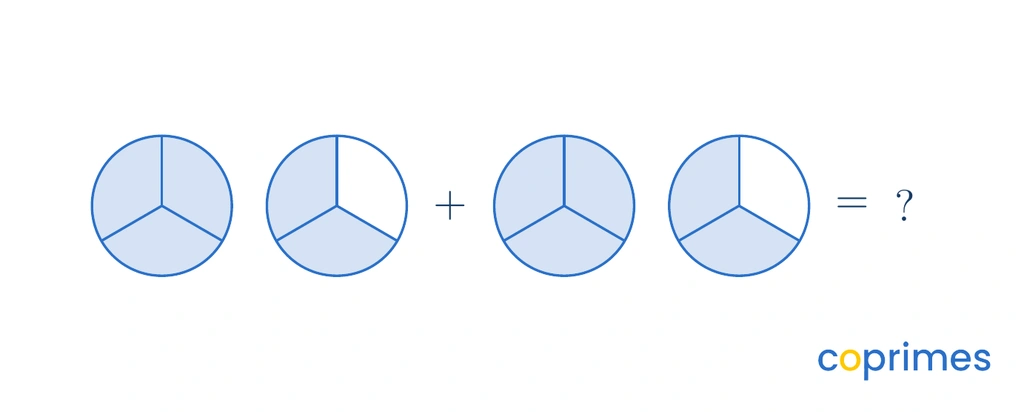
Based on the visual representation, what is the sum of ?
What is the result of ?
What is the result of ?
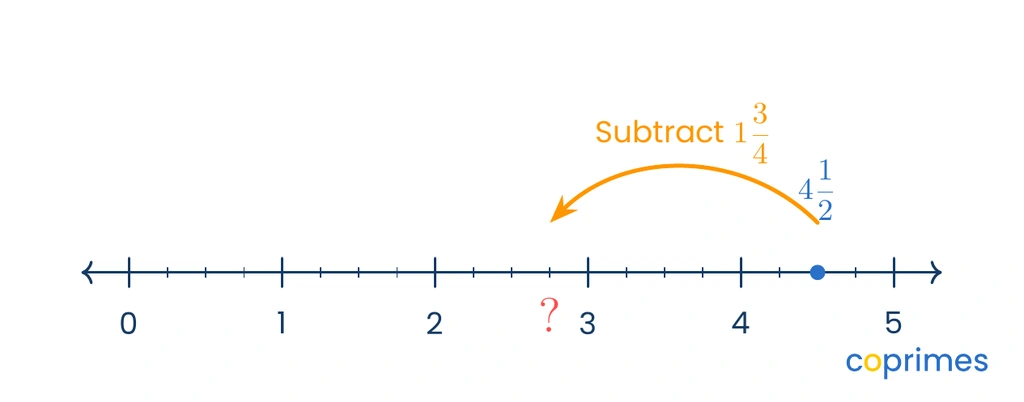
The number line represents the calculation . What is the final value?
A baker uses kilograms of flour for bread and kilograms for pastries. How much flour is used in total?
kilograms
kilograms
kilograms
kilograms
kilograms