
Common Denominator: Definition, Method and Examples
A common denominator is a shared bottom number in two or more fractions. When fractions have a common denominator, they are divided into equal-sized parts. This matching part size makes it possible to compare, add, or subtract the fractions accurately.
What is a common denominator?
A fraction consists of a numerator (the top number) and a denominator (the bottom number). The denominator represents the total number of equal parts that make up a whole.
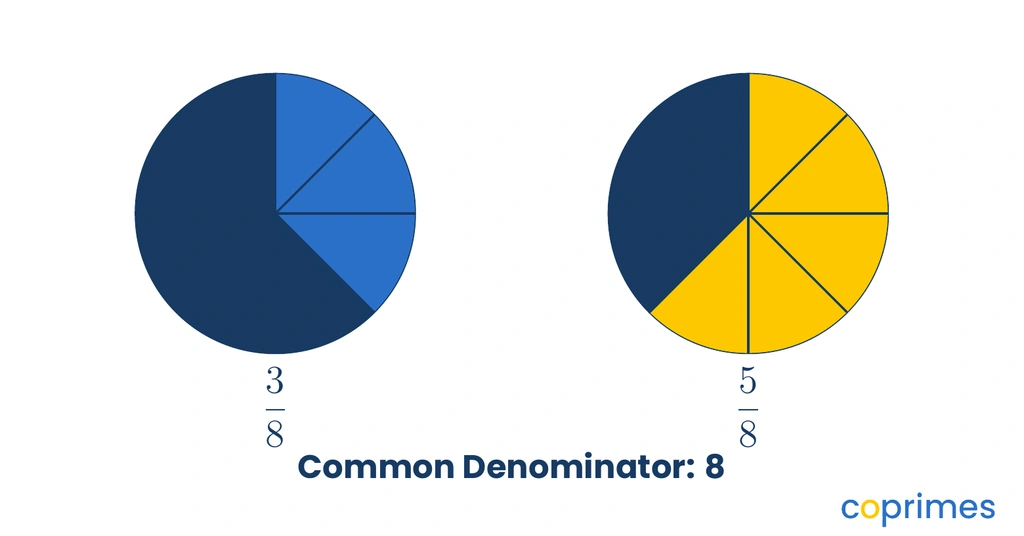
When two or more fractions share the exact same denominator, they have a common denominator. Having a shared denominator or common bottom number means the fractions represent pieces of the exact same size. Fractions that share the same denominator fall into the category of like and unlike fractions.
Why make denominators the same?
If you want to add, subtract, or evaluate fractions, their parts must be the same size. For instance, evaluating and together is difficult because a third is a larger slice than a fourth. You cannot combine pieces of different sizes into a single accurate number.
Finding a common denominator splits both fractions into identical, smaller pieces. Once the parts represent the same size, you can count the total number of parts effortlessly. This makes comparing fractions directly or ordering fractions much simpler.
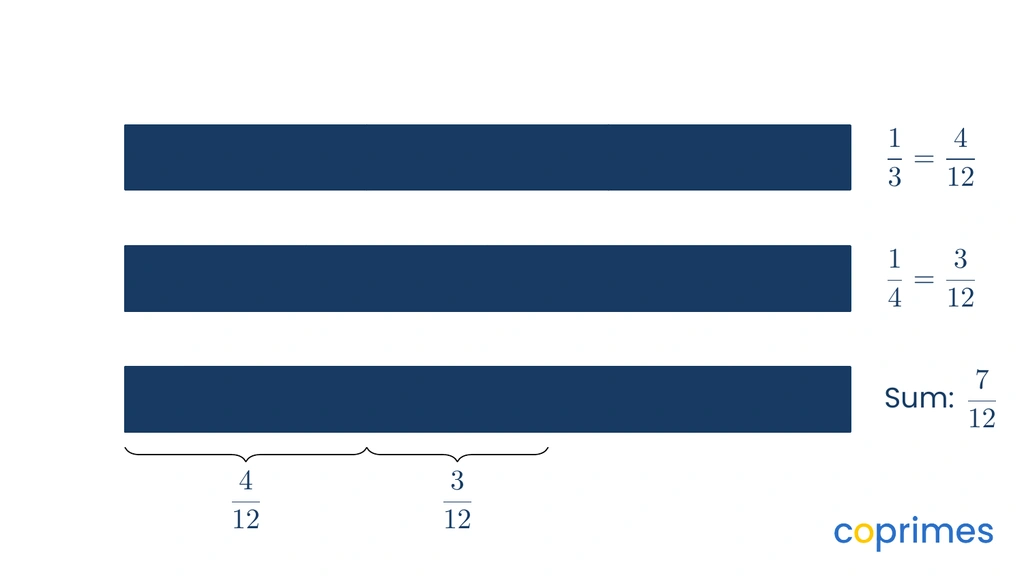
Find a common denominator
To perform calculations with fractions that have different denominators, you must first find a common denominator. There are two primary methods to do this.
Method 1: Product of the denominators
The fastest way to find a valid common denominator is to multiply the two bottom numbers together. For example, to find a common denominator for and , multiply . Both original denominators divide evenly into .
Method 2: Least Common Multiple
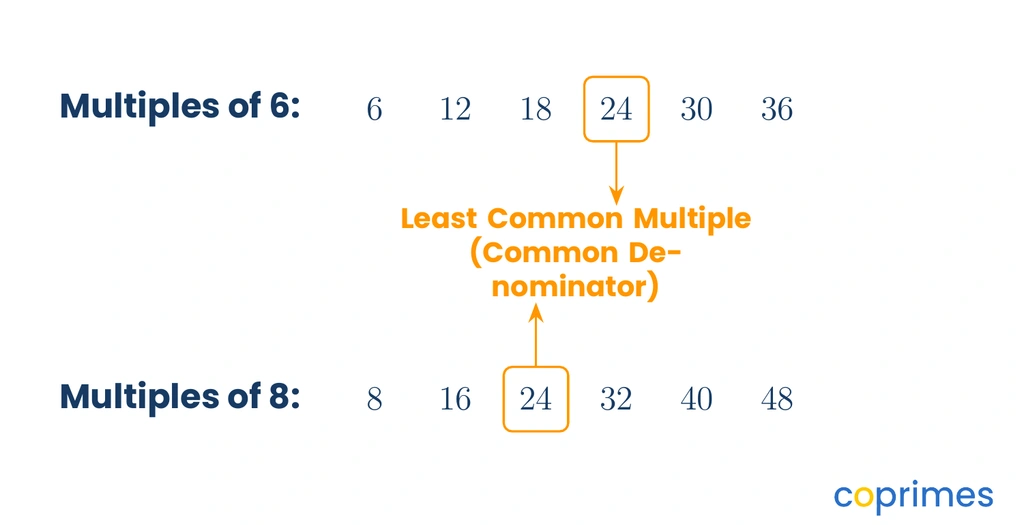
To keep the final numbers as small as possible, list the multiples of each denominator and find the smallest number that appears in both lists. This shared value is called the least common multiple. For and , list their multiples:
- Multiples of :
- Multiples of :
The lowest number in both lists is . The common denominator is .
A learning plan shaped by your child, not the class
State-aligned Math plus our own Logic and English curriculum. An adaptive baseline test finds the gaps and fills them.
Rewrite equivalent fractions
Once you identify the common denominator, the next step is to rewrite the original fractions. This creates equivalent fractions that retain their original value but are expressed using the identical part size.
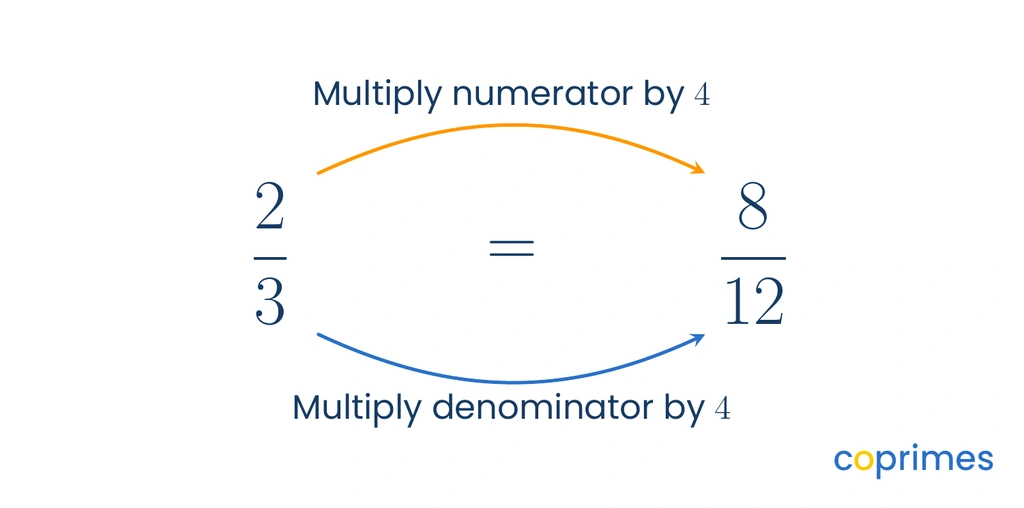
To do this, determine what factor was used to multiply the original denominator. Then, multiply the numerator by that exact same factor.
Multiply the numerator and the denominator by the exact same value.
For example, to convert to a denominator of , multiply the denominator by . You must also multiply the numerator by , giving .
Common versus least common denominator
Any shared multiple of the original denominators can serve as a common denominator. However, the lowest possible shared multiple is known as the least common denominator.
While multiplying denominators together is fast, using the least common denominator keeps the calculations simpler and avoids the need to simplify large fractions at the end.
Feature | Common Denominator | Least Common Denominator |
Meaning | Any shared multiple of the denominators. | The smallest possible shared multiple. |
Example for and | , , or | |
Advantage | Quick to find using the product method. | Keeps calculations and simplified numbers smaller. |
Worked examples
Example 1: Using the product method
Question: Find a common denominator for and , then rewrite the fractions.
Method:
- Multiply the two denominators together to find a quick common denominator.
- Multiply .
- Rewrite by multiplying both parts by , resulting in .
- Rewrite by multiplying both parts by , resulting in .
Answer: The common denominator is , and the equivalent fractions are and .
Example 2: Adding using a least common denominator
Question: Add and .
Method:
- List the multiples of () and ().
- Identify the lowest shared multiple, which is .
- Rewrite as .
- Rewrite as .
- Add the numerators while keeping the common denominator the same: .
Answer: The sum of and is .
Check: The product method gives a common denominator of . The equivalent fractions are . Simplifying by dividing by results in , confirming the answer.
Example 3: Subtraction with a related denominator
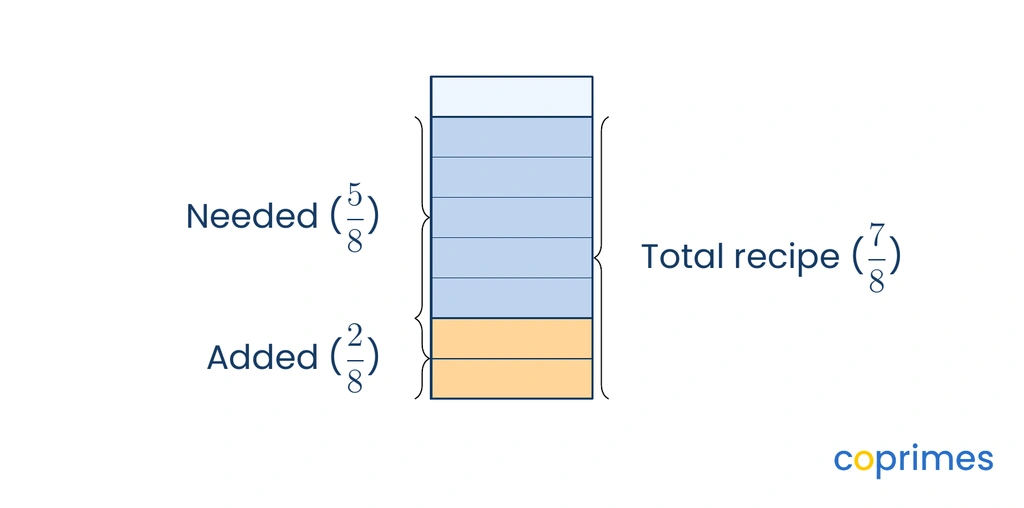
Question: A recipe requires of a liter of water. You have already poured in of a liter. How much more water is needed?
Method:
- Identify that the denominator is a multiple of .
- Use as the common denominator.
- Rewrite by multiplying both the numerator and the denominator by , making it .
- Subtract the equivalent fractions: .
Answer: You need of a liter more water.

Common mistakes
Adding the denominators
Some learners mistakenly believe they can find a common denominator by adding the bottom numbers together. Denominators represent the fixed size of the parts, so you must find a common multiple. Adding denominators changes the mathematical meaning of the fractions.
Forgetting to update the numerator
If you change the denominator to match another fraction but leave the numerator the same, you have completely changed the value of the fraction. You must always multiply both parts of the fraction by the identical number to keep it equivalent.
Frequently asked questions
Can a common denominator be zero?
No. A denominator shows how many equal parts make up a whole. A denominator of zero means dividing a whole into zero parts, which is mathematically undefined.
Can a common denominator be ?
Yes. When working with whole numbers, they can all be written as fractions with a shared denominator of .
What is the common denominator of and ?
Because and do not share any common factors other than , their least common denominator is their product, which is .
Practice questions
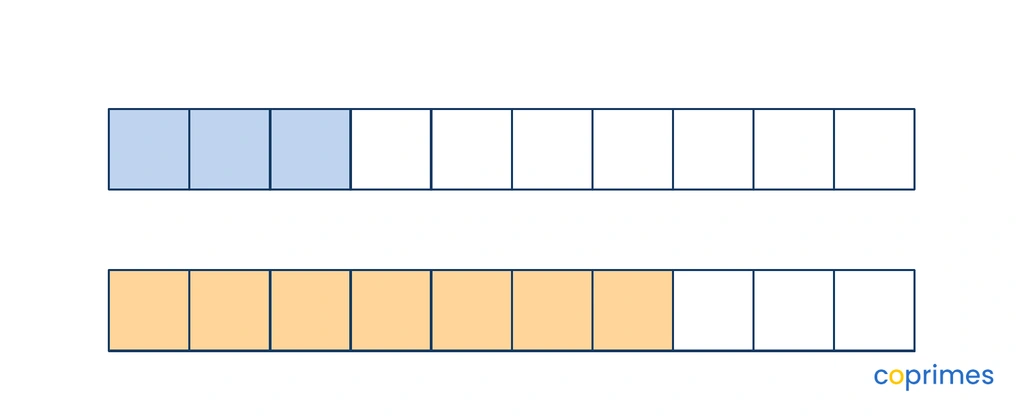
What is the common denominator shared by these two fraction models?
What is the least common denominator for the fractions and ?
Which pair of equivalent fractions correctly uses as a common denominator for and ?
and
and
and
and
and
A student tries to find a common denominator for and . They state the common denominator is because . Why is this incorrect?
A common denominator is found by finding a common multiple, not by adding the denominators.
The student forgot to add the numerators to make the common denominator .
The lowest common denominator should be found by subtracting .
Denominators cannot be common unless one is a multiple of the other.
A common denominator is found by finding a common multiple, not by adding the denominators.
You have of a liter of water and your friend has of a liter. To compare the amounts accurately, you rewrite both fractions with a common denominator of . What are the new fractions?
and
and
and
and
and