
Subtracting Fractions: Definition, Method and Examples
To subtract fractions, rewrite them with a common denominator when needed, subtract their numerators, keep the denominator exactly the same, and simplify the result. When fractions already share a denominator, you can subtract them immediately without converting them first.
How do you subtract fractions?
To calculate the difference between two fractions, you must first determine whether their denominators match. Fractions represent pieces of a whole, and subtraction is only straightforward when those pieces are exactly the same size.
When denominators are identical, the sizes match, and you can simply find the difference between the numerators. When denominators are different, the fractional parts differ in size. You must convert them into a uniform size before subtracting them.
Subtract fractions with the same denominator
Fractions with matching bottom numbers are called like fractions. Because the denominators are identical, the parts being subtracted represent the same size, allowing you to subtract immediately.
Method:
- Subtract the second numerator from the first numerator.
- Keep the common denominator exactly the same.
- Simplify the resulting fraction to its lowest terms if possible.
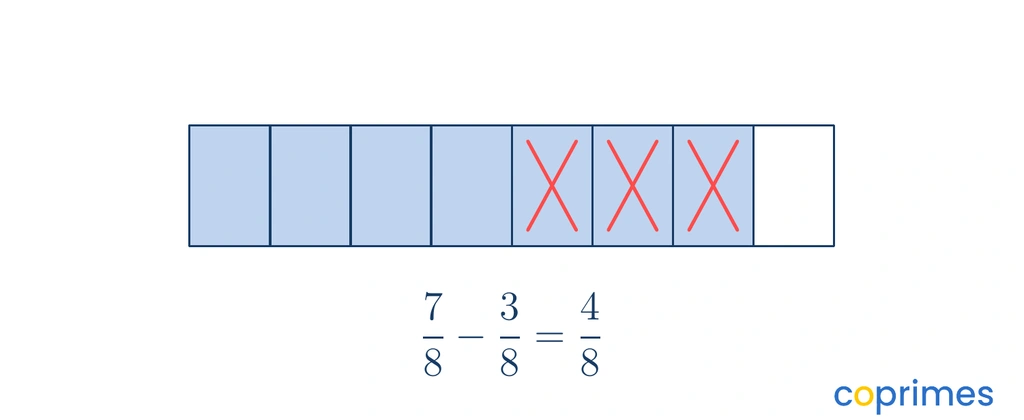
Always leave the common denominator unchanged. Never subtract the denominators.
Subtract fractions with different denominators
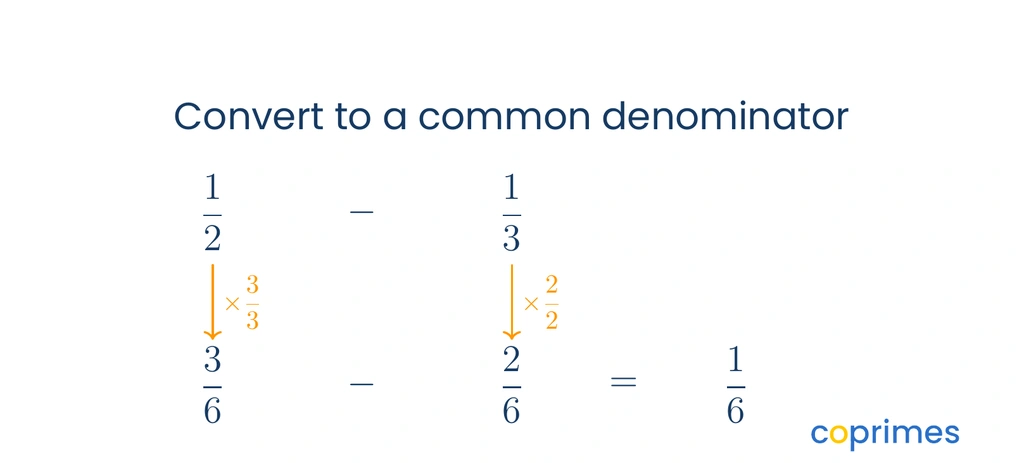
Fractions with different bottom numbers are called unlike fractions. Before you can subtract them, you must convert them into equivalent fractions that share a common denominator.
Method:
- Find the lowest common multiple of the two denominators. This becomes your common denominator.
- Multiply the numerator and denominator of each fraction by the factor needed to reach the common denominator.
- Subtract the new numerators and keep the common denominator unchanged.
A learning plan shaped by your child, not the class
State-aligned Math plus our own Logic and English curriculum. An adaptive baseline test finds the gaps and fills them.
Subtract a fraction from a whole number
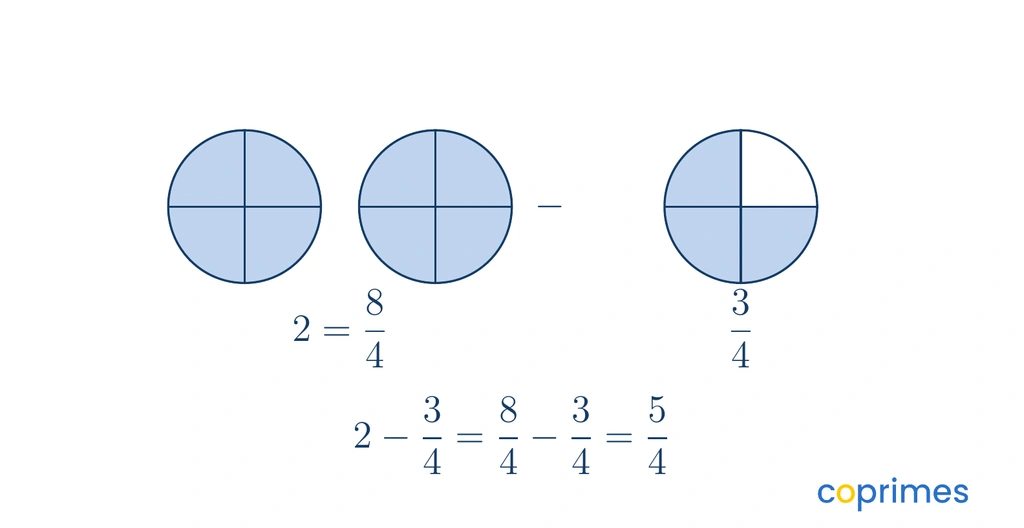
To subtract a fraction from a whole number, express the whole number as an equivalent fraction by writing it over a denominator of .
Once both numbers are written in fractional form, find a common denominator just as you would with any other unlike fractions, then subtract.
Check and simplify the difference
After finding the difference, your final answer might not be in its simplest form. The process of simplifying fractions involves finding the greatest common factor shared by the numerator and the denominator.
Divide both parts of the fraction by this factor to reduce it to its lowest terms. If your result is an improper fraction, where the numerator is larger than the denominator, you can also rewrite it as a mixed number.

Visual worked examples
Applying these steps to fraction word problems and standard equations helps build a strong understanding of how fraction subtraction behaves in different practical contexts.
Example 1: Subtracting like fractions
Question: A baker has of a bag of flour. They use of the bag for a recipe. What fraction of the bag remains?
Method:
- Confirm the denominators are the same. Both are .
- Subtract the numerators: .
- Keep the denominator: .
- Simplify by dividing the numerator and denominator by .
Answer: of the bag remains.
Check: Add the difference back to the subtracted amount to verify the original total: .
Example 2: Subtracting unlike fractions
Question: Calculate .
Method:
- Find the lowest common multiple of and , which is .
- Convert : multiply the numerator and denominator by to get .
- Convert : multiply the numerator and denominator by to get .
- Subtract the converted numerators: .
Answer: .
Check: Verify using addition: , which simplifies to .
Example 3: Subtracting from a whole number
Question: Evaluate .
Method:
- Write the whole number as a fraction: .
- Find the common denominator for and , which is .
- Convert : multiply the numerator and denominator by to get .
- Subtract the fractions: .
- Convert the improper fraction to a mixed number if required.
Answer: or .
Check: Evaluate using a regrouping method: rewrite as . Then evaluate .

Common mistakes
A frequent error is subtracting both the numerators and the denominators across the equation. This mistake ignores the mathematical meaning of the denominator, which simply names the size of the fractional parts, not a quantity that can be subtracted.
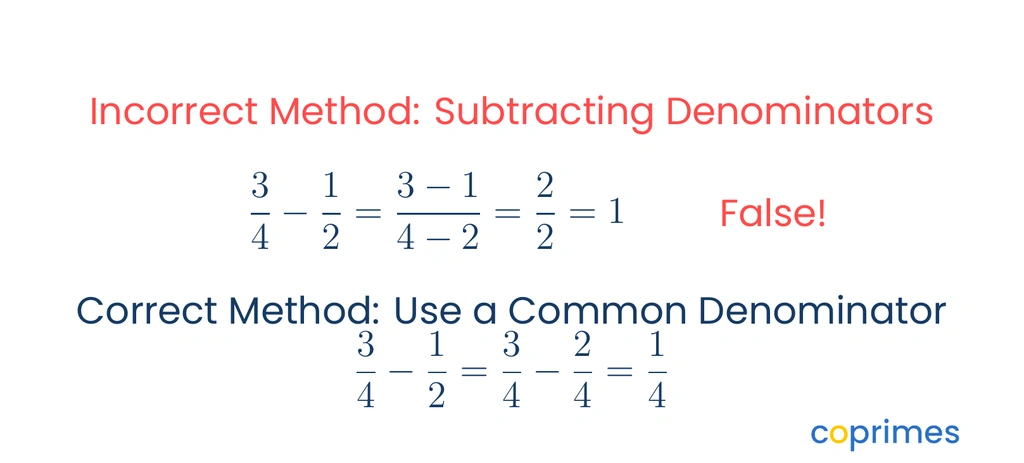
Always establish a common denominator first, and never subtract the denominators from each other.
Frequently asked questions
Can you subtract an improper fraction?
Yes. The exact same rules apply when subtracting an improper fraction. Ensure the denominators match, subtract the numerators, and simplify the final result.
Do you always have to use the lowest common denominator?
No. Any common multiple of the denominators will work. For example, simply multiplying the two denominators together will always give you a valid common denominator. However, using the lowest common multiple keeps the numbers smaller and usually requires less simplification at the end.
How does this compare to fraction addition?
The steps are largely identical to adding fractions. In both operations, you must establish a common denominator and keep that denominator unchanged in your answer. The only difference is whether you add or subtract the numerators.
Practice questions
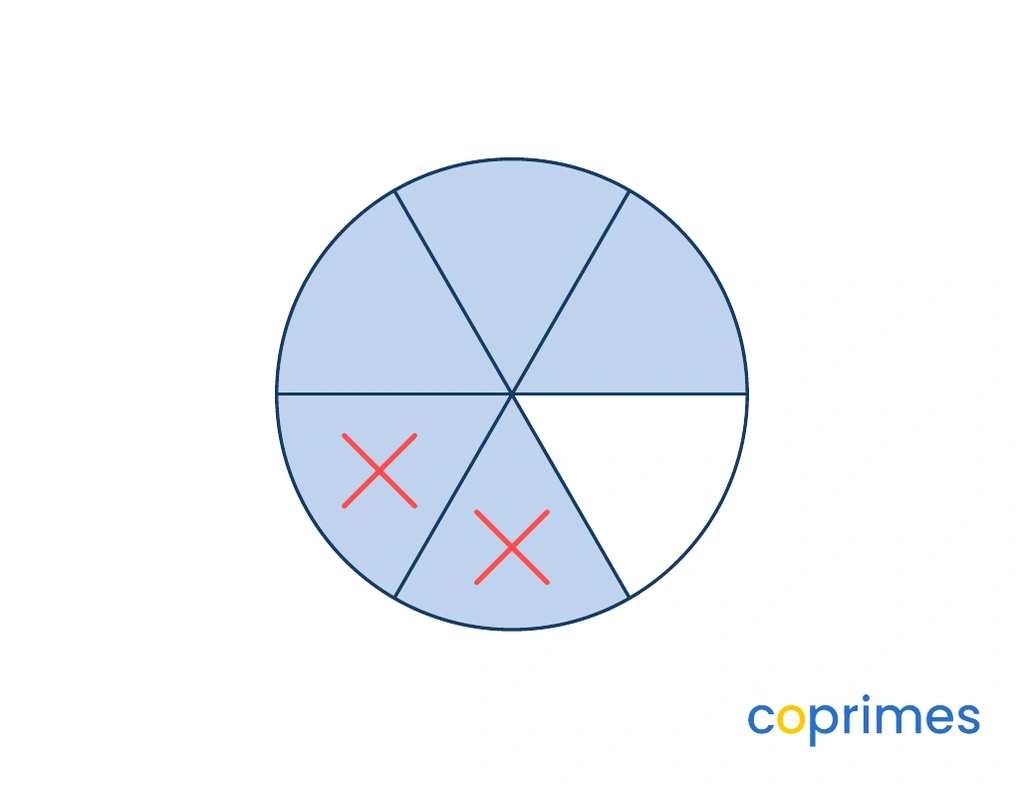
Which expression represents the subtraction shown in the model?
Calculate the difference:
Evaluate:
A string is meters long. Sara cuts off meters. How much string is left?
meters
meters
meters
meters
meters
Find the missing fraction to make the equation true: