
Associative Property of Multiplication: Rules, Models, and Examples
The associative property of multiplication states that regrouping three or more factors does not change the final product.
Whether you calculate the first two numbers or the last two numbers first, the answer remains the same.
Understanding this property builds a strong foundation for mental math, algebra, and advanced multiplication.
What is the associative property of multiplication?
The associative property of multiplication is a mathematical rule that allows you to change how numbers are grouped using parentheses without affecting the result.
The word "associate" means to group or connect.
When multiplying three numbers, you must choose two numbers to multiply first. The associative property guarantees that whichever pair you pick, the overall total will match.
The associative property of multiplication means the grouping of factors does not change the product.
Formula and grouping model
The formula for the associative property uses variables to represent any real numbers.
For any three numbers , , and , the formula is:
The parentheses show which operation happens first. The left side groups and together, while the right side groups and together.
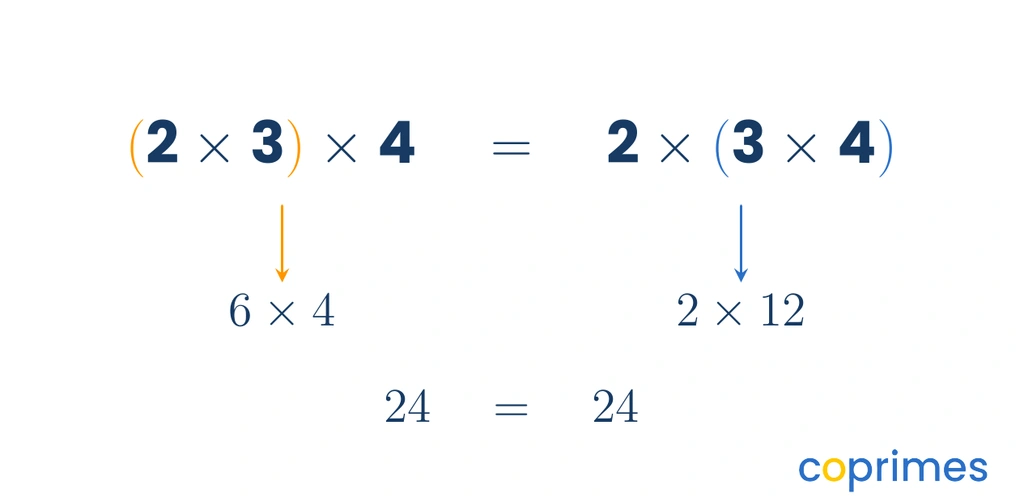
Both calculation paths lead to the same result, confirming that multiplication is associative.
How to make friendly groups
You can use the grouping property of multiplication to make mental math much easier.
Instead of multiplying straight across from left to right, search for factor pairs that create multiples of , , or .
By changing the grouping with parentheses, you can calculate the friendlier numbers first.
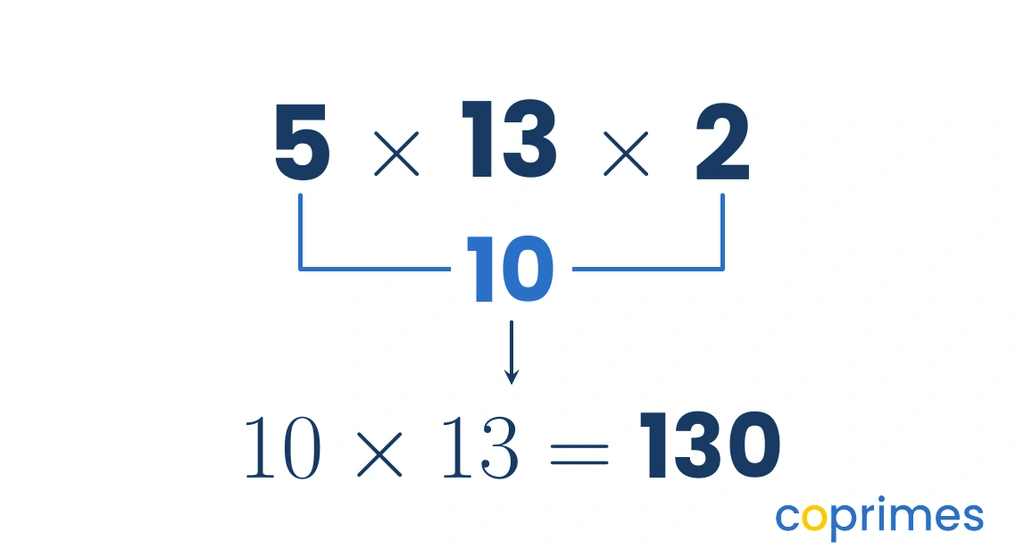
This trick is one of the most useful properties of multiplication because it saves time and reduces errors without needing paper or a calculator.

Associative versus commutative
The commutative property of multiplication and the associative property are closely related, but they describe different concepts.
- Commutative Property: Changes the order of the factors. For example, .
- Associative Property: Changes the grouping of the factors using parentheses without moving their places. For example, .
Both properties ensure that multiplication remains flexible, and you will frequently use them together in the same mathematical problem.
What is not associative?
The associative law applies strictly to addition and multiplication. It does not work for subtraction or division.
If you shift the grouping symbols in a division equation, the results will not match.
Consider the division example compared to .
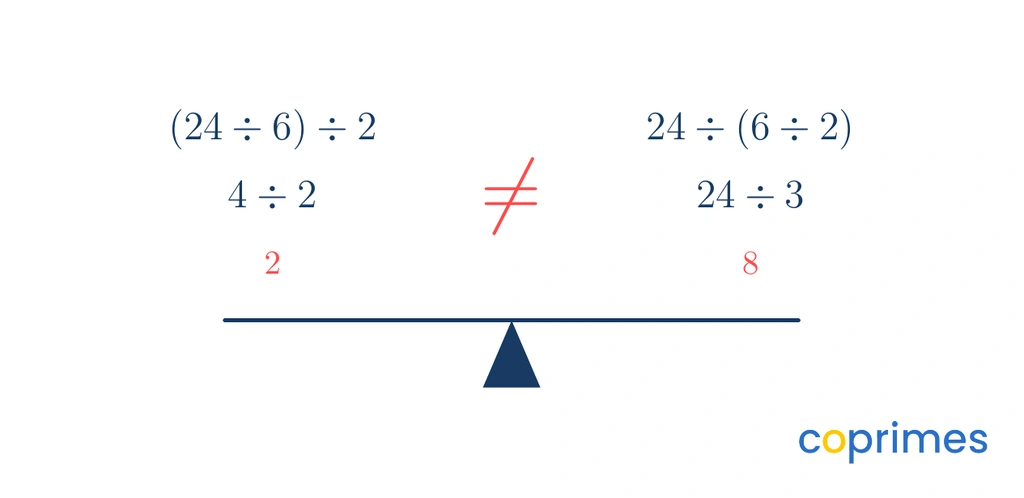
Because does not equal , this proves that division is not associative. The order in which you divide terms permanently alters the quotient.
Worked examples
Practicing associative examples will help you solve complex equations quickly.
You will often use this concept before learning the distributive property of multiplication to break numbers apart.
Example 1: Finding an unknown value
Question: If , what is the value of ?
Method:
- Check both sides of the equation to see if they contain the same sequence of numbers.
- Observe that the only difference is the placement of the parentheses, which indicates the associative property.
- Match the numbers in the corresponding positions.
Answer: The value of is .
Check: Calculate both sides: . The right side is . Both sides match.
Example 2: Regrouping factors for mental calculation
Question: Evaluate the expression using the associative property.
Method:
- Identify numbers that multiply together to make friendly numbers.
- Notice that equals .
- Change the grouping from the second and third factors to the first and second factors.
- Multiply the grouped numbers, then complete the calculation.
Answer: .
Check: Standard multiplication gives . Since , and , the mental math holds true.
A learning plan shaped by your child, not the class
State-aligned Math plus our own Logic and English curriculum. An adaptive baseline test finds the gaps and fills them.
Frequently asked questions
How many numbers are required for the associative property?
You must have at least three numbers to use the associative property. It is impossible to form two different groupings when there are only two numbers present.
Does the associative property work with a mix of operations?
No. The expression must be entirely multiplication or entirely addition. If an expression mixes multiplication and addition, such as , you cannot use the associative property.
Practice questions
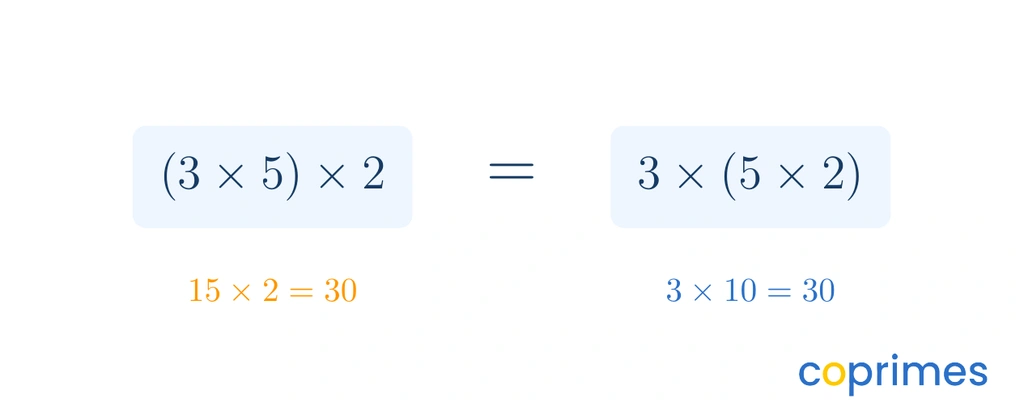
Which mathematical property is demonstrated in the visual above?
Distributive property
Commutative property
Associative property
Identity property
Associative property
Find the missing number in the following equation:
Which expression uses the associative property to make the calculation of easier?
Which of the following equations represents the associative property of multiplication?
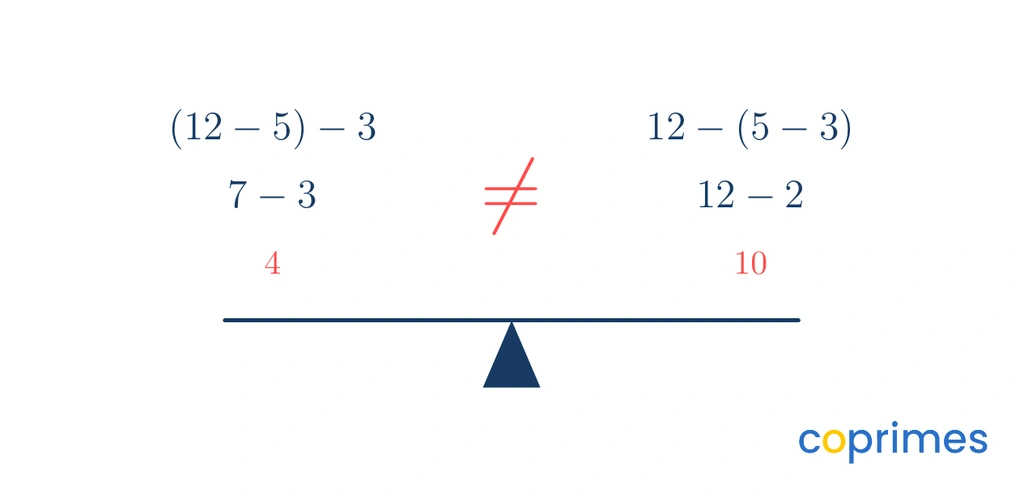
Based on the visual above, which of the following operations does not follow the associative property?
Addition
Subtraction
Multiplication
Both addition and subtraction
Subtraction