
Understanding Compatible Numbers: Definition and Strategies
Compatible numbers are friendly, close-by numbers chosen because they are easy to add, subtract, multiply, or divide mentally. They replace the exact numbers in a problem, allowing you to calculate a quick and reasonable estimate without needing a calculator or written working.
What are compatible numbers?
When performing calculations, some numbers pair together naturally. For example, numbers ending in , , , , or are often much easier to work with in your head than numbers ending in or . These convenient numbers are called compatible numbers.
Unlike strict rounding, there is no single correct way to choose compatible numbers. The goal is to substitute complex digits with nearby numbers that make the specific mathematical operation simpler.
A number is compatible if it simplifies mental calculation while staying close to the original value.
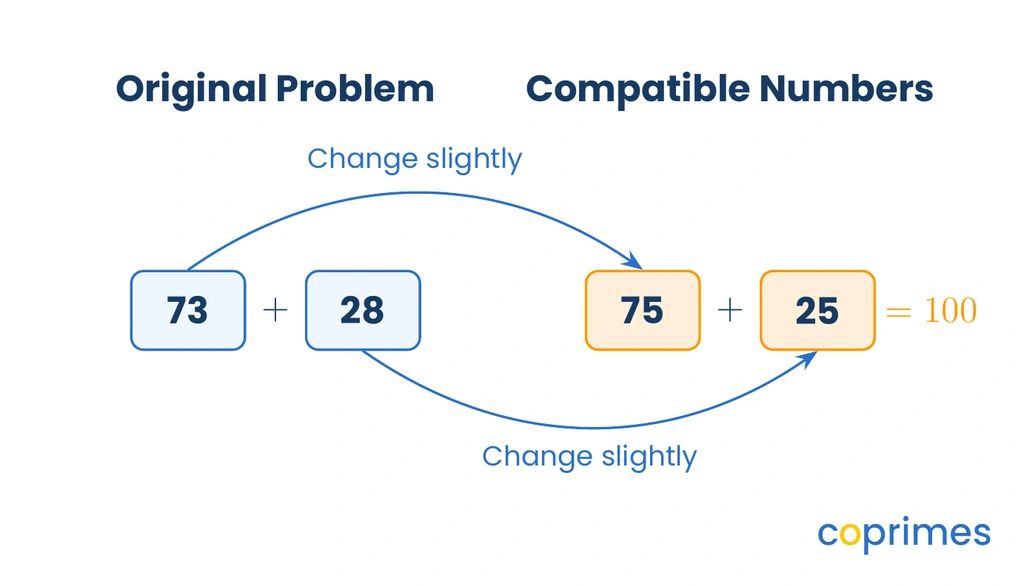
Using mental math strategies helps quickly identify which numbers combine beautifully. Learning to spot these relationships builds strong number sense and estimating skills.
Compatible numbers versus rounding
While both methods simplify numbers to make calculations easier, they follow different rules. Understanding rounding whole numbers involves following strict place-value criteria, whereas compatible numbers depend entirely on the context of the operation.
- Rounding: Uses strict rules. If the next digit is or more, you round up. If it is or less, you round down. For example, rounding to the nearest ten strictly yields .
- Compatible Numbers: Uses flexibility. If you are calculating , you might treat as and as because . Place value rules are ignored in favor of mental ease.
When division is involved, rounding can often create a problem that is still difficult to solve. Compatible numbers prioritize finding multiples that divide cleanly without a remainder.
Compatible numbers for addition and subtraction
When estimating sums and differences, look for numbers that form round totals like , , or . The most common compatible pairs for addition end in or .
For example, finding the exact sum of takes time. If you use compatible numbers, you can adjust to and adjust to . The new calculation is .
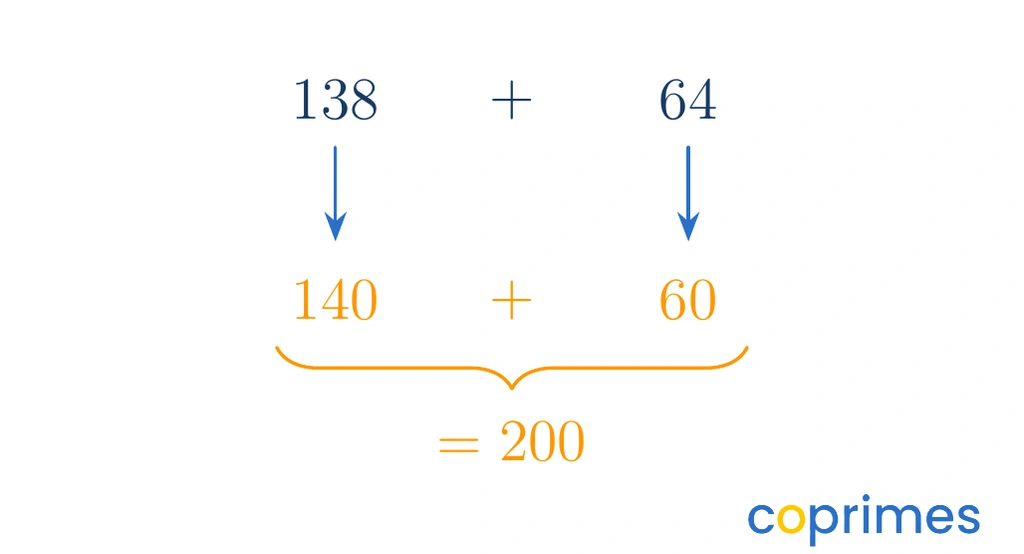
In subtraction, aim to match the final digits to make borrowing unnecessary. To calculate , you could change to . The operation equals , providing an excellent mental estimate.
A learning plan shaped by your child, not the class
State-aligned Math plus our own Logic and English curriculum. An adaptive baseline test finds the gaps and fills them.
Compatible numbers for multiplication and division
When estimating products and quotients, choosing the right numbers is even more critical because multiplication and division scale quickly.
For multiplication, numbers ending in or are highly compatible, especially when multiplying by or . For instance, estimating is much easier if you adjust to . The mental math becomes .
For division, compatible numbers must form a known multiplication fact. The goal is to find a dividend that is a clean multiple of the divisor.
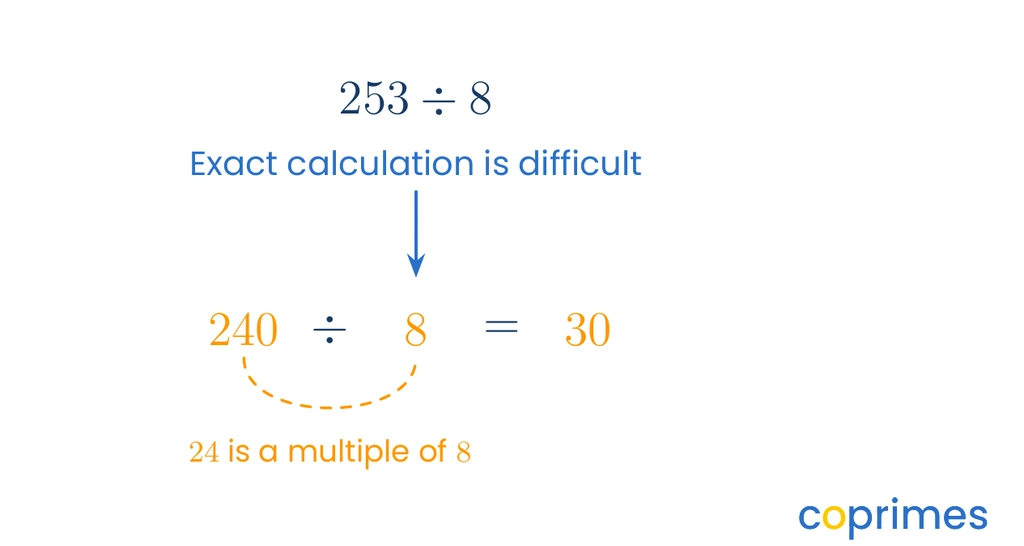
If you need to estimate , regular rounding changes to . However, is still difficult. Instead, think of your times tables. Since is a multiple of , change to the compatible number . The estimate is .
How to choose useful numbers
Effective estimation strategies require inspecting the whole mathematical expression before altering any digits.
Follow these steps to choose excellent compatible numbers:
- Identify the mathematical operation. Addition pairs look different from division pairs.
- Examine the most significant digits in the problem.
- Adjust the numbers slightly up or down to reach friendly numbers like tens, hundreds, or known multiplication facts.
- Perform the calculation mentally.
- Ensure the chosen numbers remained close to the original values so the estimate stays accurate.
If you adjust one number significantly upward, try to adjust the other number downward to keep the overall estimate balanced.
Worked examples
Example 1: Estimating addition
Question: Estimate the sum of and using compatible numbers.
Method:
- Look for numbers that end in or .
- Adjust to the friendly number .
- Adjust to the friendly number .
- Add the numbers: . Adding the twenty-fives makes , and .
Answer: The estimated sum is .
Check: . Wait, is a good estimate? Actually, is much closer to but an even better compatible number for adding to might be . Let's refine. . Let's recalculate the addition accurately: , and . The sum is exactly . Therefore, is a great estimate for .
Example 2: Estimating division
Question: Estimate .
Method:
- Identify the divisor, which is .
- Look at the first two digits of the dividend: .
- Find a multiple of that is close to . The closest multiple is (since ).
- Change to the compatible number .
- Divide .
Answer: .
Check: , which is very close to .
Example 3: Estimating a real-world product
Question: A school buys sets of art supplies for dollars each. Estimate the total cost.
Method:
- The problem requires multiplication: .
- Adjust to the highly compatible number .
- Adjust to a round number that is easy to multiply, such as . (Alternatively, keeping and using or is an option, but and or and are both valid). Let's use .
- Adjust to and to .
- Multiply the compatible numbers: .
Answer: . The total cost is approximately dollars.
Check: . The estimate of dollars is reasonable and fast.

Common mistakes
Choosing numbers that are too far away
The most frequent mistake is changing the original numbers too drastically just to find an easy calculation. If you want to estimate and you adjust it to , the calculation is incredibly easy, but the estimate of is far from the true sum of . Always choose the nearest convenient number.
Rounding dividends without considering multiples
If estimating , a common error is rounding to the nearest ten () or hundred
(). Neither nor is easy to calculate mentally. The correct approach is to look for multiples of . Since is a multiple of , change to . Then .
Frequently asked questions
Are there multiple correct compatible numbers for one problem?
Yes. Estimation is flexible. For , one person might use . Another person might use . Both are valid estimates, though is closer to the exact answer of .
Can I use compatible numbers with decimals?
Absolutely. The same principles apply. If you need to estimate , you can adjust them to to estimate a sum of .
How do I know when to use compatible numbers instead of rounding?
Use compatible numbers when you need a fast mental estimate, particularly for multiplication and division. Use rounding when instructions explicitly ask you to round to a specific place value, or when comparing data strictly by thousands, hundreds, or tens.
Practice questions
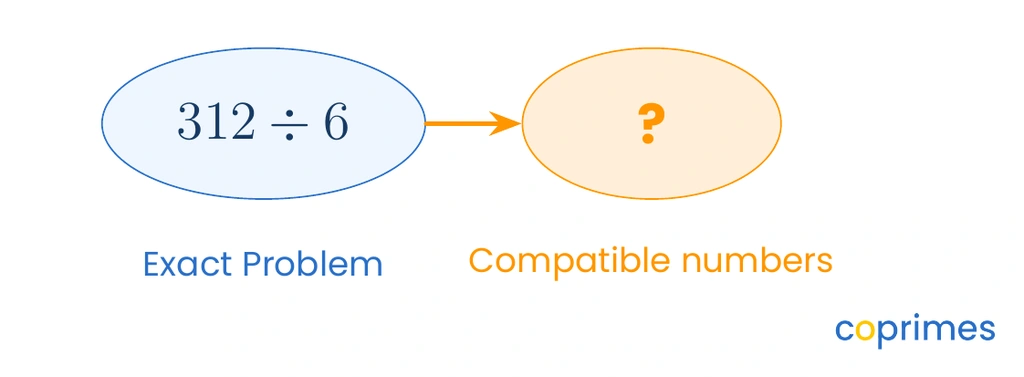
Which of the following expressions uses the best compatible numbers to estimate ?
When estimating the sum of and , which pair of compatible numbers makes the mental math easiest while remaining accurate?
and
and
and
and
and
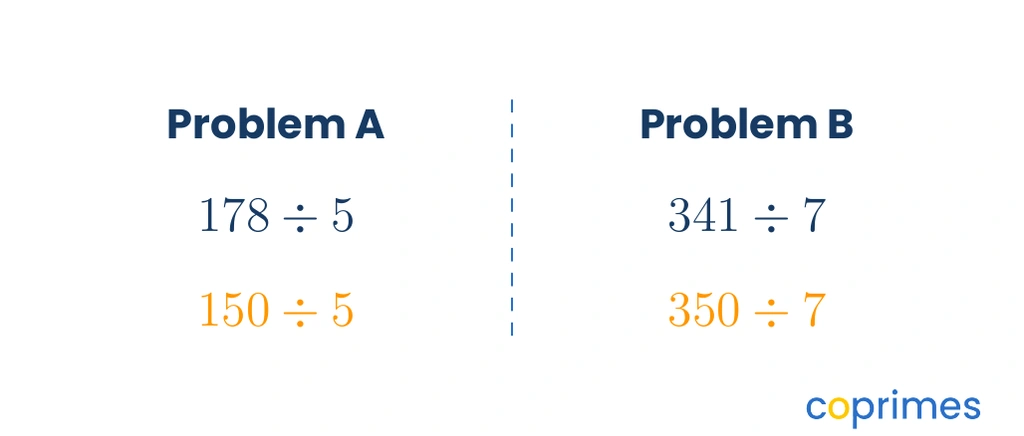
Based on the principles of compatible numbers, what error is present in the visual above?
Problem A adjusts too far to when is a much closer compatible number.
Problem B incorrectly uses instead of strictly rounding down to .
Problem A should change the divisor to instead of altering the dividend.
Problem B should use because rounds to .
Problem A adjusts too far to when is a much closer compatible number.
Which is the most reasonable estimate for using compatible numbers?
A primary difference between rounding rules and choosing compatible numbers is:
Rounding is only used for fractions, while compatible numbers are used for whole numbers.
Rounding follows strict place-value rules, while compatible numbers depend entirely on finding mental math shortcuts for the operation.
Compatible numbers always result in the exact answer, whereas rounding results in an estimate.
Rounding allows you to change the operation, while compatible numbers do not.
Rounding follows strict place-value rules, while compatible numbers depend entirely on finding mental math shortcuts for the operation.