
Properties of Multiplication: Definitions, Rules, and Examples
The properties of multiplication are mathematical rules that describe the predictable behavior of numbers when multiplied. These rules—specifically the commutative, associative, distributive, identity, and zero properties—explain how changing order, altering groups, or distributing values affects a product. They simplify complex arithmetic and form the foundation of algebraic problem-solving.
What are the properties of multiplication?
Multiplication properties are standardized laws that govern how numbers interact during multiplication. They prove that certain manipulations, such as changing the sequence of factors or splitting numbers apart, will reliably produce the same result.
There are five primary rules of multiplication:
- Commutative property: The order of factors does not change the product.
- Associative property: The grouping of factors does not change the product.
- Distributive property: Multiplication distributes over addition and subtraction.
- Identity property: Multiplying by leaves a number unchanged.
- Zero property: Multiplying by results in .
Property | Symbolic Form | Example |
Commutative | ||
Associative | ||
Distributive |
| |
Identity | ||
Zero |
Commutative property
The commutative property of multiplication states that the order in which two numbers are multiplied does not change their product.
Rule:
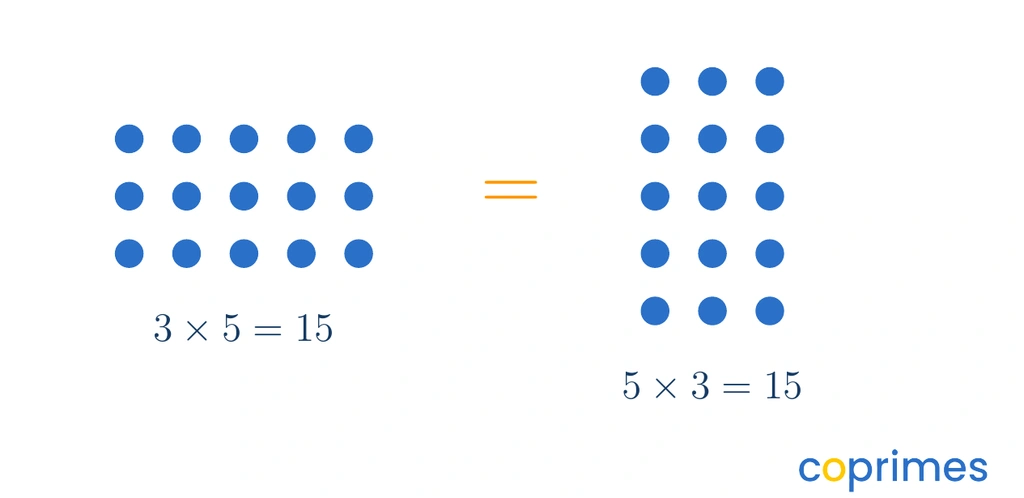
For example, calculating yields , and reversing the order to also yields . A visual array perfectly demonstrates this rule. Rotating a grid of dots changes its orientation but does not change the total number of dots.
Associative property
The associative property of multiplication states that when multiplying three or more numbers, the way the numbers are grouped does not change the final product. Parentheses are used to indicate which numbers are grouped to be multiplied first.
Rule:
For example, when calculating the product of , , and , you can group the last two numbers: . Solving the grouped part first gives , and multiplying by the remaining number gives .
Using the alternative grouping , the first step becomes . Multiplying that result by gives . Both groupings produce the same final value. This property allows learners to group numbers strategically to make mental calculations simpler.
Together, the commutative and associative properties allow multiplication to be performed in any sequence.

Distributive property
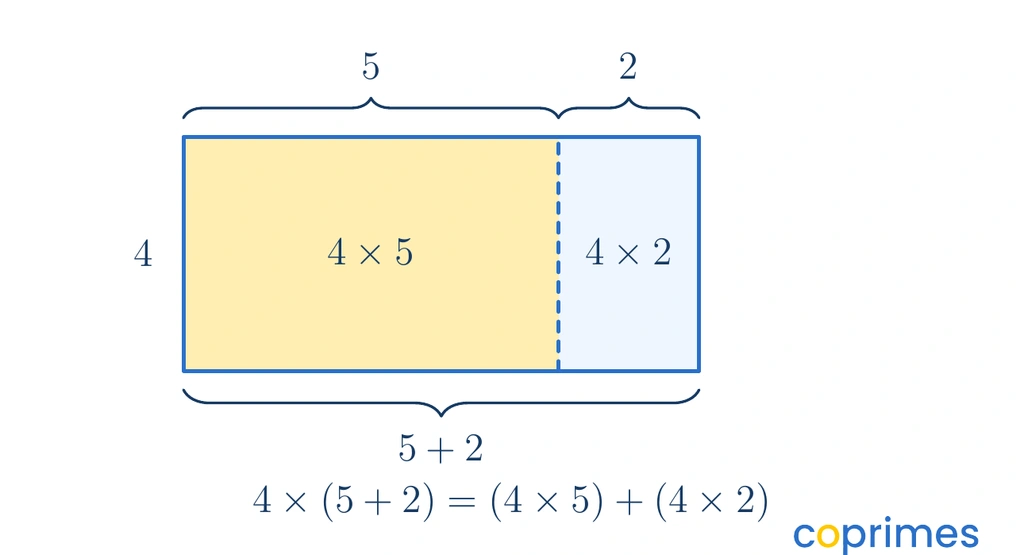
The distributive property of multiplication states that multiplying a number by a sum or difference gives the same result as multiplying that number by each part individually and then adding or subtracting the products.
Over Addition:
Over Subtraction:
For example, can be solved by adding the numbers inside the parentheses first to get . Alternatively, distributing the multiplication gives . This property is highly effective for breaking down larger numbers into manageable pieces.
Identity and zero properties
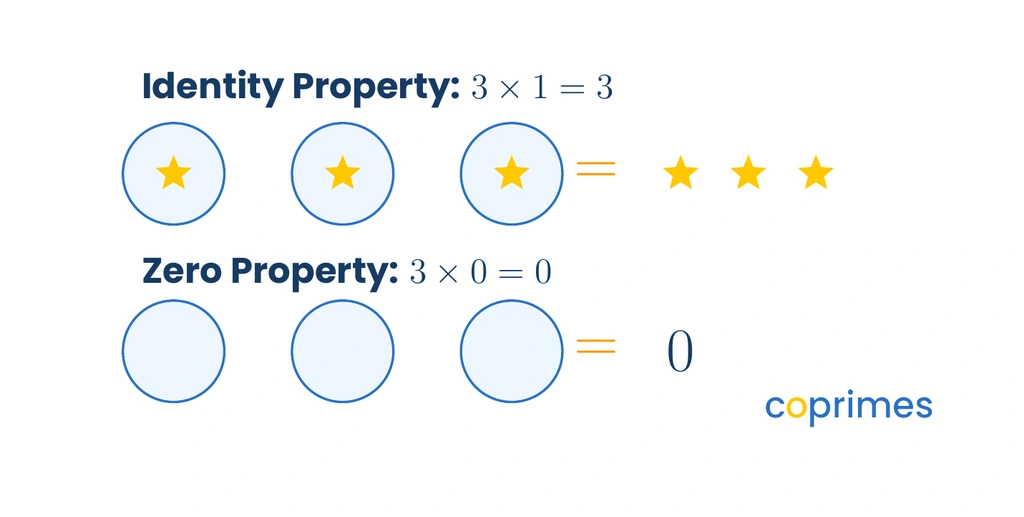
The identity property of multiplication states that any number multiplied by remains unchanged. Because it preserves the identity of the original number, the number is known as the multiplicative identity.
Rule:
For instance, . This rule holds because one group of any amount is simply that original amount.
The zero property of multiplication states that any number multiplied by always results in a product of .
Rule:
For example, . Representing zero groups of any number, or any number of empty groups, will always yield a total of nothing.
A learning plan shaped by your child, not the class
State-aligned Math plus our own Logic and English curriculum. An adaptive baseline test finds the gaps and fills them.
Worked examples
Example 1: Identifying the missing property
Question: Which mathematical property is demonstrated by ?
Method:
- Observe the numbers on both sides of the equation.
- Note that the sequence of the numbers remains identical: , then , then .
- Identify the structural change. The parentheses have moved, changing how the numbers are grouped for the first step.
Answer: This demonstrates the associative property.
Check: Evaluate both sides. The left side is . The right side is . Both equal .
Example 2: Distributing to calculate products
Question: Use the distributive property to calculate .
Method:
- Break into a simpler sum, such as .
- Rewrite the expression as .
- Distribute the to both parts of the sum: .
- Calculate the partial products: and .
- Add the results to find the total product.
Answer: .
Check: Multiply directly. is , and is . Adding them confirms .
Example 3: Reasoning with zero
Question: Find the missing value in if is an integer, and identify the property that forces this result.
Method:
- Notice that the final product of the equation is .
- Recall the zero property, which states that a product is if and only if at least one factor is .
- Since neither nor is zero, the missing value must be .
Answer: The missing value is , governed by the zero property.
Check: Substitute back into the expression. The inner parentheses become . The outer expression becomes .
Frequently asked questions
What is the multiplicative inverse property?
The multiplicative inverse property states that multiplying a real number by its reciprocal results in exactly . For example, multiplying by gives . The number has no reciprocal, so this property does not apply to zero.
Does the closure property apply to multiplication?
Yes. The closure property states that multiplying two numbers from a specific set (such as integers or rational numbers) always results in a product that belongs to the same set. For example, the product of any two integers will always be an integer.
What are the parts of a multiplication equation?
The numbers being multiplied are called factors. Specifically, the first number is often called the multiplicand, and the second is the multiplier. The final result is called the product.
Practice questions

Which property is demonstrated by the visual?
Commutative property
Associative property
Distributive property
Identity property
Associative property
Which equation correctly demonstrates the commutative property of multiplication?
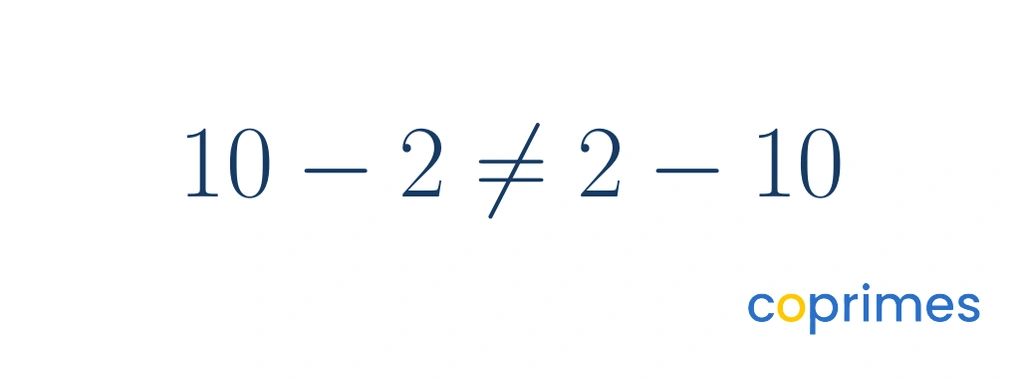
Which mathematical property does the visual prove is false for subtraction?
Commutative property
Associative property
Distributive property
Identity property
Commutative property
Find the missing value to complete the distributive property:
If and , what must be true about assuming is not zero?
is because of the identity property.
is the reciprocal of .
must be because of the zero property.
must equal to cancel it out.
must be because of the zero property.