
Commutative Property of Multiplication: Definition, Method and Examples
The commutative property of multiplication states that changing the order of two factors does not change the product. Whether you multiply the first number by the second or the second number by the first, the total amount remains exactly the same.
Because this rule focuses entirely on the sequence of the numbers, it is often called the order property of multiplication. It is a fundamental rule that allows learners to solve problems from the direction that feels easiest.
What is the commutative property of multiplication?
In mathematics, the word "commute" means to move around or travel. The commutative property of multiplication means that numbers can move or swap their positions in a multiplication sentence without altering the final answer.
Changing the order of the numbers being multiplied will never change their total product.
For example, if a notebook costs dollars and you buy of them, you can find the total cost by multiplying , which equals dollars. If you instead multiply the cost per notebook by the number of notebooks, , the result is still dollars.
This commutative property multiplication rule applies to whole numbers, fractions, decimals, and algebraic variables.
Formula and array proof
The mathematical formula for the commutative property, also known as the commutative law, is written algebraically using two variables.
Often stated simply as a times b equals b times a, the relationship is written as:
We can prove this using multiplication arrays by changing the orientation of the rows and columns. When an array is rotated, the total number of objects inside it does not change.
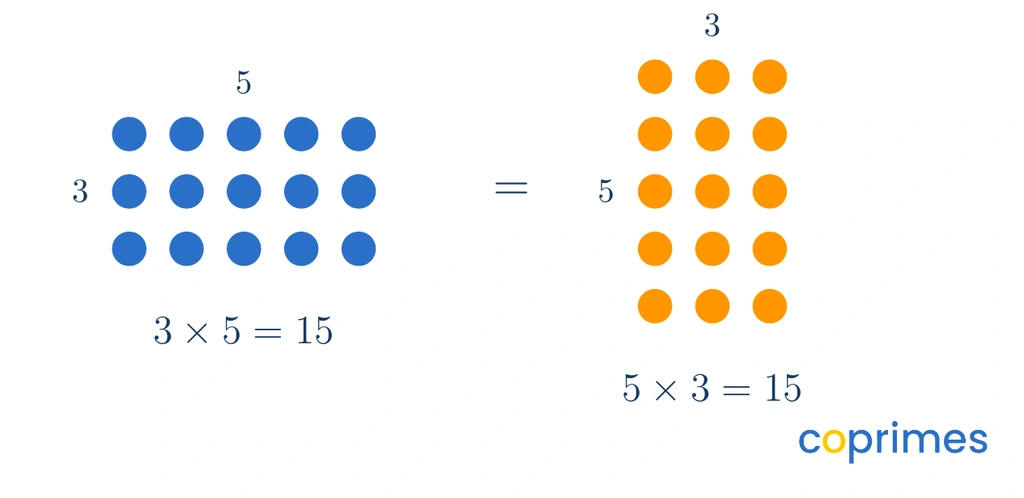
As the model shows, creating groups of items produces the same total as creating groups of items.
Turn-around facts
Learning the turn-around property cuts the number of multiplication facts and times tables you need to memorize in half.
Because of this property, multiplication tables mirror themselves. Once you learn that , you automatically know that .
These matching pairs of equations are commonly called turn around facts because you simply turn the factors around to read the new equation. Recognizing turn around facts builds confidence and speeds up mental mathematics.
A learning plan shaped by your child, not the class
State-aligned Math plus our own Logic and English curriculum. An adaptive baseline test finds the gaps and fills them.
How to use the property
The commutative law is one of the foundational properties of multiplication that allows you to reorganize complicated problems.
When an equation contains large numbers or multiple factors, you can commute the numbers to create simpler combinations. This is especially helpful when multiplying three or more numbers together.
For example, calculating from left to right requires multiplying , which is difficult to do mentally. However, by changing the order of the factors to , you can first multiply to get . Multiplying leaves a simple mental product of .
What is not commutative?
While the order property multiplication applies consistently to addition and multiplication, it does not apply to subtraction or division.
If you reverse the order of the numbers in a subtraction or division problem, you create a completely different mathematical expression with a different result.
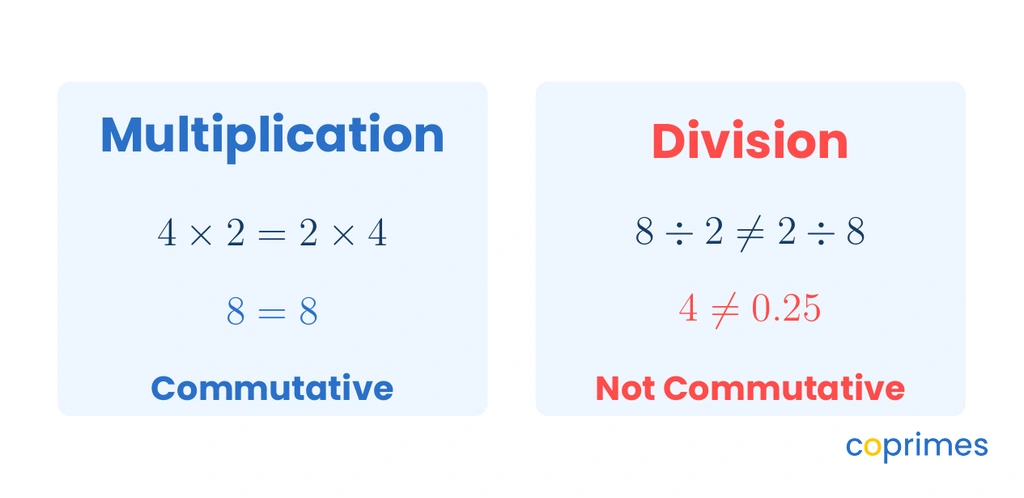
For example, dividing items evenly into groups gives items per group (). However, attempting to divide items into groups produces the fraction , which simplifies to the decimal . Because is not equal to , division is never commutative.
Worked examples
Example 1: Finding a missing factor
Question: Find the missing value in the equation: .
Method:
- Identify the two given factors on the left side of the equation.
- Apply the commutative property to reverse their order on the right side.
Answer: The missing value is .
Check: Calculate both sides of the equation independently. and . The products match exactly.
Example 2: Reordering three numbers
Question: Use the commutative property to rewrite the expression so that it is easier to calculate mentally, then find the final product.
Method:
- Identify the factors that are easiest to multiply together first, such as and , which make a multiple of .
- Commute the factors to place and next to each other.
- Multiply , and then multiply the result by .
Answer: The rewritten expression is . The product is .
Check: Multiplying left to right in the original order gives . Calculating using a standard algorithm also equals .
Example 3: Checking if division is commutative
Question: A student claims that will have the same result as because of the commutative property. Is the student correct?
Method:
- Calculate the first expression, .
- Calculate the second expression, , by writing it as a fraction.
- Compare the two results to determine if they are equal.
Answer: The student is incorrect because , but , which simplifies to .
Check: Reversing a division problem changes the quotient. The commutative property only applies to addition and multiplication.

Frequently asked questions
Does the commutative property apply to addition?
Yes, addition is completely commutative. Just as with multiplication, changing the order of the addends does not change the total sum. For example, and .
What is the difference between the commutative property and the associative property?
The commutative property is about moving or changing the order of the numbers. The associative property of multiplication is about how numbers are grouped using parentheses. The associative property states that changing the groupings of factors does not change the product, such as .
Can we commute more than two numbers?
Yes, the commutative property can be applied to equations with three or more numbers. You can rearrange any number of factors in a multiplication sequence, and the final product will remain unchanged.
Practice questions
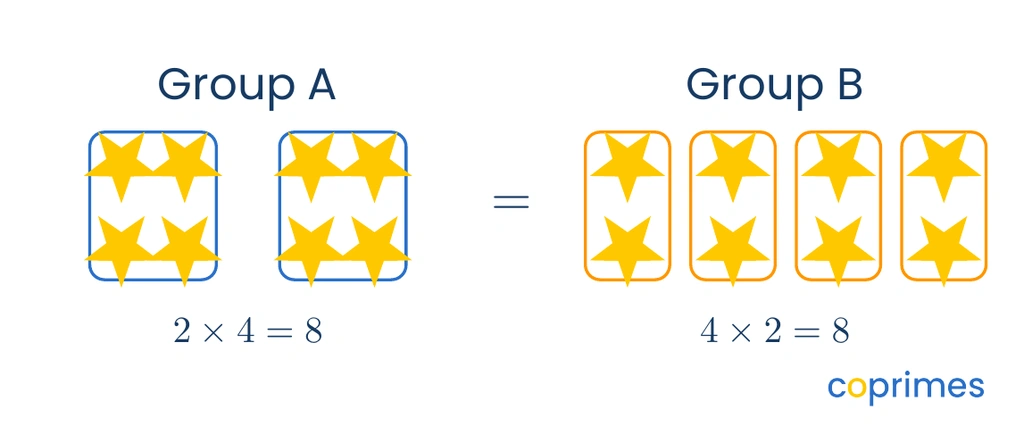
What property of multiplication is modeled by the two equivalent groupings shown above?
Commutative
Associative
Distributive
Identity
Commutative
Find the missing number that makes the equation true:
Which of the following mathematical operations does NOT have a commutative property?
Addition
Multiplication
Division
Counting
Division
Which equation correctly demonstrates the order property of multiplication?
A gardener plants rows of tomato plants. A second gardener plants rows of tomato plants. Both gardeners discover they have exactly plants.
Which property mathematically explains why they both have the same total number of plants?
Commutative property of multiplication
Associative property of multiplication
Distributive property of multiplication
Identity property of multiplication
Commutative property of multiplication